Client Onboarding Process: Design It Backward From Live
A client onboarding process fails at design time, long before the first missed step.
How to work backward from first value, set exit criteria a buyer could verify, name one owner per step, and build a run your team can be inspected against.
A client onboarding process is the defined sequence of phases a firm runs to take a new client from signed contract to live and getting measurable value, with an exit criterion and an owner for every step.
A new client signs, and the delivery lead opens last quarter’s onboarding plan, saves a copy, and moves the dates. Design by inheritance is how a client onboarding process comes to hold forty tasks and not one testable claim about the client. A client onboarding process is the defined sequence of phases a firm runs to take a new client from signed contract to live and getting measurable value, with an exit criterion and an owner for every step. The second half of that sentence is the part inheritance never passes down, and it decides everything that follows.
An onboarding process fails or succeeds at design time. Not at kickoff, not in week six. A process designed without exit criteria cannot be inspected, and a process no one can inspect decays into a suggestion, because you can only expect what you inspect. The design work is cheap and the redesign is one afternoon. What it buys is the difference between having a process and running one.
What is a client onboarding process?
On paper, it is the map from signature to value: the phases, the steps inside them, who does what, in what order. In practice it is a behavior, run by busy people account after account, and the two are routinely confused. We wrote about the tooling side of this in client onboarding software, where the finding was that the market sells you a place to store the plan and stays silent on whether anyone runs it. The client onboarding hub covers the full first-90-days picture; this piece is about the design of the process itself, because the design is where the run is won or lost.
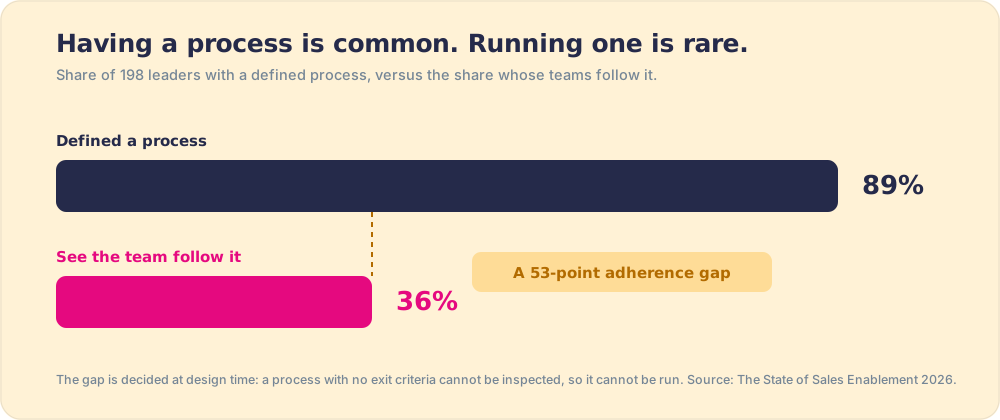
The scale of the confusion has a number. In The State of Sales Enablement, our study of 198 revenue leaders, 89 percent had a defined process and only 36 percent saw their teams follow it. A 53-point gap, and none of it is a documentation problem. The 89 percent already have the document.
The useful design question is what would make the process inspectable, so that running it becomes the path of least resistance. That question has a method, and the method runs backward.
How do you design a client onboarding process backward from first value?
Take a worked case and carry it the whole way: an implementation agency has signed a 140-person equipment distributor to move its sales operation onto a new CRM. The kickoff is not booked yet. The process is about to be designed.
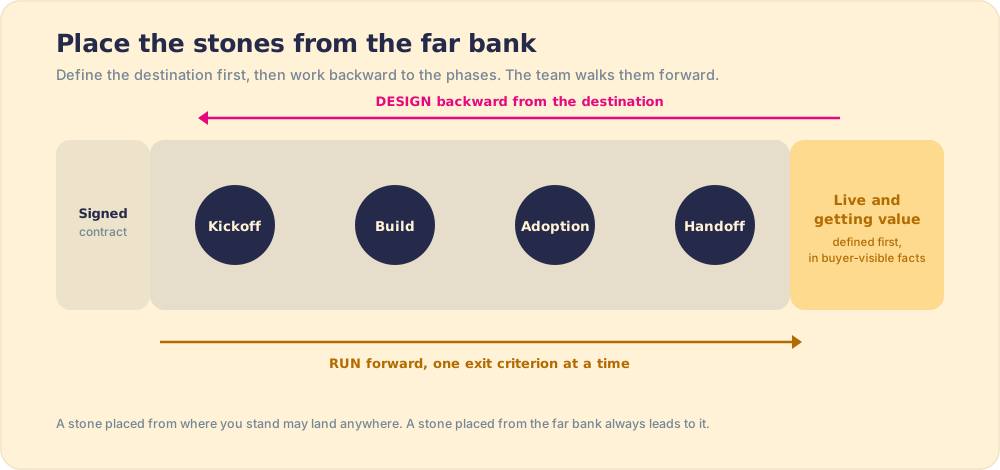
Start at the far end. Before a single phase exists, write down what “live and getting value” means for this client, in facts a skeptic could check. For the distributor, the agency writes two: the client’s reps are managing their active pipeline in the new system without the agency in the room, and the owner has run his weekly pipeline review from it. Neither fact mentions the agency’s deliverables. Both live in the client’s world, and the day both are true, the clock called time to first value stops. That clock started at the signature, and instrumenting it, per account, is the single most useful measurement decision in the whole design. A firm that knows its median time to first value can improve it; a firm that does not is guessing.
Now the phases. With the destination written, work backward and ask, repeatedly: what must be true immediately before this? For the owner to run his weekly review from the new system, his team must already be working in it, so there is an adoption phase. For the team to work in it, the system must be built and their data in it, so there is a build phase. For the build to fit how the distributor sells, someone must have mapped that first, so there is a kickoff and discovery phase. And after the destination, someone has to keep it true, so there is a handoff. Four phases, derived rather than brainstormed: kickoff, build, adoption, handoff. The onboarding process steps inside each phase fall out the same way, each one existing because the fact after it requires it.
Designing this way is like laying stepping stones across a stream. Placed from where you stand, each stone lands wherever a stone can land, and the path wanders until it strands you mid-current. Placed from the far bank, working backward, each stone exists because the next one needs a foot to arrive from. The team still walks them forward. But the path can only end one place.
The same method builds a customer onboarding process for a SaaS success team. The far bank changes; the derivation does not.
What makes a good exit criterion?
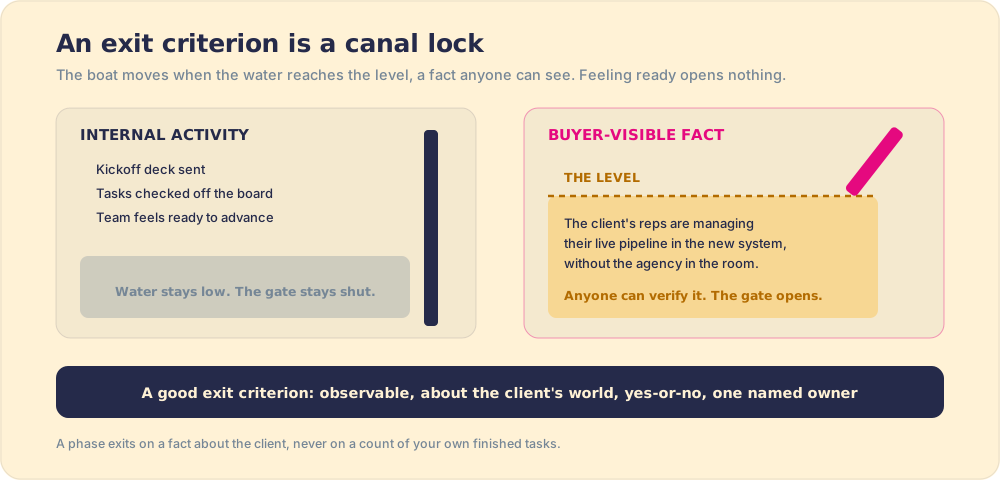
An exit criterion is the fact that must be true before an account leaves a phase. The rest of the design hangs on it, and it is the first thing a copied plan loses, because a task list feels like rigor while you are writing it. An exit criterion states a buyer-visible fact. An internal task tracks your own effort. Only the first kind can end a phase. “Kickoff deck sent” is a fact about your deck. “The distributor’s ops lead has signed off on the pipeline-stage map” is a fact about the client.
Think of it as a canal lock. The boat does not proceed because the crew feels ready or because the paperwork is done. It proceeds when the water on the far side reaches the level, a physical fact anyone standing on the bank can see. An exit criterion is that water level: observable, about the client’s world, answerable yes or no, and owned by one named person whose job is to raise the water. One person. A step owned by “the delivery team” is owned by whoever feels guiltiest that week.
There is behavioral science underneath this, and it is some of the best-replicated in the field. Peter Gollwitzer and Paschal Sheeran’s meta-analysis of implementation intentions, 94 independent tests and more than 8,000 participants, found that specifying when, where, and what (an if-then plan) improves goal attainment with an effect size of d = 0.65, medium to large by any convention. A phase with an exit criterion and an owner is an implementation intention at team scale: when phase two ends, this named person confirms this specific fact. A phase that ends “when it feels done” is the vague goal the same literature shows people abandon.
How often should you inspect the onboarding process?
Weekly, per account, and reading exit criteria rather than task counts. The design pays out here, because an unchecked standard is a preference, and the team can tell the difference. The reason inspection so often dies on the calendar is that inspecting a 40-task list is an interrogation. Inspecting four exit criteria is a two-minute read of facts. The backward design did not make inspection virtuous; it made it cheap, and cheap is what survives.
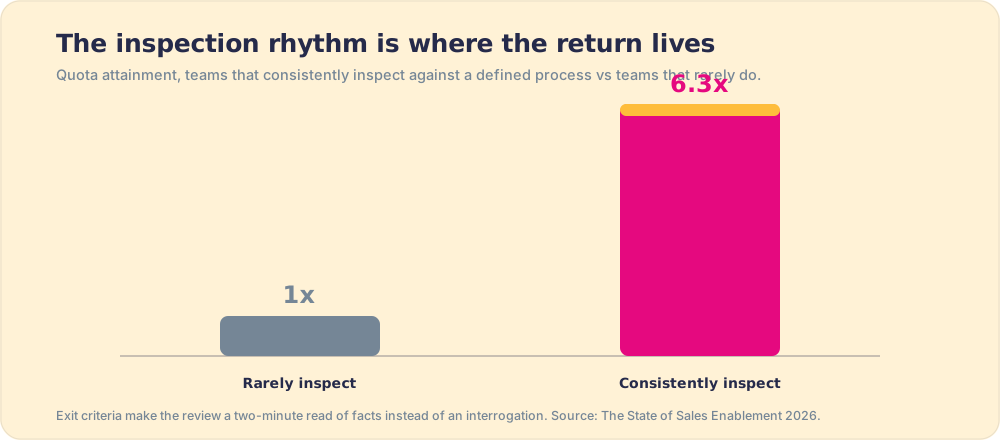
The return on that rhythm is the largest effect in our data: teams that consistently inspect work against a defined process hit quota at 6.3 times the rate of teams that rarely do. That figure comes from sales execution, and onboarding is the same species of problem, a defined motion run by a team under time pressure, where drift compounds until the account feels it.
Two design facts make the rhythm non-optional. The first is decay. Hermann Ebbinghaus measured in the 1880s how fast trained knowledge fades without reinforcement, and the forgetting curve he drew still governs your kickoff training: teach the process once, in a session or a deck, and by the third account the standard is half-remembered and the team improvises. The countermeasure is reinforcement in the flow of work, the step surfacing where the work happens, so memory is never the delivery mechanism. The second is what non-adherence means. When the distributor’s onboarding drifts, the cause is a step that lived in a document two tabs away, an exit no reviewer could verify, an owner no design ever named. That is a system failure, and the fix is to the system. Blaming the delivery team for a process that was never designed to be run is blaming the crew for a lock with no gate.
The stakes are the renewal. Frederick Reichheld’s research at Bain, written up in Harvard Business Review, found that raising customer retention by five points lifts profits by 25 to 95 percent, and for a services firm the retention decision forms during onboarding, while the client is deciding what working with you is like.
The design, in five moves:
- The destination, defined first. Write “live and getting value” as buyer-visible facts with a target date, and start the time-to-first-value clock at signature.
- Phases derived backward. Ask “what must be true immediately before this?” from the destination until you reach the contract. Keep the count small; each phase exists because the next requires it.
- Exit criteria per phase. Observable, about the client’s world, yes-or-no. Internal tasks track effort; only buyer-visible facts end a phase.
- One named owner per step. A single person carries each step, because a step assigned to a team belongs to no one on a busy week. Above the steps, one person owns first value for the account, the job we describe in what a customer enablement manager does. Gollwitzer’s if-then evidence (d = 0.65 across 94 tests) is the mechanism: specificity of who-does-what-when turns intention into action.
- A weekly inspection rhythm. Read the exit criteria per account, catch drift while it is cheap, and treat every miss as a design defect to fix rather than a person to blame.
What we recommend
You have three ways forward. Keep inheriting last quarter’s plan, which costs nothing today and compounds into the 53-point gap. Redesign the process on paper, backward from first value with exit criteria and owners, which one afternoon accomplishes and which we would do this week regardless of tooling; a client onboarding checklist is a fine skeleton to hang the design on. Or redesign it and give it a delivery and measurement system, so the steps reach the team in the flow of work and adherence is read rather than assumed.
Our recommendation is the third, sequenced through the second, and the evidence above is the reason. The design determines whether the run is even possible: exit criteria are what make inspection a two-minute read, inspection is where the 6.3x lives, and reinforcement in the flow is the only durable answer Ebbinghaus left us. Supered’s Business Logic Layer was built for that job, surfacing each step where the work happens and measuring per-account adherence against the standard you designed. But the design comes first, and it is yours to do. Define the far bank, place the stones backward, and if you want the run measured on the hundredth account the way you designed it for the first, book a demo.
Frequently asked questions
What are the steps of a client onboarding process?+
How long should client onboarding take?+
What is an exit criterion in client onboarding?+
Why do client onboarding processes fail?+
Is a client onboarding process the same as a customer onboarding process?+
Your process, running itself.