How to Scale a Marketing Agency: Caleb Phillips on Time, Money, Capacity and the $1M Wall
Caleb Phillips started his first agency at 18, knocking on doors in Oklahoma City. A decade later his agency sat under $1M and would not cross it. How time, money and capacity kept it there, and what he does now.
How to scale a marketing agency comes down to growing revenue faster than the founder's hours by easing three linked constraints, time, money and capacity, with a delivery method new hires can run to the founder's standard.
Caleb Phillips started his first agency at 18, knocking on doors in Oklahoma City. He knew some Facebook ads and how to run a social account, and not much else. “I would say, ‘Hey, can I do this for free for you?’ And then eventually people started paying me for it.”
When I asked him on Fast & Tierious how to scale a marketing agency, his answer came out of the decade after that first door.
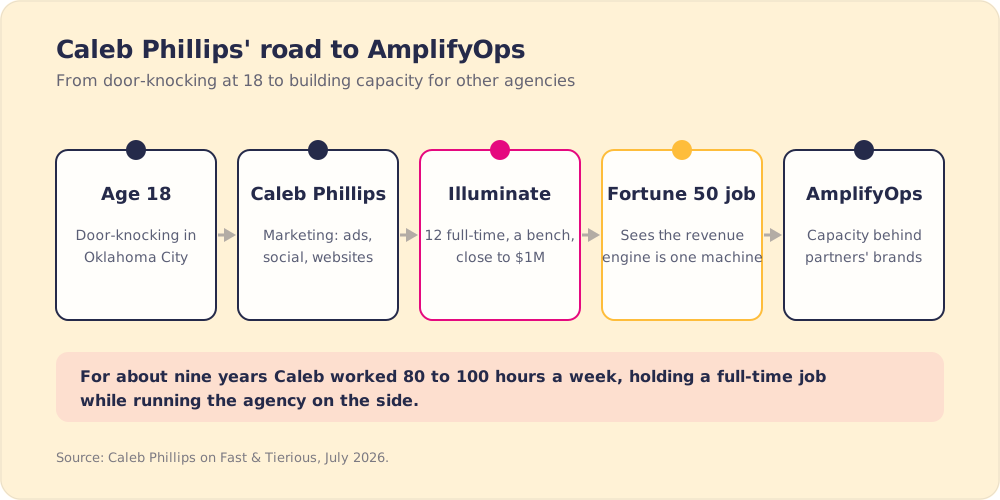
One of those early clients ran an old version of HubSpot, and Caleb learned the platform on their account. He paid for college with the consulting and a bartending job. The door-knocking turned into Caleb Phillips Marketing, then Illuminate Marketing, with 12 full-time people and a bench of contractors. For about nine years he ran it on top of a full-time job, 80 to 100 hours a week. Illuminate got close to $1M in revenue and stayed there. Today he is CEO and co-founder of AmplifyOps, which does delivery work for HubSpot agencies under their own brand.
He brought four ideas an agency owner can put to work: sales, marketing and service are one machine; time, money and capacity are tied together; a founder has to copy themselves into the team; and the HubSpot market is too big for one agency to serve alone.
What did Caleb learn when he saw the revenue engine as one machine?
The idea came from a day job. Caleb ran an operations team on the marketing ops side of a Fortune 50 cybersecurity company, all of it in HubSpot. His internal customers were the BDR team, the ad team and the marketing team, and he owned the automations and the system under them. A good part of that job was listening to those teams blame each other.
Marketing said it sent good leads and sales dropped them. Sales said “I don’t have a system that works I can barely do my job.” Executives wanted to know who was right. Caleb thought they were arguing about the wrong layer. “The revenue engine is actually one machine,” he said, “and nobody was integrating it, no one was automating it.” In a B2B company, “the processes need to be centered around sales, and then you come and bring the supporting factors of marketing and service into it.”
He took that back to Illuminate. The agency stopped pitching itself as a marketing shop and started selling process work to B2B teams, the work most people now file under revenue operations. Years later, after reaching Platinum, he took the company out of the HubSpot partner program altogether to serve two groups: “partners who need depth and capacity behind their brand. And the clients who need someone in their corner.”
He has worked by one rule since a first job on a farm at 14: “say yes to everything until you know you should say no.” On the show he finished it with a much firmer no, in words I will leave in the episode.
Why is it so hard to scale a marketing agency past $1M?
I asked Caleb what made scaling hard. He answered in one breath. “It really is three factors. It’s um time money and capacity.”
Money went wrong first. Leads for a HubSpot agency come in bunches and then dry up, and “a lot of times the money doesn’t align timing wise to when you need to pay these contractors that are coming in.” His fix is the one agency owners chase: “The goal is obviously to get everyone to retainer, right? Where it’s a lot easier to manage margins and put contractors on.” His peers want the same. In SparkToro’s State of Digital Agencies survey for 2025, 85% of agencies said they prefer to work on retainer (SparkToro, 2026).
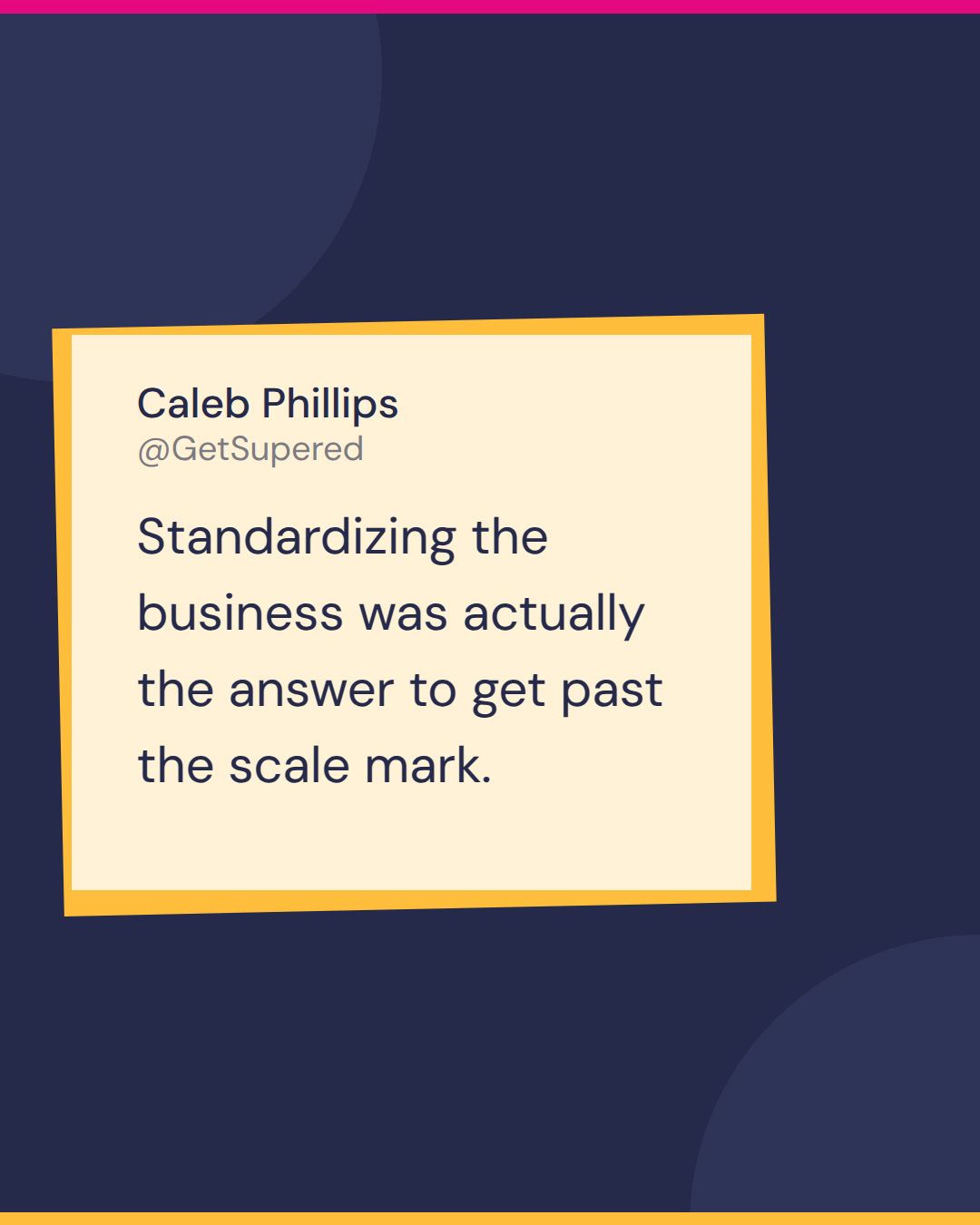
Time came next. “As soon as I would get time back, like things would stabilize or I’d have the right contractors in the right place, new accounts would come in or accounts would get challenging and my time would get limited again.” He knew what would get him out, “packaging action building action plans and standardizing the business was actually the answer to get past the scale mark,” and he rarely had a free afternoon to do it.
Capacity was the third: finding good people and getting their work up to his standard. The three kept feeding each other. Hiring to add capacity added hours of managing, and more people did nothing for cash that “was on and off.”
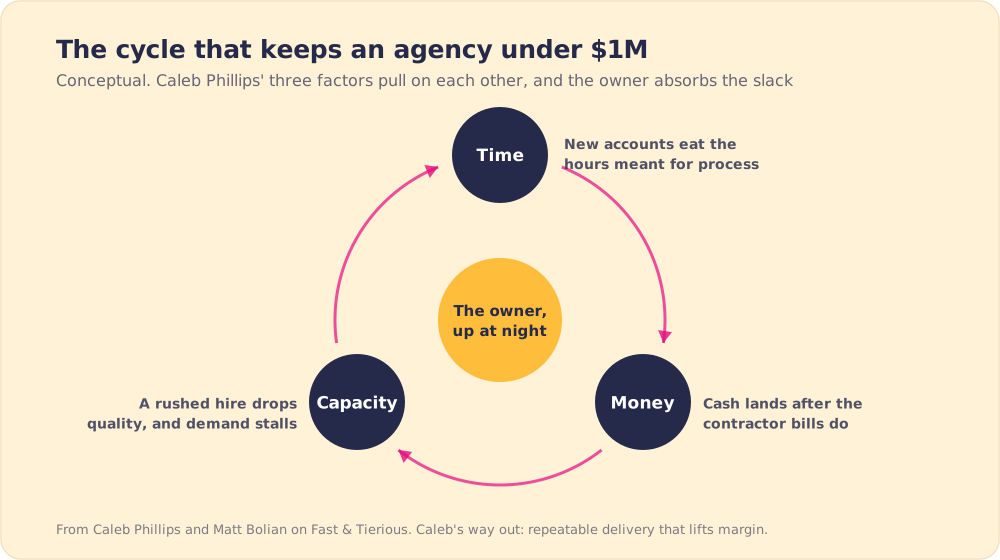
I lived my own version of this growing an agency to about 100 people, and I told Caleb how it went. You hire the wrong person and quality drops. You stop selling to fix delivery. Then you have people and no deals for them, and no money coming in. “It’s the evil cycle. It’s a vicious cycle. And what it always falls back to is the owner staying up at night.”
Caleb’s reply was the most personal moment of the episode. “I worked 80 to 100 hours a week for almost nine eight to nine years straight because like I have that standard.” Some of those weeks went into building processes. Others went to rescue work: “all of a sudden I’m going into an account because it’s been dropped. And now I’m up late.”
How does an agency founder replicate themselves?
What Caleb would change is now how AmplifyOps runs. “You have to have processes that meet your standards and can match them, a team that you can trust, and relieve the capacity. And you have to be able to increase margins for deliverability through repeatability.” Packaged builds and one delivery method keep clients happier and margins steadier, “which gives us the cash, the time, and the capacity internally.”
I told him how I came to the same place. An agency is in the business of making people, because what the client buys is the consultant who shows up on the call. The agencies that get big can train more consultants to deliver the way the founder would. Caleb took it a step further. The right hire feels rare, he said, but “if you invest the time into replicating yourself and being able to onboard people in a way that holds the same standards you do, it really is an unlock to grow.”
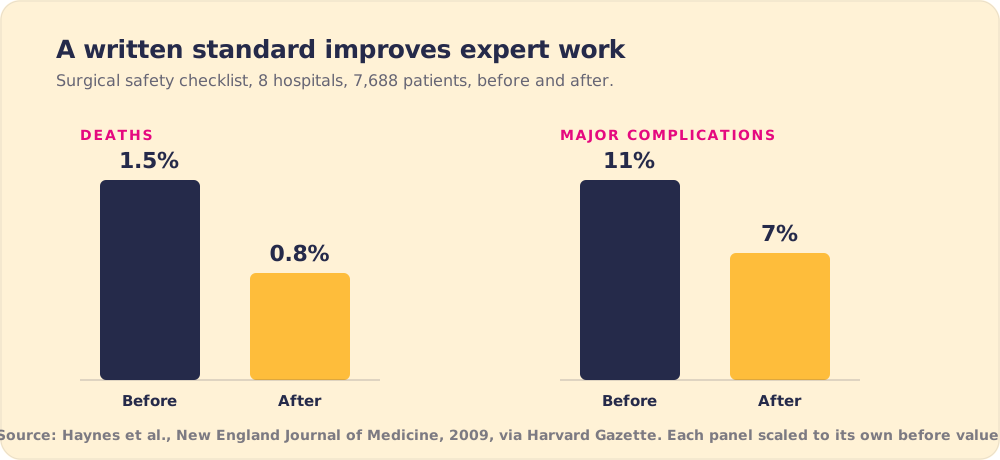
Surgeons have tested a version of this. In 2009, Alex Haynes, Atul Gawande and colleagues brought a surgical safety checklist into eight hospitals. Across 7,688 patients, deaths fell from 1.5% to 0.8%, and major complications fell from 11% to 7% (Harvard Gazette, 2009). The surgeons were the same people before and after. A short list made sure steps they already knew got done on each patient, which is close to what Caleb means by holding a new hire to the founder’s standard.
In an agency the effect lands in revenue per head. SPI Research’s 2026 benchmark of more than 500 professional services firms puts revenue per employee at $168K and revenue per billable consultant at $210K, with billable utilization at 66.4% (Deltek summary of SPI 2026). Hours spent rewriting a scope for each new client are hours no one bills. To start writing your own method down, our SOP template and guide to standard work walk through it.
Why does Caleb think community is the missing piece?
I asked about his biggest bet. He started with what he called the pie-in-the-sky one: “The HubSpot pie is bigger than we think.” HubSpot ships changes all the time, and the knowledge it takes to serve clients well “is wider than anyone can hold or keep up with.” His team reads the community threads on Reddit, Facebook, LinkedIn and the HubSpot forums, “and people are struggling,” partners and clients both.
Of the three limits on agency growth, capacity is the one Caleb worries about most: “capacity is the scarcest thing in this ecosystem.” Money can be found and time can be made, he said, “but capacity is hard to manage and keep consistent.” So small agencies need each other. A person who runs HubSpot marketing and a person who designs a sales process have different skills. I admitted to him that I have never run an ad in my life.
I also brought up a view I repeat on most episodes: this is the age of services more than the age of AI. The tools change fast enough to confuse buyers, and they hire services firms with a clear point of view to sort it out.
Caleb’s second bet comes from his own years at Illuminate. “What I wanted desperately was a partner that was an extension of my team and an extension of me, and it never felt like I found that.” He built AmplifyOps to be that partner for small and midsize agencies, one that adds people and takes work off the founder’s plate instead of waiting for tickets.
Caleb Phillips’ lessons for agency owners
- One revenue machine. Marketing, sales and service run as one engine. In B2B, Caleb builds the process around sales and brings the other two in behind it.
- Time, money and capacity. The three pull on each other, and the founder’s hours cover whatever slips.
- Retainers. Recurring work makes margins and contractor plans easier to manage.
- A founder who replicates. Processes written to your standard, plus onboarding that holds new people to it, let one expert grow into a team.
- Shared capacity. The HubSpot market is bigger than one agency, and partners who extend each other’s teams can take on more of it.
Where should an agency owner start?
An owner stuck under $1M usually tries hiring faster and hoping quality holds, or selling harder and letting delivery stretch. Caleb would start somewhere else, and he says he would do it from day one. Package the work and write down the standard first. Then grow the team and the pipeline on top of it, and borrow capacity from partners while your own people come up to speed.
We would follow his order. The checklist study found a written standard improved results even for experienced surgeons, and the SPI numbers show what repeatable work does to revenue per head. Caleb paid for the lesson with nine years of 80-hour weeks. You can start where he ended up.
If you run a HubSpot agency, our partner program is set up for firms turning their delivery into packages, and AmplifyOps is in our partner directory. Supered puts the written standard in front of each consultant and rep while they work. Next, read our guide to time to productivity, on how long a new hire takes to reach the founder’s bar.
Frequently asked questions
How do you scale a marketing agency?+
Why do marketing agencies get stuck before $1M?+
What is the biggest constraint on agency growth?+
What revenue per employee should a growing agency target?+
Should an agency move clients to retainers?+
Your process, running itself.
Turn the playbook into rep behavior.
More from Fast & Tierious

Performance-Based Pricing: Why Matthew Kay Puts Coleman Rose's Fee on the Line
Matthew Kay
Agency Referral Program: How Rebecca Gonzalez Rebuilt Orange Marketing After Her One Source Dried Up
Rebecca Gonzalez