Time to Productivity: It Is Time to Adoption, Not a Date on a Calendar
Most teams measure time to productivity as a date, the day a rep is certified.
That date tracks an input and predicts nothing. Here is the number that does, and how to shorten it.
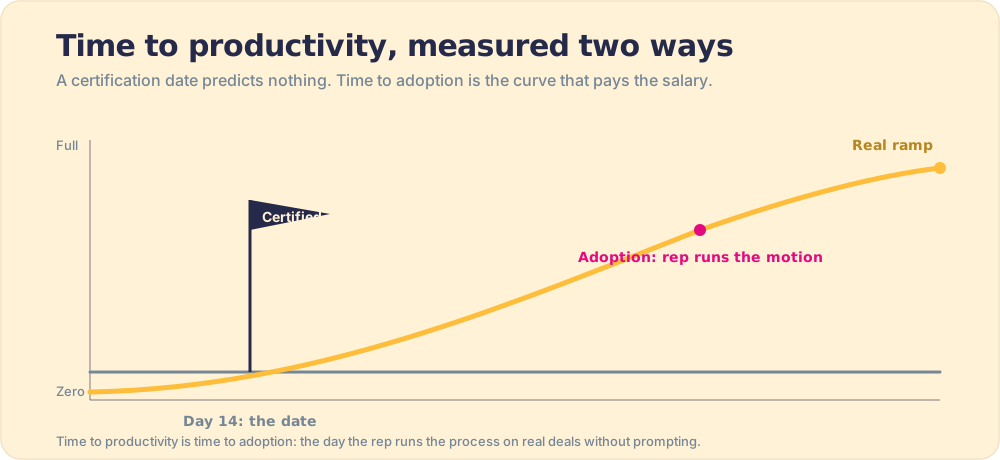
Time to productivity is how long a new rep takes to consistently run your sales process on real deals without prompting; the honest version is time to adoption, not the day training is marked complete.
Watch a new rep on day fourteen. The certifications are done, the deck is memorized, the battlecards are highlighted, and a manager somewhere has checked a box that reads onboarding complete. A line in a spreadsheet now records the rep’s time to productivity as fourteen days. Then, in week six, a real buyer asks a real question, and the rep stalls, scrolls a folder, and promises to follow up. The date said productive. The behavior was not there.
That date is the problem this post is about. Most teams measure time to productivity as a moment, the day training finishes or the rep is “certified,” and that moment tracks an input and predicts almost nothing. It records that knowledge was delivered, not that a motion was learned, and the two come apart in exactly the place money is decided. The real measure is time to ADOPTION: the day the rep runs your process on deals nobody is watching, without being told to. The front-loaded classroom mostly evaporates before that day arrives. You shorten the gap by putting reps on real deals fast, surfacing the next step in the flow of the work, and measuring adherence from the first week.
So it is worth being precise. Time to productivity is how long a new rep takes to consistently run your sales process on real deals without prompting. The honest version is time to adoption, not the day a calendar says training is complete.
What does time to productivity mean in sales?
Two clocks get confused here, and the confusion is where the metric goes soft. Search the term and you mostly find time to productivity sales benchmarks reported as a single tidy number, which reads cleanly on a slide and badly in reality, because two clocks hide inside it. The first clock is the one that is easy to read: training delivered, modules finished, the certificate printed. The second is the one that pays the salary: the rep running the motion, the right stages, the required fields, the qualification questions you decided matter, on a deal in week nine that no manager is standing over. The first clock stops on day fourteen. The second keeps running, often for months, and it is the only one a forecast can feel.
Ramp time names the same thing from a wider angle. Ramp time is the broader phrase for how long a rep takes to reach full productivity; time to productivity is the metric a team uses to put a number on it. We have written the longer treatment of the clock itself in sales ramp time; this post takes the narrower angle of the measurement, because the number you choose decides whether you are managing the thing or fooling yourself about it.
Hold the two clocks apart and a clean test appears.
- The certification date is attendance. It proves the rep sat through the content and passed the quiz. Necessary, and silent on whether the motion ever shows up on a deal.
- Time to adoption is behavior. It is the day the process runs in sequence, on a real opportunity, without a prompt. This is the number that predicts the next two years.
- The gap between them is the real ramp. A rep can finish every module on day fourteen and adopt none of it until month four. That stretch is not a paradox. It is the normal state of affairs.
Why does time to productivity keep getting longer?
Because the clock is long and lengthening, and the orientation week is a rounding error against it. The Bridge Group, which has benchmarked SaaS sales metrics for over a decade, put average ramp to full productivity for a new account executive at 5.7 months in its 2024 report, up from 5.3 in 2022 and 4.3 in 2020 (The Bridge Group, 2024 SaaS AE Metrics). The line moves one way. Deals are getting more complex, with bigger buying committees and more stakeholders to satisfy, so the behavior a rep has to master takes more repetitions to settle, and for larger multi-threaded deals nine months or more is common.
Now set the certification date against that 5.7-month curve. A team that books time to productivity at the end of a two-week bootcamp is reporting a number off by a factor of ten, and then planning headcount, quota, and pipeline coverage on the wrong figure. The orientation is a small front porch on a much longer house. Declaring victory on the porch is how a program celebrates in month one and pays the bill in month five, surprised.
The deeper trouble is that the teaching method has not moved with the clock. Ramp got longer; the classroom got no smarter. Most onboarding still front-loads its heaviest information density into the first two weeks, exactly when the rep has no real deal to attach it to, and then trusts it to be there in month two when a buyer finally tests it. Memory does not work that way, and we have known it for almost a century and a half.
Why does the certification date predict nothing?
In 1885 Hermann Ebbinghaus ran the first experiments on memory and found the forgetting curve. He measured memory as savings, the share of the original learning effort he could skip when relearning a list, and after one day only about a third was saved. A 2015 replication found the same shape: savings of about 47 percent after 20 minutes, 32 percent after a day, and 4 percent after a month, from one subject learning nonsense syllables (Murre and Dros, PLOS ONE, 2015). The decay is steepest right after learning. So the deck delivered on Tuesday is mostly gone by Thursday, and the battlecard taught in week one is a faint outline by the time a buyer pressures it in week six. The certification date certifies that information passed through the rep, on the day it begins to leak out.
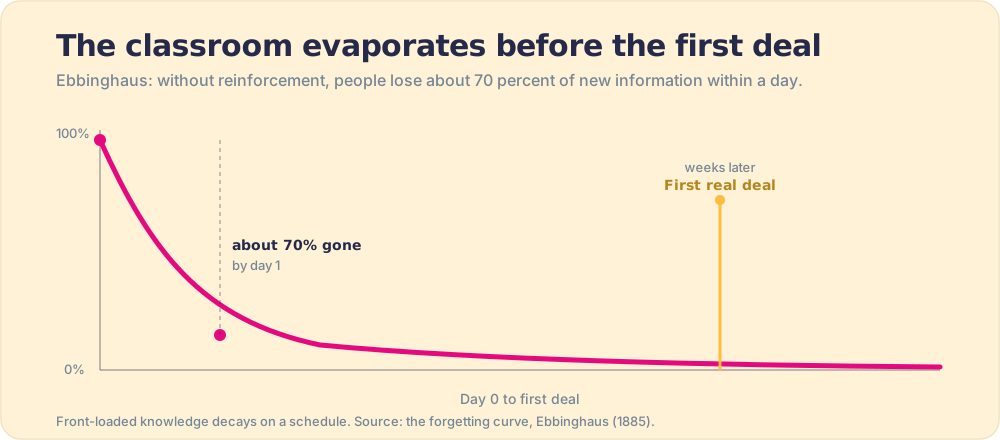
This is not a discipline failure on the rep’s part, and it is not a motivation problem. It is how human memory is built. Knowledge learned away from the moment of use, with nothing to attach it to and no spacing to refresh it, decays on schedule, and no amount of effort on day one changes the slope of the curve. When a rep who passed every quiz freezes on a live call, the system handed them a test of recall weeks after the cramming, and recall lost. The fix is the rep, not at fault; the design, at fault.
There is a second reason the date predicts nothing, and it sits underneath the memory problem. Selling is a motion, and a motion is not learned by listening. You would not certify a swimmer by seating them in a lecture hall, quizzing them on stroke mechanics, and stamping their card before they had touched water. The discovery question asked at the right moment, the stage not skipped, the economic buyer confirmed before the demo, none of these can be installed by a slide. The classroom can build the vocabulary. Only the work builds the swimmer, which is the same argument we make about the wider knowing-doing gap: knowing the stroke and taking it are different skills, and the second is the one that ramps.

The convergence is what makes the case hard to wave off. The behavioral science says front-loaded knowledge decays before use. Our own field data says the same from the other side. The State of Sales Enablement 2026 found teams whose guidance is embedded in the flow of the work hit quota at 49 percent, more than double the 15 percent of teams whose guidance lives in docs, wikis, and an LMS. Same content. Different moment of delivery. The moment is the lever, and a certification date measures the moment that matters least.
Teams whose guidance is embedded in the flow of the work hit quota at 49 percent. Teams whose guidance lives in docs, wikis, and an LMS hit quota at 15 percent. The same content, in a different moment, more than doubles the outcome.
What does the orthodoxy get right, and where does it break?
The most-cited book on building a sales team from scratch is Trish Bertuzzi’s The Sales Development Playbook, and the ramp methodology from her firm, The Bridge Group, is the benchmark RevOps leaders quote when they argue for a structured program. It is worth saying plainly what that orthodoxy gets right, because it gets the core of it right.
Bertuzzi’s prescription is sound. Give a rep the language to talk to your buyers, give them a process to follow, run ramped quotas so you are not demanding full output in month one, hire in a class so nobody learns alone. None of that is the firehose. Where she is sharpest is on what ramps a rep, and it is not the classroom:
The key thing for leaders to remember is to get new reps on the phones ASAP. I’m not sure that there is a magic number, but I know that reps need hundreds of live connects before they are truly ramped. The faster they get there, the better. It is my personal belief that reps should be on the phone making dials by the end of their first week.
Read that twice, because it is the argument of this post in the words of the person who owns the topic. Time to productivity is not a function of how much you taught. It is a function of how many live reps the rep has logged, how many times they have stood in the real water and taken the stroke. The disagreement, then, is not with Bertuzzi. It is with how her advice gets implemented: a team reads “give them the language and a process,” builds a two-week curriculum, front-loads every battlecard into it, and calls that the onboarding, having skipped the half about hundreds of live reps starting in week one. The orthodoxy says both. The forgetting curve is why the first half cannot stand alone.
How do you reduce time to productivity?
Shorten time to adoption, and the date takes care of itself. Three levers do the work, and not one of them is a longer reading list. They are the same loop that drives sales onboarding for a new hire, aimed here at the single goal of pulling the day of adoption earlier.
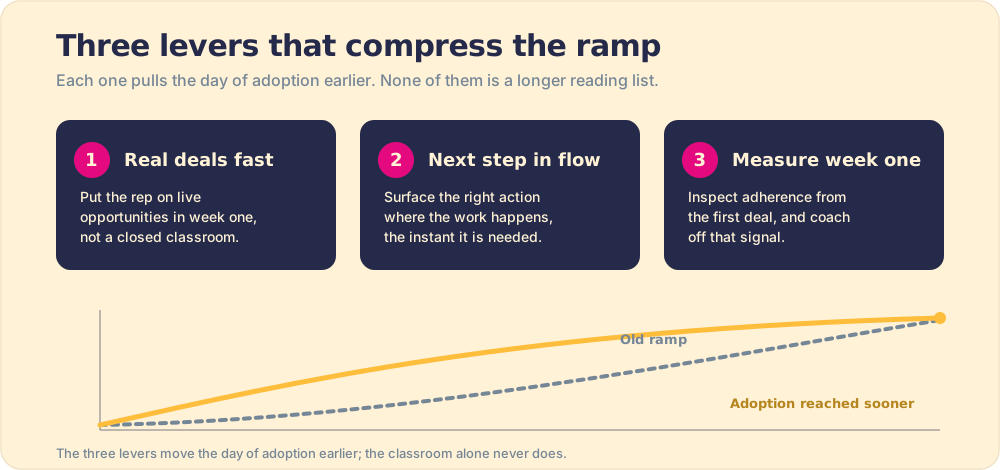
- Real deals fast. Put the rep on live opportunities in week one, alongside the orientation, not after it. Bertuzzi’s hundreds of live connects start accruing on day five, not day forty, and every connect is a repetition the forgetting curve cannot erase because the rep used the knowledge while it was fresh.
- Next step in the flow. Surface the right action where the work already happens, the instant it is relevant, so following the process is the path of least resistance instead of a memory test. This is the difference between handing a rep a manual and standing beside them at the bench. It is also why guidance in the flow links to 49 percent quota attainment against 15 percent for guidance stored away.
- Measure from week one. Inspect adherence on the new rep’s real deals from the first deal, continuously. This is the keystone, because you cannot coach a drift you cannot see, and a bad habit caught in the first ninety days is corrected before it sets into the way the rep sells for the next two years.
A traditional onboarding checklist is fine as far as it goes, and worth keeping. The trap is mistaking it for the goal. A checklist of finished trainings proves attendance and says nothing about whether the motion runs on a deal next month. Keep the checklist for the knowledge. Build the loop for the behavior.
How do you measure a ramp you can trust?
Pick the number that predicts the future, not the one that is easy to report. Time to adoption is harder to read than a certification date, because it requires looking at real deals and asking whether the process truly ran, but it is the only number that moves with performance. The lever that bends it is inspection. In our survey, teams that consistently inspect deals against a defined process hit quota at 6.3 times the rate of teams that rarely do, the single largest effect we measured.
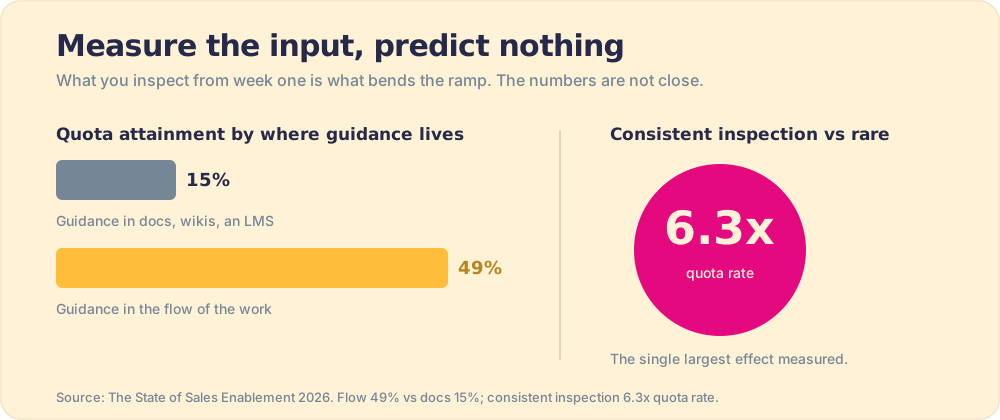
For a new rep, inspection from week one matters more, not less. It is how you catch a habit while it is still forming and steer it, rather than discovering at quarter close that a rep has been skipping discovery on every deal for three months. The reason inspection gets skipped is that doing it by hand is tedious, so a manager either spot-checks a few deals or waits for the pipeline review. The win is automating that burden so the manager spends a new rep’s first quarter coaching the motion rather than chasing field updates. Inspection and coaching are not a trade; the point of lifting the inspection load is to free the human time for the coaching. For the fuller treatment of which ramp numbers are worth tracking, see sales enablement KPIs.
There is a payoff beyond the manager’s calendar, and it is buyer-facing. A rep who ramps on a consistent motion gives buyers a consistent experience from their first deal, and a strong onboarding program correlates with a 71 percent improvement in time to productivity and an 82 percent lift in new-hire retention in research from the Brandon Hall Group (Brandon Hall Group). The rep stays longer and the buyer is served better, from the same root cause: the behavior was built, not briefed.
What we recommend
A clear choice sits underneath the metric, and it is not about how good your content is. You can measure time to productivity as a date, the day the bootcamp ends and the certificate prints, and accept that the number is comfortable, easy to report, and disconnected from whether the rep can sell. Or you can measure time to adoption: the day the process runs on real deals without a prompt, tracked against your own tenured team as the benchmark.
We recommend the second, without hedging, and the evidence is why. The forgetting curve says front-loaded knowledge will not survive to the first deal, so a certification date certifies recall that has already decayed. The Bridge Group’s 5.7-month ramp says the orientation week is a tenth of the real timeline. Trish Bertuzzi, who wrote the book on building a sales team, says reps need hundreds of live connects before they are truly ramped, starting in week one. Our own data says guidance in the flow of work more than doubles quota outcomes and that inspection is the largest single lever there is. Those four point the same way: the orientation is necessary, and it is not where ramp is won.
So keep the bootcamp, and stop calling its end the finish line. The finish line is adoption, and it is the one number worth reporting. Surfacing the next step in the flow of the work, and measuring adherence from the first deal, is exactly the job of the Business Logic Layer: continuous, in-the-moment guidance that meets a new rep where the work is happening and shows whether the motion is taking hold. If you want the wider picture of the clock itself, read sales ramp time next; if you want the science of why a trained rep still does not do the thing, the knowing-doing gap is where that argument lives, and the sales coaching guide is the system that turns ramp into a repeatable motion. The date will always be easier to read. Adoption is the one that pays.
Frequently asked questions
What is time to productivity?+
How is time to productivity different from ramp time?+
Why does time to productivity keep getting longer?+
How do you reduce time to productivity?+
What is a good time to productivity benchmark?+
Your process, running itself.