Founder Bottleneck: How Dan Peterson Took Off the Everything Hat
Dan Peterson started Granite Slopes with $2,500 of his own money and ran sales, delivery and invoicing himself until he nearly crashed. His lessons on hiring for pain, hiring for learnability, and handing over intent.
A founder bottleneck is the point where a company can only move as fast as its founder, because the founder personally holds the selling, the delivery decisions, or the knowledge that everyone else waits on.
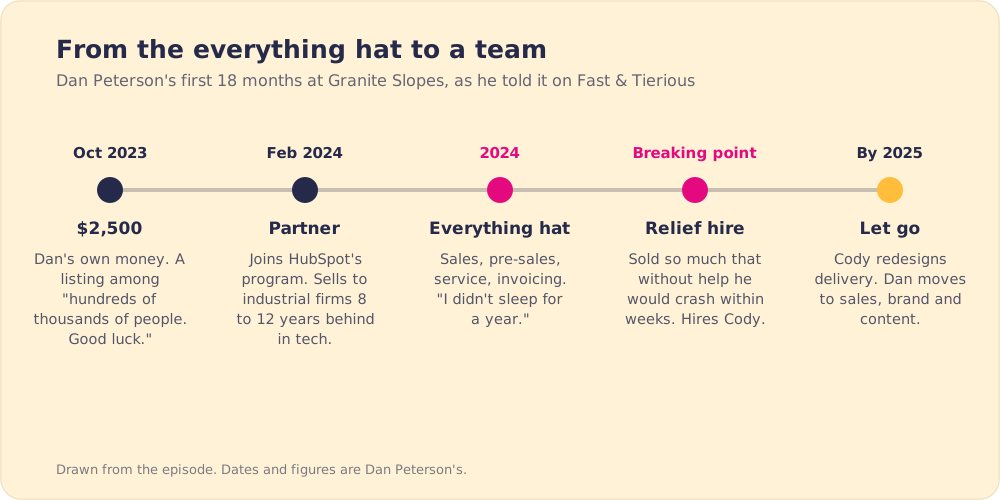
Dan Peterson started Granite Slopes in October 2023 with $2,500 out of his own pocket. He had a manufacturing background and years consulting on Microsoft Dynamics, and he saw industrial companies running “8 to 12 years behind in tech.” He signed on as a HubSpot provider first, which he describes as “pretty much throw your name on the website with hundreds of thousands of people. Good luck.”
By early 2024 he was a full HubSpot partner, and Granite Slopes was growing faster than one man could run it. Dan was the founder bottleneck, and he says so. “I was the everything hat,” he said. “I was the the garage CEO, the basement CEO saying, ‘Oh, hey, I’m going to do sales. I’m going to do pre-sales engineering.’” Service and invoicing too. “I didn’t sleep for a year, you know, maybe a few hours.”
A year later Granite Slopes reached Platinum, still bootstrapped and 100% his. By the time we recorded, Dan had a six-month-old daughter and a first hire who ran delivery without him.
Dan walked me through how he got out of his own way on our Fast & Tierious episode. He hired when the work was about to break him, he picked people he could teach, he gave his first hire the goal and let him design the process, and he stopped calling himself the HubSpot guru. Each of those came from a mistake or a near miss, and he is open about both.
When is the founder bottleneck ready to break?
Dan did not plan his first hire. The contracts forced it. “I had sold so much in contracts that if I didn’t hire somebody, I was going to crash within a couple of weeks,” he said. “I have to get someone in now or I’m going to fail from being too big.”
He calls it “more of a relief hire than anything else,” and says he would not repeat the timing.
I defended the pattern on the episode, if not the pain. A founder has to create more demand than they can serve, and at that point there are two choices: stop selling and catch up on delivery, or keep selling and hire. I think stopping is the worse choice, because the sales engine is hard to restart and “you don’t know what it’s going to turn into after in three months, six months.” Dan agreed: “you got to keep doing it until you hurt all the time.” I said you do it until you hurt, “and you hire for your pain.”
I also told him where I am stubborn. In a service company, the founder should stay in sales longer than they want to, because early customers are buying the founder. So the first hire usually goes into delivery, which is what Dan did.
He chose full-time over white-label help on purpose. Contractors could have fulfilled the work, but he was thinking about “the people that I want to train, the people, you know, the the culture I want to create here. And you can’t do that with white label.” The hire was Cody. “That man is a godsend,” Dan said. “I hope he doesn’t watch this. It’ll blow up his ego.”
Why hire for learnability before skill?
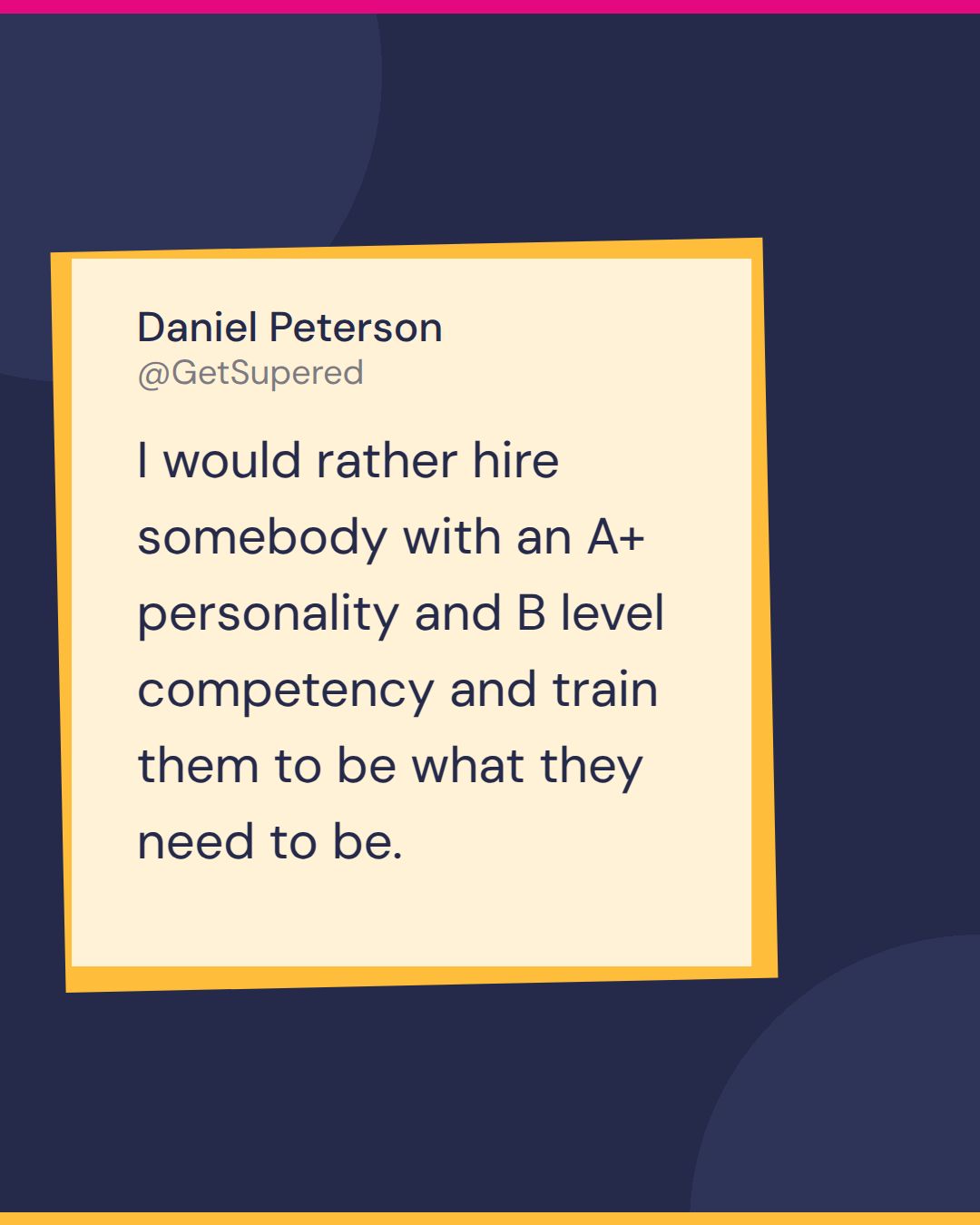
Dan has used the same interview style since his corporate days, built around “learnability and cultural fit.” He puts it this way: “I would rather hire somebody with an A+ personality and B level competency and train them to be what they need to be.”
He has seen the other kind of hire up close. “You can have an A player in technicality, but if they’re an F in personality and they’re toxic, you don’t want them on.”
He still tests. The technical interview throws “pretty difficult situations” at candidates, often involving systems beyond HubSpot, because Granite Slopes works across ERP, field service software, sales, marketing, service, and back-office finance. He is not looking for a perfect score. He wants “a base level understanding that I’m confident that I can teach them and then their willingness to learn and then again the personality.”
The research leans his way. Leadership IQ tracked more than 20,000 new hires and found that 46% failed within 18 months, and that “89% of hiring failures come from having poor or incompatible attitudes, not a lack of technical skills” (Leadership IQ). Coachability topped the list. Hire for attitude, train for skill is an old saying. Dan runs an actual interview on it, with a technical test to set the floor.
How does a founder let go without losing the standard?
Dan named this as the hardest part. “Willingness to let go, I would say, is the biggest one.” He cares about client work to a fault: “I have the passion of like, I need this to go perfectly.” Letting go meant trusting other people “as long as you’re training them correctly to do what you can do.”
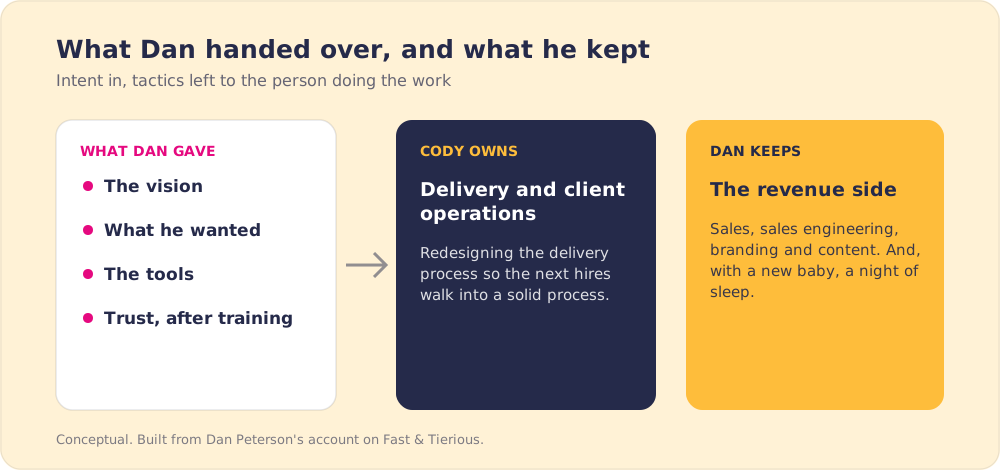
The first thing he let go of was delivery, including the job of redesigning how delivery worked. He did not write the new process and hand it down. “I handed it to Cody so that you know when we got our next teammate and we had other people come in, we had a solid process. I told him the vision, what I wanted, the tools, everything else.” Cody, in Dan’s words, “went nuts.”
That freed Dan for the revenue side: branding, content, sales engineering. “Being able to hand those things off was uh, I mean, a breath of fresh air and a night of sleep, especially since I just had a kid.” His daughter was six months old when we recorded.
I went to a military academy, and what Dan did sounded like something the Army taught me. On the episode I put it as “Give intent versus tactics.” You set left and right limits and the goal, and the person closest to the work decides how. The Navy has a well-known example. Captain David Marquet had his submarine officers stop asking permission and start telling him “I intend to” do something; the USS Santa Fe went on to win the Arleigh Burke award as the most improved ship in the Pacific and produced nine later submarine commanders (Training magazine, 2012).
The number of people one leader can keep on a process is small. In our State of Sales Enablement 2026 research, 47% of teams with one to five reps per manager reported high process adherence, falling to 23% at six to eight reps and 5% at 17 or more (The State of Sales Enablement 2026). Those numbers come from sales teams, not a two-person agency. They point the same way as Dan’s year, though: he could not keep watch over sales, delivery and billing at once, and the fix was to give one of them away.
Why did Dan stop being the HubSpot guru?
His one regret from the first year is about positioning. “I kind of pigeon holed myself into this HubSpot guru position, which if you’re an individual consultant, you’re a lifestyle business, that’s awesome,” he said. “If you’re trying to scale uh scale a an agency like this or scale a firm, especially technical firm, that’s not the solution. You can’t just be the HubSpot guru. You you need to have an arsenal solution to take to your customers.”
So Granite Slopes now sells a wider kit for industrial clients: ERP, field service software such as Zuper, which announced a partnership with the firm in July 2025 (Zuper, 2025), and AI tools such as AskElephant alongside HubSpot.
I told Dan the same thing happened to us at RevPartners. We stopped saying we were good at HubSpot and started saying we were there for the CRO, with HubSpot as the weapon of choice.
His next bet goes further: building apps for his niche on top of being a services partner. “It could crash and burn,” he said. “It could kick our ass.”
Dan’s lessons on the founder bottleneck
- A hire for the pain. Dan kept selling until he was weeks from crashing, then hired into delivery.
- Learnability first. He screens for attitude and a teachable base, then trains: “A+ personality and B level competency.”
- Intent handed over. Dan gave Cody the vision, the goal and the tools, and Cody designed the delivery process.
- A full kit. Granite Slopes sells ERP, field service and AI tools alongside HubSpot, so clients buy the firm’s answer to their problem instead of Dan’s personal HubSpot skill.
What should a founder do at the breaking point?
Make the hire. Slowing sales caps the firm at your own hours, and white-label help eases the pain without building a team. Dan hired, trained Cody to his standard, and handed over the intent behind the work. He did it with $2,500 of starting money and no investors, and a year later Cody owned delivery and Dan was back on sales with some sleep. Dan also told me the next HubSpot milestone is a secondary concern next to helping his customers. I agree with him. The things to watch are the proxies along the way that tell you the firm is doing right by clients, and revenue may be one of them.
Handing over intent only works if the process the new hire builds reaches the next hire when they need it. Supered works on that problem. It puts the team’s process inside HubSpot and Salesforce, in the flow of work, so a founder can inspect results instead of doing the work. Partner firms can see how other agencies productize delivery on our page for HubSpot partners.
If you are about to make a first delivery hire, read our post on sales onboarding for how ramp works, then our piece on institutional knowledge, which covers what walks out the door when only the founder knows it.
Frequently asked questions
What is a founder bottleneck?+
When should a founder make the first hire?+
Should a first hire be chosen for skill or for attitude?+
How does a founder let go of delivery?+
Should a first hire be full-time or white-label?+
Your process, running itself.
Turn the playbook into rep behavior.
More from Fast & Tierious

How to Pivot Your Business: Lessons From an Agency That Changed Course Three Times
Przem Orlikowski
How to Plan a Conference: Brendan Tolleson on Building Southbound From 100 Guests
Brendan Tolleson