Davey of Pearagon on Agency Utilization Rate, Project Managers and Giving Work Away First
Davey built Pearagon from a one-man CRM consultancy into a ten-person HubSpot firm with a Customer First award. He holds a 30 to 35 hour billable band, hires PMs who know software, and gives work away first.
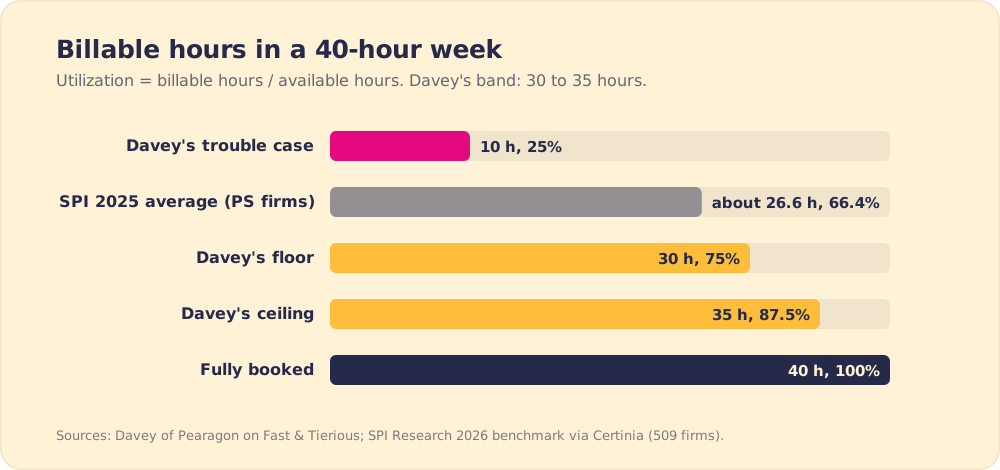
Agency utilization rate is the share of a delivery person's available hours that gets billed to clients, and Davey of Pearagon aims for 30 to 35 billable hours of a 40-hour week, or 75 to 87.5%.
Davey knew HubSpot was worth betting a company on when his mother started closing deals in it. She typed with two fingers. She had gone back to school and spent her evenings writing papers. Two weeks after Davey put her in a CRM he barely knew himself, she told him “oh this is easy,” and she was closing sponsorship deals worth tens of thousands of dollars for his client. In the six years after that, Davey built Pearagon and learned agency operations the expensive way, including the agency utilization rate a small HubSpot firm needs to pay its people and still serve its clients.
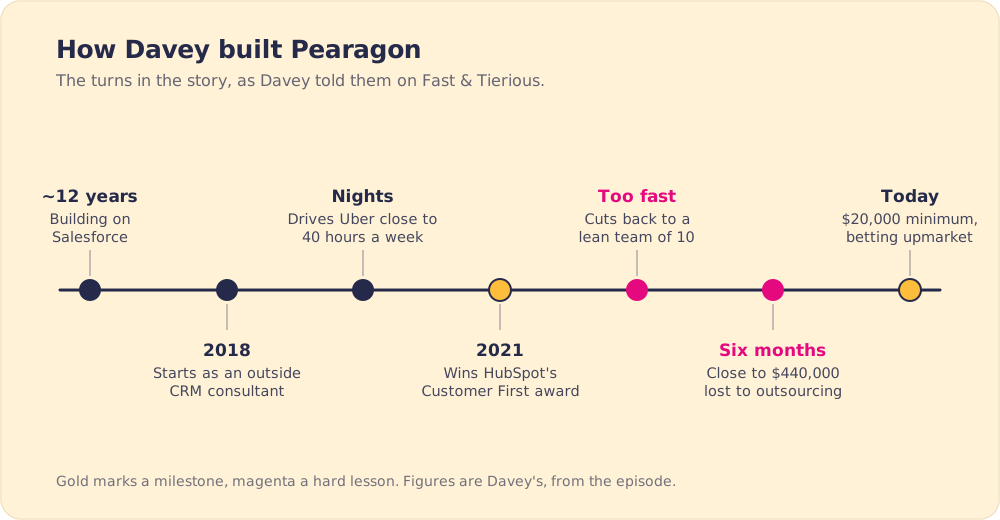
Davey came from almost 12 years of Salesforce work and started Pearagon in 2018 as an outside CRM consultant. He built it into a ten-person firm that won HubSpot’s Customer First award in 2021 and placed in its top 10 in 2022 and 2023. When he came on Fast & Tierious, I asked for his top three lessons for a new partner, “out of the 100 things that I failed on.” He gave me a project manager, utilization, and hustle, and then a fourth he paid close to $440,000 to learn, about outsourcing.
Why does Davey give work away before he asks for any?
Pearagon has never been a marketing firm. When we recorded, Davey’s marketing team was one intern. So he grew by giving first. Pearagon offered prospects free audits of their HubSpot portals, and the audits turned into projects. “It’s a give and get scenario right not just a get,” he said.
He had watched the other approach at a company he worked for before Pearagon. Its leaders gamed their way to the top of a Salesforce partner listing, by a method he called “what I would call thievery.” They got a lot of business out of it. Davey wanted no part of it.
His biggest giveaway is WinterBound, an in-person event in Utah for HubSpot admins, priced at $75 a ticket, with HubSpot Academy’s Kyle Jepson as keynote. Its purpose is to turn admins into experts, and Davey has seen what those experts do next. “When those Champions leave those companies and go to other companies they bring HubSpot with them,” he said. New prospects often tell him they used HubSpot at their last job and want it again.
For the same reason, the Customer First award matters more to him than Partner of the Year. As I said on the episode, Partner of the Year is about how much HubSpot a firm sells, and Customer First is about whether its clients stay. Frederick Reichheld of Bain & Company found that raising customer retention by 5% raises profits by 25% to 95% (Harvard Business Review, 2014). Davey says it his own way: “it’s all about helping the ecosystem and it will always come back to you tenfold.”
He is candid about what it costs. Firms with bigger marketing budgets passed him. “I’ve watched companies literally just run by,” he said, and he caught himself wondering what he had done wrong. He decided he had done nothing wrong. Pearagon grows the slower way, by keeping the clients it has.
What makes the right project manager for a HubSpot agency?
Lesson one was to hire a good project manager. Pearagon went through a couple before it found the right one, and he said getting there “took a little bit of money too.”
His definition is specific: “somebody who understood some technical aspects of a CRM and actually has some project management experience in software.” A generalist project manager falls short, he explained, because a client does not behave like a colleague: “your client is not like an internal Department your client is a client and if they are upset you can’t just wash them away.”
The project manager is the person who keeps each build to Pearagon’s standard while several clients push on the team at once. Davey wants that person to understand the CRM well enough to spot a bad build, and to have run software projects before, so an upset client is not their first.
What is a good agency utilization rate?
Lesson two was the one he said “a lot of people don’t talk about”: “watch how you’re doing your utilization.” Pearagon bills projects by the hour, so a delivery person on a 40-hour week needs 30 to 35 billable hours, or 75 to 87.5%. If someone is billing 25%, he said, the firm will “start failing,” because “I might not be able to afford the employee.”
His band sits well above the average, if professional services firms are the benchmark. SPI Research’s 2026 benchmark of 509 professional services organizations found average billable utilization fell to 66.4% in 2025, the lowest in the survey’s history (Certinia summary of the SPI 2026 benchmark).
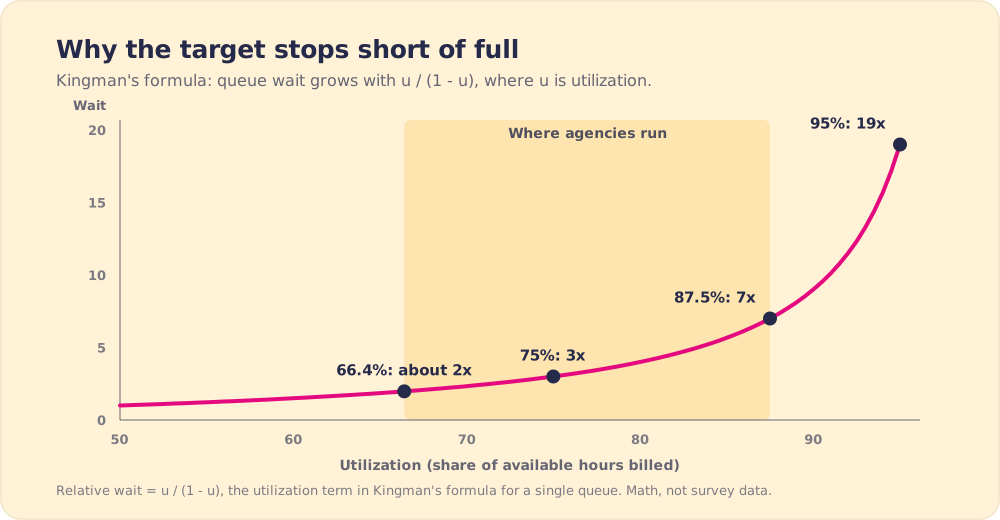
It also stops short of 40 hours, and queueing theory gives a reason to keep it there. In Kingman’s formula, the time a piece of work waits in line grows with u / (1 - u), where u is utilization (Kingman’s formula). The factor is about 2x at 66.4%, 3x at 75%, 7x at 87.5%, and 19x at 95%. An admin booked solid has no slot for the urgent workflow fix, so the fix waits, and so does the client.
How do you calculate agency utilization rate?
Billable utilization is billable hours divided by available hours for the same period. Davey’s math uses a 40-hour week, so 30 billable hours is 75% and 35 is 87.5%. His warning case, a person billing 25%, is 10 hours of client work in a week. Pearagon bills by the hour, which makes the number close to revenue. A person who drops from 32 billable hours to 20 has cut what they bring in by more than a third while costing the same salary. Run it per person each week, then for the whole delivery team, so you can see both who is overloaded and who is waiting for work.
Davey’s utilization lesson has a second part, and it is about the person billing the hours. He knows owners are told not to talk this way, and he does anyway: “I do love my employees.” He has hired family and fired family, and they still get together for the Super Bowl and Christmas. When an employee’s number drops, his first question is what is going on in their life that he can help with. He had lunch the day we recorded with a former employee who is now a client.
He took the idea from an old 60 Minutes piece about a software company that gave its people everything to keep them. The line he half remembered belongs to Jim Goodnight of SAS, who told Inc. that “95 percent of my assets drive out the gate every evening” (Inc., 2011). Davey put it in his own words: if his people do not come back tomorrow, he does not have a business.

How hard should a new HubSpot partner hustle?
Lesson three was hustle, and he meant something specific. When he started Pearagon he drove for Uber close to 40 hours a week at night while putting 60 hours a week into the business. “You cannot expect HubSpot to bring you deals every single day,” he said. You have to network and go get the work.
He was just as specific about the other side of it. He says “we work hard we play hard,” and he plans family vacations and keeps them. If a client needs him while he is away, the client waits, and if a prospect walks because of it, he decided that was worth losing “to keep my family happy.”
When does outsourcing cost an agency more than hiring?
Asked what he wished he had done earlier, Davey went straight to outsourcing. Pearagon failed “three four times” with outside delivery firms. The firms were good, he said. They came from marketing work and could not keep up with the architect-style CRM builds Pearagon sells. When Pearagon sent a complex request, the outside team would scratch their heads and say, “I guess we could do that.” In one stretch, he said, “I lost one year close to $440,000 in Outsourcing in six months.”
He fixed it by hiring contractors directly and training them the Pearagon way. Eight of his ten people work in the office. The other two work remotely, hired and trained by Pearagon, which keeps the margin. “Training them is hard,” he admitted, but it was far easier than paying a third party that “adds a cost on top.”
He made a related mistake with headcount. “We grew a little too fast I started adding too many people,” he said. Pearagon cut back, got lean, and took a hard look at what it did well. His advice to a young founder is shorter: stop hiring friends and family, and hire the right people.
Both mistakes had the same cause. A new team, inside or outside the firm, can only follow Pearagon’s way of working if that way is written down and taught. Manufacturers call a written, taught method standard work. Davey does not dwell on the $440,000: “failure is the ingredient of learning success.”
Davey’s lessons on agency utilization and operations
- Generosity as a growth channel. Free audits, a $75 admin event, and champions who carry HubSpot to their next job built Pearagon’s pipeline without a marketing team.
- A project manager who knows software. Technical CRM knowledge plus software project experience, because a client who gets upset can leave.
- A utilization band with a person behind it. 30 to 35 billable hours of 40, with the first question about the person and the second about the number.
- Hustle with limits. Uber at night in year one, and family vacations on the calendar every year since.
- Outsourcing after the process is written. Close to $440,000 in six months taught Pearagon to hire contractors directly and train them to its standard.
What should a new HubSpot agency copy from Pearagon?
Davey’s closing advice to new partners was about where to aim. “Don’t settle for the bottom scraps,” he said. He will not take a $5,000 implementation anymore. Pearagon’s minimum engagement is about $20,000, “because we know what it takes to build a good system.” He bet the firm on HubSpot moving toward bigger companies, and he calls his team HubSpot solution architects, a title he says HubSpot started using about six months after he said it in a meeting.
We would copy his order. Give first, because clients who stay are worth more than clients you chase. Hire the project manager before the next admin. Set a billable band of 30 to 35 hours and ask about the person when the number drops. Write your delivery down before you hand it to anyone outside, so a contractor learns Pearagon’s way instead of guessing at it.
That last step is where Supered fits. HubSpot partners in our partner program put their delivery process inside HubSpot, so an admin or contractor sees the next step while doing the work, and the project manager can see which builds drifted without chasing each one. Partners use it to productize client delivery.
If your next problem is the first 90 days with a new client, read our guide to designing a client onboarding process backward from the outcome.
Frequently asked questions
How do you calculate agency utilization rate?+
What is a good agency utilization rate?+
Why shouldn't an agency aim for 100% billable utilization?+
What should a HubSpot agency look for in a project manager?+
Should a HubSpot agency outsource delivery?+
Your process, running itself.
Turn the playbook into rep behavior.
More from Fast & Tierious

Agency Profitability in a Downturn: How Idan Carmeli Brought Envy Through
Idan Carmeli
How Much Does HubSpot Onboarding Cost? Jasey Tielen Quotes 5K for a 20K Setup
Jasey Tielen