Agency Profitability in a Downturn: How Idan Carmeli Brought Envy Through
Idan Carmeli fell for Marketo in 2011, switched to HubSpot, and merged his small agency into Envy. When Israel's tech funding fell 56%, Envy put agency profitability ahead of revenue, trusted its team, and made excellence a daily habit.
Agency profitability is how much of each dollar a client pays an agency keeps after the cost of the hours spent serving that client, and Idan Carmeli of Envy put it ahead of revenue to carry his agency through Israel's tech downturn.
In 2011, a friend who owned a Salesforce consultancy came back from a convention in London and told Idan Carmeli she had seen something he should look at. It was Marketo, a marketing automation platform. “I fell in love with the concept of a technology built especially for marketers,” he said.
He has worked in B2B tech marketing ever since. Today Idan is managing partner at Envy, a HubSpot agency in Israel that serves B2B tech companies. When Israel’s tech market turned in 2022, agency profitability was the first thing Envy worked on, and in the year before we talked it brought in about $3 million with about 18 people. He joined me on Fast & Tierious to explain how Envy got through the downturn in better shape than its partners expected, and he gave three reasons: they got their numbers in order, the partners handed more work to the team so they could think ahead, and they made good work a daily habit.
How did Idan find his way to HubSpot and Envy?
He came up the long way. “I’ve been in the business, in the high-tech kind of business, in the past for 24 years,” he said, the first decade in sales and marketing roles at enterprise companies. In 2010 he left to start his own practice. “It was really terribly planned, was really terribly executed,” he said. “I just left a very good position.”
Marketo gave the practice a direction, and he implemented it for companies across Israel for years. He tried HubSpot on projects in 2014, 2015 and 2016. “Each time I said no, it’s not good enough.” Then, as he saw it, Marketo “got stuck in some stasis situation” while HubSpot kept gaining ground in Israel. “I said I’m missing something.” He became a HubSpot partner around 2017 or 2018. “I never looked back.”
I told him on the episode how much I respected that. He had put hundreds of hours into learning Marketo, and he still switched when he saw something better. In 2020 Idan merged his own agency, then seven or eight people, into Marketing Envy, another long-time HubSpot agency, and became a managing partner. Envy has held Diamond since.
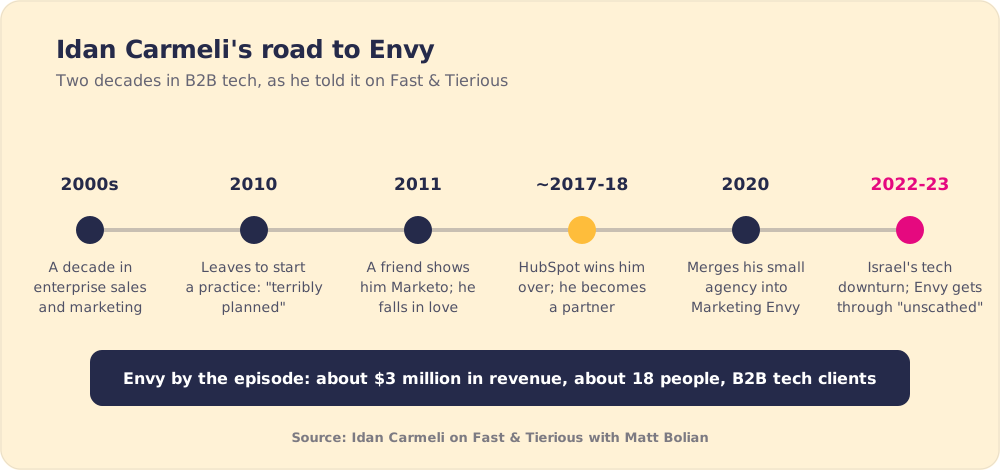
Then the market fell.
“In Israel the startup economy makes up a big chunk of B2B tech,” Idan said. A downturn that began in the middle of 2022 ran through 2023, and the country’s political and security situation made it worse. Israeli tech companies raised about $6.9 billion in 2023, down 56% from 2022, according to IVC and Leumitech data reported by The Times of Israel (The Times of Israel, 2023). Envy’s clients are those companies, so their marketing budgets shrank with the funding. Envy still finished the year ahead of what the partners had planned, and Idan walked through how.
Why did Idan put agency profitability ahead of revenue?
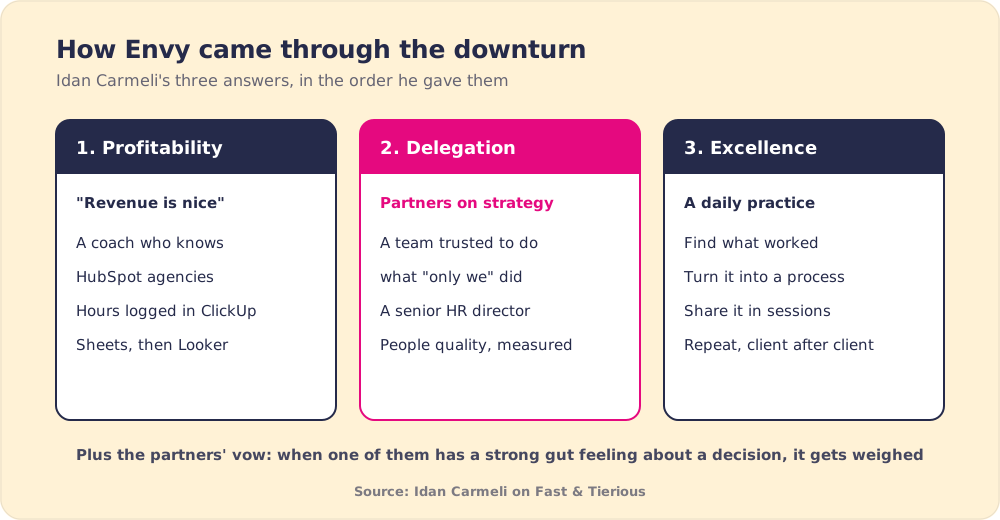
He started with money. “Revenue is nice, tiering is nice, all of that is great, but at the end, if you make $10 million but profitability sucks, you can’t benefit from that.” Envy fixed its profitability in 2022 and 2023, and “that allowed us basically to get through 2023 relatively unscathed.” At his earlier solo agency, he said, profitability “was a real issue for me.”
The fix had two parts. First, “get a good coach, get a good consultant,” ideally one who has worked with HubSpot agencies. Envy does broader digital marketing too, but the partners figured that if they fixed the business as a HubSpot agency, the rest would follow. Second, get the numbers, financial and operational, which “means getting people in the agency to log their hours and all the grunt work that needs to happen so that we can measure ourselves.” Envy tracks time in ClickUp and reports from Google Sheets, and when we talked Idan was building Looker dashboards on top.
Agency margins are thin to begin with. SPI Research’s latest Professional Services Maturity Benchmark, covering more than 500 firms, found billable utilization at 66.4%, the lowest in the survey’s history, and EBITDA at 9.9% (Deltek on the SPI benchmark). At about ten cents of profit on the dollar, one client who eats twice the hours they pay for can wipe out the profit from several others, and the timesheet is the only place that shows which one. Clients were tightening too: Gartner’s 2025 CMO Spend Survey found 39% of CMOs planning to cut agency spending (Gartner, 2025).
How do you improve agency profitability, step by step?
Envy’s fix, put in order, works for an agency of any size.
- Bring in a coach or consultant who has worked with your kind of agency. Envy chose one who knew HubSpot agencies.
- Have each person on the team log hours against a client. Envy uses ClickUp.
- Put those hours next to what each client pays, first in a spreadsheet and then on a dashboard. Envy went from Google Sheets to Looker.
- Compare the totals with SPI’s figures, 66.4% billable utilization and 9.9% EBITDA, to see where you stand against other firms.
- Act on the clients the numbers show losing money. Idan’s reason for all the “grunt work” was to know which work pays.
How do agency partners find time for strategy?
Idan’s second challenge is one he says never stays solved: “getting the partners, the senior management, to focus on what’s strategic” instead of the day-to-day. “It’s a paradox, because you feel that if you let go of the day-to-day stuff, then you’re not going to get revenue for the next month.” Years of doing it taught him otherwise: “when you look ahead longer than one quarter and longer than one year ahead, that’s when you get true motion, and that’s when you move the needle.”
What let the partners step back was a closer look at their own people. “The aha moment was the realization that we have an extremely talented group of people working with us that have the capability to do more of the things that we used to think that only we can do.” Envy put money behind that: “a dedicated, very senior HR director who’s been with us for many years.” And the partners track the result. “The average quality of the people in our agency keeps going up, and we measure it, and it keeps going up consistently.”
I brought up the Pygmalion effect, which a coach once taught me: people tend to perform at the level you expect of them. The research on it is mixed. Rosenthal and Jacobson’s 1968 classroom study reported large gains, and later studies found a much weaker effect (Wikipedia, Pygmalion effect). Idan doesn’t rely on expectation by itself. He pairs it with a senior hire whose whole job is the people, and with a quality measure the partners check.
What makes a culture of excellence stick?
Idan’s third answer was a culture of excellence, and he was wary of the phrase. “McKinsey consultants are super good at giving names to that,” he said. For him it means “a day-to-day practice of giving high-end service, giving high quality service, getting results, striving towards the results even when the conditions are not ideal.”
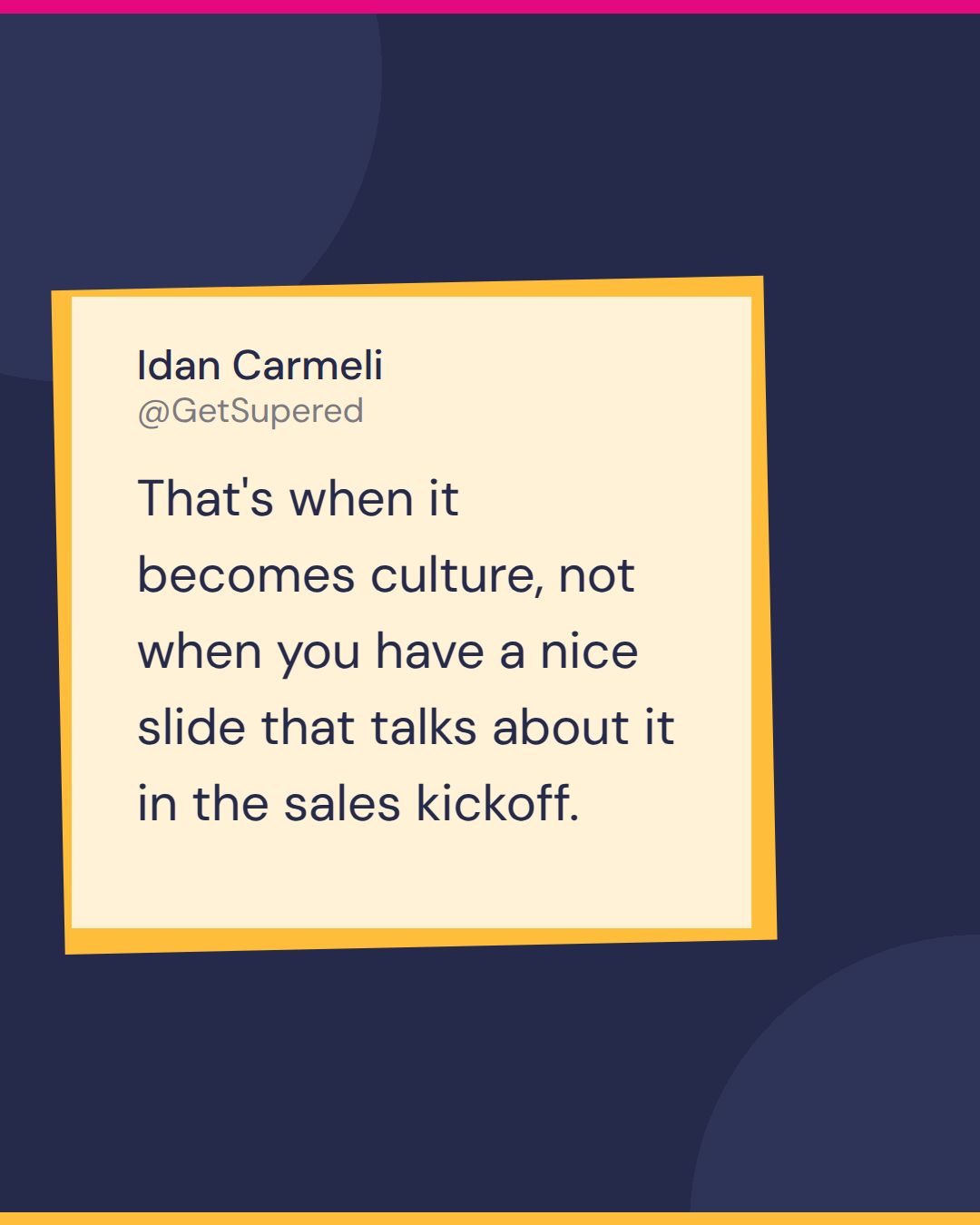
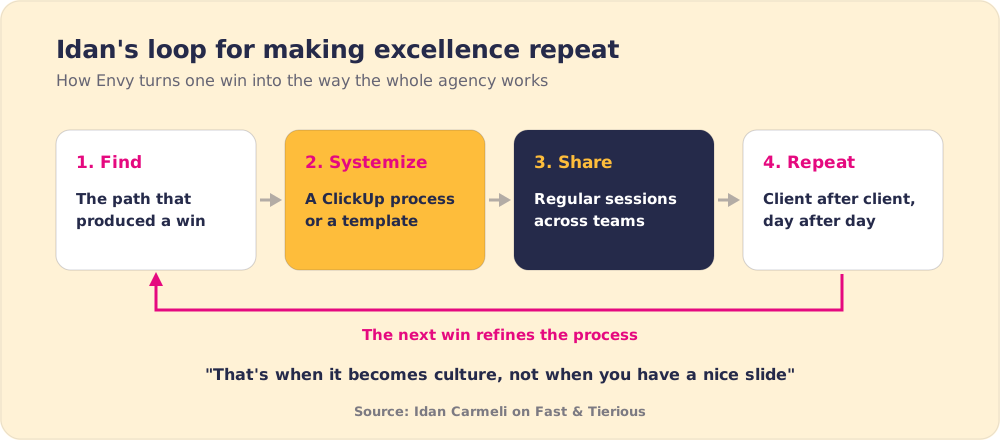
He admitted that for years he talked about a culture of excellence before Envy had one. The habit that changed it was simple to describe: “identify the path to success that happened and try to make that a system.” At Envy that means automated and semi-automated ClickUp processes for onboarding a client, shared templates, and regular sessions where teams “share ideas and try to cross-pollinate between teams and between clients.” His test for any of it: “take something that worked and making sure that it’s repeated.”
Our own survey found the same pattern in sales teams. In The State of Sales Enablement 2026, teams in the top quota band scored 3.83 on a five-point scale of deal-execution consistency, against 3.00 for teams in the bottom band. The top teams ran their deals the same way more often. Our post on standard work covers how to write that repeatable version down.
When should a data-driven agency trust its gut?
Idan’s one hard rule came out fast: never go against “a very strong gut feeling, especially one that’s shared by colleagues, by the other partners.” He has 24 years in the business, and his partner Billy has almost as many. “You have to trust your gut,” he said, “especially in an agency where saying yes or saying no to the right client can have a huge impact.”
The partners “almost made a vow” that when one of them has a strong feeling about a client, a partnership or a decision, the others weigh it. “I know it’s not very popular in all our data-centric, measure-everything kind of culture,” he said. He sees it as something that comes with age: “you learn to trust again your instincts after they failed you in the past.” He doesn’t think it cancels out the timesheets and dashboards he described a few minutes earlier. The dashboards show last month. Four partners with decades each have a feel for a client before the first invoice.
His other regret: “I would have gone all in on HubSpot earlier than I did.” The software of 2017 did not win him over. “What got me was how they treated partners.”
Idan Carmeli’s lessons on agency profitability and growth
- Profit before revenue. A coach who knows your kind of agency, hours logged for each client, and dashboards that show which work pays.
- Partners on the future. Hand the team work you assumed only partners could do, pay for a senior people function, and measure the quality of your people.
- Excellence as a habit. Find what produced a win, turn it into a process or template, share it across teams, and repeat it client after client.
- A shared gut feeling as data. When experienced partners feel strongly about a client or a decision, weigh it next to the numbers.
What should an agency owner take from Envy?
Israeli tech funding fell 56% in a year, and the average professional services firm keeps about 9.9% as EBITDA. Envy came through 2023 relatively unscathed because it knew which clients made money and ran its best work the same way each time. We would follow Idan’s order: the profit numbers first, then the team, then the habits.
If you run a HubSpot agency, Supered’s partner program works with firms that sell that kind of consistency to their clients. For your next read, our guide to moving from Marketo to HubSpot covers the switch Idan made, and our post on sales and marketing alignment covers what marketing needs from the sales side.
Frequently asked questions
What is agency profitability?+
How do you improve agency profitability?+
How do agency partners get time for strategy?+
How do you build a culture of excellence in an agency?+
Why did Idan Carmeli move from Marketo to HubSpot?+
Your process, running itself.
Turn the playbook into rep behavior.
More from Fast & Tierious

Freelance to Agency: Logan Armstrong on Hiring for the Load in Your Head
Logan Armstrong
HubSpot Consultant: Romeo Mann on Why Knowing the Buyer Beats Knowing the Tool
Romeo Mann