Revenue Leakage: You Are Not Losing to Competitors, You Are Leaking to Yourself
Revenue leakage is the money lost not to rivals or price, but to deals that stalled, follow-ups that never happened, and discounts that did not need to be given. It is mostly invisible, and mostly a behavior problem.
Revenue leakage is the revenue a business loses not to competitors or price but to gaps in its own execution, stalled deals, missed follow-ups, needless discounts, and churn from poor handoffs, and most of it goes unrecorded because the losses are behaviors that never happened.
Ask a sales leader why they missed the number and you will hear about competitors and price. The rival undercut us. The buyer went cheap. It is a comfortable story, because it puts the loss outside the building. Now pull the actual record of what happened to the pipeline, deal by deal, and a different, larger story climbs out: deals that stalled and were never revived, demos with no follow-up, deals riding on a single contact who left, discounts handed out by reflex, accounts that churned weeks after a rushed handoff. None of those went to a competitor. They leaked out the sides of your own process, and almost none of them got recorded, because there is no field in any CRM labeled “nobody followed up.” Revenue leakage is the money you earned the right to win and then lost to yourself, and it is larger than the losses you can name precisely because you cannot see it.
Revenue leakage is the revenue a business loses not to competitors or price but to gaps in its own execution, stalled deals, missed follow-ups, needless discounts, and churn from poor handoffs, and most of it goes unrecorded because the losses are behaviors that never happened. Find the leaks, and you find revenue you already earned the right to keep.
Why is most revenue leakage invisible?
Because the losses are non-events, and organizations only record events. Picture two deals that both die in the same week. The first is taken by a competitor: a real moment, a clear villain, an email that says they went with someone else, and a tidy “Closed Lost, competitor” in the CRM. The second just goes silent. The champion stops replying, the rep is busy with noisier deals, the record ages in place, and at some point everyone has silently agreed it is dead without anyone marking the hour it died. Both cost you the same money. Only the first leaves a fingerprint. That is the whole asymmetry: competitive losses get coded because they are events, and execution losses do not, because the thing that killed them was the absence of an event, the follow-up that never happened. There is nothing to write down when nothing is what occurred.
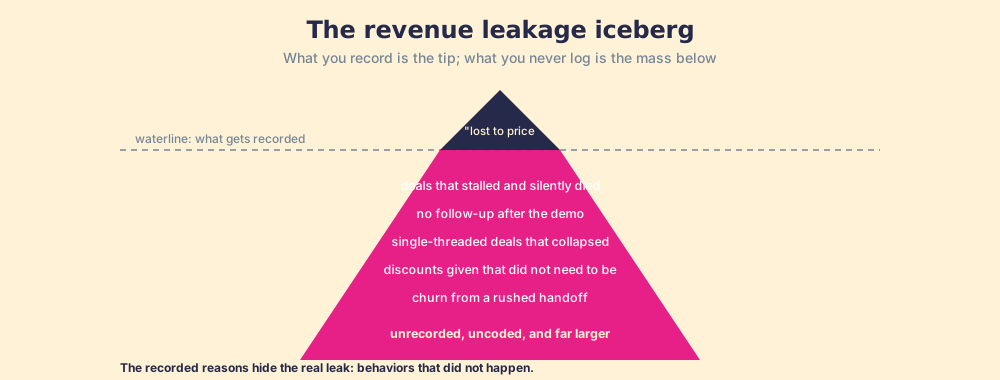
This asymmetry rigs every loss report you have ever read, and it does it silently. The reasons in the dropdown (“lost to price,” “lost to competitor,” “lost to timing”) are the losses tidy enough to record, and they sit on top of a much larger submerged mass that no field captures, because the mass is made of deals no behavior ever finished. So the report tells you that you lose to rivals and price, and you believe it, and you go buy a battlecard. The report was never measuring the larger leak. It was measuring the only losses that leave a body.
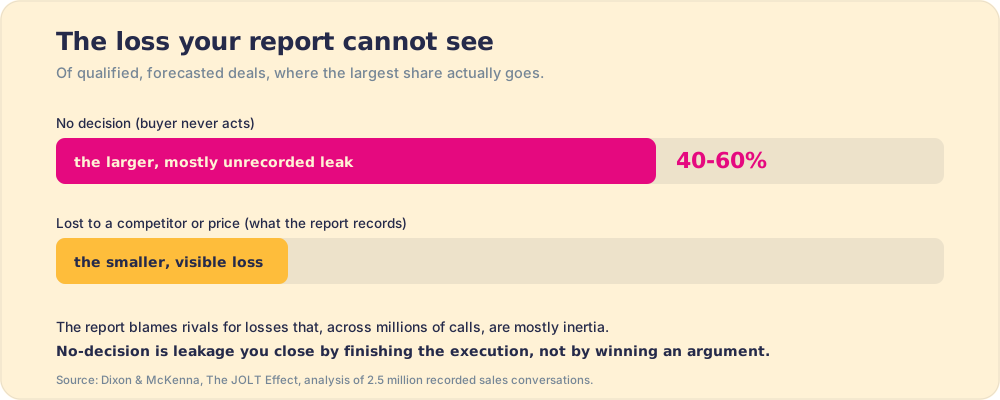
The independent data points the same way, and it is hard to argue with the sample size. In the win-loss analysis we examined, the single most common outcome in a complex B2B deal is not a loss to a competitor at all but “no decision.” Matthew Dixon and Ted McKenna, studying 2.5 million recorded sales conversations for The Jolt Effect, found that 40 to 60 percent of qualified, forecasted deals end in no decision, the buyer never acting at all, with most of that driven by indecision and fear rather than a preference for a rival (Dixon and McKenna, The JOLT Effect). Read that next to your loss report and the gap is staggering: the report blames competitors for losses that, across millions of calls, are mostly the deal dying of inertia. No-decision is revenue leakage with a name. It is a deal that wanted to happen, that you had the right to win, and that unfinished execution let drift away.
What are the causes of revenue leakage in sales?
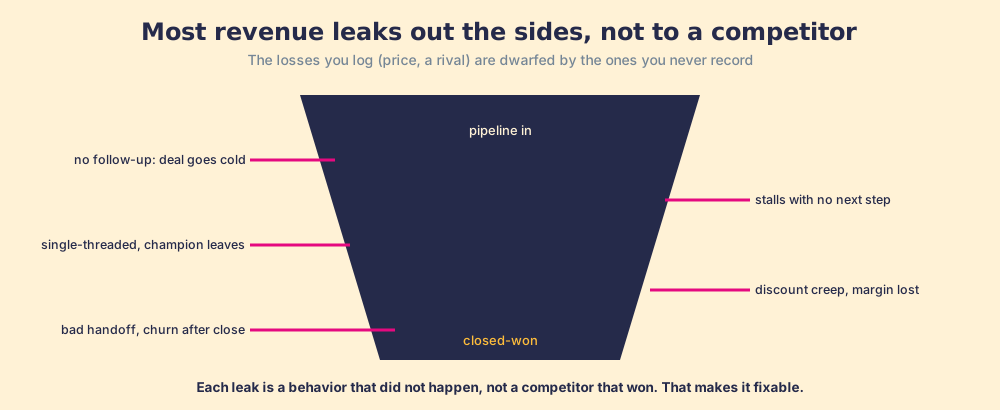
The revenue leakage causes worth your attention are not strategic; they are behavioral, and they sit at every stage of the pipeline, each one a specific behavior that did not happen. Revenue leakage in sales is, at root, a long list of small omissions. The leaks are predictable, which is the good news hiding in the bad, because predictable means addressable. A deal stalls with no agreed next step and ages into the dead pile while the forecast keeps counting it. A warm prospect gets no follow-up and cools, even though persistence is one of the most reliably documented edges in selling: a large share of deals that eventually close do so only after several follow-ups, and the average rep stops well before then. A deal single-threaded on one contact collapses the day that contact changes jobs, which in a normal year is a coin-flip risk over the life of a long deal. A rep discounts to close faster when the discount was never required, and because price drops straight to the bottom line, every needless point of discount is margin that does not come back. A closed deal gets a rushed handoff and churns before it ever pays back the cost of winning it. Each of these is the absence of a behavior, which is what wires revenue leakage straight to the sales execution gap: the leak is the distance between what the rep should have done and what they did.
This reframes prevention, and the reframe is where the money is. You do not plug revenue leakage with sharper pricing or a fresh competitive battlecard, because those tools fight over the visible losses, which are the small ones sitting above the waterline. You plug leakage by making the missing behaviors happen consistently, deal by deal, which is a different kind of work than buying a tool that argues with rivals you mostly are not losing to.
- Stalled deals. No next step, so the deal dies unseen. Require a real next step on every open opportunity.
- Missed follow-up. Warm deals go cold. Enforce the follow-up so persistence is consistent, not optional.
- Single-threading. One champion leaves and the deal collapses. Multi-thread so no deal rides on one person.
- Discount creep and bad handoffs. Margin given away and post-sale churn. Govern discounting and standardize the handoff.
How do you stop revenue leakage?
Make the missing behaviors consistent deal by deal, which is the same discipline that closes the execution gap. Because leakage is the absence of behaviors, the fix is not a new pricing model or a competitive play; it is ensuring the behaviors that prevent each leak do happen. Require a real next step on every open opportunity so nothing stalls unseen. Enforce follow-up so warm deals are worked, not abandoned. Qualify hard, as in lead qualification, so capacity is not leaked onto bad-fit deals. Multi-thread so a champion’s exit does not sink a deal. Govern discounting so margin is not given away by reflex. Standardize the handoff so closed revenue does not churn. Each of these is a behavior you make happen in the flow of work and then measure, which is the loop in sales process adoption. Plug the behavior gaps and the leaks close, because the leaks were the gaps all along.
What we recommend
Stop attributing your missed number to competitors and price, because those are the losses you can see, and they are the small ones. The larger loss is revenue leakage: deals that stalled, follow-ups that never happened, deals that rode on one contact and collapsed, discounts given that were not needed, accounts that churned from a rushed handoff. It is invisible because each loss is a behavior that did not happen, and there is no field in your CRM for the thing nobody did, which is why your loss report keeps blaming rivals for a leak that, across millions of recorded deals, is mostly inertia.
So you have a choice in where you spend the next quarter’s effort. The visible road is to fight harder over the losses you can see: better pricing, a new battlecard, a competitive war room. That road defends the tip of the iceberg and leaves the submerged mass untouched. The other road is to make the missing behaviors consistent, deal by deal, a real next step on every open opportunity, enforced follow-up, hard qualification, multi-threading, governed discounting, standardized handoffs, each surfaced in the flow of work and then measured so it stops being optional. We recommend the second without much hesitation, because the evidence is lopsided: the Jolt Effect’s millions of calls say most lost pipeline dies of no-decision, not of a competitor, and a no-decision deal is leakage you close by finishing the execution, not by winning an argument. Leakage is execution, and execution is fixable. You are not mostly losing to rivals. You are leaking to yourself, and that is the rare loss you can go and stop.
From here: the silent no-decision losses in win-loss analysis, the pipeline discipline in pipeline hygiene, the adherence that plugs the leaks in sales process adoption, and the wider frame in the sales execution gap.
Frequently asked questions
What is revenue leakage?+
What causes revenue leakage in sales?+
Why is revenue leakage so hard to see?+
How do you prevent revenue leakage?+
Your process, running itself.