Sales Battlecard: A Six-Page Doc the Rep Cannot Use Mid-Call
Most sales battlecards are exhaustive reference docs no rep opens during a live call. A battlecard has to work under pressure, which means three things to say, surfaced when the competitor is named, not a binder.
A sales battlecard is a quick competitive reference that helps a rep handle a rival in a live deal, and it works only when it is short enough to use under pressure and surfaced at the moment the competitor comes up, not when it is an exhaustive document filed in a drive.
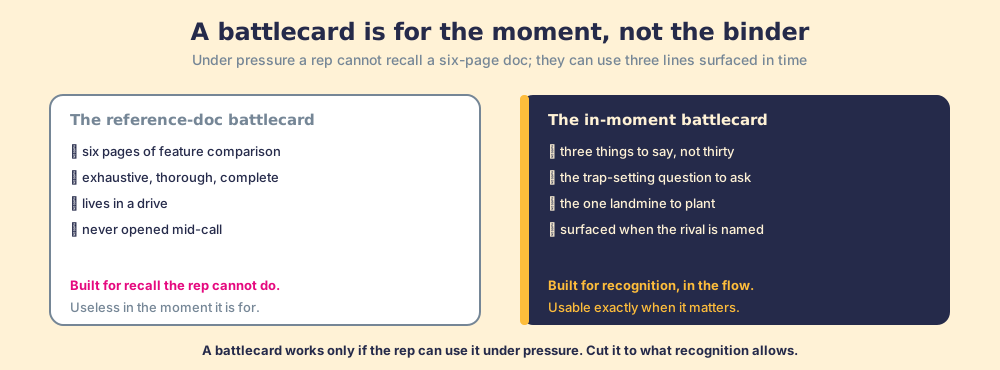
The typical sales battlecard is a monument to thoroughness: six pages of feature-by-feature comparison, every objection anticipated, every competitor weakness catalogued. It is also useless, because no rep on earth opens a six-page document in the middle of a live call. The battlecard is built for a moment, the instant a buyer says “we’re also looking at a competitor,” and that moment does not allow for stopping the conversation to find a file and read it. Under pressure, a rep cannot recall a long document; they can only use what is short enough to recognize and act on in the moment. The battlecard that works is not the most complete one. It is the one a rep can use when the competitor’s name comes up.
A sales battlecard is a quick competitive reference that helps a rep handle a rival in a live deal, and it works only when it is short enough to use under pressure and surfaced at the moment the competitor comes up, not when it is an exhaustive document filed in a drive. Build it for the moment, and it earns its name.
Why does the six-page sales battlecard fail?
Because it demands recall the rep cannot perform under pressure, and the moment it is built for does not pause. Cognitive science draws a sharp line between recall, retrieving information unaided, and recognition, identifying the right thing when it is in front of you, and recognition is far easier, especially under stress (on recognition versus recall). A six-page battlecard demands recall: the rep would have to remember what it says, or stop the call to read it, neither of which happens in a live competitive moment. So the exhaustive battlecard fails not because its content is wrong but because its form is unusable, it is built for a calm reader, and it is needed by a rep under pressure mid-conversation. This is the same delivery failure that sinks any sales content stranded in a drive, the knowing-doing gap in competitive form: the information exists, and the rep cannot act on it when it counts.
The fix is not more content but less, shaped for recognition. A battlecard cut to the two or three things a rep can use in the moment, the points that win, the question to ask, the landmine to plant, and surfaced when the competitor is named, works precisely because it respects how a rep operates under pressure. The exhaustive version optimized for completeness and lost usability; the short version trades completeness for the one thing that matters, being usable in the moment it exists for.
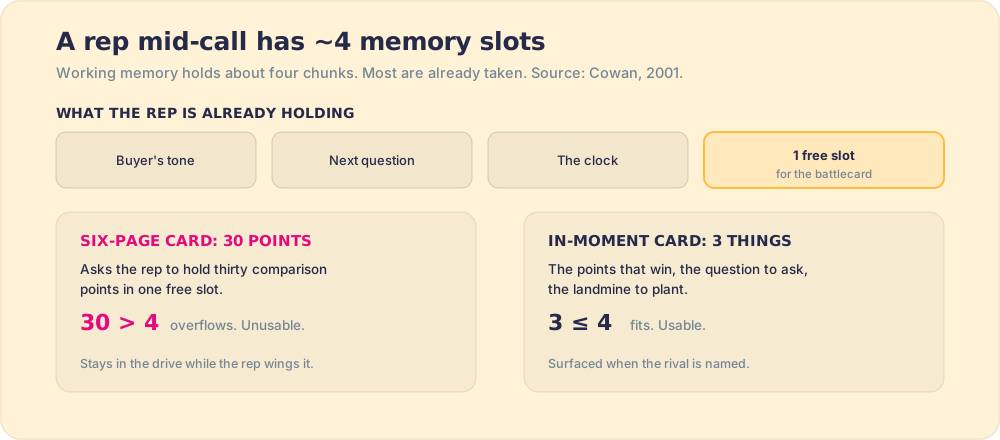
There is a second cognitive limit the six-pager ignores, and it is the more damning one. A live competitive moment is working memory under load, and working memory is small. The psychologist George Miller’s famous paper put the span at “the magical number seven, plus or minus two” items, and later work by Nelson Cowan revised the realistic figure down to about four chunks when you cannot rehearse (Cowan, 2001). A rep mid-call, tracking the buyer’s tone, the next question, and the clock, has perhaps four slots free. A battlecard that asks them to hold thirty comparison points has lost before it started, because the human it was built for cannot hold thirty of anything while talking. Three points fit. Thirty do not. The completeness that feels responsible on the page is precisely what makes the card unusable in the head, and no amount of good content survives a container the mind cannot carry.
The industry data confirms the form problem is real, not theoretical. Competitive-intelligence vendors who study this find that sales reps consistently report battlecards as a top-requested asset and then fail to use the ones they are given, the classic produced-but-not-adopted pattern, because the cards are built as reference libraries rather than in-the-moment prompts (Crayon, State of Competitive Intelligence). The demand is genuine; the format defeats it. Reps want the help and cannot reach a six-page PDF while a buyer is talking, so the asset with the highest stated demand becomes one of the least used, a gap that is a delivery failure, not a content failure.
What should a sales battlecard contain?
A battlecard holds the few things a rep can use in the live moment, and nothing they cannot. It is not a competitive research document; it is a prompt for the instant a rival comes up. So it holds the two or three points that win against this specific competitor, the one trap-setting question that exposes their weakness, and the single landmine to plant in the buyer’s evaluation, the things a rep can recognize and deploy without breaking the conversation. The exhaustive feature matrix and the full competitive analysis belong in a research doc, not the battlecard, because including it does not help the rep and guarantees they will not use the card at all. This is the same recognition-over-recall logic behind a good objection handling approach: in the moment, the rep needs the move, not the manual. So the card holds only what travels into a live conversation.
- The two or three points that win. Against this competitor specifically, what your buyers care about. Not the whole matrix.
- The trap-setting question. One question that exposes the rival’s weakness through the buyer’s own discovery.
- The landmine. The single criterion to plant in the buyer’s evaluation that favors you. One, not ten.
- Surfaced in the moment. The card appears when the competitor is named, not filed where the rep must go find it.
A useful sales battlecard template is therefore less a document outline than a constraint: it should have room for only what fits in working memory, which forces the hard editorial choices that make a card usable. If your template has a page-two, your template is wrong, because a rep will never reach page two mid-call. The discipline of the format does the work the author keeps avoiding, which is deciding what actually matters against this competitor and cutting the rest. The trap-setting question deserves a word on mechanism, because it is the most powerful slot and the most misused. The reason a question beats a claim is that buyers discount what a vendor asserts and trust what they conclude themselves, so a competitive battlecard that hands the rep one sharp question (“when you tested their setup, how long did it take to get a clean report out?”) plants the doubt through the buyer’s own experience rather than the seller’s say-so. The buyer arrives at the weakness on their own, which makes it stick in a way no asserted feature comparison can.
How do you keep sales battlecards usable and accurate?
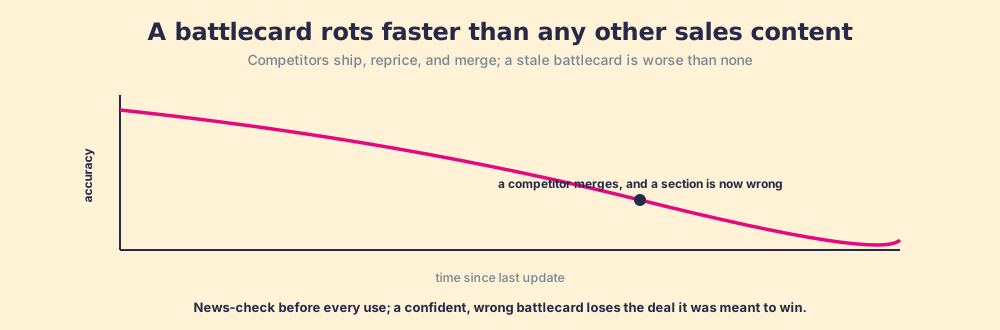
Keep them short, surface them in the flow, and news-check before every use, because a battlecard fails on form and on freshness. The form fix is to cut the card to what a rep can use under pressure and surface it in the flow of work when the competitor comes up, so it is a prompt in the moment rather than a document in a drive, the sales process adoption discipline applied to competitive content. The freshness fix is constant maintenance: battlecards decay faster than any other content because competitors ship, reprice, and merge, and a card naming a now-false fact is worse than none. The competitive field shifts under you, as the Highspot and Seismic merger showed, so always check a competitor’s current status before deploying a card against them. A short, fresh card surfaced in the moment is a battlecard. A long, stale one in a drive is a liability.
What we recommend
Build your sales battlecard for the live competitive moment, not for completeness, because the moment is where it either works or does not, and a six-page reference doc never works there. Cut the card to what a rep can use under pressure: the two or three points that win, the trap-setting question, the one landmine, and surface it in the flow of work the instant the competitor is named, so it is a prompt the rep can act on rather than a file they will not open. Then keep it fresh, news-checking the competitor before every use, because battlecards rot fastest of all and a confident wrong card loses the deal it was built to win. The reason this beats the exhaustive battlecard is that it respects how reps operate in a live deal, on recognition under pressure, not recall from a binder. A battlecard is not a document. It is a move, made in the moment, and it should be built for exactly that.
From here: the in-moment logic in objection handling, the freshness lesson in Highspot vs Seismic, the playbook it belongs to in the sales playbook, and the adoption underneath in sales process adoption.
Frequently asked questions
What is a sales battlecard?+
Why do most sales battlecards fail?+
What should a sales battlecard include?+
How often should you update sales battlecards?+
Your process, running itself.