Sales Competencies: A Skill Only Counts When Someone Can See It
A list of sales skills tells you what good reps can do. Sales competencies tell you whether your reps are doing it, at what level, and what to coach next. The core list by role, a sample matrix, and how to score it from evidence.
Sales competencies are the observable behaviors that combine a selling skill with the knowledge behind it, described precisely enough that a manager can see them in a rep's real work, score them against defined proficiency levels, and coach the gap.
Sales competencies are the observable behaviors that combine a selling skill with the knowledge behind it, described precisely enough that a manager can see them in a rep’s real work, score them against defined proficiency levels, and coach the gap. A list of skills gives each rep one overall impression. A competency model scores each behavior on its own. Plenty of sales teams own the first and never wrote the second, the one that changes what reps do. The question underneath all of it has two halves:
From the field
It’s always, how do I have a framework, and how do I ensure people are following the framework?
A competency model answers the first. Scoring it from evidence answers the second.
What are sales competencies, and how do they differ from sales skills?
In 1973 the Harvard psychologist David McClelland published “Testing for competence rather than for intelligence,” arguing that aptitude tests predicted school grades and little else, and that employers should study what their best performers do on the job (summary of McClelland’s paper). The competency movement grew from that one move: stop measuring what people can recite, and describe what the best ones do.
Our post on sales skills argues that skills are procedural, the knowing-how a rep performs on a live call, and that training delivers the knowing-that instead. A competency takes the next step. It packages a skill so it can be seen, scored, and coached:
- Knowledge. What the rep has to know, such as your ideal customer profile or the three reasons buyers churn. Necessary, cheap to deliver, and the part AI has made nearly free.
- Skill. What the rep can do with it, such as turn a vague complaint into a cost the buyer will act on.
- Observable behavior. What the skill looks like in the work at a given level, written so two managers watching the same call would score it the same way.
- Evidence. Where you look to confirm it: a recording, a stage history, a field in the CRM.
Drop the last two and you have a skills list with a fancier name.
What are the core sales competencies by role?
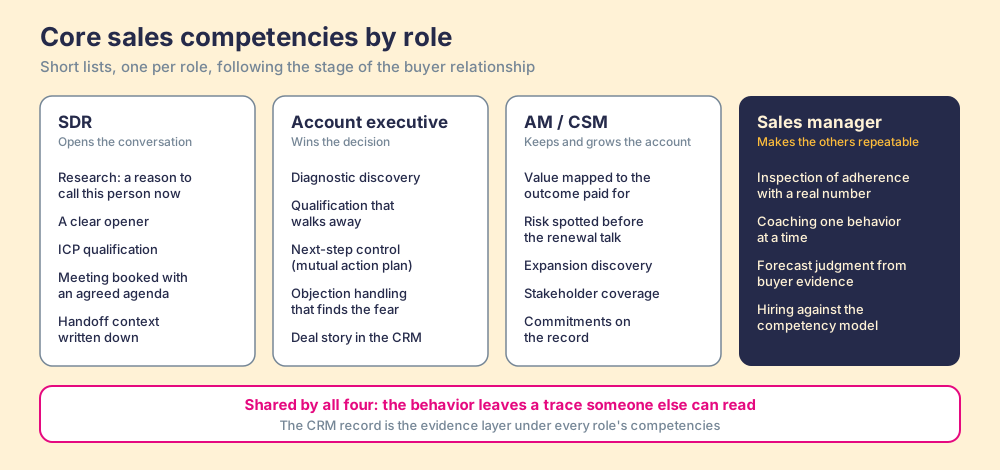
One list for the whole revenue team measures each role badly. An SDR booking meetings and a CSM protecting a renewal share a few behaviors and differ on most. Here is a core set by role. (If the SDR and BDR titles blur on your team, our BDR vs SDR breakdown separates them.)
- SDR competencies. Research that finds a reason to call this person now, a clear opener, qualification against the ideal customer profile, booking a meeting with an agenda the buyer accepted, and a handoff with the context written down.
- AE competencies. Diagnostic discovery, qualification that walks away from bad fit, next-step control with a mutual action plan, objection handling that finds the fear under the words, and a CRM record that tells the deal’s story without the rep in the room.
- Account manager and CSM competencies. Mapping value to the outcome the buyer paid for, spotting risk before the renewal conversation, expansion discovery, stakeholder coverage as champions change jobs, and a clean record of commitments made.
- Sales manager competencies. Inspection of process adherence with a real number, coaching one behavior at a time, forecast judgment grounded in buyer evidence, and hiring against the competency model the team runs.
The best-known published sales competency model goes much wider. Objective Management Group, Dave Kurlan’s assessment firm, scores salespeople on 21 competencies grouped into Will to Sell (5), Sales DNA (6), and Tactical Selling (10) (Kurlan, 2020). For hiring a stranger, that breadth is useful. For coaching the team you already have, go smaller. A manager cannot coach 21 things. They can coach one, and the model’s job is to show which.
How do you build a sales competency matrix?
A sales competency matrix is the working view of the model for one role: competencies down the side, proficiency levels across the top, and a short observable behavior in each cell.
- Your best reps as the source. Write the level-four cells by watching what your top performers do, McClelland’s method on your own floor. The team trusts that more than a consultant’s template.
- Five to seven competencies per role. Fewer misses whole stages of the sale; more turns the matrix into a form filled in once.
- Four proficiency levels. Developing, proficient, consistent, and model. The line between “does it sometimes” and “does it on nearly all deals” is where coaching lives, so the scale has to split there.
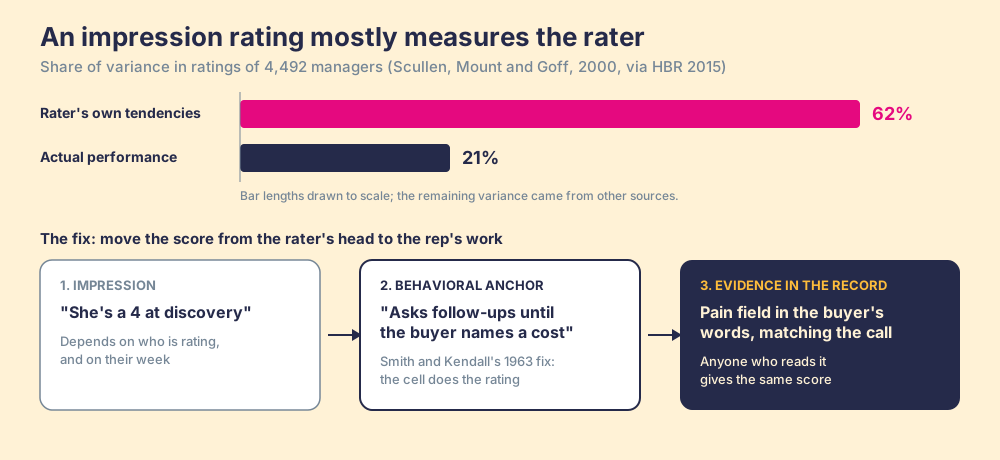
- Behavioral anchors in each cell. Describe what the manager would see or hear, never an adjective. “Strong discovery” is an opinion. “Asks follow-ups until the buyer names a cost” is a behavior.
- An evidence source per competency. Name where the proof lives: the call, the stage history, a field.
The anchors carry more weight than they look. Marcus Buckingham and Ashley Goodall, writing in Harvard Business Review, cite a study of 4,492 managers, each rated by six colleagues: 62% of the variance in ratings came from the raters’ own tendencies, and only 21% from the performance being rated (Buckingham and Goodall, HBR, 2015, citing Scullen, Mount and Goff, 2000). A manager’s “she’s a 4 at discovery” tells you mostly about the manager.
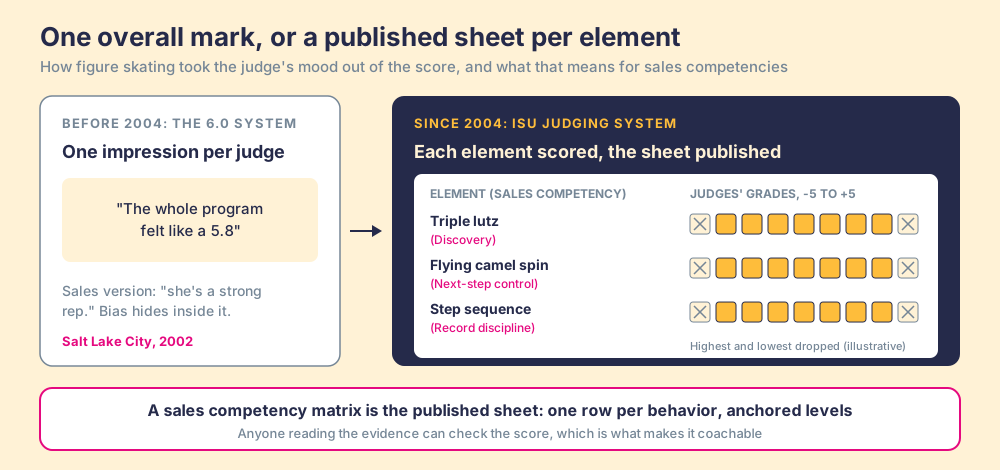
Psychologists have a fix for that, and it is sixty years old. Patricia Smith and Lorne Kendall developed behaviorally anchored rating scales in 1963 to strip the rater’s quirks out of performance appraisal, by “defining performance in behavioral terms and offering concrete, specific examples of actions that exemplify performance at different levels” (Kell et al., ETS, 2017). A well-built competency matrix is a behaviorally anchored scale. Figure skating made the same move after the 2002 Winter Olympics in Salt Lake City, when a French judge told the event referee she had been pressured to put the Russian pair first in the pairs final (2002 judging scandal). The old 6.0 system asked each judge for one overall mark on a whole program, and bias hid inside it. Under the ISU Judging System, in use since 2004, each jump and spin carries a published base value, each judge grades its execution from -5 to +5, the highest and lowest grades are dropped, and every judge’s mark on every element is published (ISU Judging System). The cells do the rating so the rater’s mood does not.
What does a sales competency matrix look like?
Here is a working example for an account executive, five competencies at four levels, with the evidence you would check for each. Adapt the words to your process; keep the shape.
| AE competency (evidence) | 1. Developing | 2. Proficient | 3. Consistent | 4. Model |
|---|---|---|---|---|
| Discovery (call recording, pain field) | Asks the scripted questions in order; takes the first stated problem as the pain | Asks follow-ups until the buyer names a cost; logs the pain in the buyer’s words | Quantifies the cost with the buyer and confirms it back on the call | Surfaces a problem the buyer had not named; the call is used to train others |
| Qualification (stage history, closed-lost reasons) | Advances deals on interest alone | Confirms the budget owner and timeline before a proposal | Disqualifies poor fits early; closed-lost reasons are specific | Forecast calls on their deals rarely surprise; slips come with a logged reason |
| Next-step control (next-step date, action plan) | Ends calls with “I’ll follow up” | Ends calls with a dated next step the buyer agreed to | Runs a mutual action plan on late-stage deals | The buyer shares the plan inside their own company |
| Objection handling (call recording) | Answers the words with a rebuttal | Asks what sits behind the objection before answering | Raises the likely risk before the buyer does | Turns a stall into a decision, yes or no |
| Record discipline (update timestamps, field completeness) | Updates the CRM before the forecast call | Updates within a day of each buyer interaction | The record tells the deal’s story without the rep present | Their records are the example new hires are shown |
Read across a row and you see a rep growing. Read down a column and you see a level. The evidence in the first column is what makes it usable in a weekly pipeline review.
How do you assess sales competencies?
Skating has one advantage sales lacks. A skater performs once, in front of the whole panel. A rep performs on forty deals at the same time, and no manager sits in the judges’ box for all of them. The evidence has to come from something that records the performance as it happens.
In hospitals there is an old rule: if it isn’t documented, it didn’t happen (Nurse.com). The nurse who turned the patient at midnight and did not chart it has, for every purpose that matters later, not turned the patient. The rule sounds bureaucratic until you are the next nurse on shift, reading the chart to decide what to do.
Sales competencies work under the same rule. A competency counts when it shows up in the record at the moment of work, because the record is what the manager, the forecast, and the next rep on the account all read. Three kinds of evidence feed the score, and each catches something the others miss:
- Call review. Shows what the rep asked and how the buyer answered, the best evidence for discovery and objection handling. It is slow, so managers sample. Conversation intelligence widens the sample.
- Deal inspection. Shows whether deals move for buyer reasons: a named budget owner, a dated next step, a real close date. Best for qualification and next-step control, where competency meets pipeline hygiene.
- CRM evidence. Shows whether the behavior left a trace when it happened: the pain in the buyer’s words, the next step with a date, the handoff note. The only kind a manager can check across forty deals in an hour.
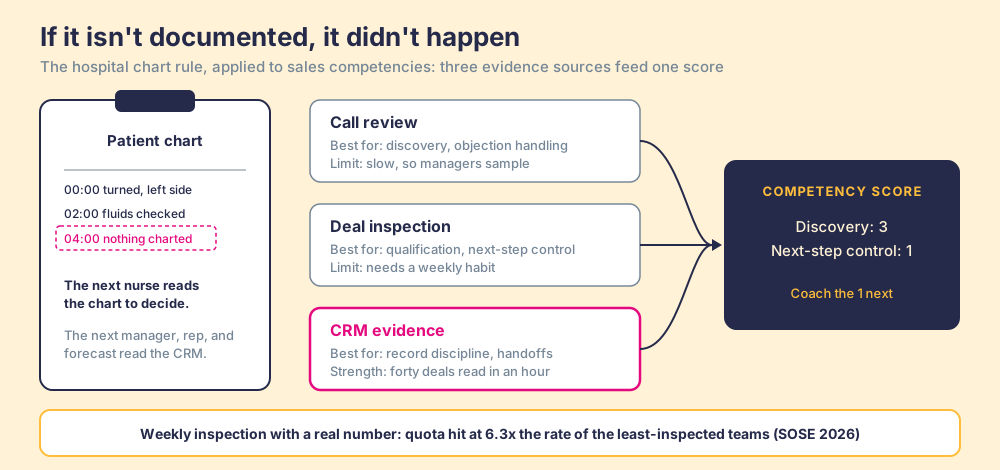
Inspection is where competency programs stall. In The State of Sales Enablement, our survey of 198 sales leaders run January through March 2026, 89% said they have a defined sales process and 36% said they see it followed, a 53-point gap between the standard on paper and what reps do (State of Sales Enablement). The most-inspected teams, whose managers review process adherence weekly with a real number, hit quota at 6.3 times the rate of the least-inspected. A competency matrix left unscored is one more document for that gap to swallow.
Once scoring starts, expect pushback, and expect it from a predictable part of the team:
From the field
It’s gonna put light on the middle. The best will love it, the new will love it, and the people in the middle will not. At first, at least.
How do sales competencies connect to coaching?
The matrix exists to answer one question for each rep: which behavior should we work on next? Without it, sales coaching drifts toward whichever deal is on fire this week. With it, the manager can see that a rep scores a 3 on discovery and a 1 on next-step control, and spend the next month on the 1.
That focus pays. Korn Ferry reports that companies with consistent sales coaching and a way to measure its impact see 32% higher win rates and 28% higher quota attainment (Korn Ferry). The matrix is the measurement half: coach a behavior, then watch the evidence for whether the score moved. A sales coaching plan built as a weekly spacing schedule gives the practice its rhythm; the matrix gives each week its target.
Where the behavior gets reinforced matters as much as how often. In the same SOSE data, teams whose process lives inside the CRM workflow reached 49% quota attainment, against 15% for teams whose process lived in a doc, wiki, or LMS. A competency remembered from a workshop decays. A competency prompted in the moment of work, leaving its trace as it happens, compounds. When a rep keeps scoring low, look first at the system: was the right action easy and visible at the moment it mattered? That you can fix. Blaming the rep fixes nothing.
Supered was built for that job. It is the Behavior Layer inside HubSpot and Salesforce: the standard behind each competency reaches the rep while they work the deal, and the manager sees whether it happened without reconstructing the story by hand, so the hour goes to coaching the gap. You can see how it works in a demo.
Which approach should you take?
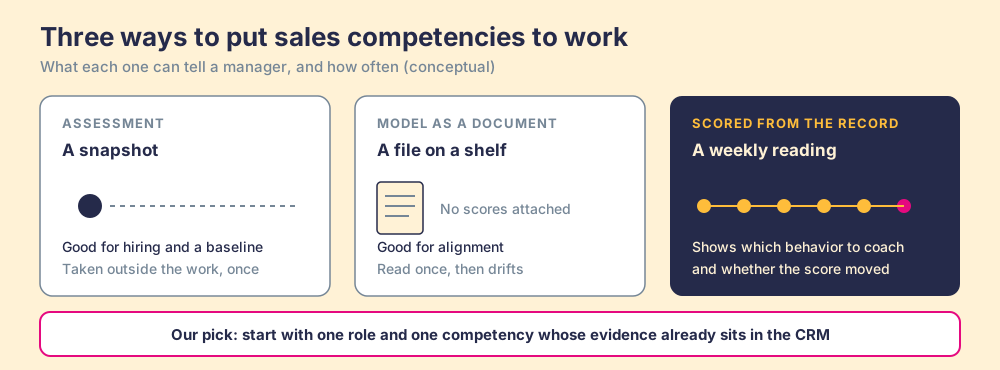
Score a small matrix from the record, and start with one role and one competency where the evidence already sits in your CRM. Next-step control is a good first pick, because the dated next step either exists or it does not. The case for it is in the numbers above: raters left to impression mostly measure themselves (62% of rating variance against 21%), inspected teams hit quota at 6.3 times the rate of the least-inspected, and process in the workflow outperforms process in a document, 49% to 15%.
The other two tools still have a job, a narrower one:
- An off-the-shelf assessment fits hiring. It gives you a baseline on a stranger. It is a snapshot taken outside the work, so it cannot tell you what changed last month.
- A competency model written as a document fits alignment. It gets managers agreeing on the words. Without scoring from evidence it becomes one more file the team read once.
- A matrix scored from the record fits coaching. Five to seven competencies per role, four levels, behavioral anchors, and an evidence source for each, reviewed weekly.
Once the first competency is scoring cleanly, build the coaching loop that moves the score one behavior at a time.
Frequently asked questions
What are sales competencies?+
What is the difference between sales skills and sales competencies?+
What is a sales competency matrix?+
What is a sales competency model?+
How many proficiency levels should a sales competency matrix have?+
How do you assess sales competencies?+
What are the core competencies for an SDR?+
Your process, running itself.