Sales Coaching Plan: A Spacing Schedule, Not a Calendar of Events
Most sales coaching plans are a calendar of big events: a kickoff, a workshop, a quarterly review.
The plans that change behavior are spacing schedules, and a 1880s memory finding explains why.
A sales coaching plan is the structured schedule of how a manager develops a rep over time, and the effective version is a weekly cadence on one behavior at a time rather than a calendar of large events, because spaced reinforcement is what makes a skill durable.
A sales coaching plan usually looks like a calendar of milestones: a kickoff in week one, a big training workshop in month two, a quarterly business review to check progress. It feels organized, it fills a slide, and it mostly does not work, because behavior change does not respond to events. It responds to repetition spaced over time, and a calendar of large, infrequent events is the opposite of that. The plans that genuinely develop reps are built on a finding about memory that is older than the telephone.
A sales coaching plan is the structured schedule of how a manager develops a rep over time, and the effective version is a weekly cadence on one behavior at a time rather than a calendar of large events, because spaced reinforcement is what makes a skill durable. Get the schedule shape right and the plan works; get it wrong and no amount of good content saves it.
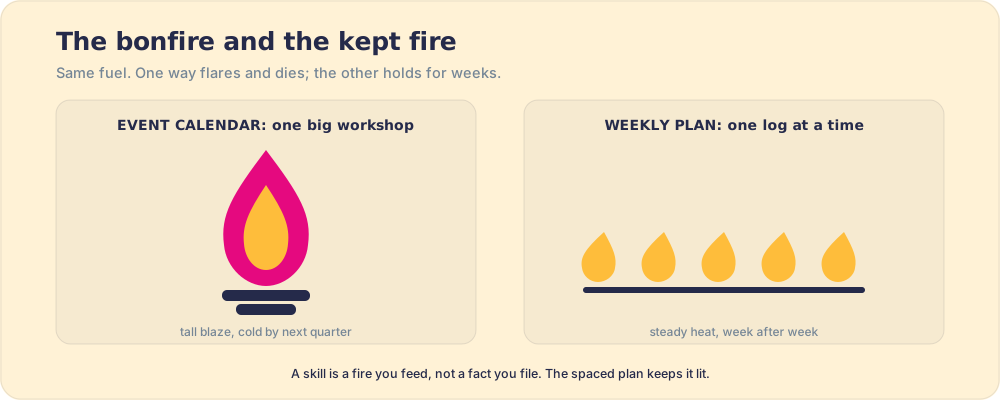
The mistake hides in plain sight because the event-calendar plan looks more serious. A two-day offsite with an outside trainer feels like an investment; a short weekly check-in feels like a formality. But a skill is less like a fact you file away and more like a fire you have to keep feeding. Pile on all the logs at once and you get a tall, bright blaze that burns out by morning. Add a log at a time, on a schedule, and the fire holds for weeks. The event calendar is the bonfire. The plans that work feed the fire.
Why is a coaching plan a spacing schedule?
Because of the spacing effect, one of the most replicated findings in the science of learning. In the 1880s Hermann Ebbinghaus, mapping his own memory, found that information reviewed at spaced intervals is retained far better than the same information crammed in one sitting, even when the total study time is identical. A 2006 meta-analysis by Cepeda and colleagues, pooling 254 studies, confirmed it at scale: distributing practice across time produces substantially more durable learning than massing it (on the spacing effect). The same total hours, spread out, beat the same hours bunched together, and it is not close.
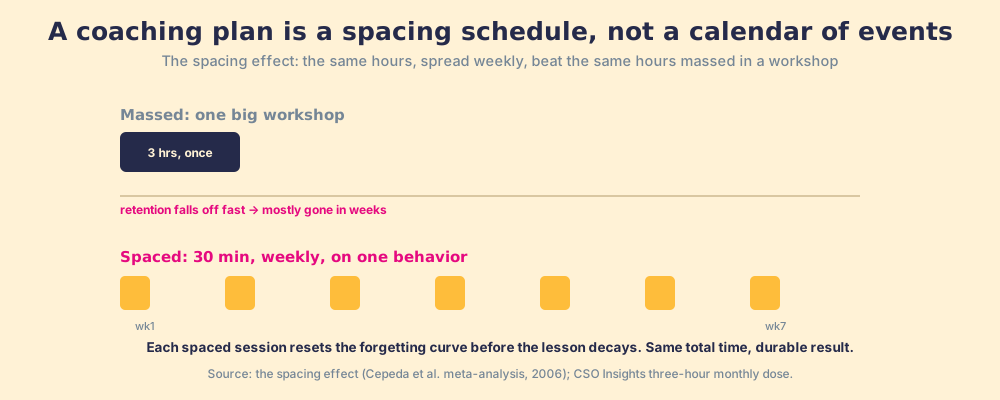
Read that into a coaching plan and the calendar-of-events approach is revealed as a scheduling error. A three-hour workshop in month two is massed practice: a big input followed by a long decay, so by the quarterly review most of it is gone. Three half-hour weekly sessions deliver the same three hours but spaced, and each session resets the forgetting curve before the lesson fades. The content can be identical; the durability is not, because durability comes from the spacing, not the volume.
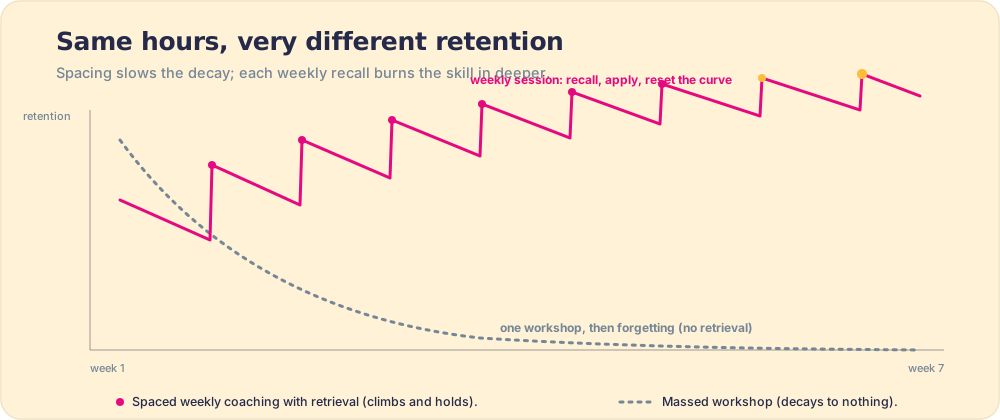
There is a second mechanism stacked on top of the first, and it strengthens the case. Spacing slows forgetting, and beyond that, the act of retrieving a half-faded memory is itself what burns it in. Cognitive scientists call this the testing effect, and Henry Roediger and Jeffrey Karpicke demonstrated it cleanly: students who were tested on material retained far more a week later than students who restudied it for the same time (Roediger & Karpicke, 2006). The effort of recall, the small strain of pulling the skill back up after it has begun to slip, is the thing that makes it stick. A weekly coaching session is a retrieval event: the rep has to surface the behavior, apply it to this week’s deal, and feel where it is shaky. A quarterly workshop is the opposite, a restudy event with no retrieval and no strain, which is exactly the condition Roediger and Karpicke showed produces the weakest retention.
Put the two findings together and the verdict on the event calendar is not a preference, it is a prediction. Massed content with no spaced retrieval is the precise recipe for forgetting that the science has documented for over a century. You could not design a worse delivery schedule if you tried.
This is also why the dose research and the spacing research agree. Korn Ferry’s CSO Insights data found coaching pays once it reaches about three hours per rep per month, run weekly, and flattens past roughly five (Korn Ferry). Three hours massed into one quarterly marathon would do little; three hours spread weekly is where the lift lives. The dose is a number; the plan is how you space it.
It is worth granting the objection here, because a fair version of it exists. Someone will say the offsite is not for skill-building at all, it is for alignment, energy, the shared language a team needs, and that is true. A kickoff has a real job (the sales kickoff ideas that change behavior are the ones built around one expectation and an inspection plan). The error is asking it to do the coaching job too, then crossing coaching off the list because the event happened. Hold the offsite for what it is good at. Do the behavior change in the weekly loop, where the science says it lives.
What does a 30-60-90 sales coaching plan look like?
Build it as phases of focus, each running the same weekly spaced loop, widening as the rep gains ground. This is the structure a 30 60 90 coaching plan should follow, and it doubles as a sales coaching plan template you can adapt.
- Days 0-30, set and fundamentals. Establish the standard, put the rep on real deals fast, and coach one fundamental at a time, discovery, then qualification, in short weekly sessions. Do not front-load every skill into a week-one firehose.
- Days 30-60, measure and close gaps. Now adherence on the rep’s live deals is visible, so each weekly session works the specific gap the deals reveal, one behavior at a time, with feedback, scored against the competencies for the rep’s role.
- Days 60-90, reinforce and widen. Reinforce what has taken hold, add the next behavior, and transition into the steady-state weekly loop that runs indefinitely. Ramp is not a finished course; it is the on-ramp to the ongoing cadence.
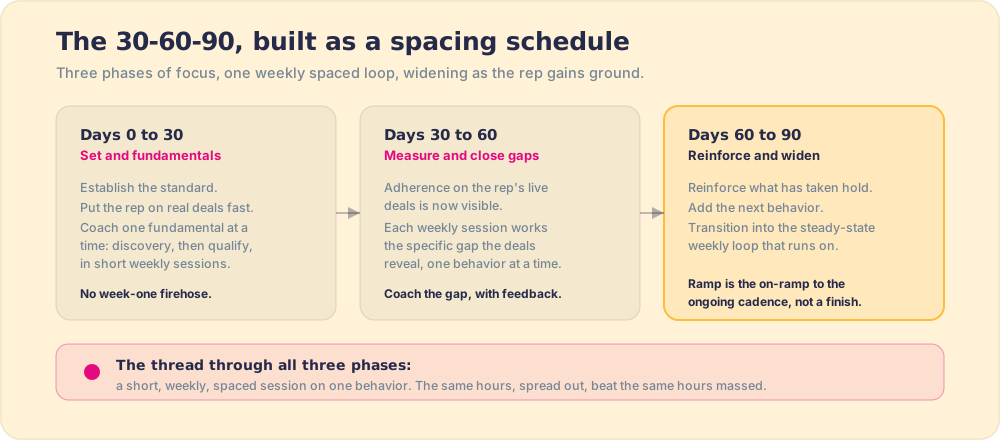
The thread through all three phases is the weekly spaced session on one behavior, which is the whole engine. The fuller method and the loop are in the sales coaching guide, and the same machinery pointed at new hires is in sales onboarding.
How do you keep a coaching plan for sales reps on track?
The hard part of any coaching plan for sales reps is not designing it; it is surviving the busy week that makes the weekly session the easy thing to skip. The defense is to lower the cost of running each session to near zero, so it happens even when the quarter is on fire.
The single biggest cost is preparation: a manager who has to reconstruct each rep’s deals before the session will skip it under pressure. Remove that cost, by having the deal status and process adherence ready before the meeting, and the weekly cadence holds, which is the difference between a plan that runs and a plan that lapses by week six.
What we recommend
Throw out the calendar of events and build your coaching plan as a spacing schedule. The non-negotiable is a short weekly session, thirty minutes, on one behavior, anchored to real deal evidence, run every week without fail; everything else is detail. Use the 30-60-90 day sales plan structure to sequence which behavior is in focus, aim for three consistent hours a month rather than a workshop marathon, and treat consistency as the product. The reason this beats the impressive-looking event calendar is not preference; it is the spacing effect, proven across 254 studies. Skills are built by spaced reinforcement, so a coaching plan that does not space its reinforcement is not a plan, it is a schedule of things the rep will forget.
From here: the dose and the loop in the sales coaching guide, the new-hire version in sales onboarding, the questions to ask each week in sales coaching questions, and the standard underneath in sales process adoption.
Frequently asked questions
What is a sales coaching plan?+
What should a 30-60-90 day coaching plan include?+
How often should a sales coaching plan schedule sessions?+
Why do most sales coaching plans fail?+
Your process, running itself.