The Best AI Sales Tools, Sorted by the Job They Actually Do
Every list of the best AI sales tools ranks features. The real split is whether a tool produces knowledge or changes behavior. Here are the seven jobs, the tools in each, and how to choose.
The best AI sales tools are the ones that change what a rep does while a deal is live; the category runs seven jobs, six that produce knowledge (now racing toward free) and one that changes behavior, and you rank them by which side of that line they sit on.
Search for the best AI sales tools and you will drown in lists of thirty, each one a parade of logos ranked by feature count and review score, each one slightly different and none of them deciding anything. The lists are not wrong so much as they answer the question nobody should be asking, which is “what exists?” The useful question is “what job am I buying?”, and once you ask it the field sorts into something a person can reason about.
Here is the sort that matters. The best AI sales tools are the ones that change what a rep does while a deal is live; the category runs seven jobs, six that produce knowledge (now racing toward free) and one that changes behavior, and you rank them by which side of that line they sit on. Six of the seven jobs make a rep’s knowledge work faster and cheaper. One job changes whether the rep does the thing that wins. As the first six commoditize, the seventh is the one that holds its value, because knowledge is the solved part of selling now and behavior is the part that is still hard.
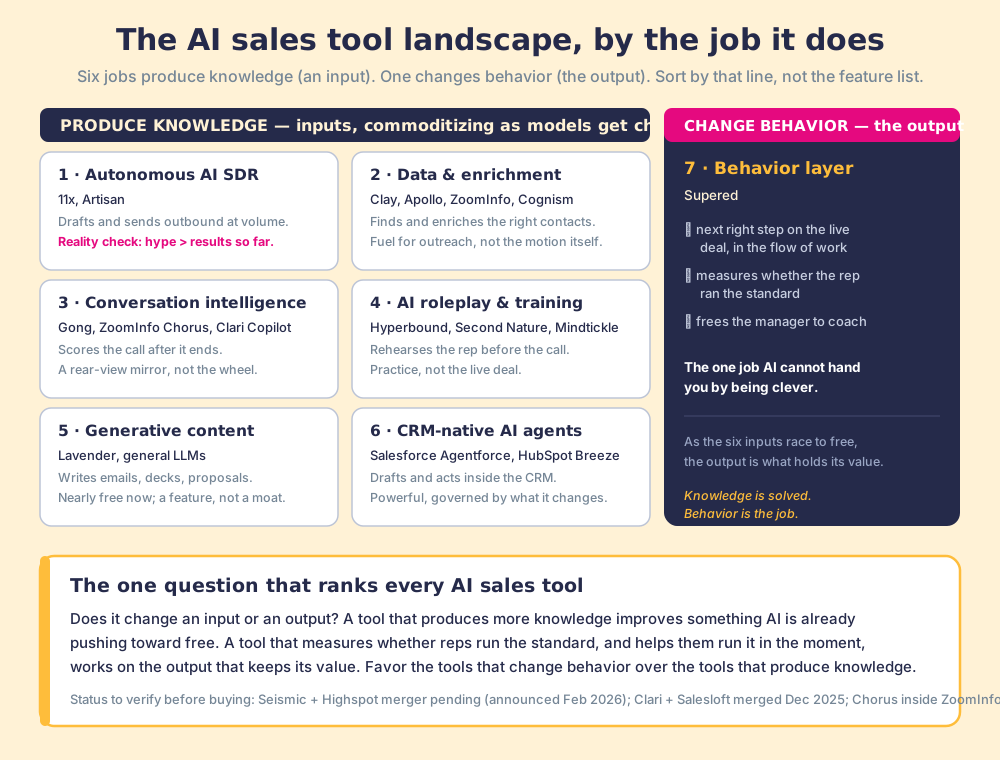
How should you sort the best AI sales tools?
By the job, not the feature list. The seven sections below are the seven jobs AI does in selling, each with the representative tools, the one question that tells you whether a tool is good at that job, and our take. If you only remember one thing about choosing ai tools for sales, make it the question under the graphic: does this change an input or an output? The best ai tools for sales, for your team, are the ones that match the job you most need done.
1. Autonomous AI SDRs (11x, Artisan): do they work yet?
The category that got the most money and the most hype, and so far the clearest cautionary tale. The pitch is a fully autonomous AI rep that prospects, writes, and books meetings with no human in the loop. It is a genuinely seductive idea, and the funding followed it: 11x raised roughly $74 million from a16z and Benchmark.
Then the receipts came in. A March 2025 TechCrunch investigation reported that 11x had listed companies as customers that were not customers, counted short trials as annual revenue, and ran early churn of 70 to 80% (TechCrunch, via Pavilion). The company disputes the framing and says current retention sits near 79%. The wider pattern is the part worth your attention: companies that deployed autonomous AI SDRs as full headcount replacements have largely reverted to hybrid or human-first models. This is where we break with the most confident voices in the category, and we will say it plainly: the autonomous-SDR thesis, that AI can own the top of the funnel end to end, has not held up in 2026.
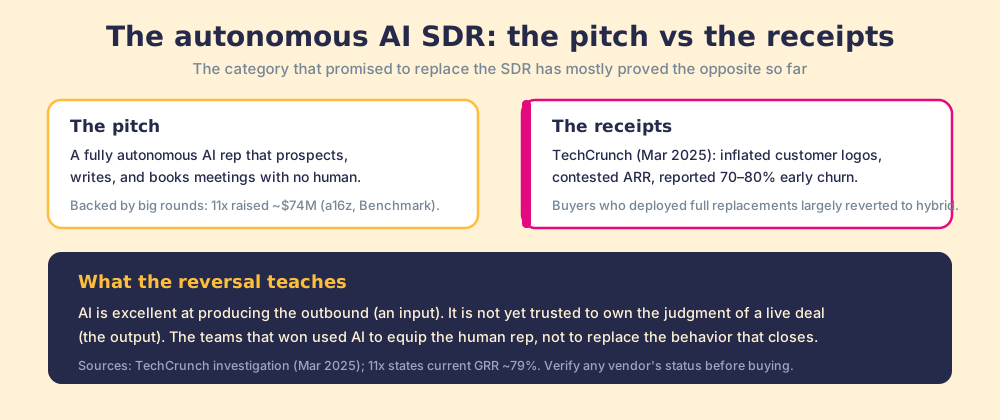
The question to ask: is the tool replacing the behavior that closes, or producing the outreach that opens? Use AI here to equip a human SDR with volume and personalization, and keep the judgment with the person. The behavior that wins is not yet something you can buy as a finished product.
2. Data and enrichment (Clay, Apollo, ZoomInfo, Cognism)
The least glamorous job and one of the most useful. Clay has become the default for AI-driven enrichment, chaining data sources and AI to build and fill prospect lists; Apollo, ZoomInfo, and Cognism pair large contact databases with AI scoring and outreach. This is a real edge, because a rep aiming at the right accounts with the right context beats a rep working a cold, stale list every time.
The question to ask: does cleaner data reach the rep as a better next action, or only a bigger list? Enrichment is fuel for the motion, not the motion itself. It earns its place when it feeds a process the rep runs, and it wastes money when it pours more leads into a pipeline that already leaks.
3. Conversation intelligence (Gong, ZoomInfo Chorus, Clari Copilot): what can it coach?
The category that made the sales call visible. Gong is the independent leader, valued around $7.25 billion; ZoomInfo Chorus has been bundled inside ZoomInfo since 2021; Clari Copilot now sits inside the merged Clari and Salesloft company (the deal closed in December 2025). These tools record, transcribe, and score calls, and the coaching signal they produce is real. We cover the category in depth in best conversation intelligence software and the concept in conversation intelligence.
The question to ask: does it change the call that is happening, or analyze the one that already did? Conversation intelligence is a superb rear-view mirror. It improves the next call by studying the last one, and it leaves the live deal untouched, which is the limit to price in before you expect it to move this quarter’s number.
4. AI roleplay and training (Hyperbound, Second Nature, Mindtickle)
The fastest-growing coaching job, and a genuine advance. Purpose-built roleplay tools like Hyperbound, Second Nature, Quantified, and Solidroad let a rep rehearse against a simulated buyer and get instant feedback; enablement suites like Mindtickle and Allego bundle that practice into a wider curriculum. The value is real because, as Anders Ericsson’s research on deliberate practice showed, skill develops only with a specific goal and tight feedback, and AI can supply unlimited reps with instant feedback that no human team could staff (Ericsson, in HBR). We go deep on this in AI sales coaching.
The question to ask: does it rehearse the rep, or guide them on the real deal? Roleplay builds the skill off the work. It is practice, and practice matters, but the buyer never feels the rehearsal, only the live call.
5. Generative content (Lavender, general LLMs)
The job everyone already uses, often without buying a tool for it. Lavender coaches email in real time; a general LLM drafts the sequence, the proposal, the follow-up. This is the purest example of an input going free: a year ago a good cold email took a skilled rep ten minutes, and now it takes one prompt. We treat the whole shift in generative AI for sales.
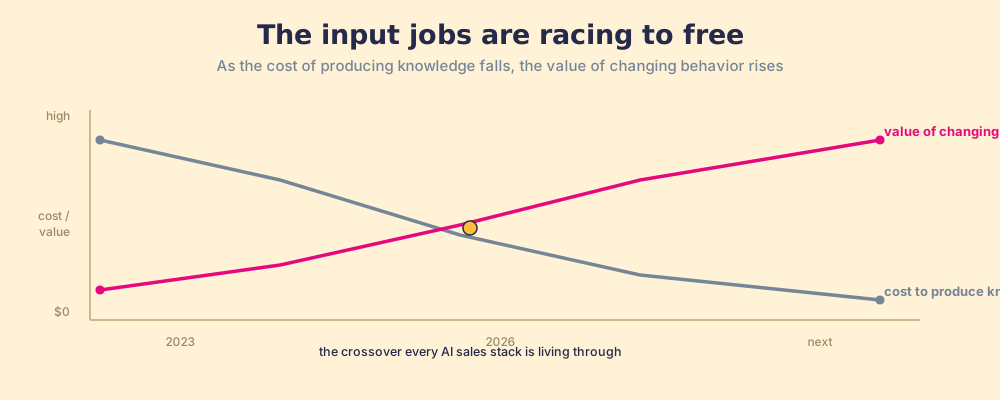
The question to ask: when everyone’s email is AI-written, what makes yours land? The content is becoming a commodity, which means the edge moves to whether the rep runs the right play at the right moment, not how polished the prose is. Generated content is now table stakes, not a moat.
6. CRM-native AI agents (Salesforce Agentforce, HubSpot Breeze): can you trust them?
The platforms are not ceding the AI layer. Salesforce Agentforce and HubSpot Breeze embed AI agents that draft, summarize, and increasingly act inside the CRM, with the advantage of living where the rep already works. That last point matters, because tools that meet the rep in the flow of the work beat tools that ask for a detour. The caution is governance: when an agent acts with a buyer, the test is not how clever the output was but whether the buyer got the experience you designed.
The question to ask: can you inspect what the agent did with the buyer, and whether it matched your intent? An agent that acts and cannot be inspected is speed without a steering wheel.
7. The behavior layer (Supered)
The seventh job is the one the other six cannot do, and the reason it sits alone in the master graphic. Where the first six produce knowledge faster, the behavior layer changes whether the rep runs the standard while the deal is live. A tool like Supered surfaces the next right step inside HubSpot and Salesforce, measures whether the rep ran the process, and frees the manager to coach off real signal. It is the output job: the one part of selling AI cannot hand you by being clever, because it is about doing, not knowing.
The question to ask: after all the knowledge is free, does the rep run the standard while the deal is live? That is the question the other six tools cannot answer, and it is the one the number turns on. The case for it, against the tide of content generators, is the same conviction under this whole list: knowledge is solved, and behavior is the job.
What we recommend
Most teams already own three or four of the first six jobs, and that is fine; they are useful, and several are now table stakes. The mistake is buying the seventh job’s outcome from a tool built for one of the first six, then wondering why win rates held flat while content output tripled. So name your problem and buy the matching job.
- Top-of-funnel volume. Use enrichment (Clay, Apollo) and AI-assisted outbound to equip a human SDR, and resist the autonomous-replacement pitch until the receipts improve.
- No visibility into calls. Buy conversation intelligence (Gong and its field) and coach from the real call instead of a story.
- Reps fumble the fundamentals. Buy AI roleplay (Hyperbound, Second Nature) and give new reps a hundred private reps before the live one.
- Reps know the motion and still do not run it. This is the most common and most expensive problem, and none of the first six fixes it. Buy the behavior layer that guides and measures the rep while the deal is live.
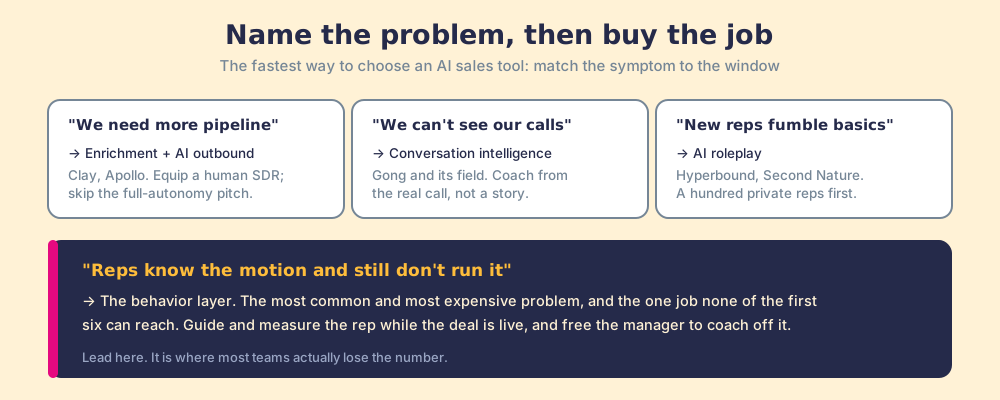
We recommend leading with the last, because it is where most teams lose the number and the one job the rest of the stack cannot reach. Buy the productivity tools for what they are, with clear eyes about which are commoditizing, and point the center of your AI investment at the output: whether the rep runs the standard when the deal is live. The autonomous-SDR detour is the lesson in miniature. AI is at its best amplifying a good rep and a good process, and at its worst pretending to replace the behavior that closes.
From here: the fuller argument in AI sales enablement, the productivity shift in generative AI for sales, the coaching version in AI sales coaching, the non-AI tool field in the best sales enablement tools, and the adoption system underneath in sales process adoption.
Frequently asked questions
What are the best AI sales tools?+
Do AI SDRs work yet?+
How do you choose an AI sales tool?+
Will AI replace salespeople?+
Your process, running itself.