The Sales Process Guide: Design It, Run It, Improve It
A sales process is 140 years old and still the highest-leverage thing most teams get wrong, because designing one was solved long ago and running it never was. The history, the stages, the science of why it is hard, and how to build, improve, and manage it.
A sales process is the defined sequence of stages a deal moves through from first contact to close, shared across the team and marked at each stage by a verifiable buyer commitment rather than a seller activity. It exists only to the degree it is run and inspected, which is why adherence, not the diagram, is what decides revenue.
The hardest problem in sales was first solved in 1884, by a cash-register salesman, and we have been losing the solution and rediscovering it ever since. That year John Henry Patterson bought a controlling interest in a failing maker of cash registers, renamed it the National Cash Register Company, and inherited a sales floor in disarray. His salesmen were not selling. They blamed the product and the territory, and no two of them sold the same way. Patterson's response was radical for its time and obvious in hindsight: he found the agents who did sell, wrote down precisely what they said and did, printed it as a manual called "The Primer" in 1887, and required every salesman to memorize it word for word. Reps who ran the script outsold reps who improvised, by margins large enough that NCR became a training ground for a generation of executives, including a young salesman named Thomas Watson who would later build IBM.
Patterson's deeper conviction outlived the script itself. He insisted, against the prevailing belief that selling was a born talent, that "good salesmen are made, not born." A written, shared process was how you made them: it let the motion of your best reps become the floor under everyone else, so results stopped depending on the lottery of who you hired. That is the first and most durable argument for a sales process, and it has not changed in 140 years. What has changed, remarkably little, is the other half of the problem, the half Patterson could enforce by standing over five men in Dayton and that no modern leader can enforce across a distributed team: getting people to run the thing once it is written.
Almost every part of the modern revenue org traces to Patterson's solution to that one ugly problem. The script was the beginning, not the end. To make the script run, he built the surrounding machinery the modern revenue org still runs on:
- The guaranteed territory. A salesman earned credit for every order in his patch and could not poach a peer's.
- The quota. Historian Walter Friedman calls it the first real attempt to set a measurable expectation for a salesman.
- The annual sales convention. The first ran in a Dayton hotel in 1886, with factory tours, training workshops, and territory-by-territory reports.
- The Hundred Point Club. The reps who hit full quota, flown to Dayton and ranked by who reached it first.
He paired the playbook with a "Book of Arguments" that scripted the answer to every objection, and a newsletter, "The N.C.R.", that pushed updates to the field twice a month. Set an expectation, equip the rep to meet it, measure who did, reinforce the ones who win: the loop a 2026 sales leader runs is the loop Patterson assembled before the Wright brothers, two of his Dayton neighbors, had left the ground.
His own field notes show how raw the adherence problem already was. In a May 1893 edition of "The N.C.R.", surfaced by sales historian Todd Caponi, Patterson complained that his salesmen "all have too much territory. They will not work it. They spend fifteen minutes in giving arguments to a P.P. [probable purchaser], and do not take time to demonstrate the register." The fix he prescribed was not a new script but the old one, enforced: "This would not be the case if all Salesmen used the Primer, because they would then demonstrate the machine in first-class shape." A documented process, and reps cutting corners on it under the pressure of the day, in 1893. The complaint is verbatim the one a sales manager will make in a forecast call this week.
And the lineage ran straight into the company that would define the next century. A young salesman named Thomas J. Watson joined NCR in 1895, became Patterson's protege, absorbed the system whole, and after a falling-out left to run a small firm he renamed International Business Machines. Watson took Patterson's playbook with him, the training school, the quota culture, the conventions, and the famous one-word motto "THINK" he had first hung on NCR's walls, and built IBM's legendary sales force on it. The point is not trivia. The single most influential sales organization of the twentieth century was a direct descendant of one cash-register company's written process, which is the strongest evidence we have that Patterson was right about the thing that mattered: the process, not the salesman, was the asset that compounded.
We put numbers on that half. In our survey of 198 sales leaders for The State of Sales Enablement, 89 percent had a defined sales process and 36 percent saw their reps follow it as designed. That 53-point gap between the process on paper and the process in the field was the single largest performance variable in the study, larger than territory, compensation, or methodology. This guide is the complete treatment of the sales process, its history, its anatomy, how to build it, improve it, and manage it, and what artificial intelligence is doing to all of the above. But it is organized around one spine, the lesson Patterson half-solved and we are still living with: the design is the easy, solved tenth, and adherence is the rest.
Where did the sales process come from?
The sales process has two intellectual parents, and they arrived a decade apart. Patterson gave us the idea of a standardized, written motion. A decade later the world got the idea of stages, the notion that a sale is not one event but a sequence a buyer is led through. The funnel is usually traced to Elias St. Elmo Lewis in 1898, whose formulation, attract attention, maintain interest, create desire, and later get action, became the AIDA model that every marketing and sales framework since has rephrased. (The exact authorship is debated; recent scholarship credits contemporaries like Frank Dukesmith, which is a useful reminder that the funnel was an idea in the air, not a single person's invention.) Put Patterson's written motion together with Lewis's staged journey and you have the modern sales process in embryo: a shared, documented sequence of stages a deal moves through.
For most of the twentieth century the process lived on paper and in the heads of sales managers, reinforced by training programs, the Dale Carnegie courses, Xerox's Professional Selling Skills in the 1970s, that taught reps how to move a buyer along it. The funnel itself hardened into the pipeline most teams picture now: a row of named stages, each with a probability weight, summed into a forecast. That arithmetic, stage times probability times deal size, is how nearly every revenue org still tells the future, and it inherits a flaw from the moment of its birth. The weight on each stage assumes the deal genuinely reached that stage. Get the stage definition wrong and the forecast is wrong by construction, no matter how disciplined the math on top of it.
The next structural change was technological. When customer relationship management software arrived in the 1990s and 2000s, Siebel, then Salesforce, the stages stopped being a poster on the wall and became fields in a database. This was a genuine advance and a subtle trap at once. The advance: the process was now visible, every deal sat in a named stage a manager could see, and a leader could finally look at the whole pipeline at once instead of asking each rep how things felt. The trap: a stage in a CRM advances when a rep updates a field, which is an act of data entry, not necessarily an act of selling. The map and the territory came apart without anyone noticing, and a new failure mode was born, the pipeline that looks healthy on a dashboard and is hollow underneath. Patterson at least watched his men demonstrate the register in person; the CRM let a deal advance without anyone watching anything, on the strength of a dropdown change alone. The instrument got more powerful and, in one specific way, less honest.
The most recent wave is the methodology era, layered on top of the process rather than replacing it. Neil Rackham's SPIN Selling (1988) brought the first large body of evidence to how reps should work inside the stages; MEDDIC emerged from PTC's sales floor in the 1990s as a qualification discipline; Challenger arrived in 2011. These sharpened the how. Through every wave, the funnel, the CRM, the methodologies, one thing improved relentlessly: the process got easier to draw, store, and report. And through every wave, the other thing did not move. Patterson's five salesmen who needed a script to sell consistently in 1887 are the spiritual ancestors of the 64 percent of teams in 2026 whose documented process goes unfollowed. The technology changed. The human gap did not.
What is a sales process, and what are its stages?
A sales process is the shared sequence of stages a deal moves through from first contact to signature. That definition is easy to agree with and easy to get wrong, because everything depends on a single design choice most teams never consciously make: how each stage is defined. There are two ways, and they lead to opposite outcomes.
The common way is to define a stage by a seller activity. "Demo delivered." "Proposal sent." "Contract out for signature." These are attractive because they are unambiguous and easy to log, and they are nearly worthless as a measure of progress, because a seller activity happens whether or not the buyer moved. A rep can deliver a flawless demo to a polite prospect who has already chosen a competitor, advance the deal to "demo complete," and the pipeline will record progress that does not exist. Define enough stages this way and you get the hollow pipeline, the one that forecasts confidently and closes softly, because every stage measures the seller's motion and none of it measures the buyer's.
The better way is to define each stage by a buyer commitment, a specific, verifiable thing the buyer does or says that proves the deal advanced. Not "discovery call held" but "the buyer named, in their own words, the cost of leaving the problem unsolved." Not "proposal sent" but "the buyer agreed the proposal maps to the problem they named." The discipline is to ask, of every stage, what did the buyer do that they would not have done if they were not serious. That is the question that separates a process which tells you the truth from one which flatters you.
| Stage | The seller activity (what gets logged) | The buyer commitment that should define it |
|---|---|---|
| Prospecting | Outreach sent, call made | Buyer agreed the problem is worth a conversation |
| Qualification | Discovery call booked | Buyer confirmed need, authority, and a real timeline |
| Discovery | Demo delivered | Buyer named the cost of the problem in their own words |
| Proposal | Proposal sent | Buyer agreed the proposal maps to their stated problem |
| Negotiation | Terms discussed | Buyer gave access to procurement and the economic buyer |
| Close | Contract sent | Buyer committed to a signature date and a mutual plan |
The table is the principle. The teaching is in walking each row, because the activity-versus-commitment gap looks different at every stage, and a leader who can see all six gaps at once can diagnose a pipeline in an afternoon.
Prospecting. The logged activity is volume: calls made, emails sent, connects. The commitment that matters is smaller and rarer, the buyer agreeing the problem is worth a real conversation. A rep can run two hundred touches and book ten meetings with people who took the call to be polite, and the activity dashboard will glow while the pipeline fills with deals that were never alive. The example to hold: a meeting booked off a cold sequence where the prospect cannot, when asked, name a problem they are trying to solve. That is activity without commitment, and it is the most expensive kind because every later stage inherits it.
Qualification. The activity is "discovery call booked"; the commitment is the buyer confirming a genuine need, the authority to act on it, and a real timeline. The classic failure is a rep who qualifies on their own enthusiasm rather than the buyer's, advancing a deal because the call went well, not because the buyer conceded those three things. Gong's analysis of more than 519,000 B2B sales calls found that reps who asked between 11 and 14 targeted questions had the highest success rate, and that the questions had to be about the buyer's own challenges and goals to correlate with a win. Qualification is the stage where asking beats telling, and a process that defines it by "call held" rather than "need, authority, timeline confirmed" will reward the rep who talked the most and learned the least.
Discovery. Take this one slowly, because it is where the most money leaks. A team that defines discovery as "demo delivered" will see deals pile up after the demo and stall, and will conclude, wrongly, that they have a demo-quality problem or a pricing problem. A team that defines discovery as "the buyer named the cost of the problem in their own words" will catch the truth earlier: the deals stall because the buyer never owned a problem worth paying to solve, so no demo could have saved them. The example that makes it concrete: two reps each run a polished demo, but only one first got the buyer to say out loud what the broken status quo costs them per month. The first rep's deal closes; the second rep's deal becomes a "no decision" that the forecast counted as a live opportunity for a quarter. Same activity, opposite outcomes, and only the commitment-based definition could tell them apart in advance.
Proposal. The activity is "proposal sent," which a rep can do in thirty seconds and which proves nothing. The commitment is the buyer agreeing that the proposal maps to a problem they have already named and owned. The example: a quote emailed to a contact who never confirmed budget or the problem's cost, sitting in "proposal" at a 60 percent weight, dragging the forecast up on the strength of an attachment. A proposal is a seller artifact; agreement to it is a buyer act. Define the stage by the second, never the first.
Negotiation. The activity is "terms discussed." The commitment is the buyer giving real access, to procurement, to legal, to the economic buyer who signs. Deals stall here when a rep negotiates hard with a champion who has no authority to close, mistaking activity (emails about price) for progress (the people who decide are now in the room). The example: weeks of back-and-forth on discount with a manager who, it turns out, still has to "run it by the VP," a VP the rep has never met. The commitment that defines the stage is access to that VP, not the volume of the haggling.
Close. The activity is "contract sent." The commitment is the buyer committing to a signature date inside a mutual plan both sides can see. Pipelines bloat at this stage with deals that are "verbally yes" and indefinitely unsigned, because a verbal yes is sentiment and a dated mutual action plan is a commitment. The example: a deal marked 90 percent for two quarters on the strength of a champion's "we're going to do this," with no signature date and no procurement step scheduled. The signed mutual plan is the commitment; the optimism is the activity.
Read all six together and the discipline is one question asked at every stage: what did the buyer do that they would not have done if they were not serious? The stage definition is not bookkeeping. It is the instrument that decides whether your pipeline data is true. The full breakdown of each stage is in the 7 sales process steps, and the category definition in what is a sales process. Most teams need five to seven stages; the test for the right number is not a best-practice template but whether each stage marks a distinct, checkable change in the buyer's position.
One more distinction belongs here, because readers conflate the two constantly: a sales process is not a sales methodology. The process is the question of where a deal sits on its shared path, the stages a whole team walks and a manager inspects. A methodology, MEDDIC, SPIN, Challenger, is the question of how a rep works inside those stages. You can run the same five-stage process with two different methodologies, and you can ruin a good methodology by bolting it onto stages defined by seller activity. Build the process first, on buyer commitments, then choose the methodology that matches how your winners already sell.
What are the common ways a sales process goes wrong?
Broken processes fail in a handful of recognizable ways, and naming them is the fastest diagnostic a leader has. If your process is not getting run, or is getting run and still lying to you, the cause is almost certainly on this list. Each failure is common because each one feels, at the time, like good practice.
- Vanity stages. The most common and most expensive error: stages defined by what the seller did rather than what the buyer committed to. They feel rigorous because they are easy to enforce and easy to report, and they produce the hollow pipeline that forecasts with confidence and closes with apologies. A pipeline built on seller activity is a measurement of effort wearing the costume of progress.
- Stage sprawl. Ten or twelve stages that look thorough and are really a map of the company's internal handoffs, not the buyer's decision. Each extra stage adds inspection overhead and the illusion of precision without adding any new signal about whether the deal is real, and it trains reps to treat stage movement as paperwork. If two stages share a single buyer commitment, they are one stage pretending to be two.
- The aspirational process. A process designed around how leadership wishes the team sold, rather than how the winners really sell. It is recognizable because no rep can point to a real deal it describes, and unrecognizable processes get the adoption that all unrecognizable things get, which is none. Patterson's instinct was the opposite: he documented the agents who were already winning, so the standard was a description of success, not an act of wishful thinking.
- Death by required field. A process enforced by making dozens of CRM fields mandatory, on the theory that requiring the data produces the behavior. It produces the data and not the behavior, an instance of Goodhart's law: when a measure becomes a target, it ceases to be a good measure. Reps satisfy the field with whatever passes validation, the pipeline fills with technically-complete fiction, and the leader trusts numbers that were generated to clear a gate rather than to describe a deal.
- Methodology mistaken for process. Licensing MEDDIC or Challenger and believing the company now has a sales process. It does not; it has a way for reps to work inside stages that still need to be defined and inspected. A methodology is how a rep drives; the process is the road, and buying a better driving technique does not build the road.
- Process on paper only. A documented, well-designed process that no one inspects, which means it exists on paper and nowhere else. You can only expect what you inspect, so an uninspected process is not a process; it is a document about one, and reps read the absence of inspection accurately as permission to improvise.
Read down that list and a single pattern connects all six: each one substitutes something measurable and convenient, an activity, a field, a methodology purchase, a tidy document, for the harder thing it was supposed to stand in for, a real change in the buyer and a real change in rep behavior. The whole craft of a sales process is refusing those substitutions.
Why is running a sales process so hard?
This is the section most process content skips, and it is the one that matters, because if you do not understand why adherence is hard you will keep reaching for the wrong fix: more training, more willpower, a sterner talk at the quarterly kickoff. None of those address the actual mechanism, which is well understood and has nothing to do with whether your reps are disciplined.
Start with what a written process is to the brain: a goal. "Run discovery thoroughly" is a goal, and your reps already hold it, because nobody opens a deal intending to qualify badly. The trouble is that goals are famously weak predictors of behavior. The psychologist Peter Gollwitzer spent his career on the gap between intention and action, and his answer is precise: goals become actions far more reliably when they are reformulated as implementation intentions, if-then plans that bind a specific situation to a specific response ("if the buyer raises price before value is established, then I ask what the cost of inaction is"). Gollwitzer and Sheeran's meta-analysis of 94 independent studies found this if-then structure produced a medium-to-large lift in follow-through, an effect size of d=0.65. The implication for a sales process is direct and damning: a process written as a list of goals ("qualify, discover, propose") is written in the form the brain executes worst.
Layer on the second mechanism. The behavioral scientist BJ Fogg compresses decades of work into one model: behavior happens when motivation, ability, and a prompt converge at the same moment (B=MAP). A rep can have the motivation to run the process and the ability to run it, and still not do it, because the prompt is missing at the instant it is needed. When the process lives in a document, a wiki, a slide from onboarding, the prompt is wherever the rep has to go to find it, which is to say, nowhere, in the moment a live buyer is talking. The friction of retrieval is small, and small frictions reliably beat good intentions; this is why default options dominate human behavior across every domain studied, from retirement savings to organ donation. The rep does not decide to ignore the process. The process simply is not present when the situation that needs it arises, so habit fills the vacuum.
A second, deeper inertia works against the process, and it sits in the buyer as much as the rep. Daniel Kahneman and Amos Tversky established that people weigh a potential loss roughly twice as heavily as an equivalent gain, and Samuelson and Zeckhauser named the consequence the status-quo bias in their 1988 study of the same name: faced with change, humans disproportionately default to doing nothing. For the rep, the documented new motion is a felt loss of the comfortable old one, so the old one wins even when the rep agrees the new is better. For the buyer, the real competitor in most deals is not the rival vendor but inaction, the decision to keep the current state, which is why so many qualified deals die in no-decision rather than to a competitor. Both inertias point to the same design conclusion: a stage defined as a genuine buyer commitment is a measured move away from the status quo, which is exactly why it carries so much more information than a seller activity, and the process has to make the new rep behavior the path of least resistance in the moment, or the status quo collects its default.
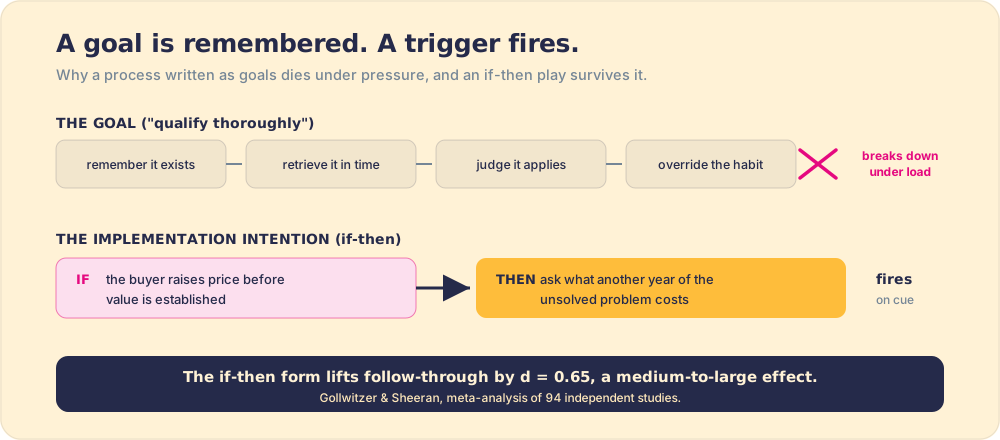
This is why "when reps do not follow the process it is a system failure, not a people failure" is not a slogan but a description of the evidence. The system asked the rep to hold a goal in memory and retrieve it under time pressure from a place that is not where the work happens, and then it blamed the rep when the predictable thing happened. The fix that follows from the science is equally specific: write the process as situational triggers rather than goals, and deliver each trigger at the moment its situation arises, in the tool where the deal is being worked. That is the behavioral core of what we call the Behavior Layer, and it is the subject, in full, of the sales playbook guide. For this guide, the point to hold is that adherence is hard for reasons that are structural and known, which means it is fixable by design rather than by exhortation.
How do you build a sales process?
Build it from your winners, not from a template, and build for adherence from the first day rather than bolting it on after the diagram is done. The sequence that works:
- Your winners' motion, captured. The working process already exists, distributed across the reps who win. Trace what your best performers do on won deals that the strugglers skip, and pave that. This is Patterson's original move, find the agents who sell and write down what they do, and it remains the only starting point that produces a process reps believe in, because it is a description of success they can already see, not a consultant's abstraction.
- Stages defined by buyer commitment. Convert each stage from a seller activity to the verifiable buyer commitment that proves it, using the discipline from the table above. This is where most of the design value is created or lost.
- Five to seven stages, cut hard. Long pipelines feel like rigor and produce the opposite, because each extra stage adds inspection overhead without adding signal, and most extra stages turn out to be internal handoffs the buyer never sees. If two stages share one buyer commitment, they are one stage.
- Exit criteria a manager can inspect without a meeting. Name the single piece of evidence per stage that proves the commitment is real, so adherence is visible on the deal record rather than reconstructed in a forecast call.
- Plays written as triggers, then delivered in the flow. For each stage, write the key moves as if-then triggers (the science above), and arrange for them to surface where the rep works. This is the step that turns a diagram into behavior, and the one teams most often omit, which is why the next section on improvement matters so much.
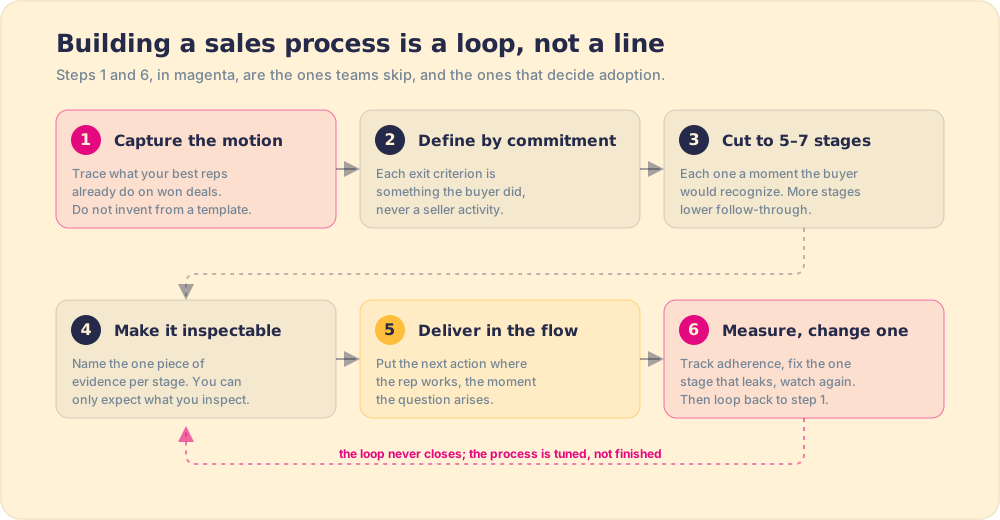
The full build walkthrough, with a worked example end to end, is in how to build a sales process, and a starting grid you can copy and adapt is the sales process template. One caution as you build: resist the urge to design the process you wish your team ran instead of the one your winners run. An aspirational process that no one recognizes gets the adherence aspirational things always get, which is none.
The capture step is worth making concrete, because teams routinely skip it for a template and pay for it later. The exercise that works is mechanical: pull your last twenty closed-won deals and your last twenty closed-lost, sit with two or three of your best reps, and walk each deal backward, asking at every stage what the buyer did that the lost deals' buyers did not. The pattern that emerges is your real process, and it is rarely the one on the current pipeline diagram. One team running this exercise found that their winners always secured a written confirmation of the problem and its cost from the buyer before any demo, while their strugglers demoed on the first call; the highest-leverage change to their process turned out to be not a new stage but a gate, no demo until the cost of the problem is confirmed in the buyer's words. That gate came from the deals, not from a best-practice list, which is the reason reps accepted it.
How do you improve a sales process?
Measure whether it is being run before you change a single stage. This is the counterintuitive heart of process improvement and the place most teams go wrong, because the instinct when results disappoint is to redesign the stages, and redesign is usually the one thing that will not help. The reason is logical, not motivational: you cannot tell whether a weak result came from a badly designed stage or a stage that was skipped, so until adherence is visible, every diagnosis is a guess. Redesigning a process nobody runs only gives you a fresh diagram to ignore. Adherence is the prerequisite to every other answer about your process, the way a controlled experiment is the prerequisite to a conclusion.
The data says the lift lives in running the process, not in perfecting it. CSO Insights, now part of Korn Ferry, found that teams with a dynamic, well-run process attain quota at a 37 percent higher rate than teams running an informal one, and our own research found a threefold quota difference between teams whose process reached reps in the flow of work and those whose process sat in a document. Notice that both findings reward the running, not the drawing.
Once adherence is visible, improve by subtraction and single variables. Find the one stage that leaks, the single point where deals stall or jump ahead on activity rather than commitment, and fix only that, then watch again. Change one thing at a time, because a process you tune by one variable teaches you what moved the result, and a process you overhaul wholesale teaches you nothing. And take a lesson from Neil Rackham about what "improvement" even means, because it is easy to improve the wrong thing. Rackham's research on 35,000 calls produced a finding that offended the entire sales-training industry of its day: in large, complex sales, classic closing techniques reduce the likelihood of a sale rather than increasing it. As he put it in SPIN Selling, "closing techniques may increase the chances of making a sale with low-priced products. With larger sales, the chances of making a sale is reduced." The harder reps pushed the close, the worse large deals did. The point for process improvement is that the move which feels like improvement, more pressure, more closing, tighter stages, can be the move that destroys value, and only measurement against the buyer's real position tells you which is which. A worked example makes the discipline concrete. Suppose your win rate from proposal to close falls from 40 percent to 25 percent over two quarters. The reflex is to fix the proposal: a new template, a better pricing page, a discount. Measure adherence first and a different story often appears. You find reps advancing deals to proposal on the activity "proposal sent" rather than the commitment "buyer agreed the proposal maps to a problem they named," and that the rate of skipping that commitment climbed exactly as a new comp plan began rewarding pipeline volume. The proposal was never the problem; the qualification gate upstream stopped being enforced, so weaker deals reached proposal and predictably lost. The fix is not a better proposal but restoring the upstream commitment, and you would never have found it by redesigning the stage where the symptom appeared, because symptoms surface downstream of their causes. The deeper treatments are sales process adoption and where the process should live.
What is sales process management, and where does adherence fit?
Management is the ongoing work of inspecting whether deals are run against the stages and coaching where they are not. It is a habit, not a launch, and the single discipline that most distinguishes high performers from low ones. The clearest articulation of why comes from Jason Jordan, whose book "Cracking the Sales Management Code" made an argument that reorders how managers think: there are metrics you can manage and metrics you cannot, and most leaders confuse the two.
Jordan's Activities-Objectives-Results model sorts every sales metric a leader tracks into exactly three buckets, and the sorting is the whole insight. Business results, revenue, market share, attainment, are what the company lives on and, in Jordan's words, "wholly unmanageable": you cannot walk up to revenue and adjust it. Sales objectives, pipeline coverage, win rate, average deal size, you can influence but not control directly; they are levers one step removed. Sales activities, the calls, the discovery questions, the stage commitments secured, are the only things "highly manageable," the only layer a manager can direct a rep to do differently tomorrow morning. The error Jordan catches the entire profession making is managing to the unmanageable layer: a leader stares at a revenue dashboard, a number produced by causes one and two levels upstream, and tries to coach it directly, like turning a steering wheel that is not connected to the wheels.
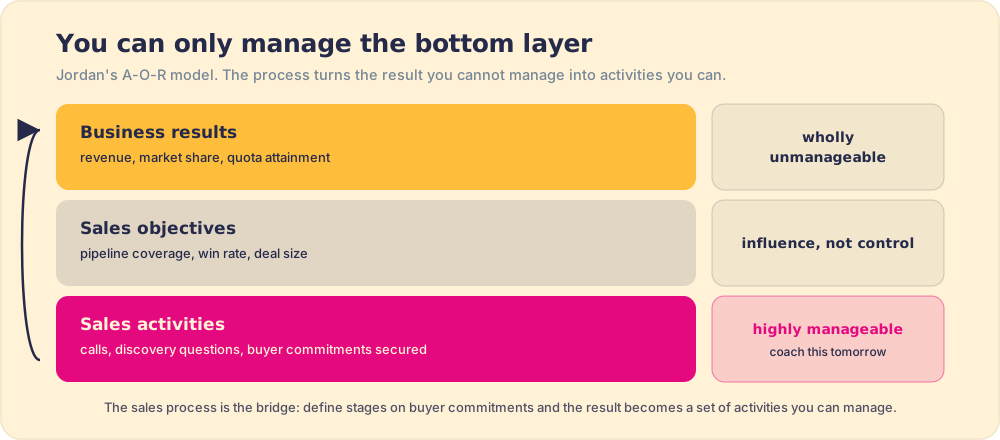
This maps cleanly onto the older distinction between leading and lagging indicators, and the sales process is what connects them. Revenue is the laggiest of lagging indicators: by the time it is wrong, the quarter is over. The buyer commitments that define each stage are leading indicators, the earliest honest signal that a deal is real or rotten, available while there is still time to act. A process defined on seller activity gives you fake leading indicators (motion that does not predict the result); a process defined on buyer commitments gives you true ones (changes in the buyer that do). The sales process, defined correctly, is the bridge across Jordan's model: it turns the unmanageable result back into a set of manageable activities a leader can inspect and coach, one stage commitment at a time.
That reframing is what makes inspection the core managerial act rather than an administrative chore. You can only expect what you inspect, and a process whose adherence no one measures is a wish with formatting. But inspection has two failure modes worth naming, because avoiding them is most of the skill. The first is inspecting on feelings instead of commitments. "How does the deal feel?" invites optimism; "show me the buyer commitment that moved this to proposal" invites the truth, and a manager who asks the second question consistently runs a forecast the first manager only dreams of. The second failure mode is letting inspection eat the time coaching needs. Manual inspection, reconstructing what happened from calls and CRM records, consumes the hours that should go to developing the rep, which is why inspection has to be automatic for management to be sustainable, the argument of the sales coaching guide.
This is also where the distinction between compliance and adoption earns its keep, because it is the difference between a process that is followed and one that merely looks followed. Compliance is reps moving stages and filling fields because they must; adoption is reps running the process because it helps them win. Compliance is the more dangerous of the two, because it produces clean dashboards that lie: the box gets checked without the buyer commitment behind it, and the organization grows confident on data that means nothing. The full argument is in compliance vs adoption. And one principle keeps inspection honest, because it is tempting to overcorrect into treating all activity tracking as vanity: capturing what the rep did is good and necessary, it is how you verify the process ran and how you understand the buyer's experience. The error is not tracking activity; it is letting a deal advance on activity alone, with no buyer commitment behind it, a captain's log that records how hard the crew rowed and never once which way the ship moved. Track the activity and the buyer's real position, and never confuse the first for the second. The distance between the process you designed and the one reps run has a name and a measurement, covered in the sales execution gap.
Does a rigid sales process hurt great reps?
Grant the objection its full force, because it is the most serious one and it is often raised by the best people on the floor. A genuinely great rep reads a room, abandons the script when the script is wrong, and closes deals a process would have talked them out of. Force that rep onto rails and you may slow them down, insult their judgment, and lose them to a competitor who lets them sell. The fear underneath is real: that a sales process is a cage, that it standardizes toward mediocrity, that it treats a craft like an assembly line. Anyone who has watched a brilliant seller work and then watched a compliance regime smother them knows the objection is not a straw man. It is true often enough to take seriously.
Two things answer it, and the first is to look at what a process is made of. The best process does not come from a consultant's template; it comes from your best reps. Patterson did not invent a motion and impose it, he found the agents who were already winning and wrote down what they did. A process built that way is not a cage around your top performer; it is your top performer's own judgment, captured and lent to everyone else. The thing the great rep fears being forced to abandon is, if the process was built honestly, the thing the process is made of. The cage objection assumes the process is foreign to the winner. Build it from the winner and the assumption dissolves.
The second answer is where it does the most good, and it is not the star. Consistency beats brilliance not because brilliance is bad but because brilliance does not scale and consistency does. A mediocre process run on every deal beats a brilliant one run on half, because the buyer feels the floor, not the ceiling. The math is unsentimental: most of your revenue does not come from your two best reps having transcendent days; it comes from the long middle of your team being reliably competent on every deal, and that reliability is exactly what a process supplies. The star loses a little freedom at the margin. The other eight reps gain a working method they did not have. The trade is overwhelmingly worth it, and the honest leader makes it with eyes open.
But the objection earns one real concession, and refusing it is how process zealots discredit themselves. Adherence does not mean rigid sameness across genuinely different motions, deal sizes, or segments. The goal is everyone running the same motion within a single segment, not one motion strangling a whole company that sells in three different ways. A six-figure enterprise deal and a self-serve renewal are not the same motion, and forcing them through identical stages is its own kind of failure. The skill is drawing the line in the right place: tight where the segment is uniform, loose where the motions genuinely diverge. Which is the question the next section is about.
Does every sales motion need the same process?
No, and pretending otherwise is how good processes get a bad name. The principle, define stages by buyer commitment and inspect adherence, is universal. The specific stages are not. Match the process to the motion, and recognize there are a few genuinely different motions.
- Transactional and SMB sales. Short cycles, one or two decision-makers, fast money. Here the process should be lean, three or four stages, and the commitments come quickly: confirmed need, agreed price, signature. Over-staging a transactional motion is the stage-sprawl error in a new costume; it adds inspection overhead to deals that are decided before a long process could run. The buyer commitment that matters most is often simply confirmed budget, early.
- Enterprise and complex sales. Long cycles, a buying committee, real procurement. Gartner finds that 77 percent of B2B buyers describe their last purchase as complex or difficult, and that buying groups which reach genuine consensus are 2.5 times more likely to report a high-quality deal. The implication for the process is direct: the load-bearing commitments are about the committee, multi-threading to the economic buyer, securing internal consensus, not the seller's activity count. This is also the motion where Neil Rackham's finding bites hardest, that pushing the close harder lowers the odds in large deals, so the stages must measure the buyer's movement, not the seller's pressure.
- Product-led and self-serve. When the product does much of the selling, the "stages" are partly usage signals: activation, a team inviting colleagues, hitting a value threshold. The commitment framing still holds, the buyer's expanding use is itself the commitment, but the sales process wraps the motion (a rep stepping in at the right usage signal to expand or convert) rather than driving it from the first touch. The danger here is the AI-era version of the hollow pipeline: counting product pings as buyer intent when they are only activity.
- Channel and partner sales. The deal runs partly through someone you do not employ, so the process must define commitments you can inspect through a partner: registered deals, joint customer meetings booked, partner-confirmed buyer milestones. The temptation is to let "partner says it's going well" stand in for a buyer commitment, which is the feelings-not-commitments inspection failure with an extra party in the chain.
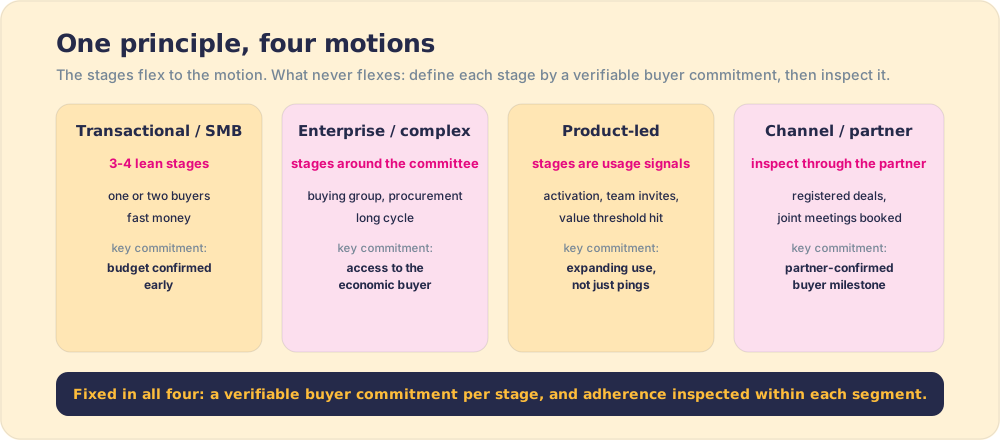
The unifying rule across all four: the principle is fixed, the implementation flexes. Define every stage by something the buyer does that you can verify, cut the count to what the motion requires, and inspect adherence within each segment separately. A company that sells in three motions runs three processes and measures each on its own terms. That is not a loophole in the consistency argument; it is the consistency argument applied honestly, because forcing one motion's stages onto a different motion is exactly the kind of process nobody runs.
What does AI change about the sales process?
It accelerates the half that was already easy and raises the stakes on the half that was always hard, which is the same pattern AI is producing across every category in sales. On the easy side, AI can now draft a competent set of stages in seconds, score every open deal against historical patterns, summarize the calls, and auto-advance a pipeline on signals it detects in email and calendar activity. The drawing, storing, and reporting of the process, the part that improved relentlessly for 140 years, is approaching free.
The risk is precise, and it is the failure mode of the next decade. An AI that advances a deal on detected activity, an email sent, a meeting booked, a deck opened, manufactures exactly the false confidence the commitment-based stage definition exists to prevent, except now at machine speed and across the whole pipeline at once. The hollow pipeline that a careless human builds one deal at a time, a careless model can build for the entire team overnight. And the scarcity of real signal makes this worse, not better: Gartner finds B2B buyers now spend only about 17 percent of the journey with all suppliers combined, so the genuine buyer commitments are rare and easily drowned out by the abundant noise of detectable activity that AI is so good at counting. The cost of getting this wrong is not abstract. Gartner reports that 77 percent of buyers call their last purchase complex or difficult, and that buyers who go self-serve are 1.65 times more likely to regret the purchase than those who bought with a rep. A model that auto-advances deals on activity does more than flatter the forecast; it pushes buyers through a journey nobody is shaping toward a commitment they will regret, which is the opposite of the better buyer experience a well-run process is for.
The defense is not to refuse AI; it is to apply the same discipline to the model that you apply to a rep. A stage still advances only on a verified buyer commitment, whether a human or an agent proposes the advance, and you must be able to inspect whether the AI, like a rep, is following the process or gaming the activity. Governing what an AI does in your deals is the same act as governing what a rep does: set the expectation, make the behavior visible, and check it. AI makes a good, commitment-based process compound faster, and it makes a vanity, activity-based pipeline lie faster. What it does not do is change what a good process is, which is the most reassuring thing about it: the 140-year-old principle holds, and AI raises the reward for getting it right.
That continuity is the closest thing this field has to a law. A principle a cash-register salesman codified in 1887, that a shared and inspected motion beats individual improvisation, has survived the funnel, the CRM, and now generative models, not because the technology was weak but because the principle was about people, and people have not changed. That is the rare kind of insight a sales leader can build a decade of decisions on: tools will keep promising to dissolve the process, and the durable work will keep being the same unglamorous loop Patterson started and we are still running, define the motion, deliver it where the work happens, inspect whether it was run, and reinforce it until it holds.
The recommendation
Treat design as the cheap, solved part, because Patterson solved it in 1887, and spend your real effort where 140 years of evidence keeps pointing: adherence. Concretely, that means three commitments. First, define your stages on buyer commitments, not seller activities, so your pipeline tells you the truth. Second, write the process as situational triggers and deliver them in the flow of work, because the science of behavior says a goal in a document does not become an action under pressure. Third, manage by inspecting commitments rather than feelings, and automate that inspection so the discipline is sustainable and your managers can spend their hours coaching rather than reconstructing. A mediocre process run on every deal beats a brilliant one run on half, because consistency is what the buyer feels and what the forecast stands on. That run-it layer, the process surfacing inside HubSpot and Salesforce at the stage where it applies, with adherence measured deal by deal, is the job we built Supered for, and it is the modern answer to the problem Patterson could only solve by standing in the room.
Read the sales process end to end: what is a sales process, the 7 steps, how to build one, the template, adoption, compliance vs adoption, the execution gap, and the behavior science of running it in the sales playbook guide.
Sales process FAQ
What is a sales process?+
What are the stages of a sales process?+
How do you build a sales process?+
Why do reps not follow the sales process?+
What is the difference between a sales process and a sales methodology?+
What is sales process compliance, and how is it different from adoption?+
Does a defined sales process improve results?+
How many stages should a sales process have?+
Does a strict sales process hurt your best reps?+
Should transactional and enterprise sales use the same process?+
Design is the easy tenth.