Account Plan Template: The Document Is Worthless, the Planning Is Everything
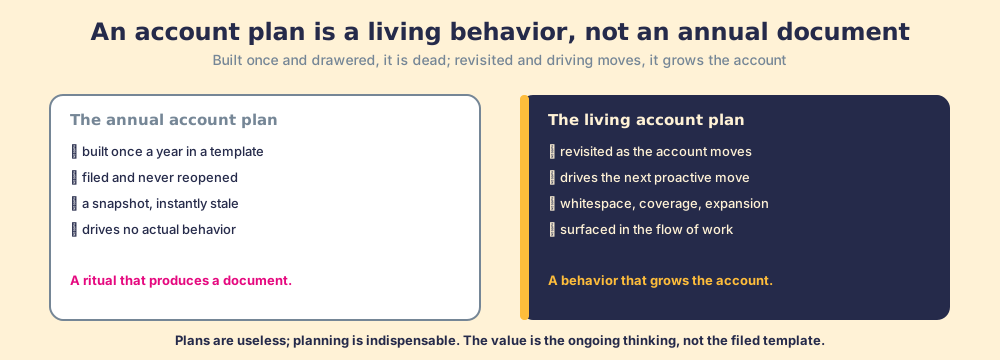
Most account plans are built once a year from a template, filed, and never reopened. A plan that sits in a drawer drives no behavior. The value is the living plan that drives the next proactive move.
An account plan template is a structure for planning how to grow and retain a key account, and its value is the ongoing planning it drives, not the filed document, because a plan built once and never revisited drives no behavior and grows no account.
The account plan is one of the most ritualized and least useful documents in sales: once a year, reps fill in a template for their key accounts, present it in a review, and file it, and from that moment it is dead. Nobody reopens it, because it was treated as a document to complete rather than a plan to use. And a plan in a drawer drives no behavior, which means the annual account-planning exercise produces a stack of stale snapshots and changes nothing about how reps work their accounts. The value of account planning was never the document. It is the thinking, the living, ongoing thinking about where to grow the account, who to reach, and what to do next, and that thinking only pays off if it drives moves, not if it fills a template.
An account plan template is a structure for planning how to grow and retain a key account, and its value is the ongoing planning it drives, not the filed document, because a plan built once and never revisited drives no behavior and grows no account. Keep the planning alive, and the account grows.
Why does the annual account plan fail?
Because an account is a moving target and a once-a-year plan is a stale snapshot the day after it is filed. Dwight Eisenhower’s line captures the distinction exactly: “Plans are useless, but planning is indispensable” (Eisenhower, on planning). He was speaking from experience: a man who had run the largest amphibious invasion in history knew that the map of the beach was obsolete the moment the first boat hit the sand, and that the value of the planning was the readiness to re-plan, not the original plan itself. The same is true of a strategic account plan template. The value is in the act of planning, the continuous thinking that keeps adjusting to reality, not in the artifact the planning produces, which is obsolete the moment the account changes. The annual account plan inverts this. It treats the document as the deliverable, completes it in a burst once a year, and then stops planning entirely until the next annual review. So the plan captures a single moment, contacts who have since changed, needs that have since shifted, risks that have since emerged, and drives nothing between reviews, because no one is doing the ongoing planning the account requires.
This is worth pressing on, because the account-planning industry mostly disagrees with it. Miller Heiman’s Strategic Selling, the canonical text on the discipline, gave a generation of sellers the blue-sheet and the gold-sheet, structured templates for mapping buying influences and large-account strategy, and the dominant practice that grew up around them is the annual or quarterly account-review cadence. The templates are genuinely good. The cadence is the flaw. A blue sheet filled in once a quarter and presented in a review is still a snapshot of a quarter that has already moved, and the deeper irony is that Strategic Selling itself never asked for the snapshot model. Its whole argument is that buying influences shift constantly and must be re-read constantly. The template was meant to capture live thinking and got demoted into an artifact filed on a schedule. The tool was right. The ritual built around it inverted the point.
The deeper failure is the same one that sinks every static sales document: a plan that is not connected to behavior changes none. An account plan filed in a drawer has the same effect on the account as no plan at all, because the account does not respond to documents; it responds to the reps’ moves, and a filed plan drives no moves. The annual ritual produces the appearance of account planning, a binder of completed templates, while the actual planning, the part that grows accounts, never happens between the yearly reviews. And the stakes are not small: existing accounts are where the cheap revenue is. It costs far less to expand an account you already serve than to win a new logo, and research on retention economics has long held that a small lift in retention compounds into a large lift in profit, because a kept-and-grown customer keeps paying with almost none of the acquisition cost attached (Reichheld & Sasser, Harvard Business Review). A dead account plan forfeits exactly that cheap revenue, deal by deal, while the binder sits in the drawer looking like diligence.
What should an account plan template capture?
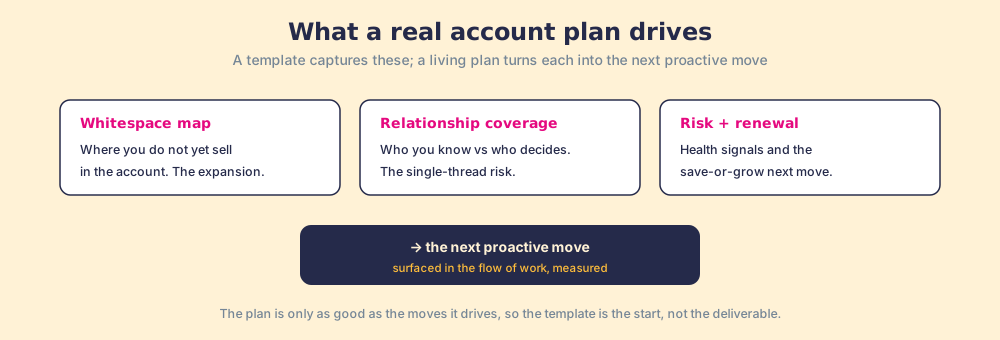
The few things that drive proactive moves, each tied to a next action rather than left as a record. A useful key account plan template captures the whitespace map, where in the account you do not yet sell, which is the expansion opportunity; the relationship coverage, who you know versus who holds the decision, which exposes the single-thread risk that sinks accounts; and the risk and renewal signals, the health of the account and the save-or-grow move each implies. But the components are not the point. The point is that each one drives a specific next move: the whitespace implies an expansion play, the coverage gap implies a multi-thread move, the risk signal implies a save motion. An account plan that captures all of this and produces no moves has missed its entire purpose, the same way a SaaS sales playbook that stops at the close misses where the revenue is.
It helps to picture the difference between a record and a plan with one homely test: a record answers “what is true about this account?” while a plan answers “what will I do about it next?” A field that says the account uses three of your seven product lines is a record. The same field becomes a plan only when it carries a next move attached: reach the operations lead who owns the fourth line, with this proof point, by this date. Most account planning template fields stop at the record and never make the second move, which is why a binder full of accurate fields can grow nothing. Accuracy is not action. The template should refuse to let any section sit as a fact; every section earns its place by producing a move.
- Whitespace map. Where you do not yet sell in the account. Each gap is an expansion move, not a note.
- Relationship coverage. Who you know versus who decides. A coverage gap is a multi-thread move, the B2B sales playbook risk.
- Risk and renewal. Health signals and what they imply. Each risk is a save-or-grow move, not a status field.
- The next move. Every part of the plan resolves to a specific proactive action, surfaced and measured, or the plan is inert.
How do you keep an account plan alive instead of in a drawer?
Tie it to behavior: revisit it as the account moves and turn each part into a next move surfaced in the flow of work. The annual plan dies because it is disconnected from the daily work, so the fix is to connect it. Use the template for structure, but keep the planning living by surfacing the account’s next proactive move, the expansion, the multi-thread, the save, where the rep works, and measuring whether they run it. That turns account planning from a yearly document into an ongoing behavior, which is the only form of it that grows accounts, and it is the sales process adoption discipline applied to account management. Done this way, the account plan also closes the kind of revenue leakage that comes from neglected expansion and single-threaded accounts, because the plan is now driving the moves that prevent it.
The mechanism that keeps a plan alive is a loop, not a document. A living account plan runs the same four steps over and over: read the account as it stands now, decide the next move each part implies, surface that move to the rep in the moment they can act on it, and then watch whether the move happened so the next reading is honest. The annual ritual runs that loop exactly once and then stops the clock for a year. The fix is to keep the loop turning, which means two things the binder model never had: a trigger that re-reads the account when something changes (a new contact, a usage drop, a renewal date approaching) rather than waiting for the calendar, and a way for the next move to reach the rep without anyone reopening a file. The plan stops being a thing you fill in and becomes a thing that runs.
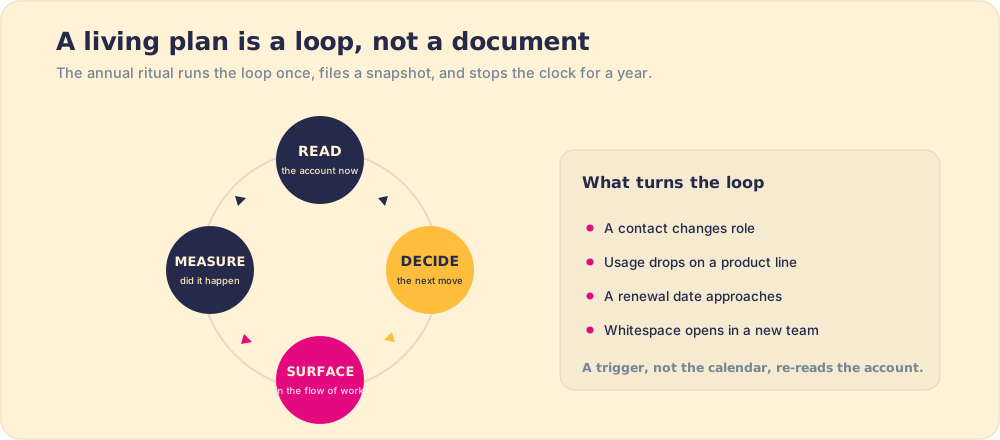
The plan you revisit and act on grows the account; the plan you file does nothing.
What we recommend
Use an account plan template for structure, but understand that the document is worthless and the planning is everything. A plan built once a year and filed is a stale snapshot that drives no behavior, which is why the annual account-planning ritual produces binders and no growth. The value is the ongoing planning, the living thinking about where to expand, who to reach, and what risk to address next, and that thinking only pays off when it drives moves. So capture the whitespace, the relationship coverage, and the risks in the template, but resolve each into a specific proactive move, surface those moves in the flow of work, and revisit the plan as the account changes rather than once a year. Measure whether the moves happen, because an account plan is only as good as the behavior it drives. Plans are useless; planning is indispensable. Keep the planning alive, and the account grows with it.
From here: the expansion motion in the SaaS sales playbook, the multi-thread coverage in the B2B sales playbook, the leakage it prevents in revenue leakage, and the adoption underneath in sales process adoption.
Frequently asked questions
What is an account plan template?+
Why do most account plans fail?+
What should an account plan include?+
How do you make an account plan that gets used?+
Your process, running itself.