How to Merge HubSpot Portals Without Merging the Mess
Two portals, one company, and every field exists twice with different meanings. The merge playbook: who survives, what travels, and the leadership decision hiding inside the technical project.
To merge HubSpot portals, pick one surviving portal, reconcile both portals' property definitions and pipelines into single agreed meanings, migrate the other portal's records and automation with a portal-to-portal tool or partner, and dedupe in transit.
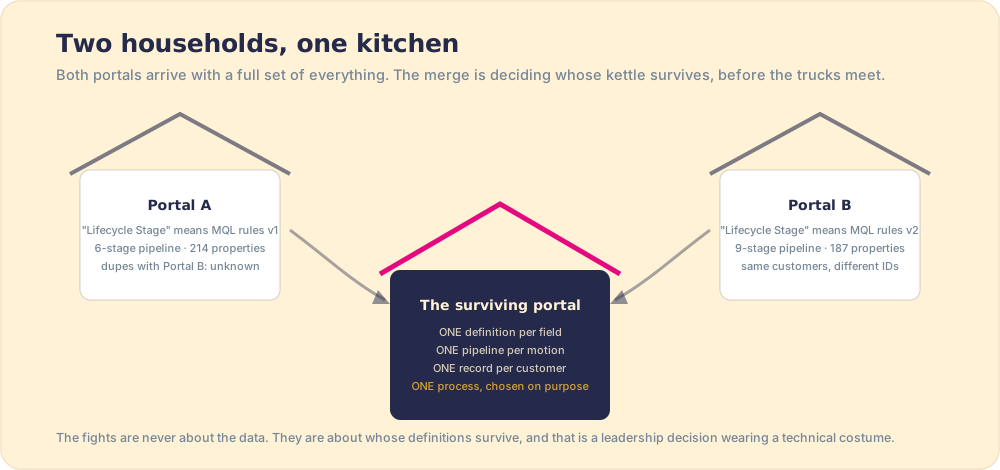
When two households move into one home, the hard part is not carrying the furniture. It is that both households arrive with a full set of everything: two couches, two kettles, two filing systems, each the obviously correct one to its owner. Somebody decides whose kettle survives, or the new kitchen holds two kettles and the resentment of whoever’s is unplugged. An acquisition hands RevOps the same problem with CRMs: combine HubSpot portals, the email says, as though a hubspot portal merge were a furniture-carrying job. It is a kettle-deciding job, and the teams that learn this in week one ship in weeks; the teams that learn it in week six ship in quarters.
Which portal survives, and who decides?
HubSpot has no merge button; a portal merge is a structured one-way migration into a designated survivor. So the first decision is the survivor, and the default most companies reach for, the acquirer’s portal, by reflex, is worth interrogating. The better default: the portal whose process is followed in practice survives, regardless of whose logo is bigger. You can move records into any portal; what you cannot easily do is import discipline into a portal that never had it. A 9-stage pipeline nobody respects beats nothing, but it loses to a 6-stage pipeline with 80 percent adherence, and adherence is the asset the merge should protect.
That makes the survivor call a leadership decision wearing a technical costume, and it is cheaper to surface that openly in week one than to let it masquerade as a field-mapping dispute in week five. The same goes for every definition underneath: both portals have a property called Lifecycle Stage, and they mean different things, encode different MQL rules, and feed different reports that two different executives trust. Reconciling them is not data work. It is the two revenue teams agreeing, field by field, on what words mean in the combined company, with the migration as the deadline that forces the meeting.
There is a deeper reason to make this call on adherence rather than on size. Mark Sirower, who studied 168 acquisitions for his book The Synergy Trap, found that acquirers routinely pay for combined-company gains they never capture, because the value lived in operations the deal model treated as a given (Sirower, The Synergy Trap). A CRM merge is that thesis in miniature. The deal model assumes the combined pipeline adds up cleanly, two books of business under one roof. What it ignores is that the number was never produced by the database; it was produced by the motion the team ran on top of it. Move the records and orphan the motion, and you have bought the furniture and left the household that knew how to run it. The portal whose process is genuinely followed is carrying the value you are paying for, which is why record count is the wrong tiebreaker and adherence is the right one.
What is the sequence to merge HubSpot portals cleanly?
- The survivor decision, first and in writing. Made on process adherence, with the reasoning shared, so the losing portal’s team hears a rationale instead of a verdict.
- The schema treaty. One definition per field, one pipeline per motion, one lifecycle model. Map every property in both portals to keep, merge-into, or archive. Expect this to be the longest phase; it is also the project, with everything after it mere logistics.
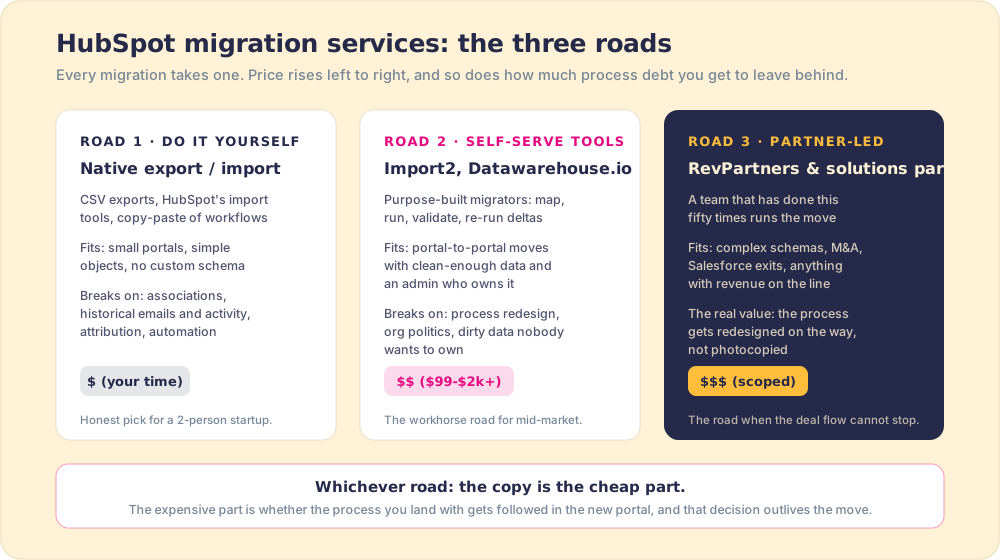
- The dedupe policy, set before transit. Match keys (email, company domain), survivorship rules per field (most recent wins, or portal A wins, decided explicitly), and a named owner for conflicts. The same customers live in both portals with different IDs; a naive copy doubles them, and the cheapest place to collapse duplicates is in transit, where the hubspot to hubspot migration tools like Datawarehouse.io’s Portal Migrator apply rules at scale.
- Automation triage. Workflows do not merge; they collide. Inventory both portals’ automation by last-fired date, kill the dead, rebuild the survivors against the new unified schema, and stage them off until cutover. Two portals’ worth of active workflows firing on one database is how merged teams end up emailing a customer twice in one morning. The rebuild itself no longer has to be manual: package the surviving configuration (workflows, pipelines, properties, dashboards, the lot) with Supered’s Package Builder and install it into the survivor dedupe-safe, with the day-one process riding in the same package.
- The rehearsal, then the move. Stage the combined schema in a sandbox first, with the valve rules in mind, then run the migration with delta re-runs for the records that changed mid-project.
- One process on day one. The combined team opens the surviving portal and finds one documented motion, delivered where they work, with adherence visible. Without this, the merge produces what most produce: one database, two tribes, each running their old process from memory inside the new portal.
How do you dedupe contacts when you combine HubSpot portals?
This is the phase that decides whether the merged database is trustworthy, and it is worth slowing down on, because the failure here is silent. A naive copy does not error. It succeeds, and the cost arrives weeks later as a rep emailing a contact who is now two records, a forecast double-counting a deal that exists twice, a sequence firing on a person who already replied to the other version of themselves.
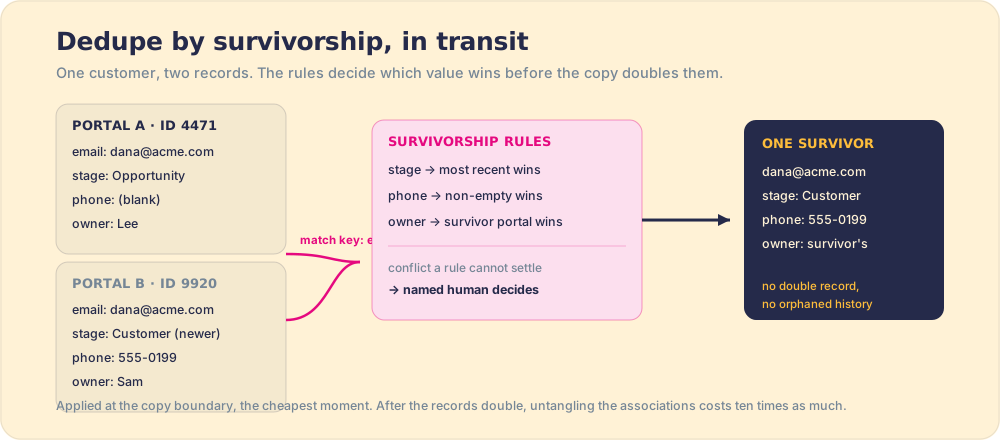
The mechanism to understand is record survivorship, which is just the rule for which value wins when two records describe the same human. Set it before transit, in three layers:
- Match keys decide what counts as the same record. Email is the strong key for contacts, company domain for accounts. The trap is the contact who used a personal address in one portal and a work address in the other; a single match key misses them, so back the primary key with a secondary fuzzy match on name plus company. Decide the keys explicitly, because the tool will do exactly what you tell it and nothing you forget to.
- Survivorship rules decide which value wins, field by field. Not “Portal A wins” as a blanket, which throws away real data, but per field: most-recently-modified wins for Lifecycle Stage, non-empty wins for phone, the survivor portal wins for Owner. Write the table. Every field without a rule is a coin flip you will discover later as a data-quality ticket.
- A named human owns the residue. No rule set resolves every conflict. Two equally-recent owners, two contradictory deal amounts on the same opportunity. The cheapest move is to route the unresolved rows to one person with authority to call it, rather than let the tool pick and bury the decision.
The reason to apply all three in transit rather than after is arithmetic. Deduping a clean import is editing one record; deduping a doubled database is untangling associations, deals, and activity history that have already fanned out across two copies. Good portal-to-portal tools apply these rules at the copy boundary precisely because it is the last cheap moment to do so.
Why do merged portals produce un-merged behavior?
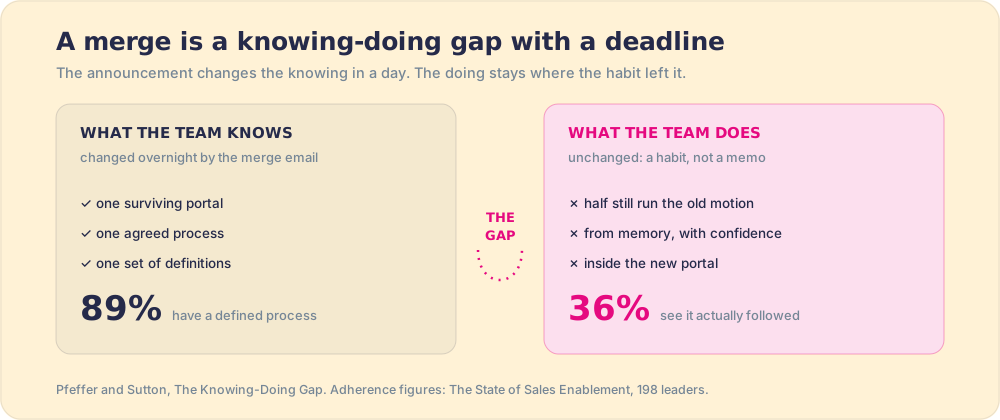
Because the merge moved the data and assumed the habits would follow, and habits do not migrate. Each team spent years learning its own motion; the merge invalidated one team’s muscle memory overnight, sometimes both teams’, and muscle memory does not read the announcement email. This is not a CRM quirk; it is the central finding of M&A research. Harvard Business Review has long put the failure rate of acquisitions between 70 and 90 percent, and the decisive factor is usually integration and culture (how the combined people work in practice) rather than the financial thesis (Christensen et al., HBR, 2011). The same pattern shows up in our own field data: 89 percent of sales teams have a defined process and 36 percent see it followed (The State of Sales Enablement), and a freshly merged team starts below that baseline, because half the room is running a deprecated playbook with full confidence.
There is a name for why the announcement email fails to change anything. Stanford’s Jeffrey Pfeffer and Robert Sutton called it the knowing-doing gap: organizations confuse knowing what to do with doing it, and a memo, a training, or a new system diagram lands squarely on the knowing side while the doing stays exactly where it was (Pfeffer & Sutton, The Knowing-Doing Gap). A merge is a knowing-doing gap with a deadline. Everyone now knows there is one portal and one process. Half the team still does the old motion, because doing is a habit and habits are not rewritten by being informed they are obsolete. The merge changed the knowing overnight and left the doing untouched, which is precisely the gap between the 89 percent who have a process and the 36 percent who run it.
The countermeasure is the same one the placement research keeps surfacing: the unified process has to reach reps in the flow of work, inside the surviving portal, at the stage where each step applies, with adherence measured in the flow of work so drift is coached in week one rather than discovered in the quarter-two forecast review. Teams whose process reached reps in the moment hit quota at 49 percent versus 15 percent for shelved processes in the same study. For a merged team, that delivery layer is not an optimization; it is how two tribes become one team on an actual schedule, and building it inside HubSpot is the job Supered exists for.
The recommendation
Treat the merge as the leadership project it secretly is. Decide the survivor on adherence, negotiate the schema treaty before any record moves, dedupe in transit, triage automation ruthlessly, and spend the savings on the part no migration tool ships: one process, delivered in the moment, measured from day one. Run the diligence list in the HubSpot migration checklist, and if the project needs hands, the partners who do this weekly, and who wire the day-one process while they are in there, are the ones worth interviewing; our partner program is where they gather. The full playbook, sandbox rules to the services field, lives in the HubSpot implementation guide.
Frequently asked questions
Can you merge two HubSpot portals?+
How long does it take to merge HubSpot portals?+
What happens to duplicate contacts when you combine HubSpot portals?+
Which portal should survive in a HubSpot portal merge?+
Do you need a partner to merge HubSpot portals?+
Your process, running itself.