B2B Sales Process: You Are Not Selling to a Buyer, You Are Refereeing a Committee
Most B2B sales processes are drawn as a linear funnel from one buyer to a close. The real B2B sale is six to ten people trying to agree, and the process that wins is the one built for that.
A B2B sales process is the repeatable set of stages a team uses to sell to a business, and the effective version is designed around the buying group rather than a single buyer, because a complex B2B purchase is a consensus among six to ten stakeholders, not one person's choice.
Draw the average B2B sales process and you get a funnel: a single prospect enters at the top, moves stage by stage through discovery and demo and proposal, and exits as a closed deal at the bottom. It is a tidy picture, and it describes a B2B sale about as well as a straight line describes a committee meeting. The defining fact of business-to-business selling is not that the cycle is longer; it is that you are never selling to a buyer. You are refereeing a group of people who have to agree with each other, and most of them would rather not. A process built for one buyer is fighting a battle the real B2B sale is not even having.
A B2B sales process is the repeatable set of stages a team uses to sell to a business, and the effective version is designed around the buying group rather than a single buyer, because a complex B2B purchase is a consensus reached among six to ten stakeholders, not a decision made by one. Build for the group, and the process starts matching the deal.
Where did the funnel model come from, and why is it outdated?
The funnel is older than almost anyone using it realizes. In 1898 an advertising man named Elias St. Elmo Lewis sketched the path a buyer takes as Attention, Interest, Desire, Action, the model that later got abbreviated to AIDA and drawn as a funnel (the AIDA model). It was a model of one mind, an individual consumer narrowing from awareness to purchase, and for a magazine ad sold to a single shopper it worked well. The trouble is that the modern B2B sale inherited the shape without inheriting the situation. A consumer buying soap is one person making one choice. A company buying software is a committee negotiating with itself, and pouring a committee into a model built for a single shopper is the original sin of most B2B sales process design.
The shape survived because it is convenient, not because it is accurate. A funnel is easy to draw, easy to put stages on, easy to forecast against by multiplying a count by a percentage. None of that makes it true. The picture you can draw fastest is rarely the picture of what is happening, and the gap between the tidy funnel on the whiteboard and the looping committee in the deal is where forecasts go to die. The fix is not to abandon stages; it is to redraw them around the group, which is what the rest of this post is about.
Why does the buying group change the whole process?
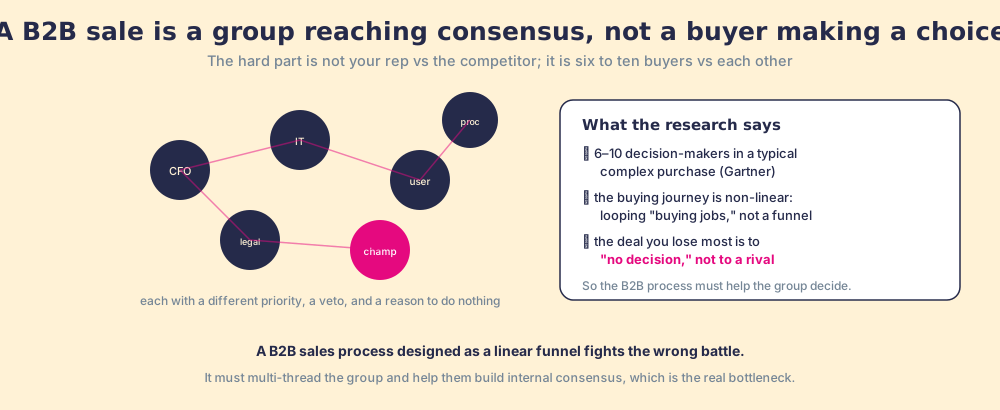
Because the hard part of a B2B sale happens between the buyers, not between your rep and a competitor. Gartner’s research on the B2B buying journey found that a typical complex purchase involves six to ten decision-makers, each bringing their own information, their own priorities, and frequently a veto (Gartner, on the B2B buying journey). Those people do not move through your funnel in lockstep. Gartner found buyers spend only about 17 percent of the purchase journey meeting with potential suppliers, and when several vendors are in play, any one rep may get something like 5 percent of the buyer’s total time. The decision is overwhelmingly made in rooms you are not in.
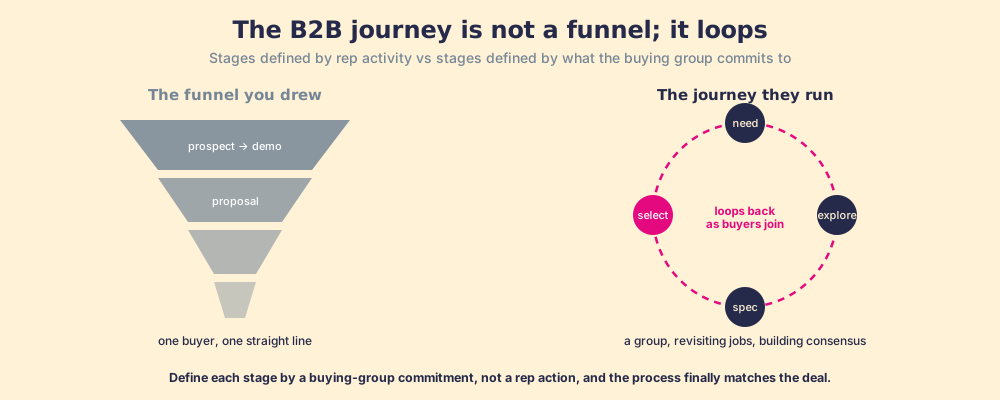
What those buyers are doing in that time is not descending a funnel. They are working through what Gartner calls six “buying jobs,” problem identification, solution exploration, requirements building, supplier selection, validation, and consensus creation, and they loop, returning to earlier jobs as new stakeholders raise new concerns. The journey is not a funnel; it is a tangle, and the rep is trying to pull a knot of people toward a shared yes.
This reframes who the competitor is. The CEB research that became The Challenger Sale, and later Matthew Dixon and Ted McKenna’s The JOLT Effect, found that the most common outcome in a qualified, complex B2B deal is not a loss to a rival but “no decision,” somewhere between 40 and 60 percent of forecast pipeline lost to the buyer’s own inability to commit (Dixon and McKenna, The JOLT Effect). And the killer is not the buyer’s status quo bias, as the field long assumed, but what the authors call the “omission bias,” the buyer’s fear of making the wrong call. The enemy of a B2B deal is usually the buying group’s own indecision, which means the rep’s job is less to out-argue a competitor and more to give a divided, nervous committee the confidence to agree. A process that only measures the rep’s march toward a close cannot see the thing that kills the deal: the group failing to converge.
How should a B2B sales process be built?
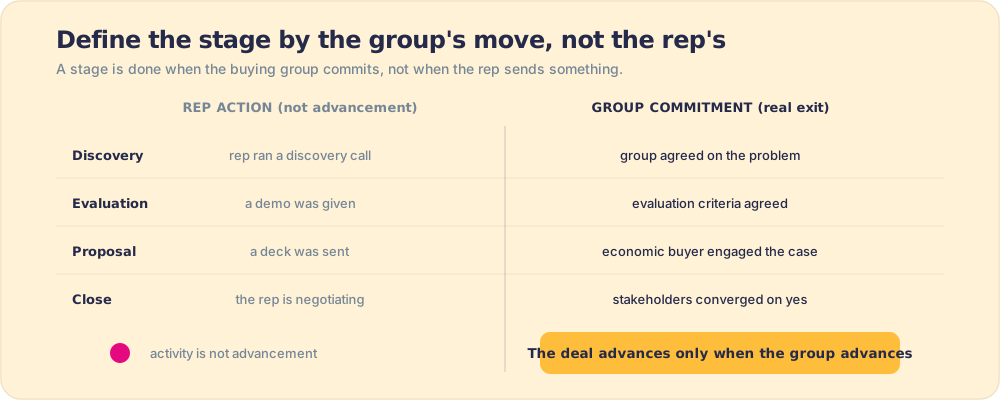
Design every stage around the buying group’s progress, not the rep’s activity. These are the b2b sales process stages that win, reframed around the committee.
- Stages defined by group commitment. Each stage advances when the buying group does something, the economic buyer engages, the evaluation criteria are agreed, the business case is built, not when the rep sends a proposal. Activity is not advancement, which is the core of sales process steps.
- Multi-threading as a requirement, not a nicety. A deal single-threaded on one contact is a deal one job change or one veto from death. The process should require reps to map and reach the full committee.
- A champion equipped to sell internally. The rep is not in the room for most of the decision, so the process must arm an internal champion with the business case and answers to sell on your behalf when you are absent.
- Consensus as the exit criterion for late stages. Late-stage progress is the group converging, not the rep negotiating. Track whether the stakeholders are aligning, because that, not the proposal, is what closes.
On that third point, the research is specific about who to arm. The CEB team behind The Challenger Customer studied which internal advocates move a deal and found the intuitive pick, the friendly, agreeable “talker,” rarely does. The advocate who moves the group is what they named the “Mobilizer,” a skeptical, influential insider willing to push for change, and the seller’s job is to find and equip that person to drive consensus when the rep is absent (Adamson, Dixon, Spenner, Toman, The Challenger Customer). This is why champion enablement is a process step, not a personality trait. You are not hoping a nice contact carries you; you are arming a specific kind of insider with the business case they need to sell internally.
The thread through all four is that a business to business sales process manages a group decision, and its value, like any process, depends on whether reps run it consistently rather than improvising the committee dance deal by deal. That consistency is the subject of sales process adoption, and the qualification that confirms a real buying group exists is in lead qualification and the deeper frameworks of MEDDIC.
A word on where AI changes this, because it changes less than the noise suggests and more than skeptics admit. AI now drafts the follow-up, summarizes the call, and suggests the next email, which compresses the rep’s busywork. What it does not do is reach consensus for a nervous committee, and the no-decision problem is a consensus problem, not a content problem. AI amplifies the process you already have: point it at a B2B motion built around group commitment and it helps the rep multi-thread and arm the Mobilizer faster; point it at a single-threaded funnel and it generates more activity aimed at the wrong battle. The sequencing matters. Get the committee-shaped process adopted first, then let AI compound it.
What are the steps of a B2B sales process, and why is the journey not a funnel?
The b2b sales process steps people list, prospecting, qualification, discovery, demo, proposal, negotiation, close, are not wrong, but the funnel shape they imply is. A funnel says one prospect descends through fixed stages in order and exits at the bottom. The Gartner research found the opposite: buyers loop. A new stakeholder joins at the proposal stage and drags the group back to requirements; legal raises a concern that reopens solution exploration; the champion changes roles and the whole journey resets. The buying group revisits earlier “jobs” repeatedly, which a one-directional funnel cannot represent.
This is why the steps have to be redefined by group commitment rather than rep action. “Discovery” is not done when the rep ran a discovery call; it is done when the buying group has surfaced and agreed on the problem. “Proposal” is not done when the rep sent a deck; it is done when the economic buyer has engaged with the business case. Anchor each step to what the committee has committed to, and the loops stop being chaos and start being visible progress you can measure.
What we recommend
Stop drawing your B2B sales process as a funnel and redraw it as a consensus-building process, because that is the deal you are in. Define each stage by what the buying group has committed to rather than what your rep has done, make multi-threading and champion enablement non-negotiable parts of the motion, and treat late-stage progress as the stakeholders converging rather than the contract being negotiated. The reason this beats the tidy funnel is that the funnel models the wrong battle: it tracks your rep against a competitor when the real contest is six to ten buyers against their own inability to agree. Build the process for the committee, and you stop losing deals to the silent killer of B2B selling, which is not a rival, but a group that never reached yes.
From here: the stage design in sales process steps, the qualification of the buying group in MEDDIC, the methodology for complex deals in the Challenger sale, and the adherence underneath in sales process adoption.
Frequently asked questions
What is a B2B sales process?+
How is a B2B sales process different from B2C?+
What are the stages of a B2B sales process?+
Why do B2B deals stall?+
Your process, running itself.