Sales Knowledge Management: A Storage Problem That Is Already Solved
Most sales knowledge management advice tells you to build a better knowledge base: tag it, search it, index it.
The finding is the easy part now. Whether the answer reaches the rep in the moment is the part nobody solved.
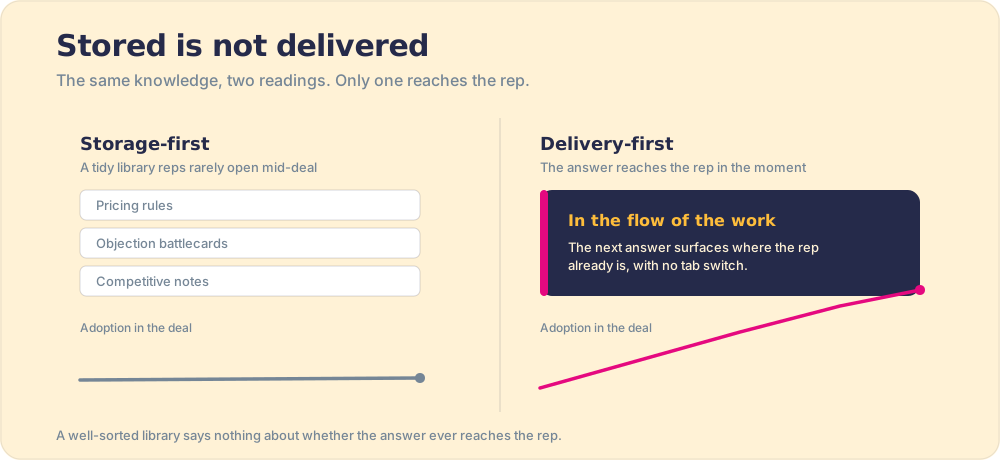
Sales knowledge management is the practice of capturing, organizing, and delivering the information a sales team needs to run deals, and in 2026 its hard part is no longer storing or finding that information but delivering it to the rep at the moment of the work.
A rep is on a call. The buyer asks how the renewal pricing works for a mid-contract upgrade, a real question with a real answer that lives, fully written, in the company knowledge base. The knowledge base article is well tagged. It is searchable. An AI assistant could summarize it in four seconds. And the rep, watching the buyer wait, does none of that. They give a rough guess and promise to follow up by email, because opening a second tab, typing a query, and reading a paragraph while a prospect sits in silence is not a thing a human does mid-sentence. The knowledge existed. The rep, in the only moment that counted, did not have it.
That gap is the entire subject of this post, and almost every guide to sales knowledge management walks right past it. The field treats this as a storage problem: build a better library, tag it well, add a smarter search bar, and reps will find what they need. That was a reasonable worldview in 2015. In 2026 it describes a problem we already solved. The doc is findable. A model can fetch and summarize it instantly. What stays unsolved is whether the answer reaches the rep in the moment of the work, and a knowledge base nobody opens mid-deal is a shelf, however beautifully it is organized.
So here is the more useful definition. Sales knowledge management is the practice of capturing, organizing, and delivering the information a sales team needs to run deals, and in 2026 its hard part is no longer storing or finding that information but delivering it to the rep at the moment of the work. Judge the program by what reaches the rep, not by how well the library is sorted.
What is sales knowledge management, exactly?
Strip the jargon and it is the work of getting what a sales team knows out of a few experts’ heads and into a form every rep can use. Product facts, pricing rules, the response to the objection that kills half your deals, the competitive battlecard, the steps of the process itself. Capture it, keep it current, and put it where a rep can reach it. Ordinary, useful, and worth defining plainly before we argue about it.
The classic approach centers on the store. Build a sales knowledge base, a searchable library of articles and assets, tag everything, and train reps to look things up. That instinct made sense when information was genuinely hard to get to. A rep without the doc was a rep without the answer, so the answer was to make a better doc and a better search.
The two readings lead to different decisions, and that is why the definition matters. Read knowledge management as a storage problem and every gap looks like a content project: missing battlecard, write one; stale pricing page, update it; weak search, buy a better index. Read it as a delivery problem and the question changes to whether reps get the answer while the work is happening. A knowledge base nobody opens mid-deal is not a knowledge layer; it is dead storage. The library can be immaculate and the behavior still absent, and only one of those shows up in a content audit.
Why does the storage-first model fail?
Not because the library is bad. Because finding the answer was never the bottleneck reps hit, and we built the whole discipline around the wrong constraint.
Start with how little of a rep’s day is even available. Sellers spend only about 25 to 40 percent of their time actually selling, the Sales Enablement Collective reports; the rest goes to admin, prep, and hunting for information (SEC). Read that against the storage-first plan and the flaw is plain: the plan adds another place a rep has to go, another search to run, another context switch, and it spends that cost out of the smallest and most valuable slice of the week. A better-organized library does not give a rep more selling time. It asks them to spend selling time on a lookup.
This is not a sales problem alone. It is a knowledge-work problem we have measured for over a decade. McKinsey’s Global Institute, in its study of the social economy, found that the average knowledge worker spends 1.8 hours every day, roughly 9.3 hours a week, just searching for and gathering information (McKinsey Global Institute, The social economy). Nine hours a week, hunting. About a fifth of the workweek gone to the act of finding things that already exist somewhere. The storage-first answer to that finding has always been to organize the things better. It has never once moved the 1.8 hours, because the friction was never the organizing. It was the going-and-getting.
Think of it like a chef’s kitchen during service. A serious cook does not get faster by alphabetizing the pantry in the next room. They get faster when the salt, the knife, and the pan are within arm’s reach at the moment of the cut. A sales knowledge base in a separate tool is a pantry with a perfect labeling system in a room down the hall. The labels are excellent. The reach is the whole problem, and reps under pressure do not leave the stove.
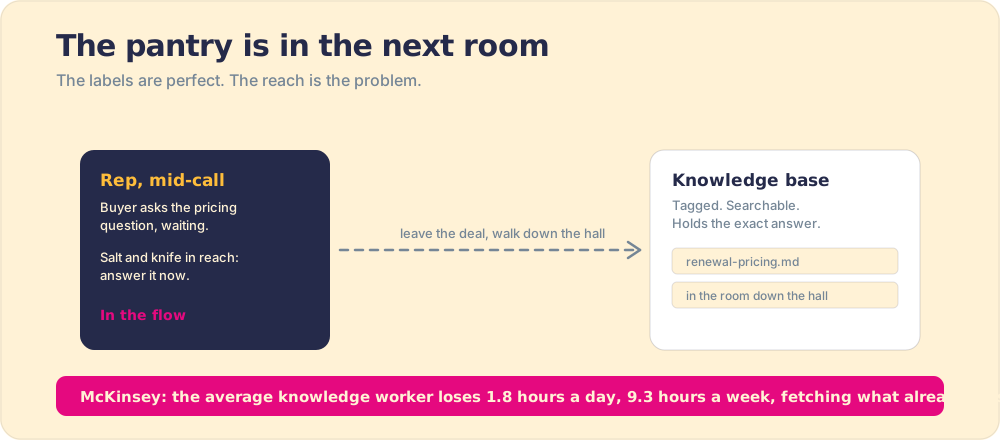
There is a behavioral mechanism under this, and it is worth naming because it explains why reorganizing never works. The path of least resistance wins under load. Reps are not refusing the knowledge base out of indiscipline; the friction of leaving the deal to go get the answer outweighs the friction of guessing, every time the clock is running. When reps do not use the resource, that is a system telling you the resource sits in the wrong place, not a people telling you they are careless. The fix is always to the system: move the answer to where the work is, not scold the rep for not walking to fetch it.
What does AI actually change about knowledge management for sales teams?
This is where the storage-first worldview finally breaks, and where most 2026 advice still gets it backward. The instinct is that AI makes knowledge management easier by making the library smarter: better search, auto-tagging, a chatbot on top of the docs. All true, and all aimed at a problem that is no longer the hard one.
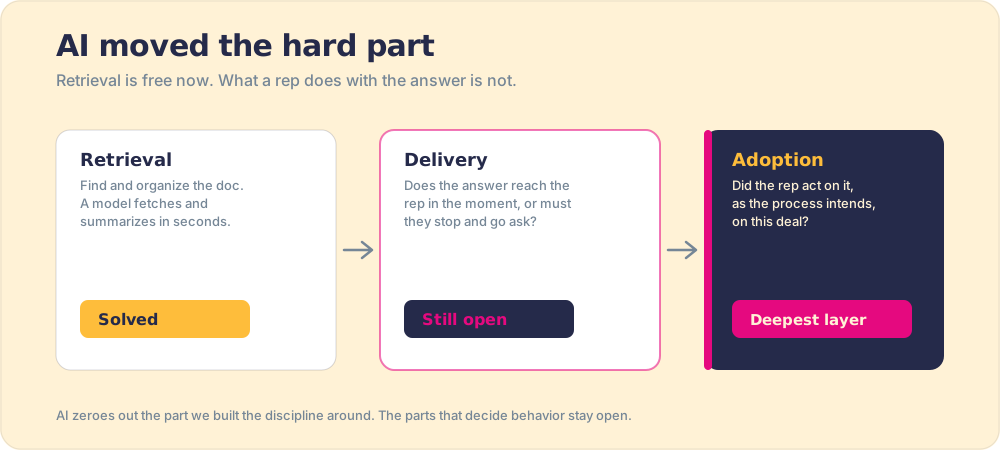
What AI does is collapse the cost of retrieval to roughly zero. Any rep can ask a model a question and get a clean, summarized answer pulled from the documents in seconds, no tags required, no folder structure to learn. The thing the entire discipline was built to solve, find and organize the information, is now close to free. Knowledge is solved. A rep or an AI can locate the doc and digest it instantly, which means the moat was never the knowing.
The unsolved problem moved one step closer to the work, and it has two parts. The first is delivery: retrieval being free does nothing if the rep still has to stop, switch context, and go ask. An answer available on request is not the same as an answer that arrives. The second is adoption: even when the answer reaches the rep, the open question is whether they act on it the way the process intends, on this deal, in this moment. AI amplifies the process you already have. Point it at a team with no working motion and it makes the wrong thing faster; point it at an adopted process and it compounds the right one. So the job shifts. It is no longer to build a bigger, better-indexed library. It is to deliver the knowledge in flow and to measure whether reps use it.
- Retrieval is free now. Any rep or model can find and summarize the relevant doc in seconds. The old core task of knowledge management, organize so people can find, is largely solved.
- Delivery is still manual. Free retrieval still requires the rep to stop, ask, and read. An answer they can get is not an answer that reaches them mid-call. Delivery is the new hard part.
- Adoption is the deepest layer. Even a delivered answer only matters if the rep acts on it as the process intends. Whether the behavior happens is the part no library and no chatbot settles on its own.
You might say a good AI assistant is the delivery layer, so the problem is solved after all. Fair, and that is the most reasonable objection. But a chatbot the rep has to invoke is still a destination, still a thing they leave the deal to consult, just a smarter one. It shortens the search; it does not remove the trip. The genuine fix is for the right answer to surface where the rep is already working, before they have to ask, tied to what they are doing right now. That is a delivery decision, not a retrieval upgrade, and it is the line between a faster library and a knowledge program that changes behavior.
How do you actually do sales knowledge management in 2026?
Start from the moment, not the library. The conventional program runs the other way: gather everything, organize it, publish the knowledge base, announce it, and hope reps come. That sequence optimizes for completeness of the store and ignores the only variable that pays off, whether the knowledge reaches the rep in the flow of the work. A delivery-first program runs in a different order.
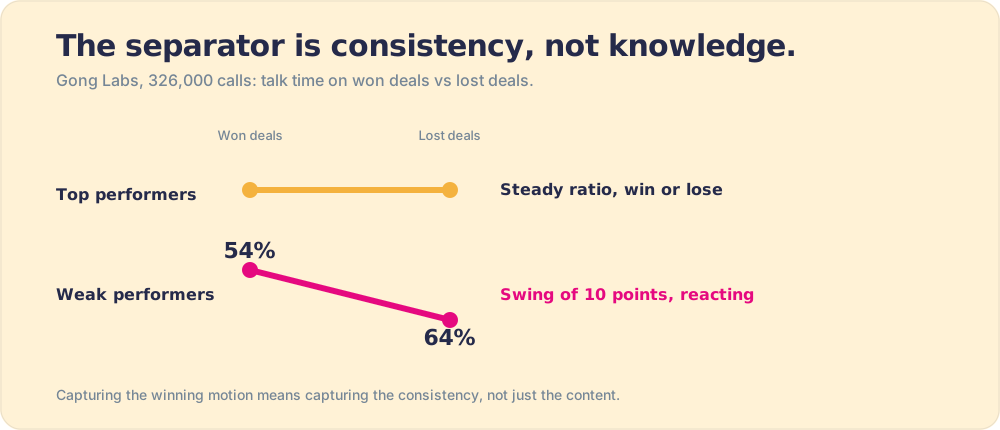
- Capture the real motion from your best reps. The best answers to your hardest objections already live in the heads of the people who win. Capture how your top reps handle the renewal-pricing question and the competitive landmine, and make that the standard. Gong Labs, across 326,000 calls, found the separator is not what reps know but how consistently they run the behavior: top performers hold a steady talk-to-listen ratio win or lose, while weak ones swing from 54 to 64 percent talk time (Gong Labs). You are spreading a proven motion, not a template nobody believes.
- Deliver the answer where the work already is. Location is the decision that pays off most. Surface the battlecard, the pricing rule, the next process step inside the CRM, the call, the inbox, the moment the question arises, so using it costs no tab switch. An answer that meets the rep in flow gets used; one that waits in a library does not.
- Curate the next action, do not dump the archive. More content is not more help; it is more to wade through. Reps get more effective with a short, curated set of actions tied to a clear expectation, not a search return of forty articles. Narrow the surface to the one right next step.
- Measure use, not volume. The size of the knowledge base is a vanity number. The number that matters is whether reps opened the right thing in a live deal and acted on it. Track delivery, adoption, and adherence to the process the knowledge encodes, and let what reps do, deal by deal, tell you what to fix.
That last point is the engine, and it is where most programs go dark. You cannot ask which article to rewrite until you can answer whether reps are using any of them, and the storage-first model has no way to see that. It counts what it stored, never what got used.
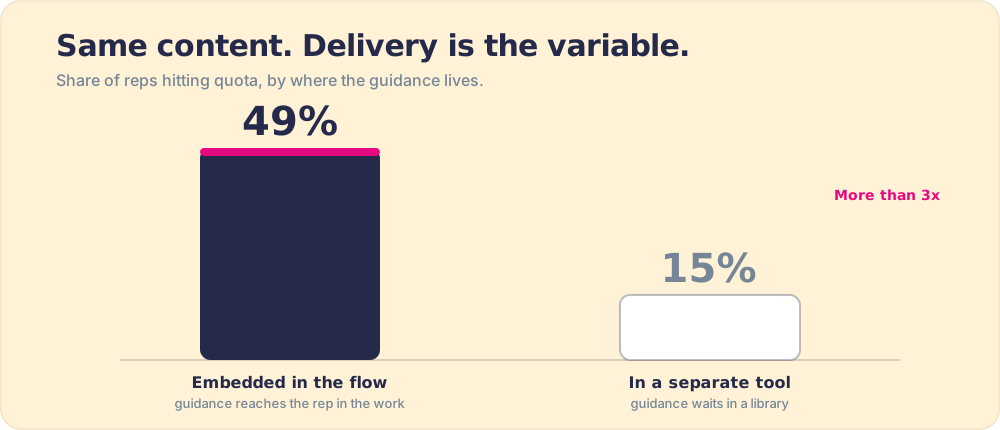
Teams whose guidance is embedded in the flow of work hit quota at 49 percent. Teams whose guidance lives in a separate tool reach 15 percent. The content is the same. The moment of delivery is the variable.
That contrast, from the State of Sales Enablement 2026, is the whole argument in two numbers. Identical guidance, delivered in the flow of the work versus parked in a separate tool, more than triples the share of reps hitting quota, 49 percent against 15 percent (State of Sales Enablement 2026). That is more than a 3x swing on a single variable. The variable is not how good the knowledge is or how well it is tagged. It is whether it reached the rep where the work was already happening. A program built on storage will keep failing that test, because storage never asks the delivery question in the first place.
What the best knowledge programs do differently
The strongest sales knowledge management is not the one with the deepest archive. It is the one where the right answer reaches the rep as a single curated action in the flow of the work, instead of waiting in a library for a search that never comes. Capture the winning motion, deliver it where the work is, curate to the next step, and measure whether reps follow it.
This connects to the wider stack, because knowledge does not live alone. It rides on the same delivery problem every tool has, which we mapped in the sales tech stack: owning a category says nothing about whether reps run the motion. The retrieval engine AI now provides is the front half of the answer, and we covered where that genuinely helps and where it overpromises in generative AI for sales and in the field of the best AI sales tools. The call-analysis layer that surfaces what reps actually said is its own piece, treated in conversation intelligence. Knowledge management is the strand that ties them together: capturing what works, then putting it in front of the rep in time to matter.
The payoff is not internal tidiness. It is the buyer’s experience. A rep who has the renewal-pricing answer in the moment gives a clear, confident reply; a rep who guesses and promises to follow up has handed the buyer doubt and a delay. Deliver a consistent answer to every rep and you produce a consistent experience for every buyer, which is what actually closes deals in a market where buying already feels hard. The knowledge program is buyer-facing in its payoff, not just an internal control.
So when you next audit your knowledge program, do not start by counting articles or admiring the tagging. Start by watching a rep mid-call, hit with the question your library answers perfectly, and ask whether the answer reached them. That one question reorders everything. If it did not, no amount of reorganizing the shelf will fix it, because the shelf was never the problem. For the system that makes knowledge, content, and process produce behavior instead of surface area, the place to go deeper is AI sales enablement and the broader sales enablement software guide.
Frequently asked questions
What is sales knowledge management?+
What is the difference between a sales knowledge base and sales knowledge management?+
Why do sales knowledge bases go unused?+
How does AI change knowledge management for sales teams?+
How do you measure sales knowledge management?+
Your process, running itself.