AI Lead Generation: You Do Not Have a Lead Problem, You Have a Bottleneck
AI lead generation makes leads nearly free. But if the constraint on your pipeline is downstream, in qualification and follow-through, flooding the top with AI leads grows the pile without growing the output.
AI lead generation uses software to find, score, and surface potential buyers at scale, and it raises pipeline only when lead supply is the actual constraint, because feeding more leads into a funnel bottlenecked downstream grows the queue without growing the output.
Most AI lead generation tools sell the same dream: an endless supply of leads, generated while you sleep, for almost nothing. And it can deliver exactly that, which is the trap. Because for most sales teams, leads were never the binding constraint. The constraint is downstream, in whether reps qualify well and follow through on the leads they already have. Pour more leads into a funnel that is jammed at a later stage and you do not get more deals. You get a bigger pile, less attention per lead, and a lower conversion rate. AI lead generation is a powerful answer to a question most teams are not even asking.
AI lead generation uses software to find, score, and surface potential buyers at scale, and it raises pipeline only when lead supply is the actual constraint, because feeding more leads into a funnel bottlenecked downstream grows the queue without growing the output. Find your real constraint first, and you will know whether AI lead generation helps you or buries you.
Why does generating more leads rarely produce more deals?
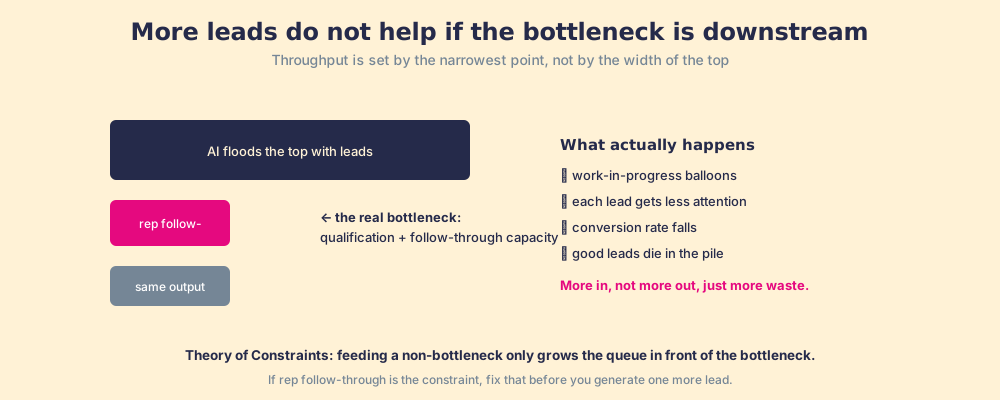
Because throughput is governed by the bottleneck, and the bottleneck is rarely the top of the funnel. This is the core insight of Eliyahu Goldratt’s Theory of Constraints: in any system, total output is limited by its single narrowest point, and improving anything other than that point produces no gain in throughput (Goldratt, on the Theory of Constraints). A sales funnel is such a system. If the narrowest point is rep follow-through, the team’s capacity to qualify, work, and advance leads, then adding leads at the top does not lift output at all. It piles up inventory in front of the bottleneck.
Little’s Law makes the consequence precise: the more work-in-progress you push into a system without raising its processing rate, the longer everything sits in queue (Little’s Law). In sales terms, flooding reps with AI-generated leads they have no extra capacity to work means each lead waits longer, gets less attention, and is more likely to go cold. Conversion rate falls. The good leads die in the same pile as the bad ones, because the rep cannot tell them apart fast enough. You have spent money to lower your own conversion rate, which is a strange thing to buy.
The cost of that queue is not a guess; speed-to-lead research has measured it for years. The classic Harvard Business Review study of lead response time found that contacting a web lead within an hour made a firm far likelier to qualify it than waiting even a few hours, and that most companies were already too slow (Oldroyd, Elkington & Trailer, Harvard Business Review). Now invert the picture. If a team is already too slow at its current volume, what does multiplying the inbound pile do? It lengthens every queue, pushes response times further past the window where a lead is workable, and converts more of them into the cold, unworked majority. Automated lead generation, pointed at a team without the capacity to respond, does more than add waste; it actively degrades the leads that were already good by making them wait. The picture is a supermarket with one open register and a marketing team whose job is to herd more shoppers into the line. The shelves are not the problem. The register is.
What determines a lead’s real value?
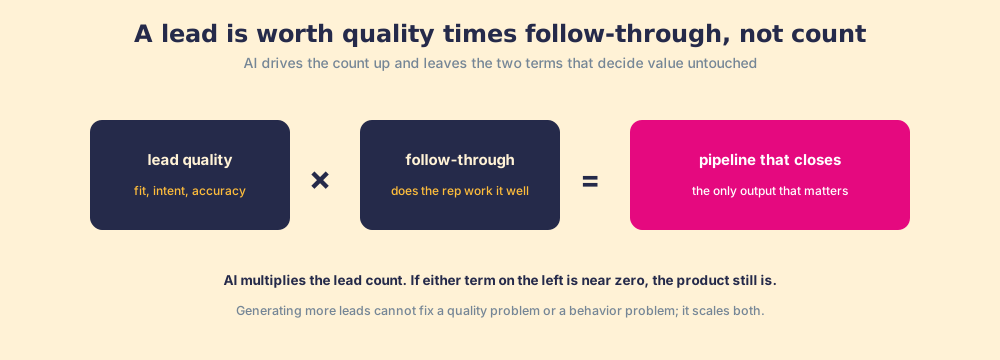
Its quality multiplied by the follow-through it receives, neither of which AI lead generation improves. A lead has no fixed worth. It is worth its fit and intent (quality) times whether a rep works it well (follow-through), and if either term is near zero, the product is near zero no matter how many leads you generate. AI lead generation acts only on the count. It leaves both terms that decide value exactly where they were.
This is why the “fill the funnel” pitch is a category error. Volume is not value, and the two things that turn a lead into pipeline, its quality and the behavior that works it, are precisely the things more volume cannot touch. We saw the same pattern in AI sales outreach: making generic activity cheap floods the channel and lowers everyone’s return. Lead generation has the identical failure mode one stage earlier.
- Quality, not count. A lead’s fit, intent, and data accuracy decide whether it is workable. AI that optimizes for count over quality fills the pile with noise.
- Follow-through, not supply. A great lead worked poorly closes no better than a weak one. The rep behavior to work each lead is the term that pays.
- The bottleneck, not the top. If reps cannot work the leads they have, more leads make it worse. Fix the constraint, then consider the supply.
Is AI-generated lead data accurate enough to act on at volume?
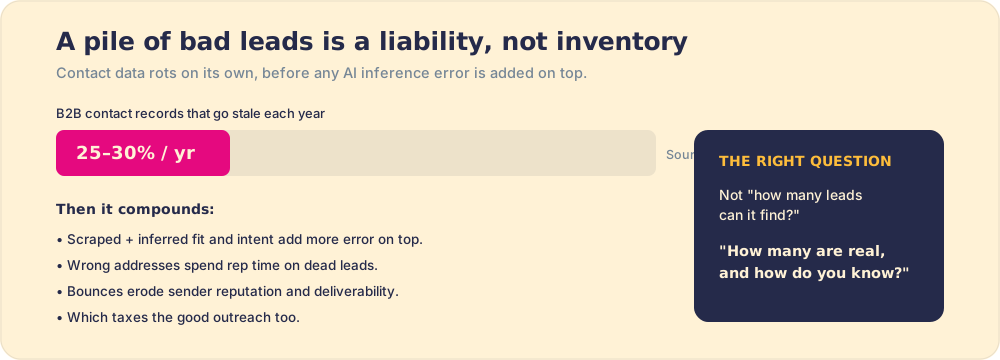
Variably, and the variance is the whole problem. Automated lead generation leans heavily on scraped and inferred data: titles guessed from a website, emails assembled by pattern, intent signals read from thin behavioral traces. Some of it is right. A meaningful share is not. B2B contact data decays fast on its own, with industry estimates putting record rot at roughly 25 to 30 percent a year as people change roles and companies, before any AI inference error is added on top (on data decay, validity.com). When a tool then infers fit and intent from that aging base, the errors compound.
Acting on inaccurate data at volume is not a neutral mistake; it has a cost that lands on the assets you most need to protect. Every email sent to a wrong or dead address, every call to a misidentified buyer, spends rep time and, worse, erodes sender reputation and domain deliverability, which then taxes the good outreach too. So the volume play has a hidden second bill: beyond wasting effort on bad leads, it degrades the channel for the good ones. This is the same compounding harm we traced in the queue, now arriving through data quality rather than capacity. A pile of low-accuracy leads is not free inventory waiting to be worked. It is a liability that charges you to hold it.
The lesson is not that AI lead data is useless. It is that accuracy is a property you have to demand and verify, not assume, and that the right question about any automated lead generation tool is not “how many leads can it find?” but “how many of them are real, and how do you know?”
How should you use AI lead generation well?
Diagnose the constraint first, then aim AI at the right term. If reps are sitting idle for want of leads, lead supply is your bottleneck, and AI lead generation is a real fix. If reps already cannot keep up with the leads they have, which is the more common case, then more leads make the system slower, and the work is downstream: tighten qualification so reps spend time on the right leads, and raise follow-through so each lead is worked well. That is a behavior problem, the kind we treat in lead qualification and sales process adoption, not a supply problem. When supply genuinely is the gap, point AI at quality, fit, intent, and data accuracy, rather than at raw count, and size the supply to the follow-through capacity you have. Better leads, matched to real capacity to work them, beats infinite leads every time.
What we recommend
Before you buy AI lead generation, find your bottleneck, because the answer decides whether the tool helps or hurts. If lead supply is genuinely the constraint, AI that improves lead quality is worth real money. If the constraint is downstream, in qualification and rep follow-through, as it is for most teams, then generating more leads is not merely wasted; it does harm, because it grows the queue, lowers attention per lead, and drops your conversion rate. A lead’s value is its quality times the follow-through it gets, and AI lead generation moves neither term, only the count. So fix the behavior that works the leads first, then size your lead supply to the capacity you have to handle it. You almost certainly do not have a lead problem. You have a bottleneck, and more leads is the one thing that makes a bottleneck worse.
From here: the qualification that protects rep time in lead qualification, the channel collapse from volume in AI sales outreach, the follow-through discipline in sales process adoption, and the wider frame in AI sales enablement.
Frequently asked questions
What is AI lead generation?+
Does AI lead generation truly increase pipeline?+
Is AI-generated lead data accurate?+
How should you use AI lead generation?+
Your process, running itself.