Sales Enablement Content Strategy: It Is Not a Calendar
Most sales enablement content strategy is a production plan, a calendar of assets to ship.
Here is the version that decides whether any of it gets used: map to the moment, deliver in the flow, measure adoption, retire the rest.
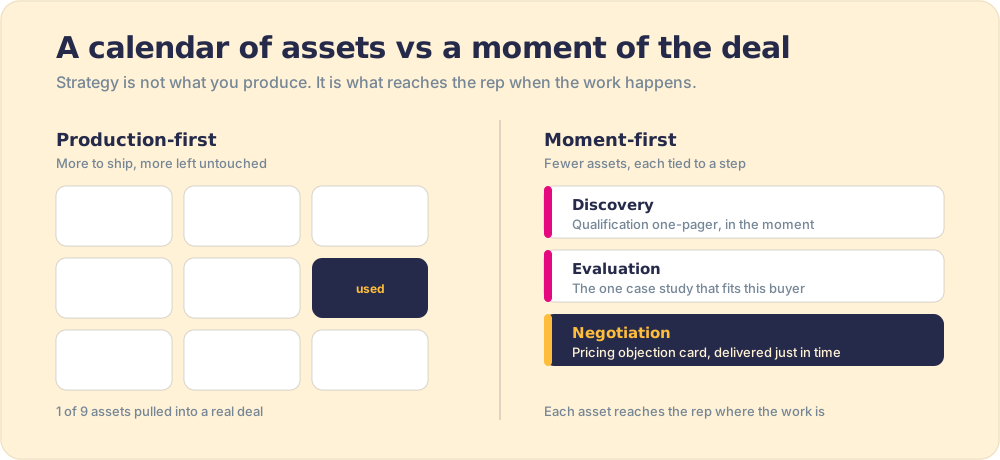
A sales enablement content strategy is the plan for which moment of the deal each asset serves, how it reaches the rep in the flow of the work, and how you retire what they do not use.
A new content lead inherits the enablement library and does the responsible thing first. She counts it. Nine hundred and forty assets, organized into folders, tagged by stage, searchable. Then she pulls the usage data, and the floor tilts: most of those assets have not been opened in a year, and the ones reps send live are a handful of decks they rebuilt themselves because the official versions were stale. The library is full. The selling is happening somewhere else.
Content plans rarely name that gap. The market treats a sales enablement content strategy as a production schedule, a calendar of assets to create and ship, and measures it by output: how many one-pagers, case studies, and battlecards went live this quarter. Our position is that the calendar is not the strategy. A sales enablement content strategy is the plan for which moment of the deal each asset serves, how it reaches the rep in the flow of the work, and how you retire what they do not use. Produce less. Deliver in the moment. Kill the unused. The asset list is the smallest part of the job, and the part teams mistake for the whole.
This is not a small reframe. It inverts what gets measured, what gets resourced, and what counts as done. A production-first team finishes when the asset ships. A moment-first team has barely started.
What is a sales enablement content strategy, exactly?
Strip away the editorial-calendar gloss and the question is simple: what is each piece of content for, and does it get used? A sales enablement content strategy is the plan that answers both. It maps each asset to a moment in the buying journey, decides how that asset reaches the rep at that moment, and sets the rule for when an unused asset gets retired. The content itself is the raw material. The strategy is everything that decides whether the material does any work.
The distinction matters because the two readings lead to different decisions, the same way a shopping list and a recipe lead to different kitchens. Read content strategy as a production plan and every gap looks like a thing to make: no mid-funnel case study, write one; no competitive battlecard, build one. Read it as a lifecycle and the first question is not “what is missing?” but “of what we have, what reaches a rep in a deal, and what is dead weight?” One question grows the library. The other prunes it. Only one of them improves selling.
People call this a content strategy for sales enablement, or a sales content strategy, and the label is fine. What is not fine is the assumption hiding inside every version of it: that producing the asset is the hard part. In 2026 it is the easy part. A rep can generate a decent first-draft one-pager with a chat prompt in ninety seconds. The doc is solved. Whether the right doc reaches the right rep at the right moment of a slipping deal is the unsolved problem, and it is the only problem a strategy should be built around.
Why do most sales content strategies fail?
Not because the content is bad. Because the strategy is production-first, and production-first optimizes for the wrong number. It measures how much gets shipped and treats a fuller library as progress, when a fuller library is mostly more places for an asset to die unseen.
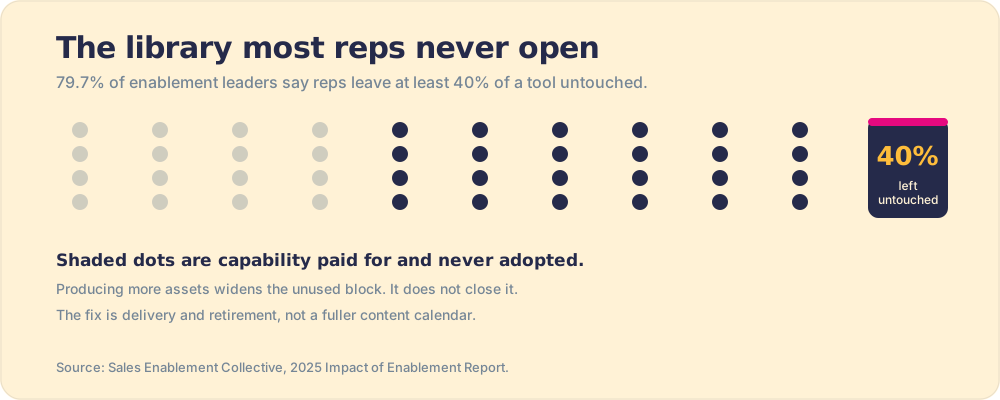
The evidence is blunt. The Sales Enablement Collective’s 2025 Impact of Enablement report found that 79.7% of enablement leaders say their reps leave at least 40% of a stand-alone tool’s features untouched (SEC). Four in five enablement leaders are paying for capability their reps leave untouched, and the standard response to a thin library, make more, enlarges the untouched block. You cannot produce your way out of a usage problem.
The pattern holds wherever someone has bothered to measure it. Forrester’s report on sales content found that 65% of the content marketing produces for sellers goes unused, much of it because reps cannot find it or it has gone stale (Forrester). Two-thirds of the factory output never reaches a deal, and a production-first plan reads that as a reason to staff the factory up.
It compounds with how little of a rep’s week is free for hunting. Sellers spend only about 25% to 40% of their time selling, the SEC reports; the rest disappears into prep, admin, and searching for information (SEC). A content strategy that parks assets in a library and expects reps to come find them is taxing the smallest slice of the week, and reps respond the way busy people always do. They stop looking. They rebuild a rough version from memory, or they wing it. The official asset, beautifully produced, sits in its folder while the deal moves on.
The mechanism runs deeper than laziness, and getting it wrong means blaming the rep and fixing nothing. The cost of using an asset is paid in attention, and attention during a live deal is the scarcest resource a seller has. Any asset that requires leaving the flow of the work, opening a new tab, running a search, scanning results, has a retrieval cost high enough that under deal pressure the rep skips it. This is a system failure, not a discipline failure. The fix is not a memo asking reps to please use the content. It is lowering the retrieval cost to near zero by delivering the asset where the work already is.
What does a real content strategy lifecycle look like?
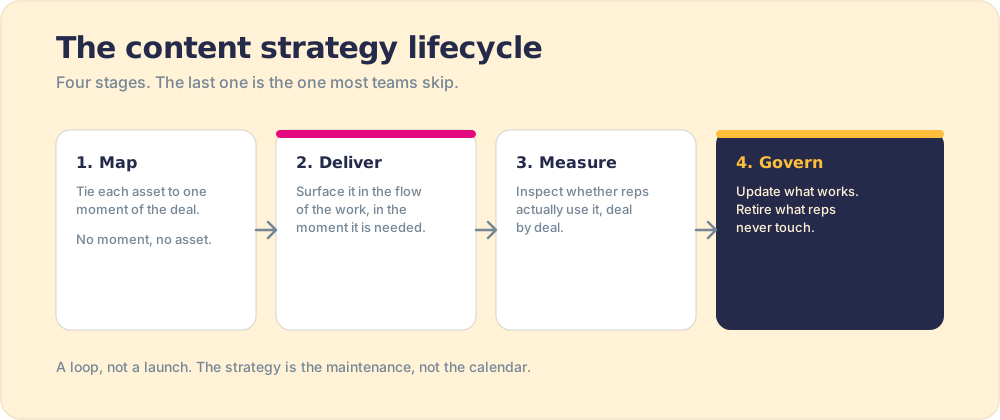
A strategy worth the name is a loop, not a launch. It runs in four stages, and the common failure is to live in the first stage and skip the last.
- Map each asset to a moment. Before anything gets produced, name the moment of the deal it serves: the discovery call, the security review, the pricing objection, the multi-threaded close. If you cannot name the moment, you do not need the asset. This stage alone shrinks a content backlog, because some requested assets serve no identifiable moment; they serve someone’s sense that more content is good.
- Deliver it in the flow of the work. The asset reaches the rep where the work is already happening, the instant the moment arrives, instead of waiting in a library for the rep to leave the deal and go find it. This stage decides usage, and production-first strategies do not have it at all.
- Measure adoption, deal by deal. Count which assets reps pull into live deals and which never get opened. Not downloads, not page views, not how many you shipped. Usage. The asset that is sent on real deals is working; the one with a thousand views and zero sends is a screensaver.
- Govern and retire. Update what works and kill what does not. An asset that goes untouched for a defined window gets flagged for retirement, not preserved out of sentiment. It is the stage that gets skipped, and skipping it is why libraries only ever grow.
Retirement is a findability fix, and it is also a quality fix, and the buyer feels the difference. Demand Gen Report’s 2024 Content Preferences survey found that 51% of B2B buyers said the content they were given was too generic and irrelevant, up from 38% the year before, and 56% said they were overwhelmed by the sheer amount of it (Demand Gen Report). A sprawling library does more than bury the good asset from the rep. It hands the rep more chances to send the buyer something stale, which is the worst thing a content strategy can do, because the payoff of the whole exercise is a better buyer experience.
That last stage has an outside name and a body of research behind it. Content strategists who study findability, going back to Jakob Nielsen’s usability work, have shown for decades that poor information architecture costs you users who cannot find content that exists, give up, and default to whatever is fastest (Nielsen Norman Group). A sales rep mid-deal is exactly that user under exactly that pressure. The implication is uncomfortable for production-first teams: past a certain point, every asset you add lowers the findability of the assets you already have, because it is one more result to scan and dismiss. Curation keeps the good asset findable at all. Tidiness is a side effect.
How should you measure sales enablement content?
By adoption, and only by adoption. The seductive metrics, total assets, downloads, completion rates, all measure that content exists. None of them measure whether content changed what a rep did on a deal. A strategy graded on output will always drift toward more output, because that is the number going up.
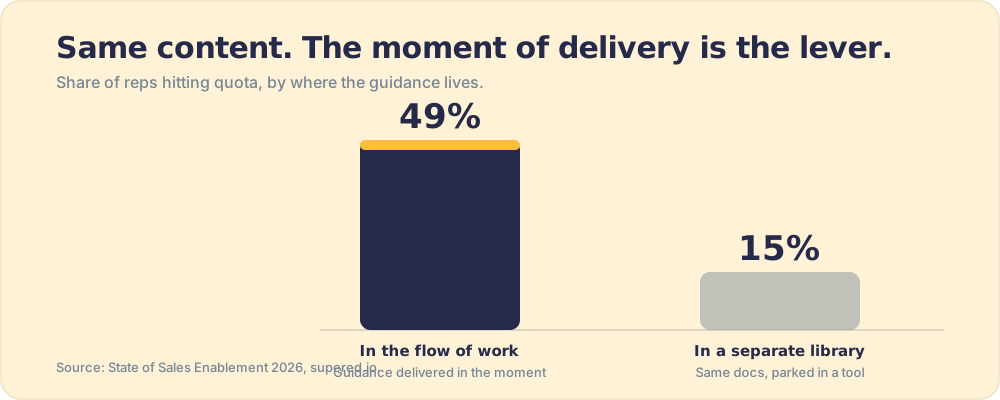
Our own field data lands in exactly the place the behavioral research predicts. The State of Sales Enablement 2026 found that teams whose guidance is embedded in the flow of the work hit quota at 49%, while teams whose guidance lives in docs, wikis, and a separate tool hit quota at 15%. Same content. What changed was where it was delivered. More than triple the quota attainment, from one change: moving the asset from a library the rep has to visit to the moment the rep is already in.
Teams whose guidance is embedded in the flow of work hit quota at 49 percent. Teams whose guidance lives in docs, wikis, and a separate tool hit quota at 15 percent. Same content. The moment of delivery is the lever.
So measurement belongs at the center of a content strategy, not bolted on as a quarterly review. You cannot ask “what should we produce next?” until you can answer “what we already have, is it being used?” Adoption is the prerequisite question, and it goes unasked when the tooling counts production and is silent on usage. The asset library knows how many files it holds. It rarely knows which ones a rep pulled into a deal yesterday.
What to do instead: produce less, deliver more
The way forward is not a better calendar. It is a different center of gravity. Three moves, in order, and each one grounded in the data above.
- Audit for retirement before you produce. Pull the usage signal on what you already have and kill everything that has gone untouched, the way the SEC’s 79.7% finding says you must. A smaller, current, findable library beats a sprawling one where reps cannot tell the live asset from the dead one. This costs nothing to ship and immediately raises findability.
- Map the survivors to moments, and produce only into named gaps. Each remaining asset gets a moment. A new asset has to earn one before it is built. That curation keeps the good content findable instead of buried under the merely-produced.
- Deliver in the flow and grade on adoption. Move the asset to where the work happens and measure whether reps use it, deal by deal, because the 49% against 15% gap says delivery is the lever, not production. That move converts a library into a strategy.
What we recommend is unambiguous: stop running a content factory and start running a content lifecycle. If you are still standing up the basics, the foundations of sales enablement content covers what to build and why. If your problem is the library itself, where it lives and how it is governed, sales content management software maps the tooling. The library is one layer of a larger system, and how the whole stack should produce behavior instead of surface area is the argument in your sales tech stack. For the system that makes content reach the rep in the moment and measures whether it is used, start with the sales enablement software guide, and the field data behind every number here lives in the State of Sales Enablement.
The next time someone asks you to grow the content library, ask them a smaller, harder question first. Of what we have, what reached a rep in a real deal this month? That one question reorders the whole strategy, and it is the only question a production calendar can never answer.
Frequently asked questions
What is a sales enablement content strategy?+
What should a sales content strategy include?+
How do you measure sales enablement content?+
Why do most sales content strategies fail?+
How often should you audit your sales content?+
Your process, running itself.