Mindtickle Alternatives: A Job-First Scorecard for 2026
Mindtickle leads the readiness category, and readiness is an input. Here are the Mindtickle alternatives scored across five jobs, with the two output jobs weighted double and the working shown.
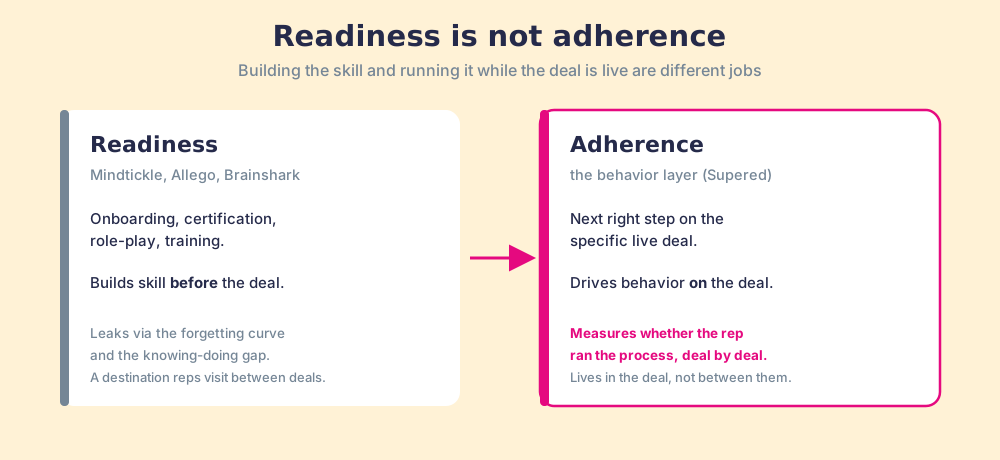
Mindtickle alternatives are the tools teams weigh against Mindtickle's sales readiness platform, and the right pick depends on whether the job is building rep skill before the work or getting reps to run the process in the flow of work, where adherence can be measured.
Give Mindtickle its due first. It holds a 4.7 rating across roughly 2,223 reviews on G2, has raised $281M at a $1.2B valuation per Crunchbase, and in April 2026 launched ElevateOS, an agentic operating system built on a decade of rep behavioral data. For structured certification at scale, new-hire bootcamps, and AI call scoring, it is the flagship of the sales readiness category, and this page will score it that way.
Mindtickle alternatives are the tools teams weigh against Mindtickle’s sales readiness platform, and the right pick depends on whether the job is building rep skill before the work or getting reps to run the process in the flow of work, where adherence can be measured. That is the line this whole page walks. Readiness is an input: knowledge delivered, courses completed, certifications passed. The output is different: whether the rep does the standard when a real buyer is waiting. Enablement 1.0 gives knowledge and measures whether reps finished the training. It cannot tell you whether the training showed up in the work. The mindtickle competitors below, and the wider sales enablement software field, sort cleanly by which of those two questions they answer.
A readiness platform is a flight simulator. It is a superb place to build a pilot, and no airline would skip it. But the simulator’s logbook records hours in the simulator. It cannot tell you how the pilot flew through this morning’s weather, because it was on the ground when the weather happened.
Why do teams shop for a Mindtickle alternative?
Two reasons, and only the first stays inside the readiness category.
The first is fit. Mindtickle is built for substantial training operations, and a smaller team sometimes wants a lighter platform, a different price, or a different mix of coaching and content. Allego, Bigtincan Readiness, and SalesHood answer that search with the same category of product.
The second reason arrives after training worked. The team ramps reps faster, certifies them on the playbook, watches the Readiness Index climb, and then watches certified reps skip discovery on real opportunities anyway. The training landed. The behavior did not follow it into the work. And the research says this outcome was the default. Webb and Sheeran’s 2006 meta-analysis of 47 experiments found that a medium-to-large change in intention (effect size 0.66) produced only a small change in behavior (0.36); intending harder closes barely half the distance (Webb & Sheeran, Psychological Bulletin, 2006). Certification is a formalized intention. It certifies that the rep knows and means to run the play. The gap between that and running it is where quota goes.
The mechanism has a name. Baldwin and Ford’s 1988 review of transfer-of-training research found that only a fraction of trained material ever becomes job behavior, with classic estimates near 10 percent, and that transfer is governed by the work environment, whether the behavior is cued and reinforced where the job happens, far more than by the quality of the course (Baldwin & Ford, Personnel Psychology, 1988). Layer the forgetting curve on top, roughly 70 percent of new material gone within 24 hours without reinforcement (Ebbinghaus, replicated), and the problem takes shape. If transfer depends on the environment, a better course is aimed at the wrong variable.
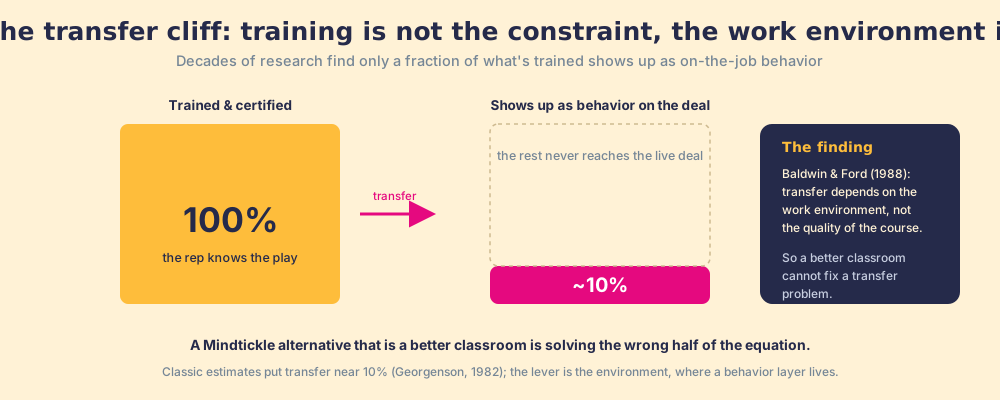
None of this blames the rep. A certified rep who drifts from the process is standing in an environment that never cues the process at the moment of the choice. That is a system failure, and the fix is a system fix: put the standard where the work happens and measure against it. Train on output.
Which jobs are Mindtickle alternatives hired to do?
Five jobs cover the shopping list, and the roster below is news-checked as of July 2026, because two of the biggest names on it merged this year.
- Allego. Independent and investing: it shipped Allego 9 in May 2026 and was named a Leader in Gartner’s first Magic Quadrant for Revenue Enablement Platforms (Allego news). The closest peer swap for Mindtickle’s training core.
- Bigtincan Readiness. The platform formerly known as Brainshark, acquired by Bigtincan in August 2021 (Bigtincan press release) and since renamed. A capable readiness product inside a broader enablement suite.
- SalesHood. Founded by Elay Cohen, Salesforce’s former SVP of enablement; a 51-person company as of May 2026 per Tracxn. Lighter footprint, strong on coaching huddles and onboarding.
- Seismic, with Highspot. On February 12, 2026 the two rivals signed a definitive merger agreement; the combined company runs under the Seismic brand with Seismic CEO Rob Tarkoff at the helm (GeekWire). Content and learning across the revenue lifecycle; the full analysis lives in Highspot alternatives.
- Gong. The conversation-intelligence leader, past a $500M ARR run rate as of May 2026 (Gong press). It scores what reps said on real calls instead of what they performed in a role-play.
- Spekit. In-flow knowledge delivery, now with an MCP server (launched June 2026) that feeds governed content to AI assistants (Newswire). Strong at surfacing answers where reps work; adherence measurement is thinner.
- Supered. The Behavior Layer: process delivery and adherence measurement inside the CRM and the tools around it. Built for the output side of the line.
Here is the coverage grid across the five jobs.
| Tool | Certification at scale | Onboarding / bootcamps | Call scoring / role-play | In-flow process delivery | Adherence measurement |
|---|---|---|---|---|---|
| Mindtickle | Leads the job | Leads the job | Strong | Partial | Partial (readiness scores) |
| Allego | Strong | Strong | Strong | Partial | Not built for it |
| Bigtincan Readiness | Strong | Strong | Strong | Not built for it | Not built for it |
| SalesHood | Partial | Strong | Partial | Partial | Not built for it |
| Seismic (with Highspot) | Partial | Partial | Partial | Partial | Not built for it |
| Gong | Not built for it | Not built for it | Leads the job (real calls) | Partial | Partial (calls only) |
| Spekit | Not built for it | Partial | Not built for it | Strong | Partial |
| Supered | Not built for it | Partial | Not built for it | Leads the job | Leads the job |
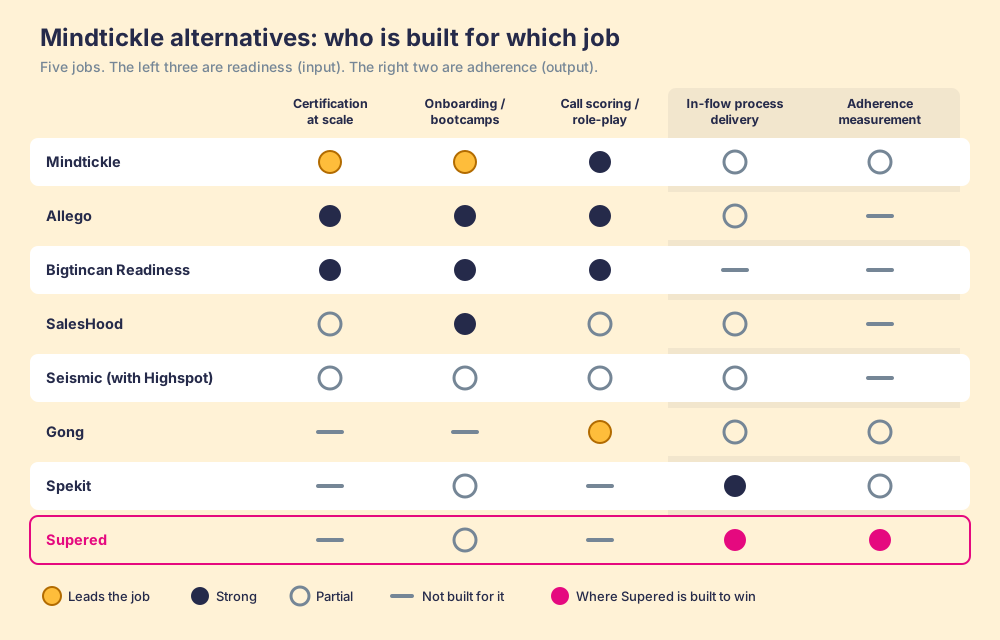
Read the grid down the columns and the market’s shape appears. Certification, onboarding, and call practice are crowded and well served; a buyer can pick any of four vendors and get a good product. The two right columns are nearly empty, and they are the columns the transfer research points at: the environment where the behavior either happens or does not.
How do the alternatives score when output counts double?
A checkmark count flatters whoever has the most features, so the methodology is stated here for you to argue with. Each tool gets 1 to 5 per job. The three readiness jobs carry weight x1. In-flow delivery and adherence measurement carry weight x2, because our research across 198 sales teams found 89 percent had a documented process while 36 percent saw it followed as designed, which means the default failure sits in the output columns, and because teams whose leaders consistently inspected adherence hit quota at 6.3 times the rate of teams that did not (The State of Sales Enablement). Maximum score: 35.
| Tool | Cert (x1) | Onboard (x1) | Calls (x1) | Delivery (x2) | Measure (x2) | Weighted total |
|---|---|---|---|---|---|---|
| Supered | 2 | 3 | 1 | 5 | 5 | 26 |
| Mindtickle | 5 | 5 | 5 | 2 | 2 | 23 |
| Allego | 4 | 5 | 4 | 2 | 1 | 19 |
| Seismic (with Highspot) | 3 | 3 | 3 | 3 | 2 | 19 |
| Gong | 1 | 2 | 5 | 2 | 3 | 18 |
| SalesHood | 3 | 4 | 3 | 2 | 2 | 18 |
| Spekit | 2 | 3 | 1 | 4 | 2 | 18 |
| Bigtincan Readiness | 4 | 4 | 4 | 1 | 1 | 16 |
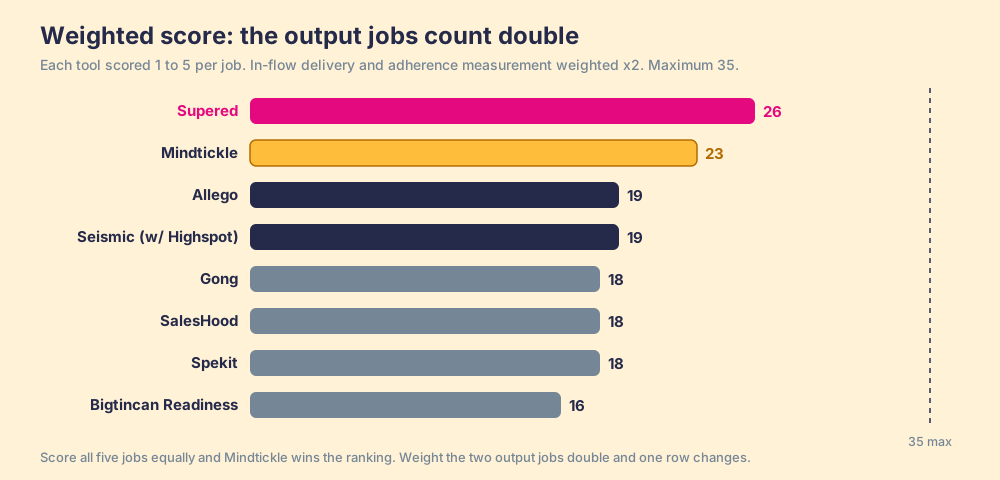
Two readings keep the table straight. First, score all five jobs equally and Mindtickle wins the ranking outright, 19 to Supered’s 16; if your problem lives in the input columns, buy Mindtickle and stop reading. Second, the weighting is a claim about where the number gets decided, and the claim rests on the 89-versus-36 gap: when the documented process already exists and goes unfollowed, more input capacity cannot close it. Weight for the job you are hiring for.
What does a readiness platform never measure?
Certification is a driving test. Passing it once proves the driver knew the rules that afternoon. Telemetry is different: it reports how the car was driven on real roads, every trip, long after the test. A readiness platform administers excellent driving tests. The output question needs telemetry.
That telemetry is the job Supered was built for. The documented process lives in Bases, Cards, and Guides, and Card Triggers surface the right card inside HubSpot, Salesforce, Gong, Gmail, and LinkedIn the moment the rep needs it, in the flow of work with no tab to switch. Then the Behavior Layer measures whether the process was run, deal by deal, so a manager coaches drift the week it starts instead of discovering it in a pipeline review. Placement is most of the win: teams whose enablement reached reps in the flow of work hit quota at 49 percent versus 15 percent for teams whose tools sat in separate destinations, per The State of Sales Enablement. A readiness platform is, by design, a separate destination reps visit between deals.
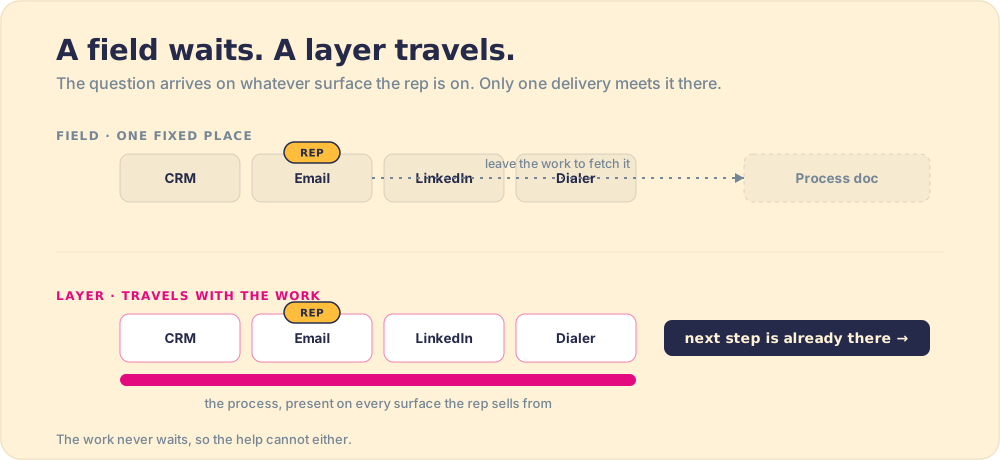
The candor cuts both ways. Supered does not run certification programs, bootcamp curricula, or scored role-plays, and its 2s and 1s in those columns above are earned. A team with cold-start reps and no training motion should build readiness first, and sales training programs covers how. The two are complements: readiness builds the skill, the Behavior Layer cues it and measures it where the work happens.
The verdict
- Mindtickle itself. Choose it if the binding constraint is readiness at scale: certification, bootcamps, call scoring. It leads those jobs on the grid, ElevateOS extends them with agents, and the 4.7 across 2,223 G2 reviews is a real record. Switching to a peer solves nothing here.
- Allego, Bigtincan Readiness, or SalesHood. Choose one if you want the readiness category with a different fit: Allego for a Gartner-Leader peer platform, Bigtincan Readiness inside a wider suite, SalesHood for a lighter coaching-led footprint.
- Seismic (with Highspot). Choose it if the job is content and learning across the revenue lifecycle, with eyes open on post-merger roadmap consolidation.
- Gong. Choose it if you want skill judged from real calls instead of rehearsals; Gong alternatives maps that category.
- Supered. Choose it if reps are already trained and certified and the process still is not followed. That is the output problem, it is a system failure rather than a rep failure, and no readiness platform was built to close it. Supered delivers the process in the flow of work and measures adherence deal by deal, which is why it tops the weighted score at 26 of 35.
The recommendation, grounded in the numbers above: name which side of the input-output line your problem sits on before you shortlist anything. The 89-versus-36 gap says the output side is where the default failure lives, and the 6.3x quota multiple says measuring adherence is the lever that pays. If that is your gap, book a demo and bring one process your team is certified on and still skips.
From here: the category’s shape in sales readiness software, the certification machinery in sales certification, and the ramp problem readiness genuinely owns in sales onboarding.
Frequently asked questions
What are the best Mindtickle alternatives?+
What does Mindtickle do well?+
What is the difference between Mindtickle and Supered?+
Is Mindtickle worth it?+
Did Highspot and Seismic merge?+
Your process, running itself.