Interactive Walkthrough Software: Training Wheels, and the Balance Check
Interactive walkthrough software is two markets wearing one name, and the metric most of it reports (tour completed) is a fact about the tour. Here is the field, the buying logic, and the question to ask after the wheels come off.
Interactive walkthrough software overlays step-by-step, in-app guidance on top of software, walking a person through a task inside the live tool, and it splits into two markets: product walkthroughs for your users and employee walkthroughs for your internal stack.
Somebody on your team taught a child to ride a bicycle, and they did not do it by handing over a manual. They bolted on training wheels, because the way humans learn a thing in motion is in motion, with support arriving exactly when balance fails. Interactive walkthrough software is that instinct, productized: instead of documentation across the room describing the task, the guidance rides along, inside the tool, at the step where the wobble happens. The instinct is right, the medical checklist literature backs delivery-at-the-moment as the strongest single move in all of process work, and this category earns its keep on first rides.
What the category does not earn, out of the box, is the claim on its pricing page. The walkthrough’s native metric is tour completed, and tour completed is a fact about the tour. The fact you are paying to change is what happens after the wheels come off: does the person ride, unaided, when nobody is watching? Hold that question; this page is organized around it.
Which interactive walkthrough software market are you in?
Interactive walkthrough software is two markets wearing one name, with different buyers, economics, and failure modes. Decide which you are in before reading a single review, because a tool that tops one list is irrelevant on the other.
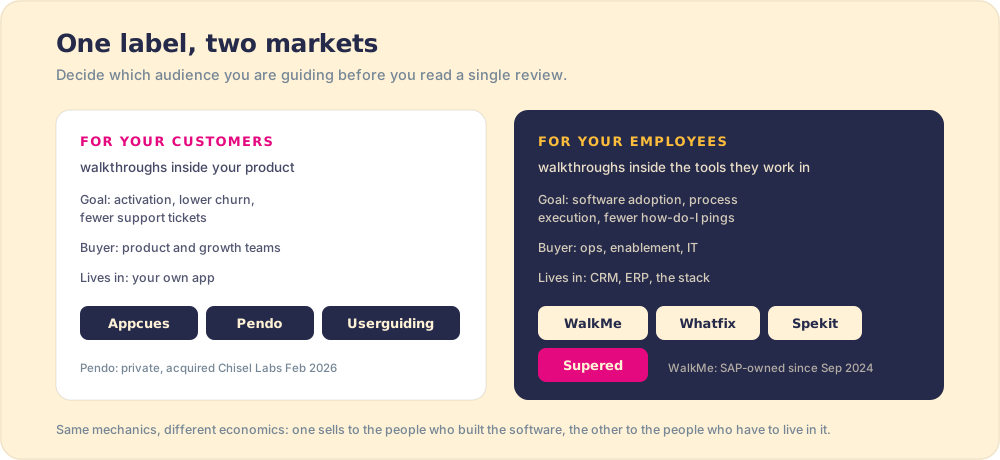
- Customer-facing walkthroughs. Appcues, Userguiding, and Pendo handle user onboarding, activating a single end-user inside your product through new features, chasing activation and lower churn. This is USER onboarding, and it is a different job from CLIENT onboarding, where a services team brings a whole new account live. Pendo is the heavyweight, pairing guidance with product analytics (still private, acquiring aggressively: Chisel Labs in February 2026, Forwrd.ai before it). If your problem is users abandoning your product in week one, shop this side and stop reading here with our blessing.
- Employee-facing walkthroughs. WalkMe and Whatfix overlay your internal stack, the CRM, the ERP, the HR system, guiding employees through tools they did not choose. WalkMe was acquired by SAP for $1.5 billion in September 2024 and is now embedded across the SAP suite, which makes it the default in SAP shops and a roadmap question outside them; Whatfix, independent on a $125M Series E, has made platform neutrality its pitch. Spekit brings the same in-app instinct specifically to sales tools, and Supered’s Digital Adoption tier puts walkthroughs themselves on a published price for internal teams running a process, the services firm onboarding a big client being the sharp case: the delivery team runs the same playbook on every account, and consistency is the whole first impression and the first defense against churn. Supered ships Step-by-Step Guides recorded once and editable afterward (reorder, branch, no re-recording), PII auto-blurred in screenshots, delivered with knowledge cards and in-app updates at $13.50 per user per month. This side of the market is a sibling of the digital adoption platform category, and the deeper comparison lives in our WalkMe alternatives breakdown.
What do walkthroughs do well, honestly?
Three things, and the first two are worth real money. They collapse time-to-first-success: a guided first pass beats a documentation hunt every time, which is the same delivery logic as the extinguisher-versus-sprinkler argument that runs through all process tooling. They deflect the how-do-I tickets, the ones that should never reach a human, and at enterprise scale that deflection alone can justify the contract. Third, more modestly: they make change tolerable, smoothing the week a team switches tools, when every workflow is suddenly unfamiliar at once.
The boundary worth naming is what they do not do. A walkthrough teaches navigation, where to click, in what order, and navigation was never the expensive problem on an experienced team. The expensive problem is execution: whether the client-onboarding checklist gets worked with thought rather than rushed, whether the same step runs the same way on the next account, whether the process you documented is the process that runs. Guidance can put the right screen in front of a person; it cannot, by itself, tell you whether the behavior survived the guidance.
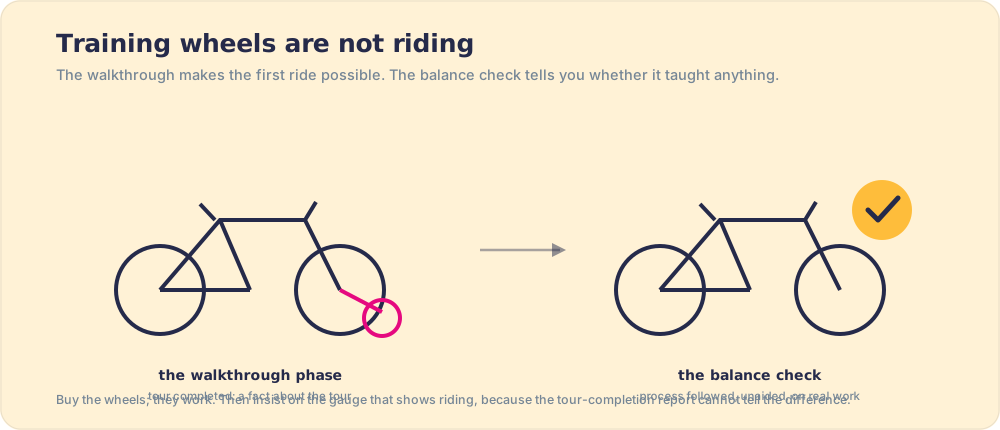
The learning science predicted this boundary decades before the software existed. Training research distinguishes guided performance from transfer, and transfer, the behavior persisting in the real environment without the scaffold, is the part that fails by default: knowledge and guided skill fade without reinforcement and feedback in the work itself, which is why classroom training alone moves behavior so little. Gollwitzer and Sheeran’s meta-analysis of 94 studies put a number on the gap between knowing and doing, finding that intention alone leaves most of the follow-through on the table until plans are bound to concrete moments (Gollwitzer & Sheeran, 2006). Walkthroughs bind guidance to the moment, which is why they work at all. What they leave unbound is the inspection: nobody is checking the balance after the wheels come off.
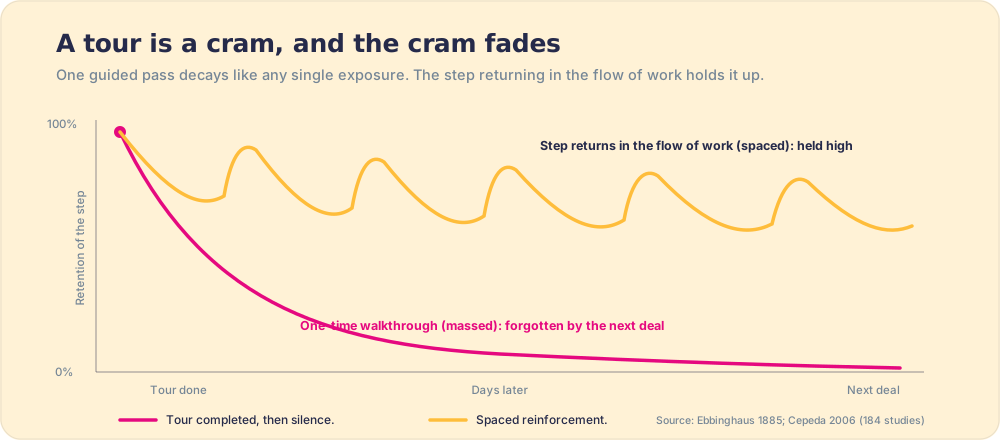
There is a second piece of science the walkthrough industry tends to skip, and it explains why the first week looks so good and the third week looks like nothing happened. A guided tour is, in learning terms, a single massed exposure: everything at once, then silence. Hermann Ebbinghaus mapped what silence does to a single exposure as far back as 1885, and the modern replications hold the shape: most of what a person takes in from one pass is gone within days unless something brings it back (on the Ebbinghaus forgetting curve). Robert Bjork and Nicholas Cepeda put the fix on firm ground. Cepeda’s meta-analysis of 184 spacing studies found that material reviewed across spaced intervals is retained far better than the same material crammed once, the durable form of practice every classroom and every product tour gets backwards (Cepeda et al., 2006). A walkthrough is the cram. It teaches the route on Monday and assumes the route is now known, when the science says the route is half-forgotten by Thursday and gone by the next account. The thing that would save it, a small return of the right step at the moment it is needed again, is exactly the part a tour-completion product was never built to do.
How should you buy, and what should you measure?
- The audience, first and ruthlessly. Your users or your employees. Each later decision inherits from this one, and the lists that mix the two markets are how teams end up demoing Appcues for an internal process-adoption problem.
- The surface fit. Employee-side tools live and die on how well they overlay your specific stack. SAP-heavy: WalkMe is now the house option. Mixed stack: Whatfix’s neutrality argument is real. Mostly the tools your team already uses to run delivery: the process-specific players fit tighter than the enterprise overlays.
- The metric past completion. Ask every vendor one question: when the walkthrough is done, what tells me the behavior stuck? Tour analytics is not an answer; it is the tour grading its own homework. You can only expect what you inspect, and what you want inspected is the work.
- The reinforcement model. A one-time tour fights the forgetting curve and loses. Ask whether the in-app guidance returns the right step at the moment it is needed again, or fires once and never comes back. Guidance that recurs in the flow of work is the spaced practice the science rewards; a single guided pass is the cram it punishes.
- The decay plan. Walkthroughs are content, and content rots when the underlying screens and process change. Ask who updates them and what flags a stale one, the same decay question that decides every documentation purchase.
For internal teams running a process, the measurement half is not hypothetical. In The State of Sales Enablement, teams whose process guidance reached people in the flow of work hit their target at 49 percent versus 15 percent for teams whose guidance lived in separate destinations, and the delivery only paid because adherence was visible enough to coach. That pairing, guidance in the moment plus measurement in the flow of work, is the specific thing Supered builds: the walkthrough instinct, pointed at process execution inside the tools your team already uses, with the balance check included. The product surface for it is shown in how Supered works.
The recommendation
Buy the wheels; they work. If your problem is users activating inside your product, pick the product-side leader that fits your analytics needs and measure activation, not tours. If your problem is an employee stack nobody navigates, WalkMe or Whatfix by stack fit. But if the walkthrough is headed for an internal team running a process, like a services firm bringing every new client live the same way, hold the category to the harder standard, because navigation was never their problem: insist on the balance check, adherence measured in the flow of work after the guidance, drift visible the week it starts. A tour-completion dashboard cannot tell a riding child from a falling one. The work can, and the tools that watch the work are the ones worth the line item. The full field sits in the digital adoption platform guide.
Frequently asked questions
What is interactive walkthrough software?+
What is the difference between a walkthrough and a digital adoption platform?+
What is the best interactive walkthrough software?+
Do interactive walkthroughs actually improve adoption?+
How is tour completion different from adoption?+
Your process, running itself.