The Best Digital Adoption Platforms, Graded Past the Odometer
Seven digital adoption platforms, three different jobs, and a category-wide habit of reporting miles instead of arrivals. The honest map, with corporate status current and a harder question for every vendor.
The best digital adoption platforms depend on whose behavior you are changing: WalkMe and Whatfix for employees across an enterprise stack, Pendo, Appcues, and Userguiding for customers inside your product, and Spekit and Supered for internal and services teams running a process.
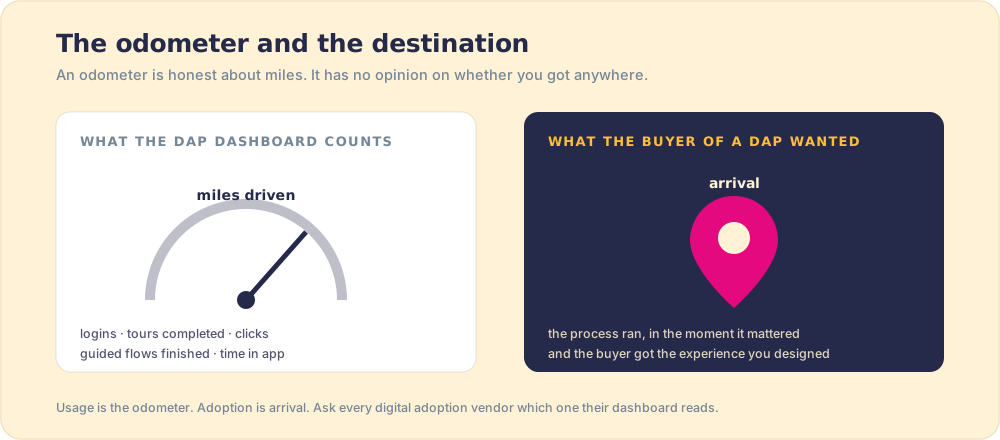
Your car’s odometer is a scrupulously honest instrument. It will tell you, to the tenth of a mile, how far the wheels have turned, and it will not venture one syllable about whether you arrived anywhere worth going. Nobody minds, because nobody confuses the odometer for the trip. Then the same people go to work, buy a digital adoption platform, and accept a dashboard of logins, tours completed, and time-in-app as proof of adoption, which is the odometer reading presented as the arrival.
That is the one critique this list applies to an otherwise genuinely useful category, so it is worth being precise. The guidance these platforms deliver works; in-the-moment delivery is the best-evidenced move in all of process tooling, and we will cite the evidence as we go. The gap is in what gets measured afterward, and it decides whether you bought behavior change or bought mileage. Hold the question through every demo: does this dashboard read miles, or arrivals?
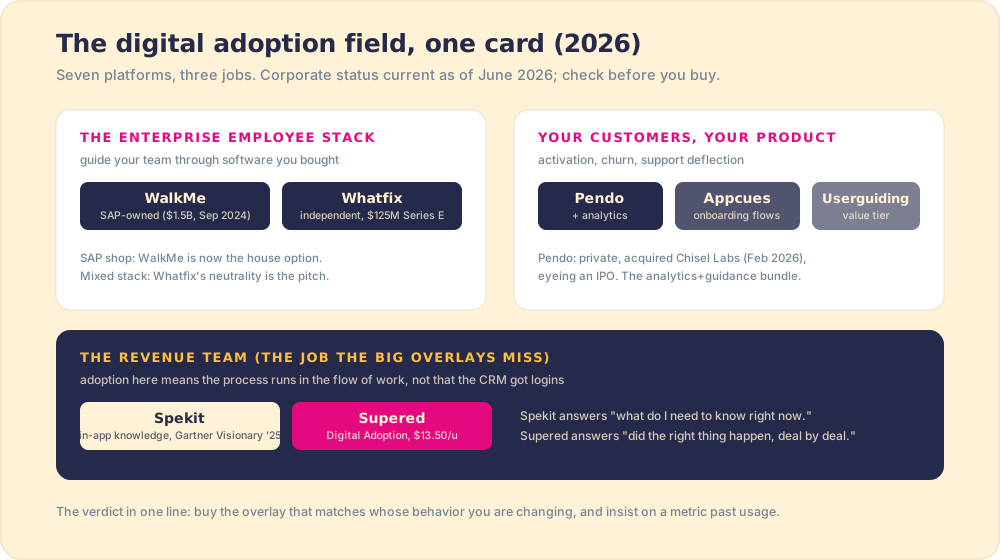
Which digital adoption platform fits which job?
The category splits on whose behavior you are changing, and a tool that tops one column is irrelevant in the next.
- WalkMe, the enterprise incumbent with a new landlord. The category’s original heavyweight, acquired by SAP for $1.5 billion in September 2024 and since embedded across SuccessFactors, Ariba, Concur, and S/4HANA. Inside an SAP estate it is now the house option, deeply integrated and getting deeper. Outside one, the honest question is whose roadmap you would be renting; the full breakdown is in WalkMe alternatives.
- Whatfix, the independent counterweight. A $125M Series E, 700+ customers, and a strategy built precisely on what the SAP deal created: platform neutrality, with partnerships across Microsoft, Salesforce-adjacent stacks, and the long tail of enterprise software. The strongest pick for mixed estates where no single vendor owns your stack.
- Pendo, guidance fused to analytics. The product-led side’s heavyweight: in-app guides plus product analytics in one system, still private, acquiring steadily (Chisel Labs in February 2026, Forwrd.ai before it) with stated IPO ambitions. The pick when you want to study your users and guide them with one tool.
- Appcues and Userguiding, the product-led specialists. Appcues for fast, no-code onboarding flows in mid-market SaaS; Userguiding as the value pick for early-stage teams. Both excel at exactly one thing, new users reaching first value inside your product, and neither pretends to the enterprise-stack job.
- Spekit, in-app knowledge for revenue teams. The sales-specific in-flow specialist: answers, battlecards, and just-in-time guidance surfaced inside the tools reps already use. A Gartner Magic Quadrant Visionary for Revenue Enablement (November 2025) and the closest philosophical cousin to our own product; the head-to-head is in Spekit alternatives.
- Supered, the digital adoption tier with an arrival upgrade. Ours, weigh accordingly, and weigh it as a direct option at this job, not a different category. The Digital Adoption tier is a full in-flow toolkit for internal and services teams, the kind running a process like client onboarding the same way on every account: Step-by-Step Guides (recorded once, editable and branchable afterward, with PII auto-blurred in screenshots), Knowledge Cards and in-app pop-up Updates delivered where the team works, Knowledge Checks, an AI assistant, white-label UI, and the Sidekick browser extension that surfaces it all in HubSpot, Salesforce, Gong, Gmail, or any URL. Published price: $13.50 per user per month billed yearly ($15 monthly), no seat minimum, free trial without a card, in a field where pricing is mostly a discovery call. Then the part nobody else on this list offers: the upgrade path from miles to arrivals. Process Compliance ($40/user/month) adds Process Rules, Process Boards, and inline record editing, so the process itself runs in the system of record with adherence measured in the flow of work. Start with guidance; graduate to behavior, on the same platform.
Why does the usage-versus-behavior distinction decide the purchase?
Because the research that justifies this category is about delivery and measurement together, and most of the category ships only the first half. The strongest single finding in our field data: among 198 sales teams surveyed for The State of Sales Enablement, those whose process guidance reached reps in the flow of work hit quota at 49 percent versus 15 percent for teams whose guidance lived in separate docs and destinations. That is the case for in-app delivery, and any vendor above can quote it. The same survey explains the second half: 89 percent of those teams had a defined process and 36 percent saw it followed, a gap that only closed where adherence was visible enough to coach. Guidance opened the door. Measurement got the team through it.
The behavioral science says the same thing from the other direction. Gollwitzer and Sheeran’s meta-analysis of 94 studies found that binding an intention to a concrete moment (when X, do Y) produces a medium-to-large jump in follow-through, d = 0.65 (Gollwitzer & Sheeran, 2006): the scientific spine of every in-app tooltip. And the medical checklist literature, the Pronovost line of work that took ICU infections from 2.7 per 1,000 catheter-days to zero, paired the in-the-moment checklist with someone empowered to verify each step (NEJM, 2006). Delivery plus verification, never delivery alone. A DAP that ships walkthroughs without behavior measurement has implemented half of the best-evidenced intervention in process science and priced it like both halves.
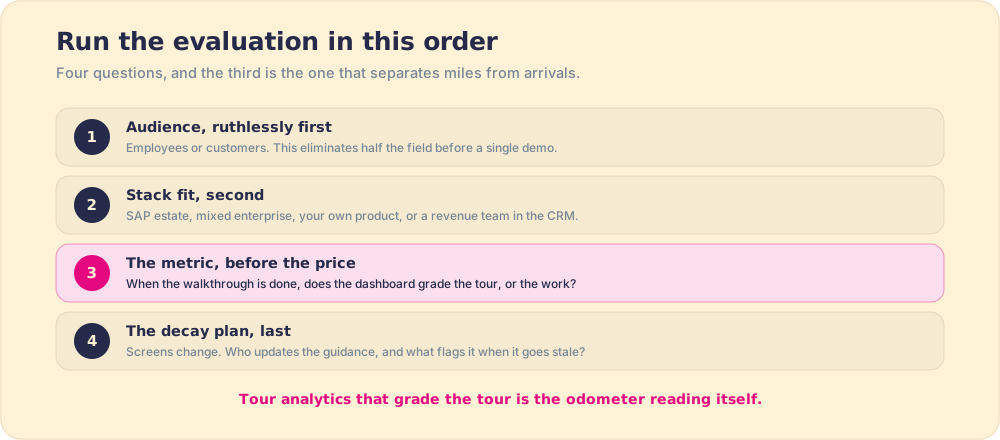
How should you run the evaluation?
- The audience, ruthlessly first. Employees or customers. This eliminates half the field before a single demo and is the reason generic top-10 DAP lists mislead: the two-market split is the category’s load-bearing fact.
- The stack fit, second. SAP estate: WalkMe is the default. Mixed enterprise estate: Whatfix’s neutrality is real. Your own product: Pendo if you want analytics fused in, Appcues or Userguiding if you want speed and price. Internal or services team running a process (client onboarding, delivery, a close process, a sales motion): a process-specific layer fits tighter than any enterprise overlay.
- The metric, before the price. Ask each vendor: when the walkthrough is complete, what tells me the behavior stuck? Watch carefully whether the answer is about the tour or about the work. Tour analytics grading the tour is the odometer reading itself.
- The decay plan. Walkthroughs are content; screens and processes change. Ask who updates them and what flags stale guidance, the same maintenance question that decides every documentation purchase.
The verdict
- WalkMe. The pick inside an SAP estate, where it is now effectively native.
- Whatfix. The pick for the mixed enterprise stack, on neutrality and breadth.
- Pendo. The pick for product-led teams who want analytics and guidance in one, with the budget to match.
- Appcues or Userguiding. The picks for fast customer-onboarding wins, at mid-market and starter price points respectively.
- Spekit. The pick when your team’s gap is knowledge in the moment: answers and enablement content reaching people in-app, strongest for a revenue org.
- Supered. Two picks in one platform, and the only upgrade path on this list. The Digital Adoption tier is the value buy of the field: guides, cards, in-app updates, knowledge checks, AI assistant, at a published $13.50/user/month while the enterprise overlays quote by discovery call. And when your team is ready to measure arrivals instead of miles, Process Compliance ($40/user/month) makes the process run in the system of record with adherence visible in the flow of work. How it works shows both layers running.
The deeper recommendation is the question itself. Whichever column you buy from, refuse the odometer as proof of arrival, because the category will happily sell you miles. Demand the dashboard that reads behavior, in the moment, at the level of the individual piece of work, and the field of dap software sorts itself in one demo cycle. The wider category, with crm adoption and in-app guidance underneath it, lives in the digital adoption platform guide.
Frequently asked questions
What are the best digital adoption platforms?+
What is a digital adoption platform?+
What are examples of digital adoption platforms?+
Is WalkMe still independent?+
How do you measure digital adoption?+
Your process, running itself.