WalkMe Alternatives: Which Side of the Town Line Are You On?
WalkMe sold to SAP for $1.5 billion and moved into a company town. If your stack lives in that town, stay. If it does not, the alternatives sort cleanly by audience and by what you need measured.
WalkMe alternatives are the digital adoption platforms teams weigh since SAP's $1.5 billion acquisition of WalkMe in 2024: Whatfix for mixed enterprise stacks, Pendo or Appcues for your own product, Supered when the job is getting a team to run an internal process.
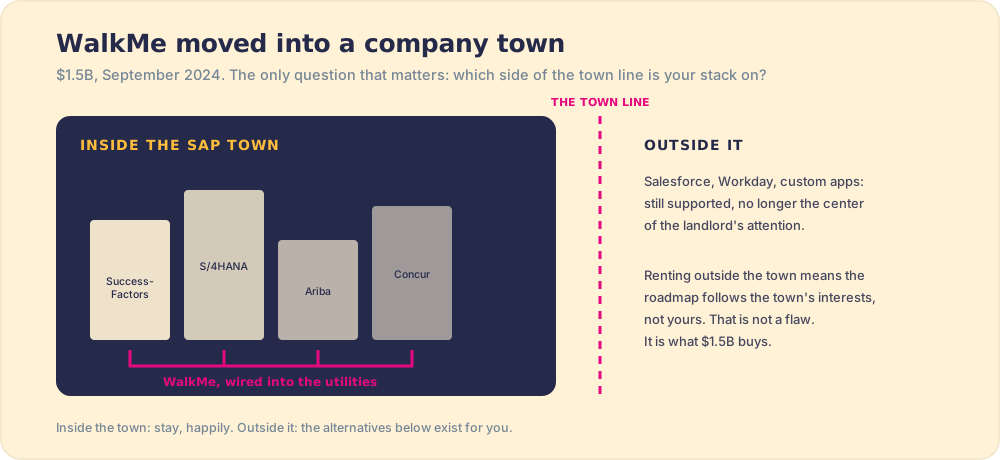
Company towns were not a scam; that is what makes them interesting. If you worked for the company, the town was a good deal: subsidized housing, the store on credit, the doctor paid for. The arrangement only pinched if you lived in the town and worked somewhere else, because every civic decision served the company’s interests, and you were a guest in someone else’s incentive structure. In September 2024, WalkMe, the original heavyweight of digital adoption, sold to SAP for $1.5 billion and moved into a company town (SAP announcement). Since then it has been wired progressively deeper into SuccessFactors, Ariba, Concur, and S/4HANA, which is exactly what acquirers do with infrastructure they paid real money for.
So the WalkMe alternatives question in 2026 is not “is WalkMe good,” because it is, and acquisition day did not change that. The question is the town line: does your stack live inside SAP’s town or outside it? Inside, WalkMe is becoming native plumbing and you should probably stay. Outside, you are renting from a landlord whose investments follow the town, and the alternatives sort cleanly from there.
Who are the best WalkMe alternatives, by situation?
- Whatfix, for the mixed enterprise estate. The structural winner of the SAP deal (and the reason searches for whatfix alternatives usually run the other direction now): an independent platform (a $125M Series E, 700+ customers including 150+ of the Fortune 1000) whose entire pitch is now the thing WalkMe cannot say, platform neutrality. Capability overlap with WalkMe is high (walkthroughs, in-app help, usage analytics across your stack); the difference is whose incentives steer the roadmap. If your estate runs Salesforce, Workday, and a long tail of custom apps, this is the like-for-like swap with cleaner alignment.
- Pendo, when the audience is your customers. A different job wearing the same category label (the pendo alternatives question belongs to product teams, not IT): Pendo guides users inside your own product and fuses the guidance with product analytics (private, acquisitive, Chisel Labs in February 2026, stated IPO ambitions). If you came to this page because customers churn before activating, you were never WalkMe’s buyer, and the two-market split is the thing to read before any demo.
- Appcues and Userguiding, the lighter product-side picks. Appcues for mid-market SaaS onboarding without engineering time; Userguiding when the budget says starter tier. Same column as Pendo, smaller commitments.
- Spekit, for in-app sales knowledge. The sales-specific cousin: answers, battlecards, and enablement content surfaced inside the tools reps already work in, recognized as a Gartner Magic Quadrant Visionary for Revenue Enablement in November 2025. The right pick when your reps’ gap is knowledge arriving too late; the honest comparison is in Spekit alternatives.
- Supered, the process-adoption option at a published price. Ours, so weigh it knowing that, and weigh it as a real digital adoption alternative in its own right. The Digital Adoption tier covers the WalkMe jobs for an internal team running a process, step-by-step guides (editable after recording, PII auto-blurred), knowledge cards, in-app pop-up updates, knowledge checks, an AI assistant, surfaced by the Sidekick extension in the tools the team already uses, at $13.50 per user per month, published, no minimum, while the enterprise overlays price by quote. It does not overlay your ERP, and it is not trying to. What it has that no overlay does is the upgrade path: Process Compliance ($40/user/month) makes the process itself run where the work happens, with adherence measured in the flow of work. The sharpest version of that job is a services firm onboarding a big client, where the team has to run the same kickoff, requirements, and handoff steps on every account and a missed step shows up as churn risk, which is the execution gap the navigation tools were never built for.
What should you grade each alternative on?
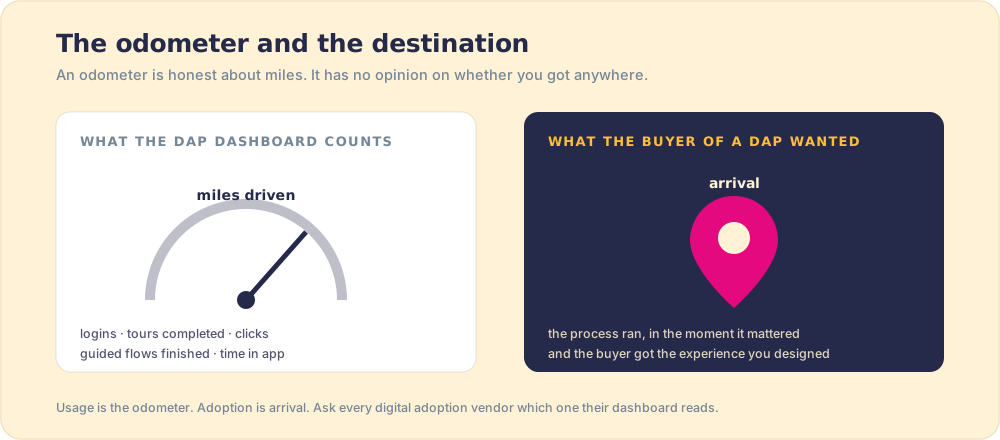
The category’s dashboards default to usage: tours completed, flows finished, time in app. Usage is an odometer, faithful about miles and silent about arrivals, and the research case for this whole category was never about miles. In-the-moment delivery paired with verification is the best-evidenced move in process science (the Pronovost checklist work took ICU line infections from 2.7 per 1,000 catheter-days to zero by putting the procedure at the bedside with someone checking it, NEJM 2006), and our own field data shows the same pairing where a team runs a process: teams whose process guidance reached people in the flow of work cleared their target at 49 percent versus 15 percent for shelved guidance, with the gap closing only where adherence stayed visible (The State of Sales Enablement).
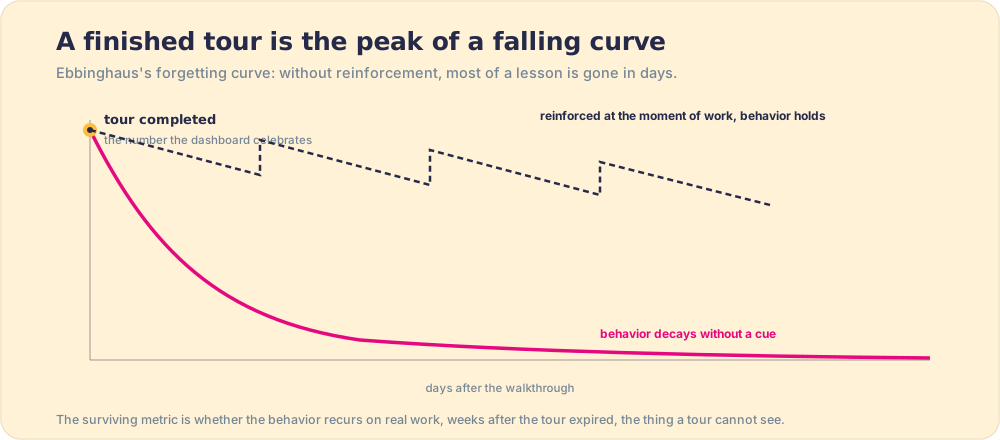
The deeper reason to grade on arrival rather than usage is a forty-year-old finding most adoption dashboards still ignore. Hermann Ebbinghaus, who ran the first controlled memory experiments on himself in the 1880s, mapped the forgetting curve: without reinforcement, people lose the majority of newly learned material within days (Ebbinghaus, on the forgetting curve). A walkthrough is a teaching event. The forgetting curve says its effect decays fast unless the lesson is repeated at the moment it is needed, which is exactly the moment a tour cannot see, because the tour fired at onboarding and the work happens weeks later. So a dashboard that celebrates a completed tour is measuring the peak of a curve that is already falling. The only number that survives the curve is whether the behavior recurs on the real work, which is the number the usage tools were never built to report.
This is why “platform-neutral” and “deep SAP integration” are real axes but not the deciding one when the job is a team running a process. Both Whatfix and WalkMe will get a user through a screen and report that they did. Neither, by design, tells you whether the team ran the play a week after the tour expired. Hold the field on one line each before the tests:
| Alternative | Built for | Status (mid-2026) | The metric it reports |
|---|---|---|---|
| WalkMe | Adoption across the SAP estate | Owned by SAP (Sept 2024) | Tour and usage, native to SAP apps |
| Whatfix | Platform-neutral enterprise guidance | Independent ($125M Series E) | Tour and usage, across a mixed stack |
| Pendo | Customer-facing guidance + analytics | Independent, IPO ambitions | Product analytics and feature use |
| Appcues / Userguiding | Lighter product onboarding | Independent | Onboarding flow completion |
| Spekit | In-app sales knowledge | Independent (Gartner Visionary) | Content surfaced and viewed |
| Supered | An internal process, run and measured | Independent (ours) | Whether the process was followed |
So run three tests, in this order:
- The town-line test. Map your stack against SAP’s. This decides WalkMe-versus-Whatfix in an afternoon and is the only question where the acquisition matters.
- The audience test. Employees or customers. Half the “alternatives” in any roundup are answering a question you did not ask, and the walkthrough split explains which half.
- The arrival test. Ask each finalist what their dashboard says the week after a walkthrough ships: tour metrics, or whether the underlying behavior happened on real work. If the job is a team running a process, insist on the second, because navigation was never the thing between your team and the outcome.
So which WalkMe alternative should you choose?
- WalkMe, still. The pick inside the SAP town, where it is becoming native infrastructure and the integration depth is the product.
- Whatfix. The pick for mixed enterprise estates: closest capability match, independent incentives, neutrality as strategy rather than slogan.
- Pendo. The pick when the audience is your customers and you want analytics fused to the guidance, at enterprise price.
- Appcues or Userguiding. The picks for the same customer-facing job at mid-market and starter budgets.
- Spekit. The pick when your sales team’s gap is knowledge in the moment, in-app, where they work.
- Supered. The pick when an internal team has to run a process the same way every time, a services firm onboarding a big client being the sharpest case: a digital adoption tier that covers the guidance job at a published $13.50/user/month (the only listed price in this verdict apart from Whatfix’s funding round), and the upgrade nobody else sells, Process Compliance, where the documented process runs in the tools the team already uses with adherence measured in the flow of work, so coaching arrives while the work can still be corrected. Both layers are shown working in how it works.
One closing note of fairness to the company this page is named after: selling to SAP was not a retreat, it was the logical end-state for stack-level adoption tooling, which always tended toward becoming part of the stack itself. Read the acquisition as a category maturing. Then notice what the mature category still does not measure, because that open question, behavior past the tour, is where the next set of decisions truly lives, and the wider field sits mapped in the digital adoption platform guide.
Frequently asked questions
What are the best WalkMe alternatives?+
Was WalkMe acquired?+
Should I leave WalkMe after the SAP acquisition?+
What is the difference between WalkMe and Whatfix?+
What is the difference between WalkMe and Supered?+
Your process, running itself.