Virtual Sales Training: Why the Webinar Fails Reps
Virtual sales training scaled the cheapest part of teaching and the worst format for keeping it. Here is why the webinar fails reps, and how to run remote training that actually changes what a rep does on the next call.
Virtual sales training is any sales skill program delivered remotely, by live webinar, recorded course, or online session, and it scales the reach and cuts the cost of teaching, but reach is not retention, and the webinar is the lowest-retention format there is.
A sales leader signs the contract for a virtual training program with the best intentions and a real constraint behind it. The team is spread across four time zones, the travel budget is gone, and getting forty reps into one room costs more than anyone will approve. So the workshop moves to Zoom, the playbook becomes a course, and the calendar fills with live sessions. Six months later the number has not moved, the recordings sit unwatched, and the leader is left wondering whether the reps are the problem. They are not. The format is.
Virtual sales training is any sales skill program delivered remotely, by live webinar, recorded course, or online session, and it scales the reach and cuts the cost of teaching, but reach is not retention, and the webinar is the lowest-retention format there is. That distinction is the whole argument, so hold onto it.
What did going virtual fix?
Be fair to the format first, because it solved a real problem. Before 2020, training a distributed sales team meant flights, hotels, and a facilitator’s day rate, and the math kept most reps out of the room entirely. Remote sales training erased that. A company can now put the same content in front of forty reps in twelve cities at once for the cost of a webinar license. That is not nothing. Reach went up, cost per head went down, and the worst version of the old world, where only the reps near headquarters ever got coached, mostly ended.
The trouble is that the thing virtual training scaled is the cheap part. Going remote made the delivery of information nearly free, and in 2026 information was already the cheapest thing in selling. Any rep can summon the spec sheet, the objection script, or a tailored email in seconds. The expensive, durable part of selling is what the rep does on the call, and a webinar does not touch that. We made the abundant thing more abundant and called it progress.
Why is virtual sales training so easy to forget?
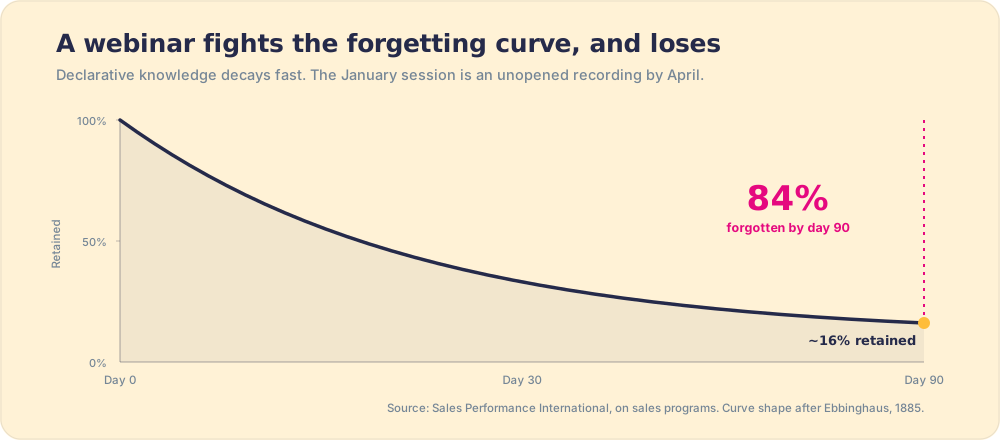
Because the dominant format, the live or recorded session, is a delivery system for declarative knowledge, and declarative knowledge decays fast. This is not a knock on any one vendor; it is the structure of memory. Hermann Ebbinghaus mapped the forgetting curve in 1885, and the numbers in a sales context are stark. Sales Performance International, studying sales programs specifically, found that reps forget about 84 percent of what they were taught within 90 days. The webinar you ran in January is, by April, a recording nobody reopens and a vague sense that the company tried.
A webinar makes that decay worse, not better, in one specific way. A room holds a body of people who can at least be watched; a webinar holds a grid of muted squares, one click from a second monitor. The format invites the exact passive, divided attention that learning needs least. You can sit through ninety minutes of online sales training with your camera off and your inbox open and retain almost nothing, and the system records you as “trained.”
Frank Cespedes of Harvard Business School put the deeper indictment plainly: most sales training is an event, disconnected from the selling context and rarely reinforced, so it fails on its own terms (Cespedes, “Your Sales Training Is Probably Lackluster,” HBR, 2017). Moving the event onto Zoom did not repair the disconnection. It deepened it, because the virtual event is even easier to schedule, easier to multitask through, and easier to mistake for the work itself.
Does a longer Zoom build a skill?
No, and this is the part that should change a training budget. A skill is procedural, a thing you can do, not a thing you can name. You can know every rule of swimming and sink. The rep who handles an objection well is not retrieving a script; they are doing something they have done a hundred times, the way a pianist does not read the notes for a piece they know. No length of webinar produces that, because procedural skill is built only one way.
That way is deliberate practice. Anders Ericsson’s 1993 study of violinists in Berlin established that expert performance tracks accumulated practice with immediate feedback on a specific weakness, not hours in a lecture hall (Ericsson, Krampe & Tesch-Römer, Psychological Review, 1993). A webinar has almost none of those ingredients: little doing, no feedback, no repetition under real conditions. A rep’s actual selling week has all three, and a calendar of live sessions ignores it.
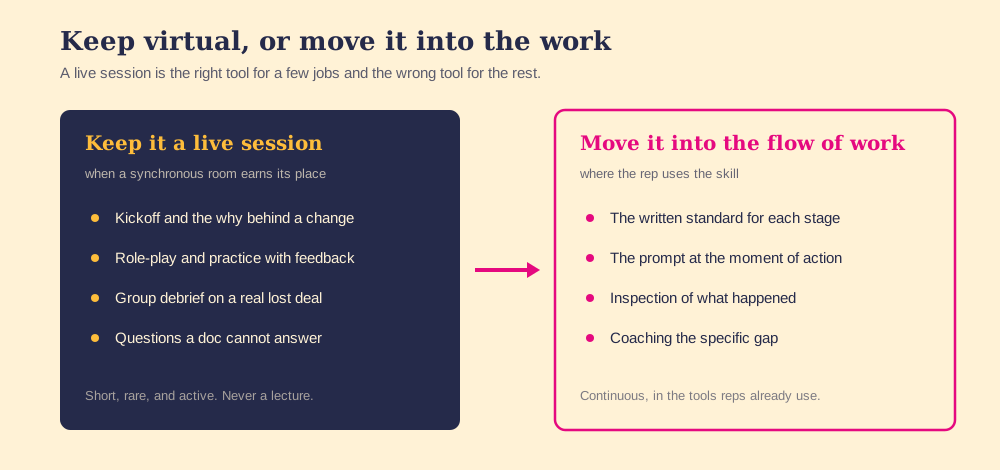
This is why the question is not how to run a better webinar but where each piece of training belongs. Some of it earns a live, synchronous room. Most of it does not.
- The live session, kept rare. A kickoff, a role-play, a debrief on a real lost deal, the moments where reps practice or wrestle with something a document cannot answer. These are active and worth everyone’s calendar. Keep them short, and never let them become a lecture.
- The reinforcement, moved into the work. The standard for each deal stage, the prompt at the moment of action, the check on whether it happened, the coaching of the gap. None of these belong on a calendar invite. They belong where the rep already works, delivered the instant the question arises.
- The recording, demoted. A library of session recordings is a reference, not a program. It is useful the way a manual is useful, and just as rarely opened. Stop treating “we recorded it” as evidence the team learned it.
How do you build remote sales training that changes behavior?
You stop counting attendance and start measuring behavior. The reps who skip the documented motion under pressure are not lazy; the right action was not easy, not visible, and not reinforced in the moment they needed it. That is a system to fix, not a person to blame. The fix has three parts, and they are the opposite of a session calendar.
- Definition. Name the specific behaviors a strong rep performs, in plain language, stage by stage. You cannot reinforce what you have not made explicit, and most teams never write the standard down. This is the same groundwork that turns a vague skills list into something you can build sales skills against.
- Reinforcement in the flow of work. Deliver the right prompt the instant the rep needs it, while they are in the deal, not in a session they will have forgotten by spring. A cue at the moment of action outweighs a hundred slides in a folder, because it lands where the skill is used.
- Inspection that feeds coaching. Check whether the behavior happens on real deals, deal by deal, so a manager can coach the specific gap instead of guessing. Inspection is not surveillance; it is the feedback half of deliberate practice, and lifting its burden off the manager is what frees the human time for actual coaching.
That loop is what a certified rep is missing. A certificate measured the knowledge, and a ready rep is measured on the skill, which is why the two so often come apart. The same logic is why sales coaching reliably beats training on every study that compares them: coaching is practice with feedback, and training is information transfer. We train on output, not input for exactly this reason.
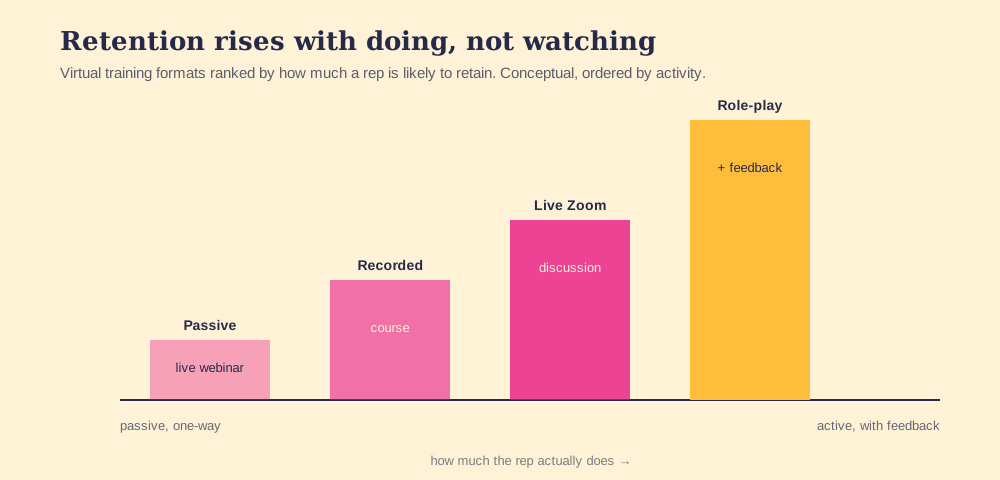
One honest edge on the picture. Reinforcement is not magic, and the gold bar on the chart above is a target, not a guarantee. A rep with no aptitude will not become a closer because you cued them well. Talent is real. But talent is the part you cannot manufacture, and behavior is the part you can, so the whole return on a training budget sits in the half you can move.
What to do with the virtual training budget
There are three ways a leader can spend to raise a remote team’s skill, and only one of them pays back. You can buy more virtual sales training programs, the courses and live cohorts, and watch 84 percent of the content leave the building inside three months. You can hire for talent and hope, which works for the top of the team and abandons the middle where most of the number lives. Or you can build the system that turns the rep’s own week into deliberate practice: a written standard, the right prompt delivered in the moment of work, and inspection that frees a manager to coach.
We recommend the third, without hedging, because it is the only one the mechanism supports. Courses fight the forgetting curve and lose. Hiring ignores the middle of the team. Reinforcement in the flow of work matches how procedural skill is actually built, and it is the job the sales training software category is finally being judged on: not whether it can host a webinar, but whether it can change what a rep does on the next call. Supered exists to be that layer, the prompt and the standard reaching the rep the instant the question arises, in the tools they already use, so the practice happens where the work does.
Keep the webinar for the few things a live room does well. For everything else, the reps do not need another session on the calendar. They need the standard in their hands at the moment they are about to use it. Stop scaling the watching. Start building the doing.
Frequently asked questions
What is virtual sales training?+
Does virtual sales training actually work?+
How is remote sales training different from in-person?+
How do you make virtual sales training stick?+
Your process, running itself.