Remote Sales Training: A Recorded Workshop Is the Worst of Both Worlds
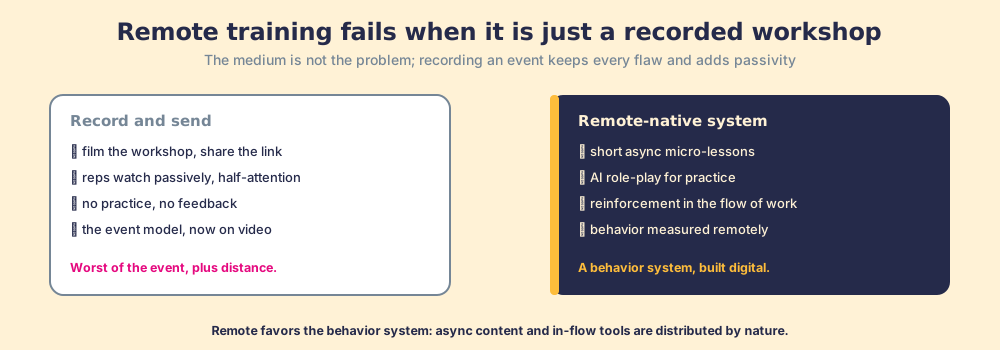
Most remote sales training is a recorded workshop emailed to reps: the event model with passivity added. The medium is not the problem. Remote in fact suits a behavior system, because its parts are already digital.
Remote sales training is developing sellers on a distributed team, and it fails when it merely records the in-person event yet succeeds as a remote-native behavior system, because async content, AI practice, and in-flow reinforcement are digital by nature and suit distance.
The default approach to remote sales training is to take the in-person workshop, point a camera at it, and email the recording. It is the worst of both worlds. The in-person workshop was already a weak way to train, a one-time knowledge dump with no practice and no reinforcement, and recording it strips away the modest engagement of being in a room and leaves reps half-watching a video between meetings. The result changes nothing, and teams conclude that remote training is harder than in-person. It is not. The medium was never the problem; the event model was. And here is the part that surprises people: once you stop trying to port the workshop and build training the way it should be built, remote is not a handicap at all. The parts that develop a rep, spaced content, practice, in-flow reinforcement, are already digital, so a distributed team can run a better training system than a co-located one still gathering everyone in a room once a year.
Remote sales training is developing sellers on a distributed team, and it fails when it merely records the in-person event yet succeeds as a remote-native behavior system, because async content, AI practice, and in-flow reinforcement are digital by nature and suit distance. Stop recording the workshop, and remote becomes an advantage.
Why does recording the workshop fail as remote sales training?
Because it keeps the event model’s flaws and adds passivity, doubling down on the wrong approach. The in-person workshop fails for reasons that have nothing to do with the room: it is a single burst of knowledge the forgetting curve erases (Ebbinghaus, on the forgetting curve), with no practice to build skill and no reinforcement to make it stick, the event-versus-system problem. Recording it changes none of that and makes it worse, because a rep watching a video alone, between calls, is even less engaged than the same rep in a room. So the recorded workshop inherits every weakness of the event and adds distance and divided attention. Teams then blame the remoteness, when the actual culprit is that they tried to deliver a bad model over video. The medium amplified the model’s flaws; it did not cause them.
The tell is that the diagnosis points at the wrong thing. “Remote training is hard” is the conclusion teams reach, but what is hard is making a one-time passive event work, which was always hard and is harder on video. Change the model rather than the medium and the difficulty disappears, because the model that works happens to be one that distributes naturally.
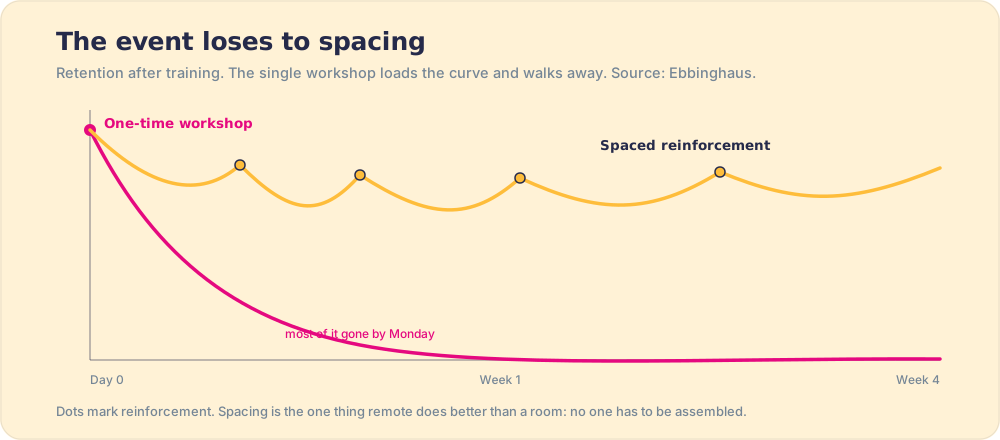
The forgetting curve is worth putting a number on, because it is the precise reason the one-time event was always a poor bet, in person or remote. Hermann Ebbinghaus, testing his own memory in the 1880s, found that without reinforcement people lose more than half of newly learned material within a day and the bulk of it within a week (Ebbinghaus, on the forgetting curve). A full-day workshop, however good the trainer, is loading the curve at its steepest point and then walking away. By the following Monday most of it is gone. This is not a remoteness problem and it is not a content-quality problem; it is a structure problem, and it sinks an in-person virtual sales training day exactly as fast as a recorded one. The only thing that flattens the curve is spaced reinforcement, returning to the material across time, which a single event of any kind cannot provide.
The science on the fix is unusually settled. Reviewing 184 studies of the spacing effect, the psychologist Nicholas Cepeda and colleagues found that spreading the same study time across multiple sessions reliably beat cramming it into one, often improving long-term retention by large margins (Cepeda et al., 2006). The implication for online sales training is direct: the same hours of content, broken into short lessons spaced over weeks, teach far more than the identical hours delivered in one sitting. And spacing is the one thing remote does better than a room, because no one has to be assembled. A distributed team can drip a lesson every few days across time zones without the logistical cost of getting everyone in one place, which is the cost that pushes co-located teams back toward the single annual event in the first place.
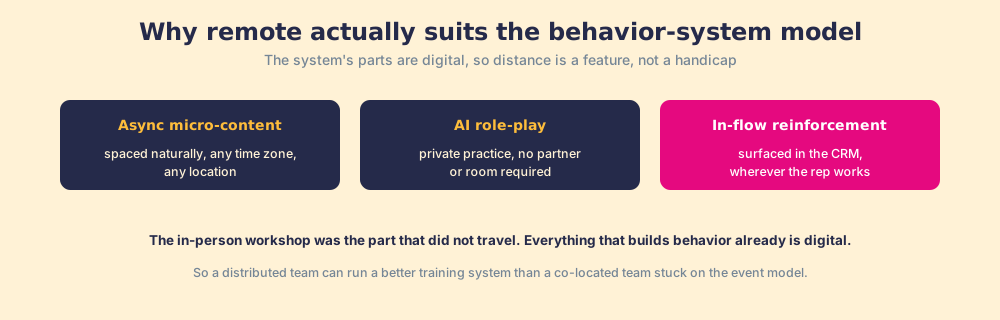
Why does remote suit the behavior-system model?
Because every part of a good training system is already digital, so distance is a feature rather than a handicap. Consider the components. Spaced micro-content distributes naturally: short async lessons reach any rep in any time zone, and spacing is easier when learning is not tied to gathering everyone at once. Practice through AI role-play is private and requires no partner or room, the sales role play bottleneck that distance used to make worse, now removed entirely. And reinforcement happens in the flow of work, surfaced in the CRM wherever the rep sits, which is location-independent by definition. The only part of training that ever depended on being in a room was the in-person workshop, and that was the part that did not work anyway. Everything that builds behavior is digital, so a distributed team can run the full system without losing anything.
- Async micro-content spaces naturally. Short lessons across time zones, spaced over weeks. Distance makes spacing easier, not harder.
- AI role-play removes the practice bottleneck. Private practice with no partner or room, the constraint distance used to worsen, now gone.
- In-flow reinforcement is location-independent. Surfaced in the CRM wherever the rep works, so it reaches a distributed team natively.
- Behavior is measured remotely. Adherence and call review are digital signals, so you can manage training by behavior across any distance.
The practice point carries more weight than it gets, so it is worth slowing down on. The psychologist Anders Ericsson spent his career showing that expertise comes not from exposure but from deliberate practice: repeated, effortful attempts at a specific skill, with immediate feedback, at the edge of current ability (Ericsson on deliberate practice). A workshop offers almost none of this. A rep watches, nods, and gets perhaps one awkward role-play with a peer. AI role-play offers the missing ingredient at scale: a rep can run the same discovery opening twenty times in an afternoon, get feedback each time, and fail privately without burning a real prospect or a colleague’s lunch hour. The thing that used to make practice scarce, needing a partner and a room, was always worst for distributed teams, and it is the exact thing AI removes. So distributed sales training does not merely match the room on practice; it can exceed it, because the practice is unlimited, private, and available the moment a rep wants a rep.
How do you build remote sales training that works?
Build a remote-native behavior system and stop porting the workshop. Replace the recorded event with short async lessons that space the learning, use AI role-play so every rep practices privately and often, and reinforce the trained behavior in the flow of work inside the CRM while measuring whether reps run it, the sales process adoption loop, which is digital and therefore distributed by default. Keep the live human element where it adds the most, coaching and feedback on real calls, which work fine over video when they are about a specific rep’s specific deal. The goal is not to recreate the room remotely; it is to build the system the room never delivered, using components that happen to suit distance. Done this way, remote sales training is not a compromise. It is the behavior system, built in the medium it was always best suited to.
What we recommend
Stop trying to make remote sales training work by recording the workshop, because that delivers a failed model with passivity added and teaches teams the wrong lesson, that remote is hard. The workshop failed for being a one-time event with no practice or reinforcement, and filming it fixes none of that. Instead, build a remote-native behavior system: spaced async micro-content, AI role-play for unlimited private practice, reinforcement in the flow of work, and measurement on behavior, every one of which is digital and suits distance. Keep live coaching for the feedback that benefits from a human, and run it over video on real deals. The surprise is that remote is not a constraint on good training; it is the natural home for it, because the only part of training that ever needed a room was the part that did not work. Build the system, not the recording, and a distributed team trains better than a co-located one ever did.
From here: the event-versus-system frame in sales training programs, the AI practice that powers it in sales role play, the metrics that judge it in sales training metrics, and the adoption underneath in sales process adoption.
Frequently asked questions
What is remote sales training?+
Does remote sales training work?+
Why is recording the workshop bad remote sales training?+
How do you do remote sales training well?+
Your process, running itself.