Sales Readiness: A Certified Rep Is Not a Ready Rep
Sales readiness gets measured by certifications and knowledge checks, which prove a rep knows the play, not that they can run it. Readiness is procedural, verified by behavior on real deals, and that changes how you measure it.
Sales readiness is a rep's ability to perform the right selling behaviors in the live moment of a real deal, which is procedural knowing-how, not the declarative knowing-that a certification measures, so a certified rep who cannot run the play is not ready.
Most sales readiness programs end with a certificate: the rep passed the assessment, completed the curriculum, is declared ready. Then the rep gets on a live call and freezes on the objection, skips the discovery, and forgets the qualification framework they aced last week. They were certified. They were not ready. The gap between those two states is not a failure of effort; it is a confusion about what readiness is. Passing a test proves a rep knows what to do. Readiness is whether they can do it, in the moment, on a real deal, under real pressure, and those are two different kinds of knowledge that no certification connects.
Sales readiness is a rep’s ability to perform the right selling behaviors in the live moment of a real deal, which is procedural knowing-how, not the declarative knowing-that a certification measures, so a certified rep who cannot run the play is not ready. Measure the right kind of knowledge, and readiness becomes real.
Why does certification not prove sales readiness?
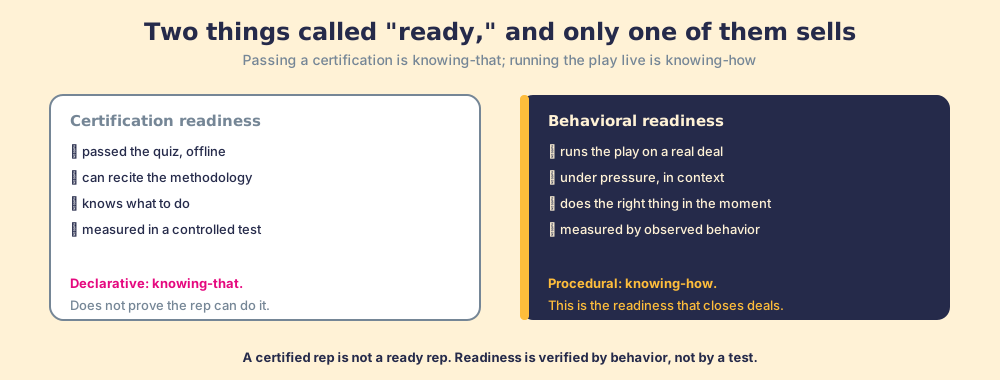
Because it measures the wrong kind of knowledge. Cognitive psychology draws a hard line between declarative knowledge, knowing-that, the facts and rules you can state, and procedural knowledge, knowing-how, the skill you can perform (on procedural versus declarative knowledge). They are stored and learned differently, and one does not imply the other. You can know every rule of swimming and drown; you can ride a bike and be unable to explain how. A certification tests declarative knowledge: can the rep state the methodology, recall the steps, pass the quiz. Readiness is procedural: can the rep perform the behavior when a live buyer pushes back. Testing the first and inferring the second is a category error, and it is the error baked into most readiness programs.
The two are not even stored in the same place. Cognitive neuroscience maps declarative memory to the hippocampus and medial temporal lobe, the system that files facts you can state, and procedural memory to the basal ganglia and cerebellum, the system that runs skills you perform without narrating. The classic evidence is the amnesiac patient H.M., who after surgery could not form a single new declarative memory yet learned a difficult mirror-drawing task day by day, improving steadily while swearing each morning he had never seen it before (on H.M. and procedural memory). His hands knew what his words could not reach. That dissociation is the whole problem with certification in one case study: you can build the skill without the ability to describe it, and you can ace the description with no skill at all. A quiz reads the file the basal ganglia never wrote.
So when someone asks what is sales readiness and is handed a certification score, the answer measures the wrong memory system. This is the knowing-doing gap wearing a different hat. The certified-but-not-ready rep knows exactly what to do and cannot yet do it under real conditions, because performing a skill under pressure is a separate ability from describing it, built only by doing it. A passed certification tells you a rep has the declarative half. It tells you nothing about the procedural half, which is the half that sells.
How is readiness different from enablement?
The sales readiness vs enablement distinction comes down to this: enablement is the input you provide; readiness is the verified output you confirm. A team enables reps by giving them content, training, and tools, the equipping side covered in sales enablement software. Readiness asks a harder, later question: given all that, can the rep perform on a real deal under pressure? The two are routinely conflated, which is how a heavily enabled team, drowning in playbooks and courses, can still field reps who are not ready. Being given knowledge is not being able to run the behavior. Enablement that stops at delivery has done half the job and measured none of it.
This is also where the tooling category gets confused. A sales readiness platform, in the way the term is usually sold, is a training-and-certification engine: it delivers courses, runs role-play and video practice, scores assessments. That is valuable for building proficiency, and it is still an enablement tool by the definition above, because it lives upstream of the real deal. It can tell you a rep practiced and passed. It cannot tell you the rep ran discovery on the live opportunity that closed last week, because the live opportunity is the one place these platforms do not reach. Naming a tool “readiness” does not relocate it to where readiness is verified. The selling happens in the flow of the work; most readiness software happens before it.
The shift from enablement to readiness is the shift from “did we provide it” to “can the rep do it,” and only the second question correlates with results.
- Enablement is the input. Content, training, tools, certifications: what you give the rep. Necessary, and not sufficient.
- Readiness is the verified output. Whether the rep performs the behavior on a real deal. The only one that predicts winning.
- The gap between them is the work. A rep can be fully enabled and unready, so readiness has to be confirmed by behavior, not assumed from enablement.
How is procedural skill actually built?
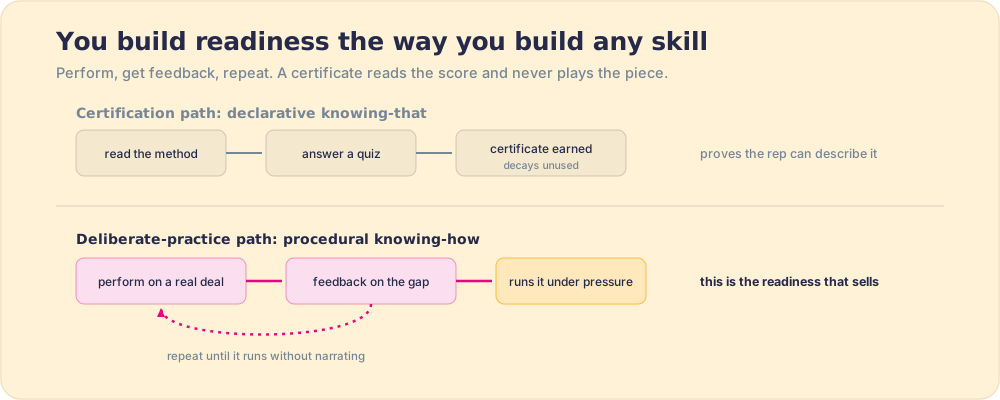
By performing it, with feedback, repeatedly, which is the one method certification skips entirely. Anders Ericsson spent his career studying how experts reach the top of their fields, and his finding was consistent across violinists, chess masters, and surgeons: the driver is deliberate practice, focused repetition of a specific skill with immediate feedback, not accumulated knowledge or time served (Ericsson on deliberate practice). A rep becomes ready the way a pianist becomes ready, by playing the piece under conditions that approximate performance, getting corrected, and playing it again, until the hands run it without the head narrating. A certification is the equivalent of reading the score and answering questions about it. Necessary to start, useless as proof you can play.
This is why readiness cannot be a one-time gate a rep passes and clears. Procedural skill that is not used decays, the same forgetting curve that erodes any unrehearsed capability, which means readiness is a state to be maintained rather than a certificate to be earned. The rep who was ready last quarter, on the motion that has since changed, is not ready now, and no certificate on file will tell you so. Only watching the behavior on current deals will.
How do you verify and build sales readiness?
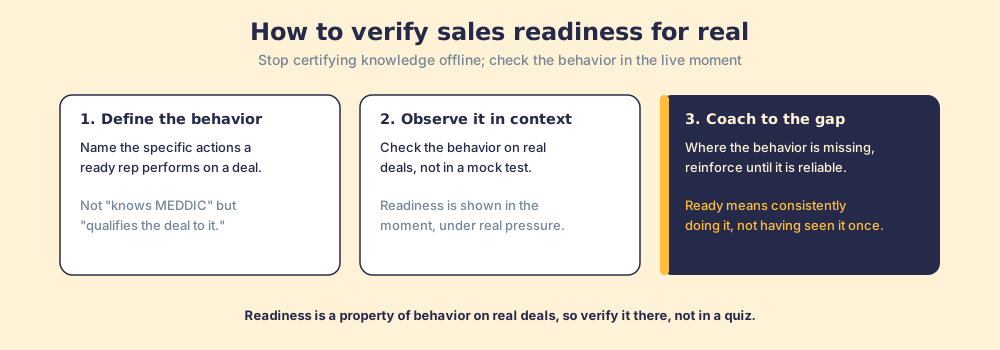
Confirm the behavior on real deals, and coach the gaps until it is consistent. Because readiness is procedural, it can only be verified where the behavior is performed: on real deals, under real conditions, not in a controlled assessment. So define the specific behaviors a ready rep runs, “qualifies the deal to the framework,” not “can name the framework,” then observe whether the rep performs them in context, and reinforce where they do not until the behavior is reliable. This is the loop in sales process adoption and sales coaching, applied to readiness: the standard is the behavior, and readiness is the rep doing it consistently in the moment. Build readiness the way procedural skill is always built, by doing it with feedback, and verify it the way procedural skill is always verified, by watching the performance, not grading the description.
What we recommend
Stop treating a passed certification as proof of sales readiness, because the certification measures knowing-that and selling requires knowing-how, and the two are different kinds of knowledge. A rep who can recite the methodology can still freeze on a live call, which is why certified-but-not-ready is the default state of most onboarding. Readiness is procedural: it lives in whether the rep performs the right behaviors on a real deal under pressure, and it can only be verified there. So define the behaviors a ready rep runs, observe them in context on actual deals, and coach the gaps until the behavior is consistent, rather than inferring readiness from a quiz score. The reason this works is that it measures and builds the kind of knowledge that sells, instead of the kind that merely passes a test. A certified rep knows the play. A ready rep runs it. Only the second one carries a number.
From here: the gap underneath in the knowing-doing gap, the equipping side in sales enablement software, the coaching that builds readiness in sales coaching, and the wider frame in the sales execution gap.
Frequently asked questions
What is sales readiness?+
How is sales readiness different from sales enablement?+
How do you measure sales readiness?+
Why does certification not prove readiness?+
Your process, running itself.