Sales Effectiveness: You Can Be Perfectly Efficient at the Wrong Things
Sales effectiveness gets confused with efficiency and activity, so teams buy tools that make reps busier and call it progress. Effectiveness is doing the right behaviors that produce the outcome, and it is measured differently.
Sales effectiveness is the degree to which reps do the right behaviors that produce sales outcomes, distinct from efficiency (doing things at lower cost) and activity (being busy), so a team can be highly efficient at the wrong things and remain ineffective.
Walk into most “sales effectiveness” initiatives and you find a project about efficiency: a faster CRM, an automation that sends more email, a tool that books more meetings. The team gets measurably busier, the cost per activity drops, and results do not move. The reason is a confusion buried in the word itself. Effectiveness, efficiency, and activity are three different things, and almost every team optimizes the bottom two while calling it the top one. You can be flawlessly efficient at exactly the wrong activity, and a great deal of sales investment buys precisely that.
Sales effectiveness is the degree to which reps do the right behaviors that produce sales outcomes, distinct from efficiency (doing things at lower cost) and activity (being busy), so a team can be highly efficient at the wrong things and remain ineffective. Separate the three, and you stop spending on speed when the problem is direction.
Picture a rower who has perfected his stroke. His form is flawless, his cadence high, his oars never catch a crab. He is, by any measure, efficient. He is also, it turns out, rowing in the wrong direction, and the more efficient he gets the further he travels from the dock. That is the whole subject in one image. Speed is a virtue only once you have the heading right, and most sales-effectiveness spending buys a faster stroke while leaving the heading alone.
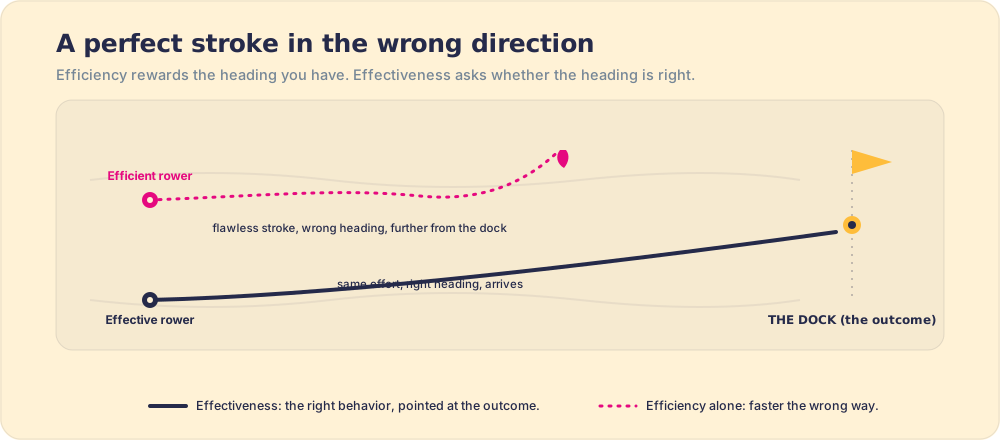
Why is efficiency not the same as effectiveness?
Because efficiency optimizes how you do something, while effectiveness asks whether it is the right something to do. Peter Drucker drew the distinction that has held for fifty years: “Efficiency is doing things right; effectiveness is doing the right things” (Drucker, on management). Drucker went further, and the further point is the one teams skip: “There is nothing so useless as doing efficiently that which should not be done at all.” The two qualities are independent. You can do the wrong thing with magnificent efficiency, low cost, high speed, full automation, and produce nothing, because the activity was never the one that mattered. This is why efficiency projects so often disappoint: they make the existing motion cheaper without asking whether the motion produces results.
The sales efficiency vs effectiveness distinction is not a word game; it decides where the money goes. Efficiency gains compound on whatever you are already doing, so if the motion is sound they multiply results, and if the motion is broken they multiply waste. A team that has not first established it is doing the right things is gambling that its current motion is correct, then pouring investment into making that unexamined motion faster. The research bears out how rarely the gamble pays. Gartner has found that despite years of automation and tooling, sellers spend only about a third of their time selling, the rest lost to administration and internal work, and adding tools to that picture tends to add administration, not selling. More efficiency, more busywork, a flatter number.
A sales team runs on three stacked layers, and they are easy to mistake for one another. Activity is the base: calls made, emails sent, meetings booked, pure busyness. Efficiency sits above it: the same activity done faster or cheaper, more emails per hour, a tighter CRM workflow. Effectiveness sits at the top, alone: doing the right behaviors that advance deals. Most tools and most metrics live in the bottom two layers, because activity is easy to count and efficiency is easy to sell. The top layer, whether reps are doing the right things, is harder to see and is the only one that decides outcomes.
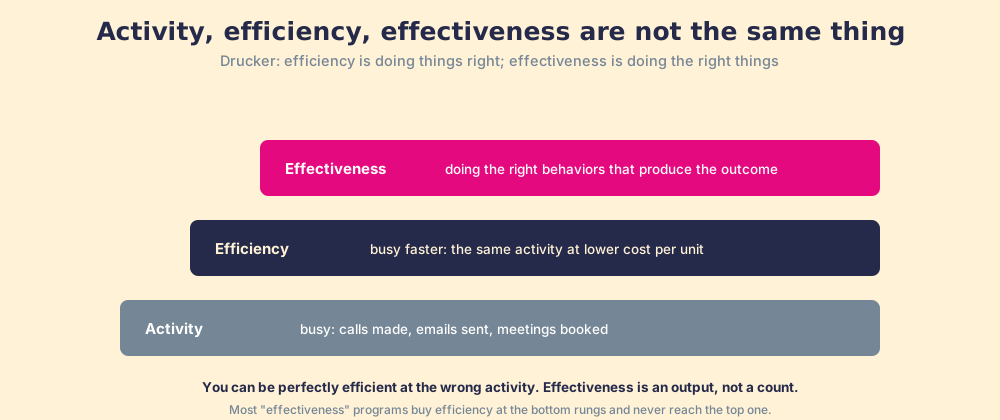
Isn’t activity a leading indicator of results?
This is the strongest objection, and it deserves a fair hearing because there is truth in it. A whole school of sales management, much of it good, argues that you should manage the inputs because the inputs are what a rep controls today, while the outcome is already decided. “You can’t manage results, you can only manage the activities that drive results,” runs the line, and it is half right. Outcomes are lagging; you cannot coach a closed-lost deal. So far, no argument.
Where it goes wrong is in treating all inputs as equal. Activity volume is an input, but it is the wrong input, because the link from raw volume to revenue is weak and easily gamed. Forty dials that skip discovery produce nothing; the input that mattered was the quality of the behavior, not the count of the action. The honest version of the leading-indicator argument is not “measure activity,” it is “measure the right behavior,” and the right behavior is rarely the thing that lands automatically in a dashboard. A rep can hit every activity target and run a hollow process, and the activity report will glow green the whole way to the miss.
So the leading-indicator school is correct that you manage inputs, and wrong about which inputs. The input worth managing is whether the rep ran the behavior that wins, discovery before demo, multi-threading, a real next step, not whether they were busy. That is the distinction between activity and effectiveness, dressed in management language.
How should you measure and improve sales effectiveness?
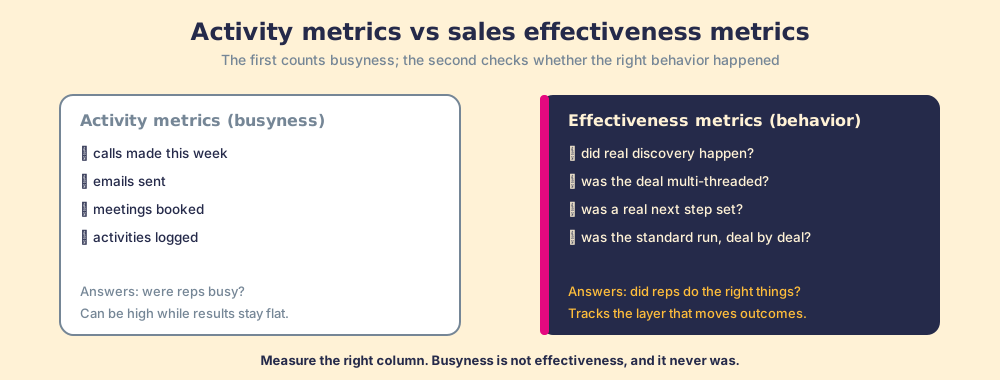
Measure whether the right behaviors happened, and improve by closing the gap between knowing them and doing them. The measurement shift is the hard part, because it means moving from activity metrics (how many calls) to behavior metrics (did the discovery happen, was the deal multi-threaded, was a real next step set). Activity counts tell you reps were busy. Effectiveness metrics tell you whether they did the things that win, which is the only question worth asking, and the one explored in sales process adoption and the broader sales execution gap.
Improvement follows from the measurement, and this is where how to improve sales effectiveness stops being a slogan and becomes a sequence. Once you can see whether the right behaviors are happening, you can close the gap where they are not, which is a behavior problem, not a tooling one. Buying efficiency for an ineffective motion only gets you to the wrong place faster. The mechanism behind that gap has a name, the knowing-doing gap, the well-documented distance between what people know to do and what they do under load, and it is the reason training alone rarely lifts effectiveness: training closes a knowledge gap the team mostly did not have.
- Define the right behaviors. Name the specific actions that correlate with winning, so “effectiveness” is concrete rather than a slogan.
- Measure behavior, not busyness. Check whether the standard was run, deal by deal, not how many activities were logged. The two are different questions.
- Close the doing gap, do not buy speed. Reps usually know the right behaviors; the work is getting them done consistently, which efficiency tooling cannot fix.
What are the right sales effectiveness metrics?
The ones that check behavior against a standard, not the ones that tally volume. The distinction between activity metrics and sales effectiveness metrics is the practical core of the whole idea. An activity metric answers “were reps busy?”, calls made, emails sent, meetings booked, and it can run high while results stay flat, because busyness is not the outcome. An effectiveness metric answers “did reps do the right things?”, did real discovery happen, was the deal multi-threaded, was a genuine next step set, was the standard run deal by deal. Only the second column tracks the layer that moves results, which is why a team drowning in green activity dashboards can still miss its number.
The trap is that activity metrics are easy to collect and effectiveness metrics are not, so teams measure what is convenient and mistake it for what matters. Building the harder measurement, behavior against a standard, is what lets you manage effectiveness instead of hoping for it.
What we recommend
Stop treating sales effectiveness as a synonym for efficiency or activity, because conflating them is how teams spend heavily and improve nothing. Efficiency makes your current motion cheaper and faster; effectiveness asks whether the motion is the right one, and a team can be exquisitely efficient at activity that never advances a deal. So define the behaviors that genuinely produce outcomes, measure whether reps perform them rather than how busy they are, and put your effort into closing the gap between knowing the right move and doing it. The reason this beats another productivity tool is that it works on the layer that decides results, doing the right things, rather than the two layers below it that merely feel like progress. Efficiency is doing things right. Effectiveness is doing the right things. Only one of them shows up in the number.
From here: the discipline that produces the right behavior in sales process adoption, the gap it lives in at the sales execution gap, the management loop in sales performance management, and the knowing-doing problem underneath in the knowing-doing gap.
Frequently asked questions
What is sales effectiveness?+
What is the difference between sales efficiency and effectiveness?+
How do you measure sales effectiveness?+
How do you improve sales effectiveness?+
Your process, running itself.