Product Knowledge Training: The Most Over-Invested Skill in Sales
Product knowledge training was the safe bet in enablement: teach the features and watch them sell. AI made the spec free to retrieve, so most of that spend now buys what a machine gives away. Here is the part that still pays.
Product knowledge training teaches a rep what your product does, what it costs, and how it fits, but the part that wins deals is applying that knowledge inside diagnostic discovery, translating one feature into the buyer's real problem in the live moment.
Walk into almost any sales onboarding and the first two weeks look the same: product training. Slide after slide of features, a certification quiz, a competitive battlecard the rep is told to internalize. It is the safest line item in the enablement budget, because it feels like the obvious foundation. Teach them the product, then they can sell it. The trouble is that this is the most over-invested part of enablement, and the year it stopped being the foundation was the year a rep could ask an AI assistant for any spec and get it back in seconds.
Product knowledge training teaches a rep what your product does, what it costs, and how it fits, but the part that wins deals is applying that knowledge inside diagnostic discovery, translating one feature into the buyer’s real problem in the live moment. Get that distinction right and a large share of the budget for sales product training moves.
Is product knowledge in sales still worth teaching?
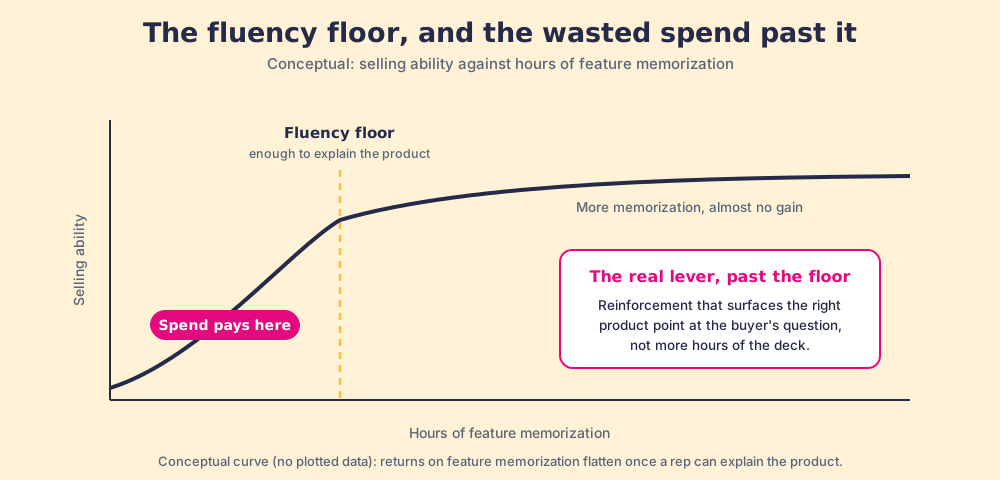
Yes, and we should say so plainly before taking the harder turn, because the contrarian version of this argument usually overshoots into “product training is useless,” which is wrong. A rep who cannot explain what the product does is sunk. Nobody buys from someone who fumbles the basics, and a buyer reads a rep’s command of the product as a proxy for whether the company can be trusted with their problem. There is a floor of fluency, the point where the rep can describe the product clearly, field the common questions without stalling, and know where the edges are. Below that floor, no amount of charm closes anything.
So this is not a case against product knowledge in sales. It is a case about where the floor sits and what happens above it. Picture a new rep climbing toward competence. The first hours of product training buy a lot: they take someone who knows nothing to someone who can hold a credible conversation. Then the curve bends. Once the rep can explain the product, the tenth datasheet adds almost nothing the ninth did not, while the budget keeps treating every additional hour as if it were the first.
Why does product knowledge training stop paying off?
Two forces meet above the fluency floor, and together they drain most of the return out of the spend.
The first is memory, and it is not kind to training. Hermann Ebbinghaus mapped the forgetting curve in 1885, and the sales numbers track its shape with grim precision. Sales Performance International, studying sales programs specifically, found that reps forget about 84 percent of what they were taught within 90 days. So the certification a rep aced in week two is, by the next quarter, mostly gone. Pour more product facts into that leaky bucket and most of them run out the bottom before a buyer ever asks.
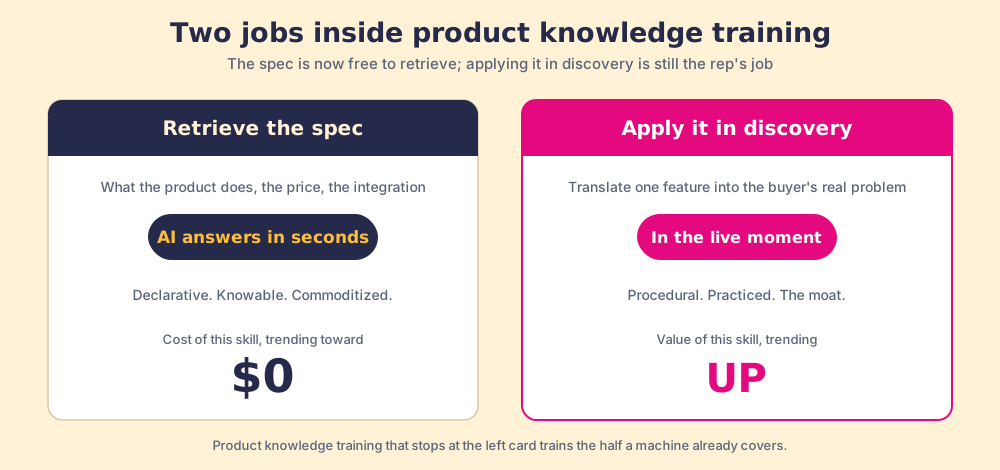
The second force is newer and sharper. The thing product training delivers, declarative knowledge, the spec, the comparison, the price, is the thing AI now hands over for free. A rep with a phone can retrieve the integration list, the feature a competitor lacks, and a tailored one-line answer faster than they could find it in their own notes. Knowledge has become the cheap part of selling. What stays expensive, and therefore valuable, is whether the rep does the right thing with it while a real buyer is pushing back.
Frank Cespedes of Harvard Business School, who has written more sense about sales training than almost anyone, put the structural problem plainly: most sales training is an event, disconnected from the actual selling context and rarely reinforced, so it fails on its own terms (Cespedes, “Your Sales Training Is Probably Lackluster,” HBR, 2017). He is right, and product training is the purest example. It is the most event-shaped, least reinforced, most quickly stale content in the whole curriculum, and it is the line companies fund first.
What does product training for sales reps miss?
Here is the move that separates a rep who knows the product from a rep who sells with it. A buyer almost never asks, “list your features.” They say something like, “our reps spend the first hour of every renewal call rebuilding context.” That sentence is a problem looking for a translation. The skilled rep hears it, reaches for the one capability that dissolves that exact pain, and connects the two in front of the buyer. That connection is the skill. It is procedural, the kind of knowing you build by doing, and a deck readout does not install it any more than reading a swimming manual keeps you afloat.
This is why the loss data points away from recall and toward application. The Jolt Effect, Matt Dixon and Ted McKenna’s study of 2.5 million sales calls, found that 40 to 60 percent of qualified deals are lost to “no decision,” and that 56 percent of those losses trace to the buyer’s own indecision and fear rather than a preference for a competitor (Dixon & McKenna, “Losing to Customer Indecision,” Challenger). Read that against a product-training budget. Those deals were not lost because the rep could not recite a feature. They were lost because the rep did not surface the right point at the moment that would have quieted the buyer’s fear. More memorization does nothing for that. Better application in discovery is the whole lever.
The science of how skill is built says the same. Anders Ericsson’s 1993 study of violinists established that expert performance tracks accumulated deliberate practice, focused repetition with immediate feedback on a specific weakness, not hours of passive instruction (Ericsson, Krampe & Tesch-Römer, Psychological Review, 1993). A product certification has almost none of those ingredients. A rep’s actual week, full of real calls and real questions, has all of them, and most teams waste it. The same procedural truth sits under why training rarely builds the sales skills that move deals.
What to do with the product-training budget
US companies spend somewhere around $15 to $20 billion a year on sales training, on the order of $1,459 per rep, and product training takes a healthy slice of it. There are three ways to spend that slice, and only one of them pays back past the fluency floor.
- The certification reflex. Keep funding decks, quizzes, and recertifications, and watch about 84 percent of it leave the building inside 90 days (Sales Performance International). This buys the fluency floor once and then keeps paying for a bucket with a hole in it.
- The retrieval crutch. Lean on AI to hand reps the spec on demand and call the knowledge problem solved. This is genuinely useful for the declarative half, and reps should use it. By itself it does nothing for whether the rep applies the point in the live moment, because retrieval is not application.
- Reinforcement in the flow of work. Fund the fluency floor once, then put the marginal dollar into delivering the right product point the instant a buyer raises the concern it answers, and inspecting whether reps make that connection on real calls so a manager can coach the gap.
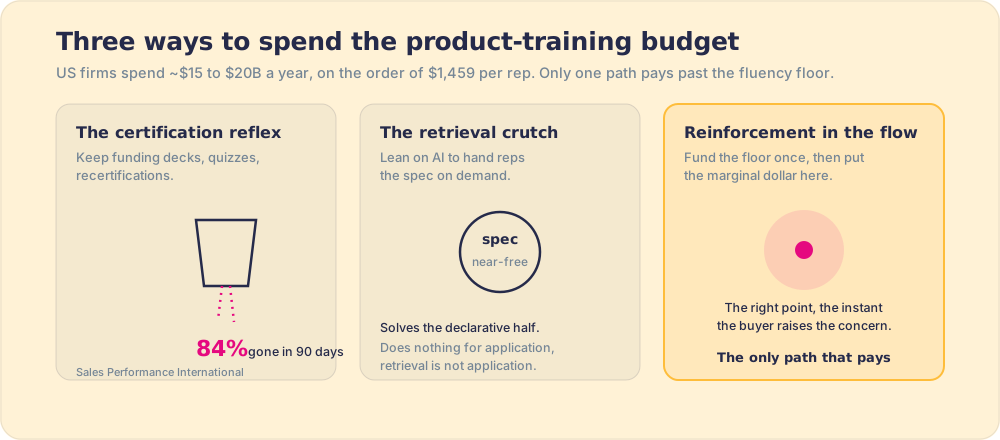
We recommend the third, without hedging, because it is the only one the mechanism supports. The first fights the forgetting curve and loses. The second solves a problem that is already mostly solved. The third matches how procedural skill is built, deliberate practice with feedback, at the point of work. This is the job the sales training software category is finally being judged on, and the same shift that is redefining what sales enablement means in 2026. The test is no longer whether a platform can deliver a course. It is whether it changes what a rep does on the next call. It is also why coaching outperforms classroom training on nearly every study that compares them, coaching is practice with feedback, and product training is information transfer.
Supered exists to be that layer, the Behavior Layer, surfacing the relevant product point and the next best step the instant the buyer’s question arises, in the flow of the rep’s work, so the connection gets practiced where it gets used. The deeper category shift, away from content-heavy enablement and toward in-flow reinforcement, is the through-line of the State of Sales Enablement, and product knowledge is the cleanest case for it.
The product training was never wrong to exist. A rep has to be able to explain what they sell. The mistake is funding it like the foundation when it is the floor, and treating recall as the skill when the skill is application. Teach the product once, well enough to clear the floor. Then put the money where the deals are won, in the moment the buyer asks.
Frequently asked questions
What is product knowledge training?+
How much product knowledge do sales reps actually need?+
Why does product knowledge training fail to improve sales results?+
What should replace traditional product training for sales reps?+
Your process, running itself.