Sales Simulation: It Only Builds the Skill If It Is Realistic Enough to Transfer
A sales simulation is deliberate practice at scale, but only if it is realistic enough to transfer. Low-fidelity, multiple-choice simulations train a test; high-fidelity AI buyers build the behavior reps use on real calls.
A sales simulation is a practice environment that imitates a real sales conversation, and it builds skill only when its fidelity is high enough to transfer, because a low-fidelity, scripted simulation trains the test rather than the behavior a rep needs on a real call.
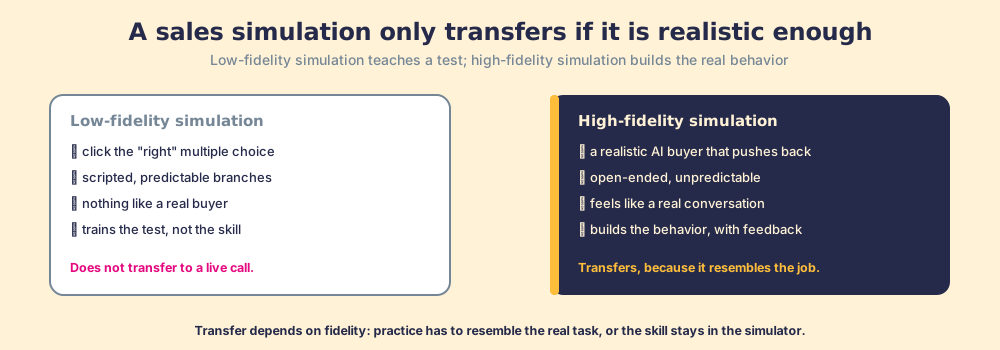
Here is a buyer’s problem that almost nobody states out loud. Two sales simulation products sit on the same shortlist. Both demo well. Both claim AI buyers, scenario libraries, scoring dashboards. One of them, used for a quarter, makes reps measurably better on real calls. The other makes reps better at the simulation and nothing else. Nothing on the feature list tells you which is which, and the property that decides it is the one buyers rarely scrutinize: fidelity, how closely the practice resembles the real task. A high-fidelity simulation, a buyer who pushes back in ways the rep cannot predict, builds the behavior a rep will use on a live call. A low-fidelity one, where you click the “right” multiple-choice answer through scripted branches, trains the rep to pass that specific test and builds nothing they can carry out the door. The two can look identical in a sales simulation software bake-off. They are not.
A sales simulation is a practice environment that imitates a real sales conversation, and it builds skill only when its fidelity is high enough to transfer, because a low-fidelity, scripted simulation trains the test rather than the behavior a rep needs on a real call. Buy and build for fidelity, and the simulation does real work. Buy for scenario count, and you have bought a quiz.
Why does fidelity decide whether a sales simulation works?
Because skill transfers from practice to the job only when the practice resembles the job, and a low-fidelity simulation does not resemble it. This is not a hunch; it is one of the oldest and best-replicated findings in the science of learning. A century ago, Edward Thorndike and Robert Woodworth ran the experiments that named it the “identical elements” theory of transfer: training carries over to a new task only to the degree the two share concrete features, and practice on a task that merely looks related produces little or no transfer to the real one (Thorndike and Woodworth, 1901). Timothy Baldwin and Kevin Ford, reviewing the modern training-transfer literature, reached the same conclusion in management terms: the similarity between practice conditions and the actual job is among the strongest predictors of whether a skill shows up at work (Baldwin and Ford, 1988, Personnel Psychology).
Apply that to the two products on the shortlist. A high-fidelity sales simulation shares the concrete features of the real task: an open-ended conversation, a buyer who reacts unpredictably, the need to read a moment and respond on the fly with no menu to choose from. The rep practices the exact skill they will use. A low-fidelity simulation shares almost none of those features. Its concrete elements are reading four written options and clicking the best one, a task the rep will never perform in front of a buyer. So the skill it builds, picking the right answer from a list, has nowhere to go. By Thorndike’s own logic it cannot transfer, because the elements are not identical, they are not even close.
There is a sharper danger than zero transfer, and the research has a name for it too: negative transfer. A practice environment can teach a habit that hurts on the real task. A scripted simulation rewards the rep for scanning for the “correct” pre-written response, which on a live call becomes the worst instinct there is, waiting for the buyer to say the line you were trained to counter instead of listening to the human in front of you. Robert Bjork’s work on “desirable difficulties” sharpens the point from the other side: practice that feels smooth and easy in the moment tends to produce the worst long-term retention, while practice that is effortful and unpredictable, the kind that makes you struggle, builds durable skill (Bjork, on desirable difficulties). A multiple-choice simulation is engineered to feel smooth. That smoothness is the tell.
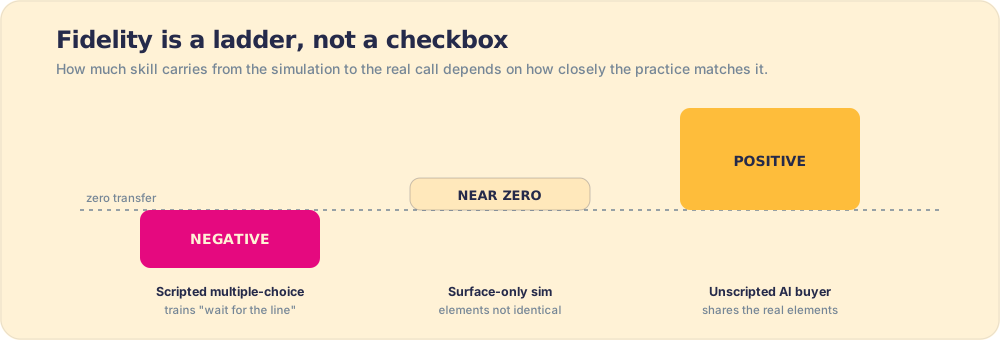
This is the same logic as a flight simulator, and the comparison is exact rather than cute. A certified flight simulator builds real piloting skill because the cockpit, the instrument lag, the way the aircraft fights back in a crosswind, all share the concrete elements of flying the plane. A video game with a joystick does not, because it shares only the surface. A scripted, multiple-choice sales simulation is the video game: the surface of practice without the elements that make practice transfer. The question to ask of any sales simulation is never how many scenarios it ships or how slick the interface looks. It is whether practicing in it is hard in the way the real conversation is hard, because that difficulty is the thing that follows the rep out of the simulator.
What does a sales simulation give you that role-play could not?
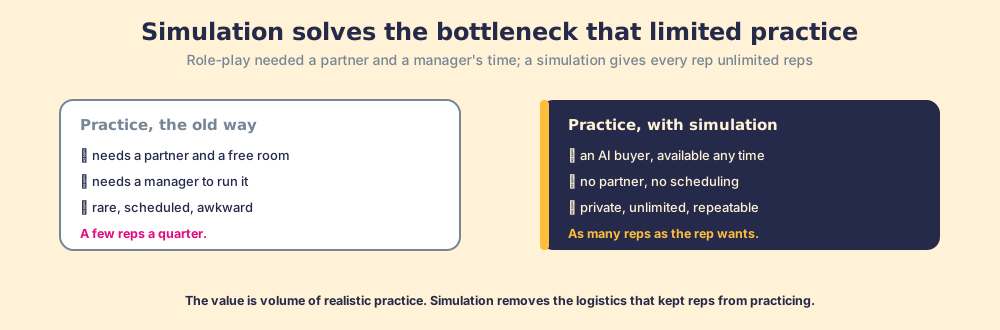
Volume, because it removes the logistics that kept reps from practicing. The reason reps rarely practiced was never that practice did not work; it was that traditional sales role play needed a partner, a free room, and a manager to run it, so it happened a few times a quarter at most. A sales simulation removes all of that: an AI buyer available any time, no scheduling, no partner, no awkwardness, so a rep can practice a hard conversation as many times as they want, privately. That unlocks the one thing deliberate practice requires and reps never had enough of, volume of repetition.
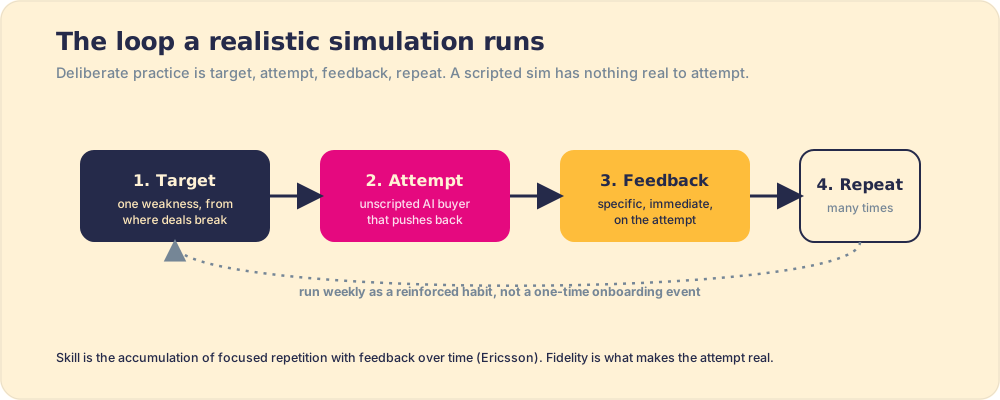
This matters more than it sounds, because the science of skill is unforgiving about volume. Anders Ericsson, whose research on expert performance is the source most of the “10,000 hours” talk distorts, found that what separates elite performers is not raw practice time but the accumulation of deliberate practice: focused repetition of a specific weakness, against a clear standard, with immediate feedback (Ericsson, in Harvard Business Review). The constraint was never the willingness to practice. It was access to enough repetitions of the right kind. A team that could give every rep three role-plays a quarter was rationing the one input that builds the skill. An AI sales simulation lifts the ration. The rep who fumbles objection handling can run the same hard moment thirty times before lunch, which is the difference between hearing about a skill and owning it.
So the honest framing of what AI sales simulation gives you is not “it replaces the coach.” It does not, and it should not try. It removes the scarcity that made deliberate practice a luxury, and turns it into something a rep can do alone, on demand, as often as the work requires. The value is the volume of realistic reps, which is the bottleneck that always limited skill-building, finally relieved.
- Unlimited reps. An AI buyer is available any time, so practice is bounded only by the rep’s effort, not by logistics.
- Private and low-stakes. No peers watching, no manager to schedule, so reps practice the things they are weakest at without embarrassment.
- Realistic and repeatable. A high-fidelity buyer lets reps run the same hard scenario until the behavior is solid, which is how skill forms.
- Feedback built in. A good simulation scores the attempt, so the practice has the feedback deliberate practice requires, the AI sales coaching capability.
How do you use a sales simulation so it builds real skill?
Buy for fidelity, point it at the behaviors that matter, and reinforce the practice rather than treating it as a one-time test. Each of those three is a direct reading of the research above, not a preference.
- Buy for fidelity, not scenario count. Thorndike’s identical-elements rule means the only thing that matters is whether practicing resembles the real conversation. Test it the way you would test a flight simulator: have a strong rep run it and ask whether it surprised them, whether the AI buyer broke from a script and made them think on their feet. If it never did, it is a quiz with a chat interface.
- Aim it at where deals break. Unlimited reps spent on a skill that was never the problem build nothing that matters. Pull the two or three moments your loss data and call reviews show deals dying, the botched discovery, the dropped objection, the flabby value story, and point the sales simulation training there.
- Run it as a reinforced habit, not a one-time certification. Ericsson’s whole finding is that skill is the accumulation of practice over time. A simulation used once at onboarding is an event; a simulation run weekly, with feedback, against a known standard, is the sales training programs system doing its job. Skill decays without reuse, so the cadence is the product, not the kickoff.
It is worth voicing the strongest objection to all of this, because it is a fair one. A skeptic says: an AI buyer is not a real buyer, so any simulation is low-fidelity by definition, and the whole category is a costly way to look busy. Grant the first half. No simulator is the real thing, which is exactly why a flight school still puts pilots in real aircraft before it hands them passengers. But “not perfect” is not “not useful.” The certified flight simulator does not have to be a storm to teach a pilot how to fly through one; it has to share enough of the storm’s concrete demands that the skill carries. A sales simulation clears the bar the same way, when the AI buyer is unscripted enough to force real-time reading and response. The skeptic is right that fidelity is never total. They are wrong that it is therefore worthless. Fidelity is a dial, and the whole argument here is to turn it up.
A high-fidelity simulation used as a regular practice habit, aimed at the right behaviors, is the closest a team can get to giving every rep a private flight simulator. A low-fidelity one used as a test is a checkbox that builds nothing.
What we recommend
Judge a sales simulation by its fidelity, because fidelity is what decides whether the practice transfers to a real call. A high-fidelity simulation, a realistic AI buyer who reacts unpredictably, builds the behavior a rep uses on a real call; a low-fidelity, scripted one trains the rep to pass a test that resembles nothing they will face. The simulation’s real value is volume: it removes the partner-and-scheduling logistics that kept reps from practicing, giving every rep unlimited, private, realistic reps, which is the repetition deliberate practice always needed and never had enough of. So buy for realism, not for scenario count or interface polish, aim the practice at the behaviors where your deals break, give it feedback, and run it as a reinforced habit rather than a one-time certification. A realistic simulation, practiced often, builds skill at scale. A scripted one trains the simulator and nothing beyond it.
From here: the practice it scales in sales role play, the AI feedback that powers it in AI sales coaching, the system that runs it in sales training programs, and the adoption underneath in sales process adoption.
Frequently asked questions
What is a sales simulation?+
Do sales simulations work?+
What makes a good sales simulation?+
Why use a sales simulation instead of role-play?+
Your process, running itself.