Sales Enablement Playbook: The Operating System, Not the Binder
Most sales enablement playbook guides hand you a binder of programs and assets. Here is the version that actually changes behavior: a written loop with the inspection cadence named.
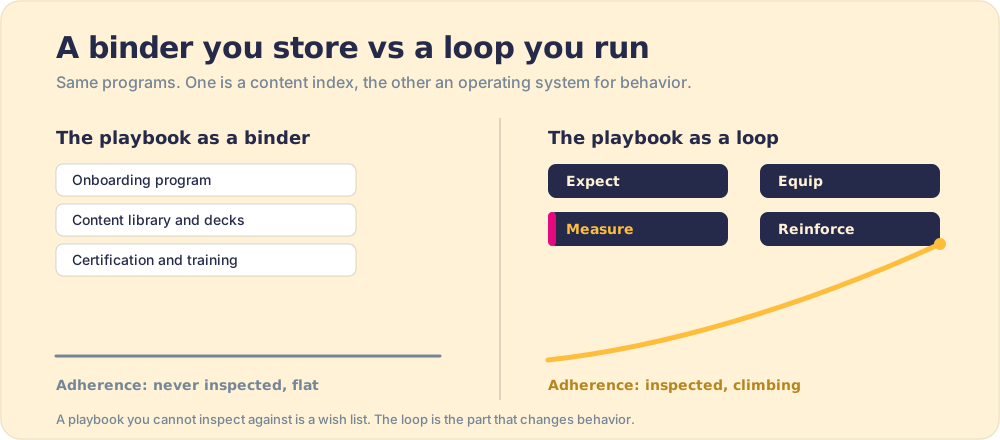
A sales enablement playbook is the enablement function's written operating system for changing rep behavior; it is a loop of Expect, Equip, Measure, and Reinforce with the inspection cadence named, not a binder of programs and assets.
A new head of enablement gets handed the playbook on day one. It is a handsome thing: a shared drive with an onboarding curriculum, a content library of nine hundred approved assets, a certification track, a quarterly training calendar. Every program is documented. Every asset is tagged. And when she asks the simple question, “are reps running the process we trained them on,” she gets shrugs, because nothing in the binder can answer it. The playbook documents what enablement offers. It says nothing about what reps do.
Almost no sales enablement playbook guide names that gap. The market treats the playbook as a content index, a binder of programs you assemble until the table of contents looks complete. Onboarding, check. Content, check. Certification, check. The trouble is that a binder stores programs and runs none of them. Defined more usefully, a sales enablement playbook is the enablement function’s written operating system for changing rep behavior, a loop of Expect, Equip, Measure, and Reinforce with the inspection cadence named, not a binder of programs and assets. A playbook you cannot inspect against is a wish list. You can document every program in the company and still not move a single rep’s behavior, because documentation is not running a process, and a process exists only to the degree adherence to it is inspected.
What is a sales enablement playbook, exactly?
Strip away the shared-drive folders and a sales enablement playbook is the written answer to one question: how does the enablement function change what reps do? The answer covers how the team takes a standard and makes reps run it on real deals. Content inventories and training logs are supporting detail. Everything else in the binder serves that job or decorates it.
The reason this definition matters is that the two readings lead to different work. Read the playbook as a content index and every gap looks like a program to build: no objection-handling course, build one; no battlecard library, assemble it. Read it as a behavior system and the question changes to whether reps run the motion the programs were built to install. A certification no rep applies on a live call is a transcript. The category is filled and the behavior is missing, and only one of those shows up in a board deck.
Some teams call it their enablement playbook, others their enablement operating model. The label changes nothing. The test is whether the document tells you how the function changes behavior, or only what it owns.
This is not a small distinction, and the field is starting to admit it. The Sales Enablement Collective’s 2025 Impact of Enablement report found that 79.7% of enablement leaders say their reps leave at least 40% of a stand-alone tool’s features untouched (SEC). Four out of five teams pay for capability the people it was bought for never use. A playbook that only catalogs what enablement offers is a playbook that cannot see this problem, let alone fix it, because the problem sits in what got adopted, and the catalog lists only what was offered.
How is a sales enablement playbook different from a sales playbook?
The confusion costs the most here, so draw the line cleanly. The two documents share a word and almost nothing else.
The sales playbook is the rep’s how-to-sell. It is owned by the rep and it is about a deal: the stages and exit criteria, the discovery questions, the scripts, the objection handling, the email and call sequences that move a buyer from a first meeting to a signature. When a rep opens it, the question in their head is “how do I sell this?” It is a fine and necessary document.
The sales enablement playbook is the enablement team’s how-to-run-enablement. It is owned by the enablement function and it is about the system, not the deal: how the team sets the standard reps run, how it delivers the next right action in the flow of the work, how it inspects whether reps follow the process, and how it coaches off that signal. When an enablement leader opens it, the question is “how do we make every rep run the sales playbook?”
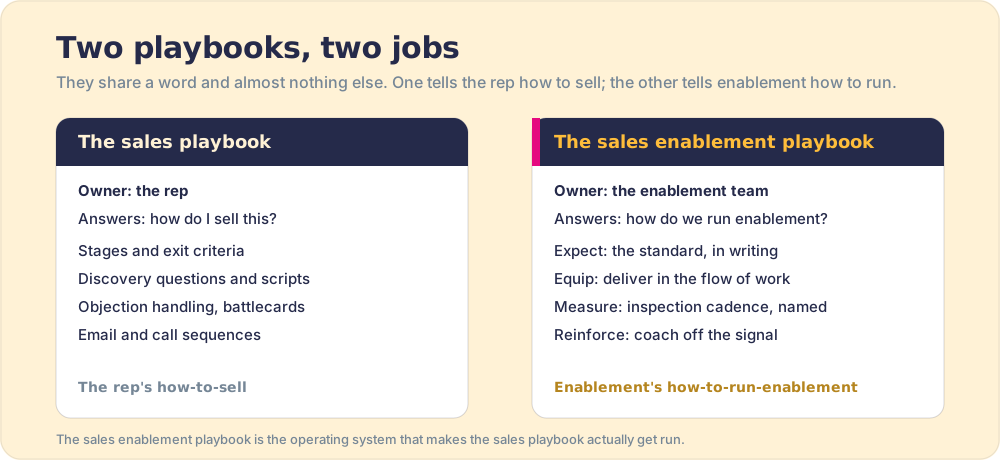
Put plainly: the sales playbook is the motion, and the sales enablement playbook is the system that gets the motion adopted. You can write a brilliant sales playbook and have it sit unread on a wiki. The enablement playbook is the document whose entire job is to keep that from happening. Confuse the two, and you spend your year polishing the rep’s binder while the question of whether anyone runs it goes unasked.
What does the field tell you to put in a sales enablement playbook?
Read the most-cited guidance on this topic and a clear orthodoxy appears, and it gets a great deal right. The standard answer, from analyst frameworks to the loud voices in enablement communities, is to define your buyer personas, map content to the buyer’s journey, build an onboarding and certification program, establish a content governance process, and set up a feedback loop with sales. The Sales Enablement Collective, the field’s largest practitioner community, organizes its guidance around exactly these pillars.
None of that is wrong, and we agree with most of it. You should map content to the journey. You should certify reps. The trouble is where the orthodoxy stops. It builds the Expect and the Equip, the standard and the materials, and then it stops at “set up a feedback loop,” which in practice means a quarterly survey and a content-request form. The one section that turns the playbook from a binder into an operating system, the inspection cadence, the named rhythm by which someone checks whether reps run the standard, is the section that gets left blank.
The orthodoxy makes the same mistake about training itself. Knowing better is not doing better. A playbook can deliver perfect knowledge, the cleanest decks, the sharpest certification, and change nothing, because a rep who can pass a quiz on discovery still skips discovery under quota pressure. The rep has no attention to spare hunting for the standard: Gartner found 77% of sellers struggle to complete their assigned tasks efficiently, buried in tools and admin (Gartner). The lever is measuring an output, whether the rep runs the standard, and coaching off what you find. More input does not move it. CSO Insights, the research arm now inside Korn Ferry, found that teams running dynamic, data-backed coaching post win rates roughly 28% higher than teams without it (cited via SEC). The lift does not come from owning a coaching program. It comes from the coaching happening, reliably, against the inspected reality of real deals.
What goes in a sales enablement playbook template?
A real template has five sections, and the order is the argument. Most published templates give you the first two and gesture at the rest. The version that drives behavior fills all five, and treats the third as the keystone.
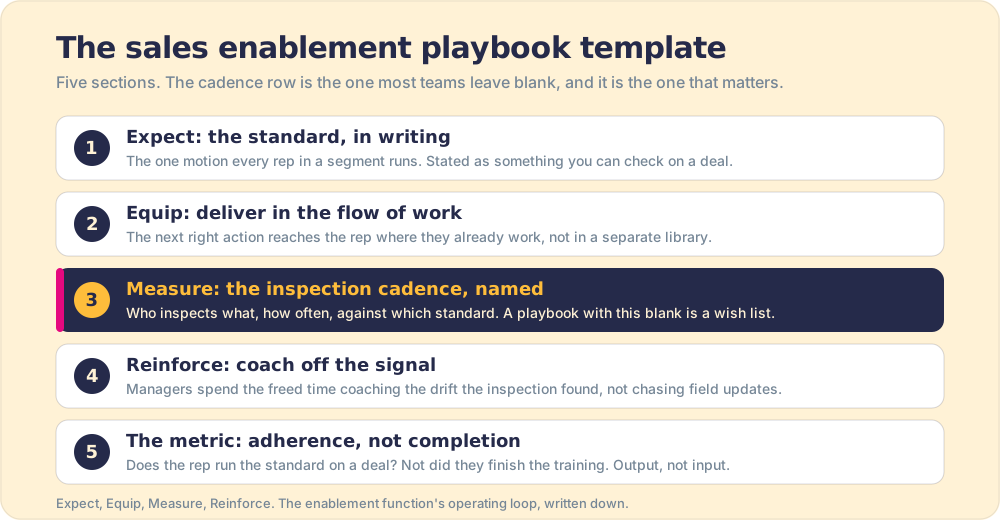
- Expect: the standard, in writing. Name the one motion every rep in a segment should run, stated as something you can check on a deal. Not “do good discovery,” but “MEDDIC fields complete before stage three.” You can only expect what you can inspect, and you can only inspect what you have defined. Your team already has a process, probably undocumented, living unwritten in the heads of your best reps. The first job is to capture it and write it down.
- Equip: deliver in the flow of the work. Specify how the next right action reaches the rep at the moment they need it, where they already work, not in a separate library they must remember to open. A standard that lives in a wiki is a standard reps meet once and forget. The fix is delivery, not more content.
- Measure: the inspection cadence, named. Who inspects what, how often, against which standard. This row separates an operating system from a binder. Write down that pipeline reviews check stage-exit adherence weekly, that managers review one deal per rep against the standard each week, that the standard is the written motion from the Expect row. A sales enablement playbook template with this section blank is a wish list with a logo.
- Reinforce: coach off the signal. State how managers turn what the inspection found into coaching: the drift gets a useful nudge this week, not a quarter-end autopsy. Inspection is mandatory, but its prize is freeing the manager’s time so the human hours go to coaching rather than chasing field updates.
- The metric: adherence, not completion. Name the one number the playbook is judged on. It is whether the rep runs the standard on a deal, not whether they finished the training. Output, not input. A playbook that reports trainings completed is reporting a 2022 metric.
The shape is easy to copy. The work, and the reason two teams can clone the same template and get opposite results, is in filling the Measure row with a real cadence and then running it. The form is not the function.
How does a sales enablement playbook actually drive behavior?
Through the cadence, and through measuring the right thing. Naming an inspection rhythm sounds like bureaucracy. It is the mechanism by which a written standard becomes a run standard, because a process exists only to the degree adherence to it is inspected, and adherence is the hidden lever beneath every other enablement question. You cannot ask “what should we change?” until you can answer “is the process being followed?”
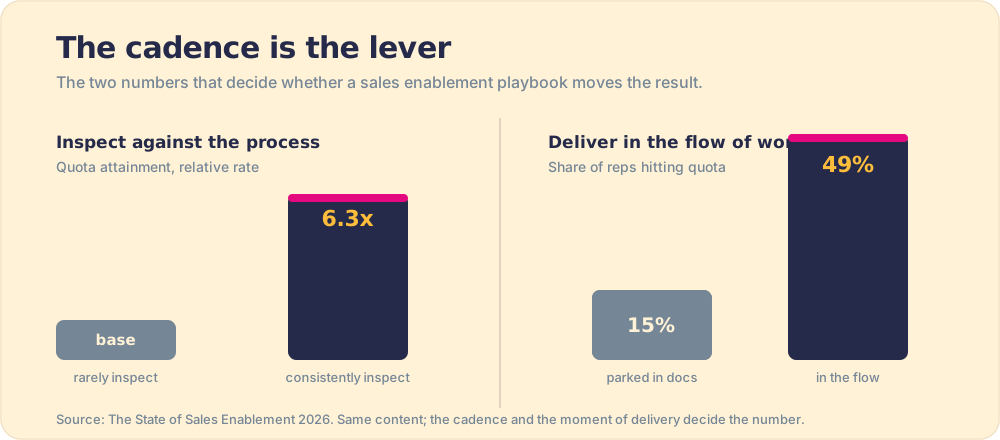
The numbers make the case better than any argument. In the State of Sales Enablement 2026, teams that consistently inspect deals against a defined process hit quota at 6.3 times the rate of teams that rarely do, the single largest effect we measured (State of Sales Enablement 2026). And the same survey found that guidance embedded in the flow of the work has 49% of reps hitting quota, against 15% when that guidance lives in docs, wikis, and a separate tool. Same content. The cadence and the moment of delivery decide the number.
Think of the playbook as a thermostat, not a thermometer. A thermometer reads the temperature and reports it, which is what a content index does: it tells you what programs exist. A thermostat senses the gap between the standard and the reality and acts to close it, over and over, on a cadence. The enablement playbook that changes behavior is the thermostat. It names the temperature you expect, it reads the room continuously, and the loop keeps pulling the two together. A binder is a thermometer someone left in a drawer.
Teams that consistently inspect deals against a defined process hit quota at 6.3 times the rate of teams that rarely do. Inspection is the largest single lever we measured. The cadence is not the boring part of the playbook. It is the playbook.
There is a fair objection here, and it deserves a straight answer. Inspection sounds like surveillance, the kind of thing that turns a sales floor sour. Grant the worry its full weight. The reason inspection gets skipped is that done by hand it is tedious and it does eat into trust, because a manager combing through fields all week is a manager doing nothing but checking. But the failure when reps do not follow the standard is almost never a people failure. It is a system failure: the right action was late, or buried in a separate tool, or never inspected, so drift went unseen until it set. The fix is to lift the inspection burden off the manager so it happens automatically, which frees the human time for coaching. Inspect the system, coach the person.
Supered is the Behavior Layer: it surfaces your process and content in the flow of the work, inside HubSpot, Salesforce, Salesloft, Gong, and Gmail, and measures whether reps follow it, deal by deal, so the inspection cadence runs itself and the manager’s time goes to coaching. It is one concrete instance of the principle. The principle stands without us: a playbook drives behavior only when it names the cadence and measures the output.
What we recommend
A clear choice sits under this topic, and it is not about how good your content is. You can build the playbook as a content index, a beautiful binder of programs and assets that documents what enablement offers, and accept that you will never be able to answer whether reps run any of it. Or you can build it as an operating system: write the standard, deliver it in the flow of the work, name the inspection cadence, and coach off the signal.
We recommend the operating system, without hedging, and the evidence is why. The SEC’s 79.7% finding says the content you offer goes largely unadopted, so cataloging it changes nothing. CSO Insights says the win rate moves when coaching happens against real deals, not when a coaching program is owned. Our own data says inspection is a 6.3x lever and in-flow delivery more than triples quota attainment, 49% against 15%. Put the three together and the programs look necessary and insufficient. Behavior is won in the Measure row, the one a binder leaves blank.
So build the binder, and stop calling it the playbook. The playbook is the loop, and the loop lives or dies on the cadence you are willing to name and run. If you want the wider plan the playbook executes against, start with sales enablement strategy; if you want to know where your function sits on the arc from binder to operating system, the sales enablement maturity model places you on it; if you are still defining the function itself, what sales enablement is is the ground floor; and if you want the system that makes the whole loop run, the sales enablement software guide is the next read.
Frequently asked questions
What is a sales enablement playbook?+
What is the difference between a sales playbook and a sales enablement playbook?+
What should a sales enablement playbook include?+
How does a sales enablement playbook drive behavior?+
Is a sales enablement playbook template enough on its own?+
Your process, running itself.