Sales Productivity: It Is Not More Activity, It Is Less Friction
Most sales productivity advice tells you to add activity: more calls, more emails, more touches per rep.
Reps already spend most of the week not selling. Adding activity to a broken motion only makes more noise. Here is the real lever.
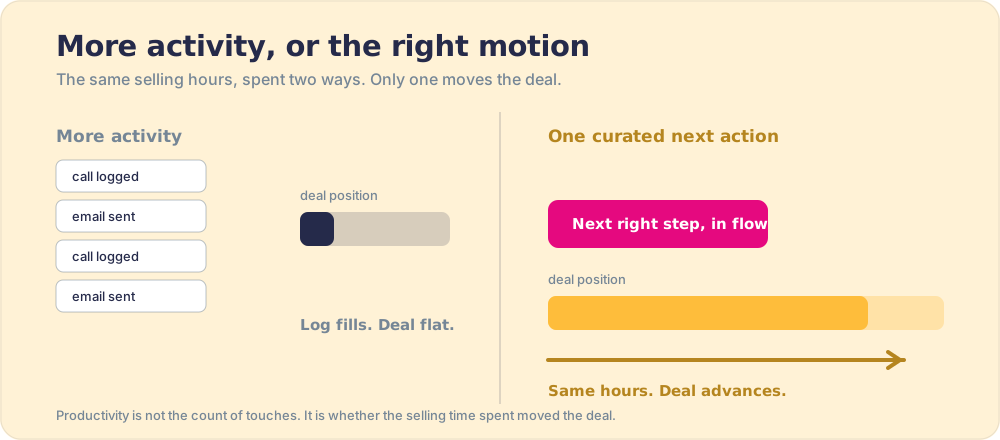
Sales productivity is the share of a rep's scarce selling time spent on the motion that actually moves and closes deals, not the raw count of calls, emails, and activities logged.
A sales leader under a soft number reaches, almost by reflex, for the same lever. More activity. Lift the dial count, raise the email quota, add a sequence step, push every rep to touch more accounts this week than last. It feels like the responsible move, because activity is the one thing a manager can demand at the start of the week and see logged by the end of it. So the team works harder, the dashboards fill with green, the numbers go up. And the pipeline, stubbornly, does not.
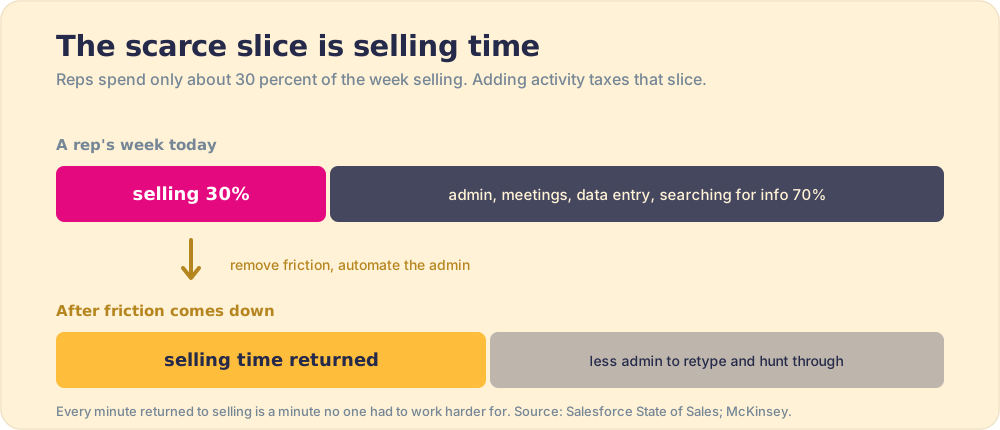
The confusion at the center of sales productivity is an expensive one. We treat productivity as a volume problem, output per rep, and assume that the way to get more out is to put more in. But reps do not have a volume problem. They have a friction problem. The Salesforce State of Sales report finds that sellers spend only about 30% of their week selling; the other 70% goes to admin, internal meetings, manual data entry, and hunting for information (Salesforce). Pile more activity onto a rep who is already drowning in non-selling work, and you do not get more selling. You get more noise on top of a motion that was never the bottleneck.
So define it differently. Sales productivity is the share of a rep’s scarce selling time spent on the motion that actually moves and closes deals, not the raw count of calls, emails, and activities logged. The lever is less friction, and a curated next action, so the small slice of the week a rep spends selling goes to the work that closes.
What is sales productivity, exactly?
Strip away the dashboards and sales productivity is a ratio: revenue out for selling effort in. The trouble starts the moment you decide what counts as effort. Read effort as activity (dials placed, emails sent, accounts touched) and productivity becomes a volume game you win by doing more. Read effort as selling time spent on the right motion, and it becomes a friction game you win by removing whatever stands between a rep and the next right action.
The two readings lead to opposite decisions. The volume reading says a slow quarter means reps are not working hard enough, so you turn up the activity. The friction reading says a slow quarter means the scarce selling hours are being spent on the wrong things, or lost to admin entirely, so you go find what is stealing them. One of those readings is supported by the data, and it is not the first one.
Begin where the time goes. If a rep spends roughly 70% of the week not selling, then the binding constraint is not how many calls they make in the selling third. It is the selling third itself, how small it is and how much of it gets spent on motion that does not move a deal. A team can double its activity and barely touch the constraint, because the activity was never the scarce resource. Selling time is.
A quick word on terms, because they get muddled. “Sales productivity” is often used as a synonym for “sales efficiency,” but they are not the same. Efficiency is doing the motion with less waste. Productivity is whether the motion produces the outcome at all. You can be ruthlessly efficient at a motion that does not close, which is the saddest place a sales team can be: fast, busy, and going nowhere.
Why does more activity fail to lift sales productivity?
Because activity is an input, and you cannot fix an output by flooding it with more input when the conversion is broken. Take a leaking bucket. The water running in is activity; the water you keep is closed revenue. If the bucket leaks (a discovery step skipped, a stage advanced on a checked box rather than a real buyer commitment, the wrong case study sent at the wrong moment), then pouring water in faster does not fill the bucket. It wets the floor faster. More activity on a leaking motion produces more waste, more noise in the CRM, and more false confidence, not more revenue.
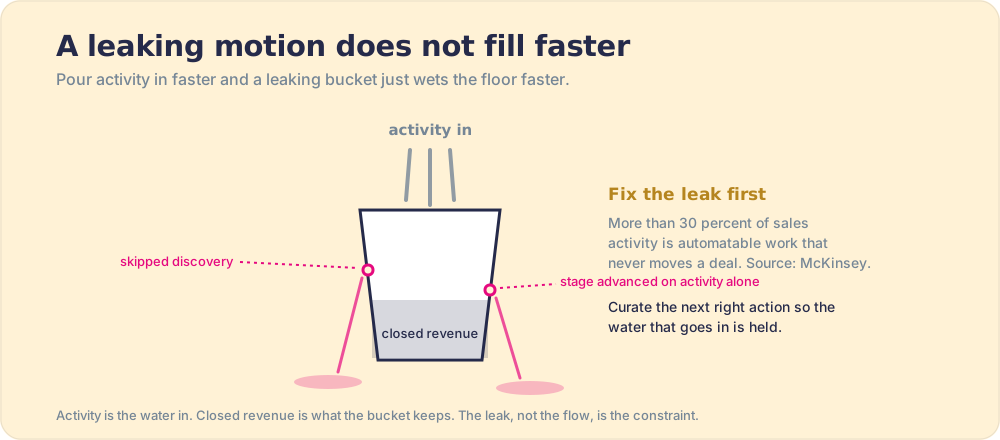
The leaks are not hypothetical. McKinsey estimates that more than 30% of sales activities are automatable, meaning roughly a third of what reps do all day is repetitive work a machine could absorb, freeing the human to sell (McKinsey). When a third of the activity is admin a computer should be doing, “do more activity” is close to the worst possible instruction. You are asking a rep who is already buried in low-value motion to generate more of it.
And the selling time itself is shrinking under the weight. The Sales Enablement Collective reports that reps spend only 25% to 40% of their time selling, the rest going to prep, admin, and the search for information (SEC). Two independent sources, Salesforce and the SEC, converge on the same picture from different angles: the selling slice is small, and it keeps getting taxed. When two sources that share no method agree, the finding is worth trusting. The scarce resource is selling time, and the conventional lever spends it on more of the work that was never the point.
The volume reflex persists for a deeper reason. Activity is legible. A manager can count dials, and a rep can produce them on demand. Whether the motion is the right motion is harder to see, so we measure what is easy and call it productivity. It is the old mistake of the man who hunts for his keys under the streetlight because the light is better there. The keys are in the dark, where the selling time is being lost.
What are the right sales productivity metrics?
Here we have to be careful, because there is a loud and wrong idea in the field: that activity metrics are “vanity,” that counting what a rep did is a distraction from results. That is half right and it leads people somewhere dangerous. The instinct behind it is sound: a deal should never advance because a box got checked. But the conclusion (stop tracking activity) throws away the one signal that tells you whether your process is even being run.
So let us hold both halves. Tracking what a rep does is good and necessary. It is how you verify the process is being followed, and it shapes the buyer’s experience, because every logged touch is a real interaction a buyer had with your company. Measuring activity is fine. The failure is letting activity stand in for the buyer’s reality, advancing a deal to “negotiation” because the rep logged three calls, when the buyer has agreed to nothing. The pipeline should reflect the buyer’s real position, not just the seller’s checklist.
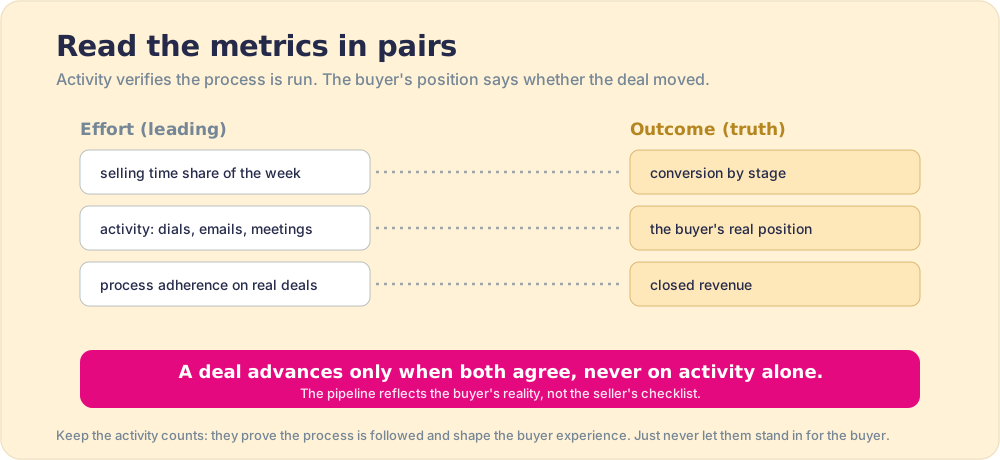
The right sales productivity metrics pair an effort measure with an outcome measure and read them together:
- Selling time as a share of the week. The first number, and the one to measure before any other. If reps are below a third of the week selling, the activity dial is not your problem. The friction is.
- Process adherence on real deals. Whether the rep ran the motion the playbook calls for, stage by stage, on deals that are genuinely live. Adherence is the signal that tells you the process is being followed, and it is an activity measure used correctly.
- Conversion by stage, against the buyer’s real position. Where deals truly advance and where they stall, read against what the buyer has genuinely committed to, not what the rep logged.
- Ramp time to adoption. How fast a new rep runs the motion without prompting. The ramp clock is a productivity metric that often gets reported as a training date instead of a behavior date.
Activity counts are leading indicators, the early read on whether the motion is being run. They never close a deal on their own. A rep can hit every activity target and close nothing, and a rep can close everything on fewer, better touches. So you keep the activity on the dashboard, because it verifies the process and shapes the buyer experience, and you refuse to let a deal advance on it alone. Both halves, always.
How do you improve sales productivity?
How to improve sales productivity is a question of subtraction: give selling time back and spend it on the right action. It takes two moves. Remove friction from the scarce selling hours. Curate the one next right action so the rep is not deciding, mid-deal, among forty possible things to do. Neither move adds activity. Both make the activity that already happens count.
Start with friction, because it is the largest and least glamorous lever. If a third of sales activity is automatable, then the fastest way to lift productivity is to delete the input that was stealing the selling hours: the manual CRM updates, the status reports a rep retypes by hand, the hunt for a document that should have surfaced itself. Every minute returned to selling is a minute that did not require anyone to work harder. Automation, done right, is a productivity play before it is a cost play. (We took this apart in sales enablement automation, and the related drag of a CRM reps avoid in CRM adoption.)
Then curate the next action, because too many places to act is its own tax. A rep with the whole stack at their fingertips, the content tool and the readiness app and the four tabs, is not empowered. They are dizzy. Productivity climbs when the rep gets a short, curated set of actions tied to a clear expectation, surfaced in the flow of the work, so following the process is the path of least resistance rather than a memory test. Add less surface area, not more. The instinct to give reps “everything they might need” is exactly backward; it spreads the scarce selling attention across a wider field and slows every decision.
Teams whose guidance is embedded in the flow of work hit quota at 49 percent. Teams whose guidance lives in docs, wikis, and a separate tool hit quota at 15 percent. Same content. The moment of delivery is the lever.
That contrast, from the State of Sales Enablement 2026, is the productivity argument in two numbers. The same guidance, delivered in the flow of the work versus parked in a separate tool, more than triples the share of reps hitting quota, 49% against 15% (State of Sales Enablement 2026). The reps did not get more productive by working harder. The friction came down, the next action arrived where the work already was, and the same selling hours produced a different number. Productivity is what is left when you stop making the rep go find the work.
Stop adding. Start clearing.
Do sales productivity tools actually help?
Sometimes, and the dividing line is sharp. The market is full of sales productivity tools that promise to make reps faster, and many are sold on a feature count. Judge a tool by one test: does it return selling time or spend it? A tool that absorbs the automatable third of a rep’s day and surfaces the next action in the flow of the work returns time. A tool that demands its own tab, its own login, and its own search adds another place to act and competes for the same scarce attention, which is the opposite of productivity wearing a productivity badge.
A kitchen makes the point better than a spec sheet. A serious cook does not get faster by buying more gadgets and scattering them across three rooms. They get faster when the knife, the board, and the salt are within arm’s reach at the moment of the cut. A productivity tool that lives in a separate room (a destination the rep must leave the work to reach) is the salt in the garage. The gear can be excellent and the reach still ruins it. We laid out the full version of this in the sales tech stack: a stack is judged by the behavior it produces, not the boxes it fills, and tools that add surface area subtract productivity even when each one looks like a gain.
The mechanism has a name, and knowing it lets you reason from it. The gap between what reps know to do and what they do, under friction, on a real deal, is the knowing-doing gap, and it is also the heart of the sales execution gap. Productivity is lost in that gap. A rep knows the right next step; the friction of finding it, the cost of switching tabs, the absence of a prompt at the moment of the work, means the step does not happen. Close the gap and the knowledge becomes behavior. A tool helps to exactly the degree it closes that gap and harms to exactly the degree it widens it.
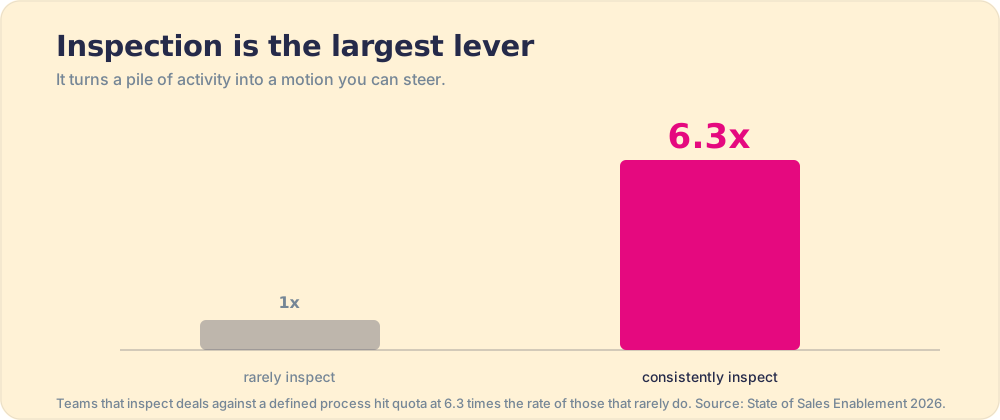
There is one more reason measurement sits at the center of this, not bolted on at the end. You cannot ask “which tool should we cut?” or “where is productivity leaking?” until you can answer “is the process being run?” In our survey, teams that consistently inspect deals against a defined process hit quota at 6.3 times the rate of teams that rarely do, the largest single effect we measured (State of Sales Enablement 2026). Inspection is what turns a pile of activity into a motion you can steer. Inspection gets skipped for a plain reason: done by hand, it eats the same time managers should spend coaching. Lift that burden and the inspection happens on its own, the manager coaches instead of chasing, and productivity stops being a guess.
What we recommend
Underneath the topic sits a clean choice, and it is not about how hard your reps work. You can chase sales productivity as a volume problem, turn up the activity, raise the dial count, push more touches through a motion that may or may not close, and accept the noise and the false confidence that come with it. Or you can treat it as a friction problem: measure how much of the week is spent selling, remove the admin that steals it, curate the next right action so the scarce hours go to the work that moves a deal, and inspect whether the motion is being run.
The friction reading wins, and the evidence is why. Salesforce and the SEC agree that reps already spend most of the week not selling, so the volume lever pushes on the wrong constraint. McKinsey says a third of the activity is automatable, which is selling time waiting to be returned. Our own data says guidance in the flow of work more than triples quota outcomes, and that inspection produced the largest quota gap in the study. Track activity, yes, because it verifies the process and shapes the buyer’s experience, and never, ever let a deal advance on activity alone. The pipeline should reflect the buyer’s reality, not the seller’s checklist.
So the next time the number comes in soft, resist the reflex to demand more activity. Ask instead where the selling time is going, and whether the next right action is reaching the rep at the moment of the work. That one question reorders everything. If you want the mechanism in full, start with the sales execution gap; if you want the tooling lens, the sales tech stack shows why surface area kills productivity; and if you want the system that turns the whole stack into behavior instead of noise, start with the sales enablement software guide.
Frequently asked questions
What is sales productivity?+
How do you measure sales productivity?+
What are the best sales productivity metrics?+
How do you improve sales productivity?+
Do sales productivity tools actually help?+
Your process, running itself.