Showpad Alternatives: Read the Consolidation First
Showpad merged with Bigtincan under Vector Capital in 2025, and the rest of the enablement category is consolidating too. Here are the alternatives by job, and why the merger should shape your shortlist.
Showpad alternatives are the sales enablement tools teams weigh against Showpad, now merged with Bigtincan under Vector Capital, and the right pick depends on the job (content, readiness, or getting reps to run the process) rather than on which suite is biggest.
Any honest list of Showpad alternatives in 2026 has to start with a fact most of them ignore: Showpad is not the company it was last year. In 2025, Vector Capital acquired Bigtincan (April) and Showpad (completed October 30), and combined the two under the Showpad brand with a new CEO (Showpad). So the “Showpad” you are weighing is a private-equity rollup of two former competitors, mid-integration. That is not a knock; consolidated platforms can be excellent. But you cannot shop alternatives intelligently without reading the board first, and the board is consolidating fast.
Showpad alternatives are the sales enablement tools teams weigh against Showpad, now merged with Bigtincan under Vector Capital, and the right pick depends on the job (content, readiness, or getting reps to run the process) rather than on which suite is biggest. The trap is comparing Showpad to “competitors” that are, increasingly, the same handful of companies merging into each other, and treating the wider sales enablement software market as more competitive than it now is. The showpad competitors worth weighing sort by job, not by suite size.
Why is the enablement market consolidating?
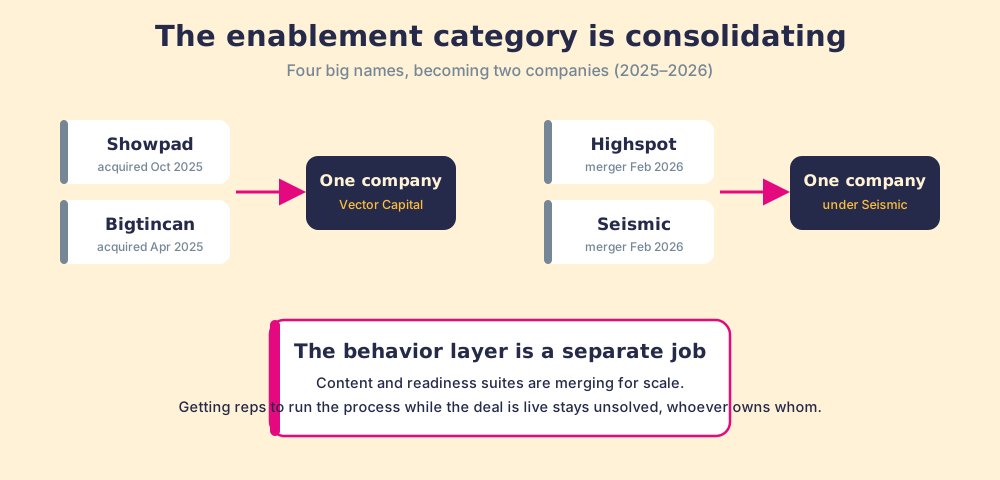
The category is collapsing into fewer, larger players, and it changes what “alternative” means. Showpad and Bigtincan are now one company under Vector Capital. Highspot and Seismic, the two largest content platforms, closed their merger on August 18, 2026 (covered here). Add it up: four of the most recognizable enablement brands are now two corporate entities. If your instinct was to pit Showpad against Bigtincan, or Highspot against Seismic, those are no longer independent rivals competing to win your business; they are converging product lines under shared ownership.
The combined Showpad is not small. Under Vector Capital it serves more than 2,000 customers across 50 countries, runs around $160 million in revenue, and employs over 600 people, with Apratim Purakayastha installed as CEO (Enterprise Times, October 2025). That is a serious platform, and the scale is real. It is also a platform now answering to a private-equity owner whose return depends on cost synergies, which is the detail buyers should weigh.
For a buyer, consolidation cuts two ways. The optimistic read is that combined platforms get broader and better-funded. The realistic read is that mergers bring roadmap uncertainty, integration distraction, and reduced competitive pressure on price, exactly the things that made the standalone products sharp. A private-equity rollup adds one more: the math that drives it is consolidation of overlapping engineering and product teams, so when two former rivals merge, one of the two product lines usually becomes the survivor and the other becomes a migration path. Buyers on the absorbed product are not wrong to ask which line theirs is. None of this makes Showpad a bad choice. It makes “compare the big suites” a weaker strategy than “name the job and pick the tool that does it.”
Why do teams look for a Showpad alternative?
Three reasons, and the new one matters most.
- Merger uncertainty. Teams in the middle of, or wary of, a platform integration look for a vendor whose roadmap is not in flux. That is a fair reason to shop right now specifically.
- Fit and weight. Showpad is built for field-selling-centric enterprises. Mid-market teams sometimes find it more platform than they need and want something lighter.
- The content gets stored, not used. The common one, and not unique to Showpad. A better-organized library does not change whether reps run the process, because findability was never the constraint.
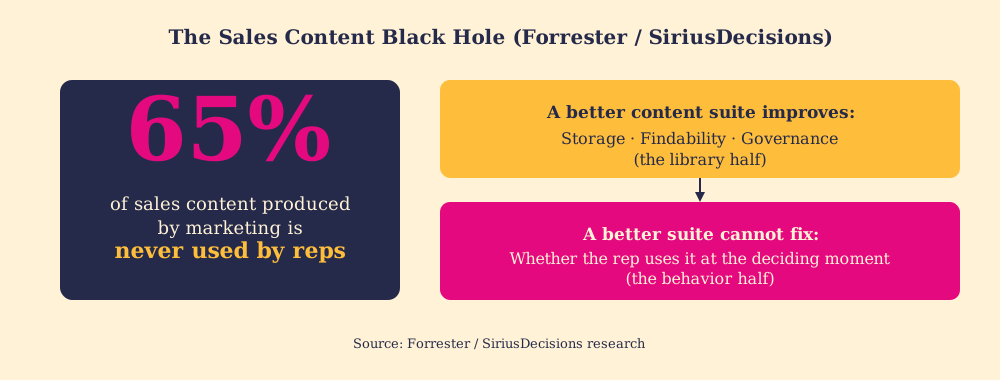
The first two are fit questions. The third is a job question, and it is the one that sends teams out of the content category entirely, because it rests on a finding the whole content-suite industry would rather you forgot. Forrester’s SiriusDecisions research has repeatedly found that roughly 65 percent of the sales content marketing produces is never used by reps, the original “sales content black hole” (Forrester / SiriusDecisions). Read that number against what a content platform sells. If two-thirds of content goes unused, the binding constraint was never storage, organization, or findability, the exact things a better library improves; it was that buying a sharper filing cabinet does nothing about whether the rep pulls the right file and acts on it at the deciding moment. A consolidated, better-funded suite organizes the black hole more elegantly. It does not close it.
What are the best Showpad alternatives, by job?
| Alternative | Job it does | Where it fits vs Showpad |
|---|---|---|
| Seismic / Highspot | Enterprise content management | Peer suites, now merged into one company |
| Spekit | In-app, moment-of-need content | Lighter, delivery-in-workflow leaning |
| Mindtickle | Training and readiness | Skill-building, the readiness half of Showpad |
| Supered | Process adoption in the CRM | A different category: acts in the moment, measures adherence |
If the job is enterprise content management, Seismic and Highspot are the like-for-like peers, with the large caveat that they are now the same company, so picking one to escape Showpad lands you in the other consolidated camp. If the job is lighter in-app delivery, Spekit is the more focused option. If the job is readiness and training, Mindtickle does the skill-building half. And if the job is adoption, getting reps to run the process while deals are still in motion, and seeing whether they did, no content or readiness suite was built for it, merged or not.
The job the suites do not do
Here is the mechanism, because it explains why switching from one content suite to another keeps disappointing. A content platform delivers information, and information decays. Hermann Ebbinghaus mapped the forgetting curve in 1885 and the replications hold: people forget roughly 70 percent of new material within 24 hours unless it is reinforced (on the Ebbinghaus forgetting curve). A perfectly governed library, however well it survives a merger, still hands the rep a fact they will mostly have lost by the time the deal needs it. And our own research found teams whose enablement reached reps in the flow of work hit quota at 49 percent versus 15 percent for those whose tools sat in separate destinations (The State of Sales Enablement). A suite you visit is a separate destination. The deal is decided in the flow.
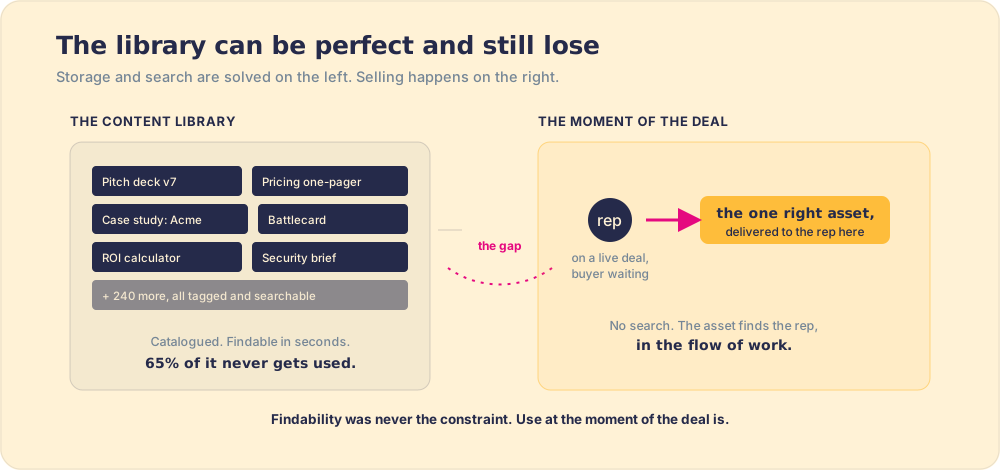
This is the category we build. A behavior layer like Supered runs inside HubSpot and Salesforce, surfaces the next right step and the right play in the moment of the deal, and measures whether reps run the process. It is not another suite to integrate; it is the adoption job the suites do not do. On G2, Supered holds a high score on a smaller, newer base than the incumbents, the signature of a younger, more focused product.
The verdict: which Showpad alternative, and when to stay
- Showpad (or the merged Showpad-Bigtincan). The right call when you are a field-selling-centric enterprise that needs content plus readiness at scale and can tolerate integration churn. The combined platform is broad, and switching to solve a problem it already solves is motion, not progress.
- Seismic or Highspot. The pick when you want a peer content suite, with eyes open that they are now one company and consolidation cuts both ways.
- Spekit. The move when you want lighter, in-workflow content delivery without an enterprise suite.
- A behavior layer like Supered. The answer when your real problem is that reps do not run the process in the moments that decide deals. That is a different category, and no content suite, merged or standalone, was built for it.
The throughline: the best Showpad alternative is not the next-biggest suite, especially when the next-biggest suite is merging too. It is the tool matched to the job you are trying to do. Read the consolidation, name the job, then choose.
From here: the merger in the Highspot-Seismic merger, the field by job in the best sales enablement tools, the content view in sales content management software, and the adoption problem underneath in sales process adoption.
Frequently asked questions
What are the best Showpad alternatives?+
Is Showpad still independent?+
Why is the sales enablement market consolidating?+
What is the difference between Showpad and Supered?+
Your process, running itself.