Product Tours: A Map for Someone Lost, Friction for Everyone Else
Product tours get a first-time user to value and then keep firing long after the user knows the road. The fix is not a better tour. It is a prompt timed to the moment of need.
Product tours are guided in-app sequences that walk a user through an interface step by step, and they work as a welcome for a first-time user with no mental model, but become friction the moment they fire for someone who already knows the road.
A product tour is one of the kindest things you can hand a person who is lost, and one of the most irritating things you can hand a person who knows exactly where they are. That is the whole tension, and most teams feel only the first half of it. They build the tour for the first-time user, who genuinely needs it, then leave it firing for the regular who has walked this hallway a hundred times and would like it to stop pointing at the door.
Product tours are guided in-app sequences that walk a user through an interface step by step, and they work as a welcome for a first-time user with no mental model, but become friction the moment they fire for someone who already knows the road. Hold both halves of that sentence. The tour is not good or bad; it is right or wrong for who is looking at it and when.
The tour became a category because a real problem demanded it. As software moved to self-serve in the 2010s, products lost the implementation consultant who used to sit with a new user, and the burden of teaching the interface fell onto the interface itself. A whole industry grew up to carry it: digital adoption platforms like WalkMe and Pendo, onboarding tools like Appcues and Userpilot, each promising to walk users through the app so support tickets and churn would fall. The promise was real and the tools delivered on the first run. The trouble started when the same overlay that welcomed a new user kept welcoming them, week after week, long after the welcome was needed. The tool was built to solve onboarding and got pointed at everything.
When do product tours genuinely work?
A tour is a map, and a map is a generous gift to someone who is lost and a small insult to someone who knows the way. The tour works when the user genuinely has no mental model: a true first run, an unfamiliar interface, a clear single path to first value. It fails when it fires for a user who already has the model, replaying steps they could do in their sleep.
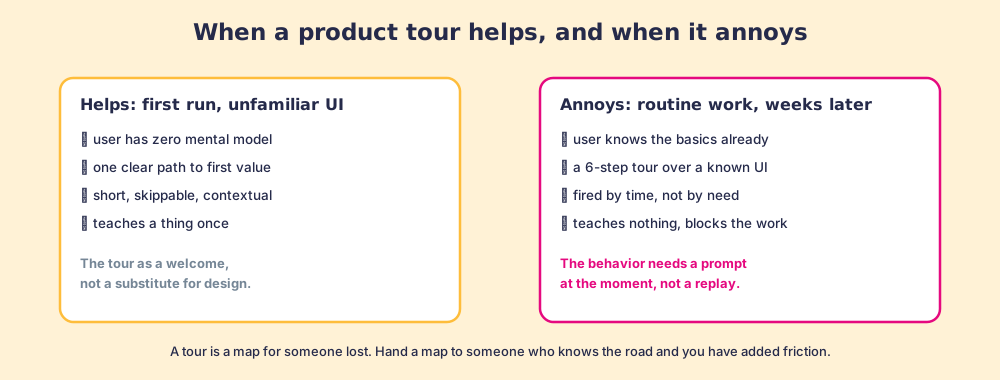
So the design rule is narrow: keep the tour short, skippable, and contextual, fire it once for the genuinely new user, and let it step back the moment the model is formed. Good product tour software makes this easy; the trouble is that the trigger is usually a login count or a date, not a real signal that the user is lost.
The behavior of real users confirms the narrow window. Pendo’s own benchmark data on in-app guides shows that guide engagement falls off sharply as steps pile up, with multi-step walkthroughs losing a large share of users before the end (Pendo, in-app guide benchmarks). The longer the tour, the fewer people finish it, which is the data saying what the experience already tells you: attention is a budget, and a six-step walkthrough spends more of it than first value is worth. A short tour that earns a quick win keeps users. A long one teaches them to hunt for the skip button, and the skip-button habit, once learned, never gets unlearned.
Why do product tours decay into annoyance?
Because the trigger is wrong, and the behavioral reason is worth naming. BJ Fogg’s model holds that a behavior happens only when motivation, ability, and a prompt arrive at the same instant, and that a prompt fired when ability is already high and motivation is low lands below the action line and gets dismissed (Fogg Behavior Model). A tour fired by a clock, over an interface the user already knows, is exactly that: an ill-timed prompt. The user has high ability and zero motivation to sit through it, so they hit dismiss and learn to ignore the next one too.
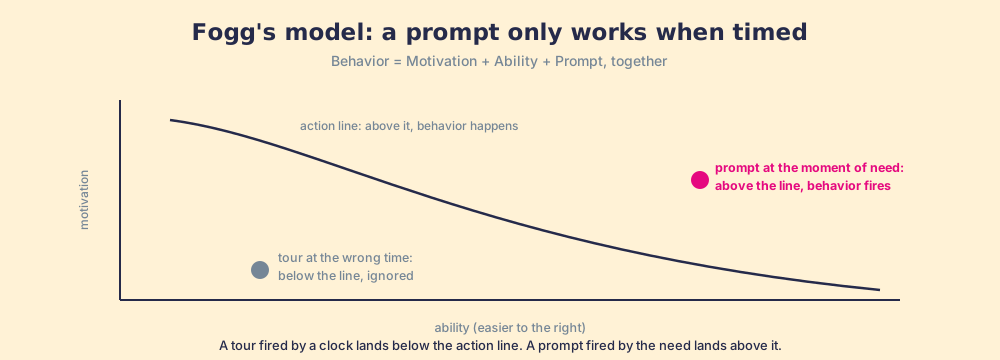
This is also the mechanism behind the broader complaint about in-app guidance: the in-app guidance that resurfaces by schedule rather than by need trains users to dismiss it, which poisons the channel for the times it would have helped.
There is a second reason the one-shot tour underdelivers even when it fires at the right moment, and it is one of the oldest findings in psychology. In the 1880s Hermann Ebbinghaus measured how fast he forgot lists of syllables and produced the forgetting curve: memory of new material decays sharply within days unless it is reinforced (Ebbinghaus forgetting curve). A product tour is a single exposure. It shows the user the road once, on day one, and then the curve does its work. By the time the user faces the real task a week later, the tour is mostly gone, which means even a well-built tour was never going to carry behavior on its own. The first run is the wrong place to teach a step the user will not need until later, because by the time they need it they have forgotten the lesson and resent the reminder.
What replaces the tour once the user knows the app?
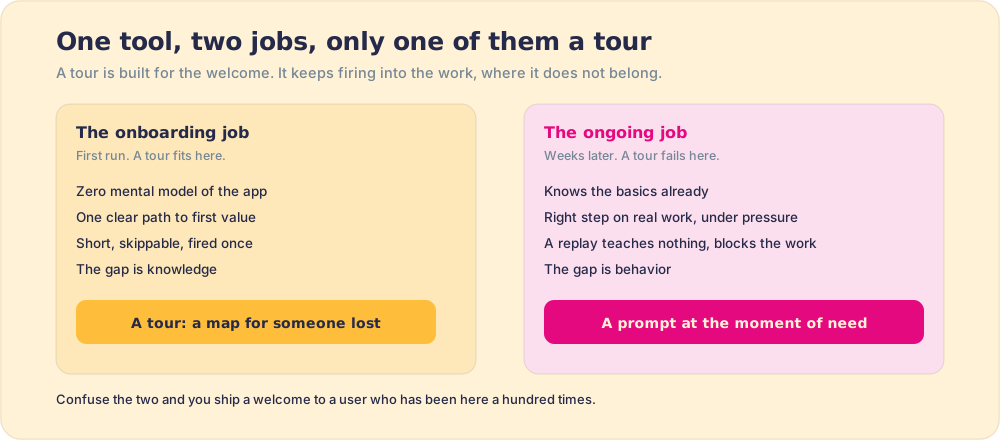
A prompt timed to the moment of need. Once a user has the mental model, the gap is no longer knowledge, it is doing the right step on real work under pressure, and that is a behavior problem, not an onboarding one. Conrad Gottfredson and Bob Mosher, the researchers behind the Five Moments of Need framework, drew exactly this line years ago: there is a moment of learning something new and a separate moment of applying it when the stakes are real, and the support each moment needs is different (Gottfredson & Mosher, Five Moments of Need). A tour serves the first moment. The work happens in the second, and a replay of the first cannot reach it.
What the second moment calls for has a different shape:
- Triggered by need, not by a clock. The guidance appears because the user hit the decision, not because seven days passed or a login counter ticked. A prompt fired by a real signal lands above Fogg’s action line; a prompt fired by a calendar lands below it.
- The single next step, not a six-stop walkthrough. At the moment of work the user needs one thing done right, not a tour of the neighborhood. Curate the next action and cut the rest.
- In the flow, not in a modal that blocks it. The help shows up where the work is and steps back the instant it is taken, so it never becomes the obstacle it was meant to remove.
- Measured, so you know if it worked. A tour reports completion. What matters is whether the step actually happened on the real task, which is an adherence question, not a view count.
That is a different job than the tour, and confusing the two is why so many user onboarding rollouts annoy the same users they meant to help. The good digital adoption platforms have started to learn this, shifting from scheduled walkthroughs toward contextual, need-triggered guidance. The frame to carry is simple: the tour answers “how does this app work,” and the work answers “what do I do right now,” and only the second question is the one a busy user is actually asking.
What we recommend
Use product tours for what they are good at and stop using them for what they are not. For a genuine first-time user with no mental model, ship a short, skippable, contextual tour and fire it once. For the user who already knows the application, retire the tour and replace it with a prompt timed to the moment of need, because their gap is behavioral and a replayed walkthrough cannot touch it. The test is simple: would a map help this person right now, or are they already on the road? If they know the road, a map is friction, and the kindest thing you can do is get out of the way until they ask.
From here: the broader case in in-app guidance, the system view in user adoption, and the tool category in best digital adoption platforms.
Frequently asked questions
What is a product tour?+
Do product tours actually work?+
Why do product tours annoy users?+
What should you use instead of a product tour for ongoing adoption?+
Your process, running itself.