Guided Selling: Why It Only Works Behind an Adopted Process
Guided selling is sold as smart software that tells a rep the next best action.
Point it at a team with no consistent motion and it amplifies the chaos, confidently. Here is the order that actually works.
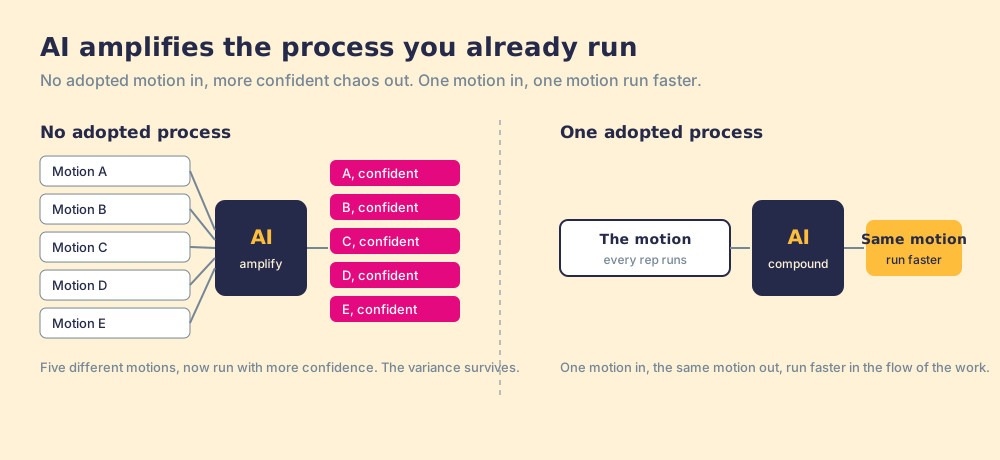
Guided selling is software that reads the signals on a deal and tells a rep the next best action to take, in the moment of the work; it only produces results behind a process the team has adopted, because guidance can only point a rep down a road that already exists.
Watch a sales team buy a guided selling tool to fix an inconsistent quarter. The pitch was clean: the software reads each deal and tells the rep the next best action, so every rep starts selling like the best rep. Three months in, the dashboards are full and the numbers have not moved. The reason is sitting in plain view. The eight reps were already running eight different motions, and the tool, asked what to do next, now recommends eight different next steps, each delivered with the calm authority of a machine. The team did not get a process. It got its old inconsistency, automated and sped up.
That is the contrarian claim of this post, and it cuts against how guided selling is sold. The market frames it as intelligence: point smart software at your deals and it will tell reps what to do. Our view is narrower and more useful. Guidance only works behind a process the team has actually adopted. Point AI guided selling at a team that does not run a consistent motion and it amplifies the chaos, confidently, because a recommendation can only ever be as good as the process it points to. The order matters, and it is fixed: get the behavior adopted, then guide it in the flow of work, then let AI compound it. And the guidance has to reach the rep in the moment of the work, not in a separate tab they open under pressure.
So here is the plain definition before we argue about it. Guided selling is software that reads the signals on a deal, the stage, the fields, the last buyer interaction, and tells a rep the next best action to take, in the moment of the work. The version that produces results sits behind a process the team has already adopted, because guidance can only point a rep down a road that already exists.
What is guided selling, exactly?
Strip away the vendor language and guided selling is a simple thing with one hard dependency. It is a system that looks at where a deal is, compares that against what your process says should happen next, and surfaces the recommended action to the rep without making them go dig for it. A deal sitting in discovery with no economic buyer identified prompts a nudge to map the buying committee. A deal that has gone dark for nine days prompts a specific re-engagement play. The promise is that the right next move finds the rep, instead of the rep having to remember it.
The hard dependency is the middle step. To compare a deal against “what should happen next,” the system needs a definition of what should happen next, and that definition is your sales process. Take it away and the loop has nothing to match against. This is why guided selling and a sales playbook are not competitors. The playbook is the written process, the stages and the qualification questions and the plays. Guided selling is the delivery mechanism that reads that playbook and surfaces the relevant piece at the moment it is needed. One is the content; the other is the timing.
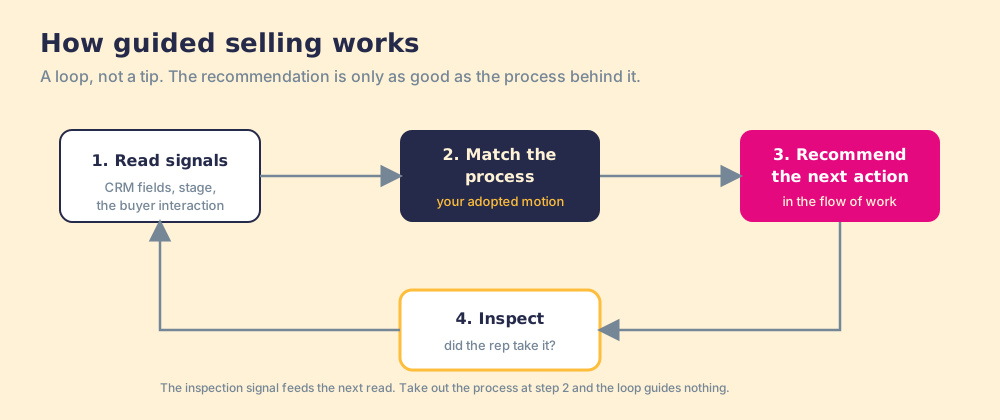
That middle step is also why the same software lands so differently on two teams that bought the identical license. On a team that runs one consistent motion, guided selling has a real road to route reps down, and it shortens the distance between a signal and the right action. On a team where no two reps qualify the same way, the system has no single road to point to, so it either picks one rep’s idiosyncrasies and pushes them on everyone, or it recommends whatever the most common historical pattern was. The guided selling software is identical. The outcome forks on whether a process was adopted first.
What is AI guided selling, and why does it amplify the process you have?
AI guided selling is the same idea with a model doing the recommending. Instead of fixed if-then rules a RevOps admin wrote, an AI reads the deal, the email thread, the call transcript, and proposes the next action, the next message, the risk worth flagging. It is more fluent, it handles messier inputs, and it can draft as well as suggest. Gartner predicted that 75 percent of B2B sales organizations would augment traditional sales playbooks with AI-guided selling solutions by 2025, driven by the volume of deal data and renewed budgets pushing leaders toward tools that recommend the next best action (Gartner). That deadline has passed, and the capability now sits on most teams whether or not the process underneath it is ready.
Reps are reaching for it on their own, too. The Sales Enablement Collective reported in 2025 that 81 percent of sales and enablement professionals now use AI at least occasionally, and 25 percent use it regularly (SEC). And the teams they land on are already swamped: Salesforce’s State of Sales report finds reps spend 60 percent of their time on non-selling tasks, hunting for the right deck, entering notes, chasing approvals, rather than in front of a buyer (Salesforce, State of Sales). The tools are in the building, landing on reps with no spare attention. What governs whether they help is a single property of any amplifier: it magnifies the signal it is given, not the signal you wish you had.
That property is the heart of the matter. AI amplifies the process you already run. Feed it a clean, adopted motion and it compounds it, every rep gets the best rep’s next move, faster. Feed it five different motions and it makes five confident recommendations that pull in five directions, and now the inconsistency carries the authority of a machine, which is harder to argue with than a colleague’s hunch. The model did its job. It read the inputs and amplified them. The inputs were the problem, and no amount of model quality fixes a missing road.
This is why AI guided selling has to be governed by its effect on behavior, not by how impressive the demo was. You need to be able to inspect, at the lowest level, the individual buyer interaction, whether the AI is recommending the motion you intend, or confidently spreading whatever pattern it found in the noise. The governing question is not “is the AI smart,” it is “are we giving buyers the experience we meant to.” You cannot answer that from a dashboard of suggestions accepted. You answer it by inspecting the interactions themselves.
Why does guided selling fail without an adopted process?
Because guidance is a satnav, and a satnav is only as good as the map beneath it.
Picture the device. It speaks with total confidence, “turn left in two hundred feet, recalculating,” and that confidence is the same whether the map underneath is the real road network or a blank screen with no roads on it at all. On the real map, the calm voice lands you at the destination. On the blank map, the same calm voice sends you into a field, recalculating cheerfully the whole way. The voice never tells you which map it is reading. You only find out when you arrive somewhere, or do not.
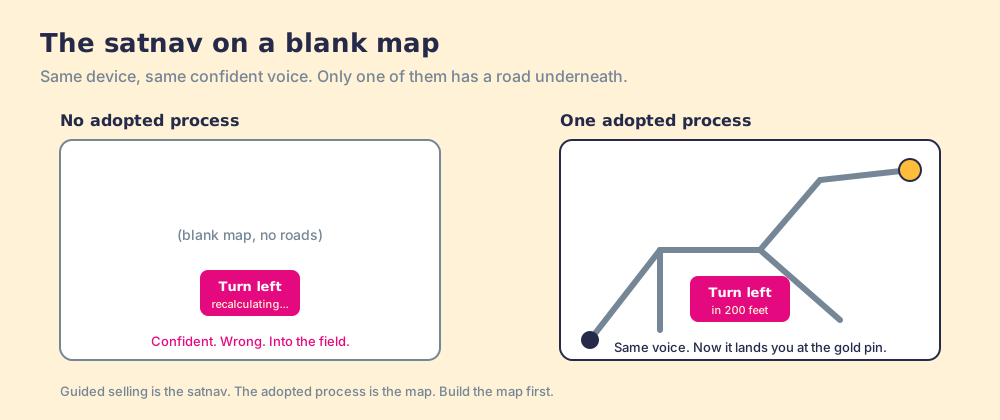
Guided selling on top of an undocumented, unadopted process is the satnav on the blank map. It will recommend a next action for every deal, because that is what it is built to do, and the recommendations will sound authoritative. But there is no shared road for them to follow, so the guidance ratifies whatever each rep was already doing instead of correcting it toward a standard. The picture has a limit worth naming. A real satnav at least has a fixed road network it did not invent; a guided selling tool with no adopted process is closer to a satnav allowed to draw its own roads as it goes, which is worse. Either way, the lesson holds: the directions are only useful once the map is real.
The second failure mode is location, and it is just as fatal. Even with a real process behind it, guidance that lives in a separate tool the rep has to open under pressure does not get followed, because following it costs a context switch at the exact moment the rep has the least attention to spare. Answers have to reach the rep in the moment of the work, the instant the question arises, or they are not answers at all. They are a library the rep does not have time to visit.
The data on that second failure is blunt. In the State of Sales Enablement 2026, teams whose guidance is embedded in the flow of the work hit quota at 49 percent, while teams whose guidance lives in docs, wikis, and a separate tool hit quota at 15 percent (State of Sales Enablement 2026). Same content, more than three times the quota attainment, and the only variable is whether the next step reached the rep where the work was already happening. A guided selling tool that surfaces the right action in a tab nobody opens has solved the recommendation and lost the delivery.
Teams whose guidance is embedded in the flow of work hit quota at 49 percent. Teams whose guidance lives in docs, wikis, and a separate tool hit quota at 15 percent. Same content. The moment of delivery is the lever.
Where does guided selling actually help?
Behind an adopted process, delivered in the flow, it helps in three concrete places, and each one is real.
- The curated next action. A rep with three tabs open on a slipping deal does not need ten options. They need the one move the process says comes next, surfaced where they are working. Guided selling, done right, is curation, not addition: it narrows the field to the next right step instead of handing the rep another place to go look. More surface area is dizzying; a short, clear next action is what makes a rep effective.
- The consistency a buyer can feel. When every rep runs the same adopted motion and the tool keeps them on it, the buyer gets a coherent experience instead of a different journey depending on which rep picked up. That consistency is what closes deals in a market where 77 percent of B2B buyers call their most recent purchase complex or difficult (Gartner). The payoff of the process reaches the buyer, beyond any internal control.
- The inspection that powers coaching. Because the loop ends by checking whether the rep took the recommended action, guided selling generates the signal a manager needs to coach, deal by deal, instead of reconstructing what happened at quarter close. Inspection is the lever; the win is automating its burden so the manager’s time goes to coaching, not chasing.
None of those three lands if the process is missing or the delivery is in a separate tab. All three compound if the sequence is right. That sequence is the recommendation this whole post has been building toward, so let me state it plainly.
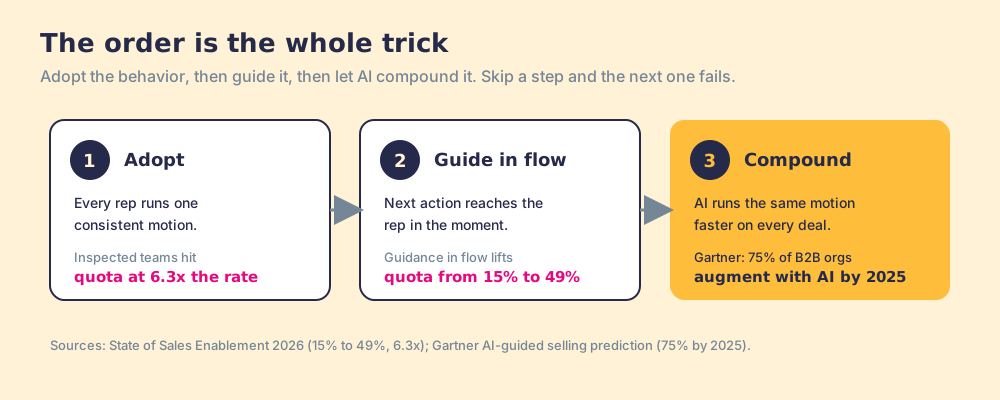
The order that makes guided selling pay off
First, adopt the behavior. Get every rep in a given segment running one consistent motion, and inspect that they are running it, because a process exists only to the degree adherence to it is checked. In our survey, teams that consistently inspect deals against a defined process hit quota at 6.3 times the rate of teams that rarely do, the largest single effect we measured (State of Sales Enablement 2026). That is the road being built. Without it, there is nothing for guidance to point at.
Second, guide it in the flow of the work. Surface the adopted next action where the rep already works, the instant the question arises, so following the process is the path of least resistance instead of a memory test. This is the 49-against-15 lever: same content, delivered in the moment versus parked in a tool, more than triples quota attainment.
Third, let AI compound it. Once the motion is adopted and delivered in flow, AI guided selling has a clean signal to amplify, and it earns its keep, drafting the next message, flagging the risk, running the standard motion faster in the flow of the work. Run in that order, AI is a multiplier on a working system. Run out of order, it is a multiplier on chaos, which is the failure mode most teams are buying without knowing it.
This is the same logic we apply to every AI claim in sales: the tool inherits the health of the process beneath it. We made the broader case in AI sales enablement, and the automation cousin of this argument lives in sales enablement automation. The selection problem, which guided selling tool for which job, is the work of choosing from the best AI sales tools by the behavior they produce rather than the features they list.
The teams that get value from guided selling are not the ones with the smartest model. They are the ones that built the road before they bought the satnav. If your reps already run one motion and the guidance reaches them where they work, AI guided selling will make a good system faster. If they do not, the tool will hand you your inconsistency back, automated and confident, and that is a more expensive problem than the one you started with. Adopt the behavior, deliver it in flow, then let AI compound it, in that order. To go a layer deeper on why the model only ever amplifies what is already there, generative AI for sales traces the same dependency through drafting, research, and forecasting, and shows where the governance has to sit. For the foundation the whole motion sits on, the sales enablement software guide is the place to start.
Frequently asked questions
What is guided selling?+
What is AI guided selling?+
Does guided selling software actually work?+
How is guided selling different from a sales playbook?+
Where does guided selling fail?+
Your process, running itself.