Conversational AI for Sales: Great at the Door, Silent in the Rooms
Conversational AI greets, qualifies, and books meetings around the clock. It is superb at the front door of a deal and silent in the rooms where deals are won. The handoff is where it gets dangerous.
Conversational AI for sales is software that talks to buyers in real time, through chatbots and voice agents, to answer questions, qualify, and book meetings; it owns the front door of a deal while the closing behavior stays with the human rep.
A conversational AI bot is the most reliable employee you will ever hire for one specific job. It never sleeps, never takes a long lunch, and greets every visitor who lands on your site at an odd hour with the same patience it had at noon. It answers the question, asks a few of its own, figures out whether the visitor is worth a rep’s time, and books the meeting before the buyer’s curiosity cools. For the front door of a deal, it is close to perfect. The trouble starts only when someone mistakes the front door for the house, and it turns genuinely risky at the one moment everyone treats as a formality: the handoff.
That is the distinction this post is about. Conversational AI for sales is software that talks to buyers in real time through chatbots and voice agents to answer questions, qualify, and book meetings, and it excels at the front door of a deal while the behavior that closes, discovery, trust, and negotiation, stays with the human rep. Buy it for the door and it is one of the best investments in your stack. Expect it to win the deal, or hand the deal off carelessly, and you have misread what it is.
What is conversational AI for sales?
It is AI that holds a real-time conversation with a buyer. On a website that means a chatbot that greets, answers, qualifies, and books; increasingly it also means voice agents that do the same on a call. The modern, LLM-based versions are a real leap past the clunky decision-tree bots of a few years ago: they resolve 50 to 70% of inbound conversations on their own, without a human handoff (on agentic chat platforms). For a buyer who wants a fast answer at an odd hour, that is a better experience than a contact form and a two-day wait, and speed here is worth more than it looks: the classic lead-response research found that contacting a web lead within five minutes rather than thirty made the lead far more likely to qualify, because interest decays fast (Oldroyd, in Harvard Business Review, 2011).
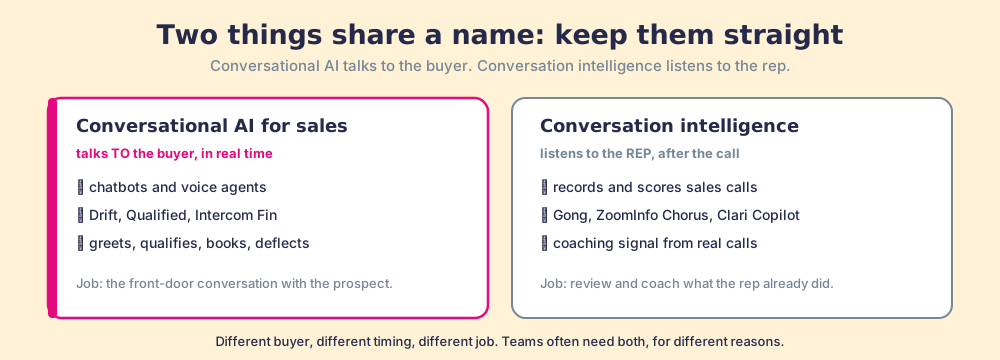
One clarification first, because two categories share almost the same name and do opposite jobs. Conversational AI talks to the buyer in real time. Conversation intelligence listens to the rep, recording and scoring sales calls after they happen so managers can coach. We cover that second category in conversation intelligence; keep them separate or you will buy the wrong one.
What is conversational AI for sales good for?
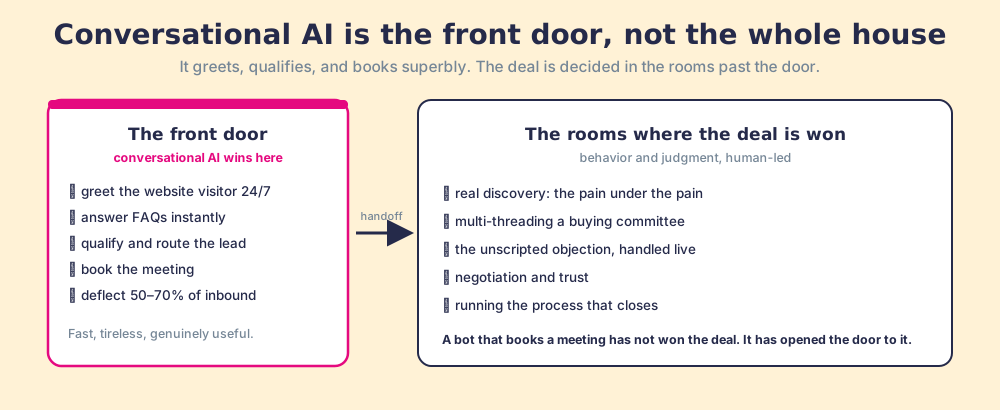
The front door, and it owns it. The conversational AI sales tools worth buying, Drift (now part of the Salesloft and Clari company), Qualified for Salesforce-native pipeline generation, and Intercom Fin for blended sales and support, are excellent at three jobs that all live at the top of the funnel.
- Instant engagement. The bot greets a visitor the second they land and answers while the interest is hot, so a lead that would have gone cold in a form queue starts a conversation instead.
- Qualification and routing. It asks the questions you would ask first, judges fit, and sends the right buyer to the right rep or straight to a booked meeting, the work covered in lead qualification.
- Deflection. It resolves the common, repeatable questions on its own, so humans spend their time on conversations that need them.
The thread through all three is speed and tireless coverage. A buyer engaged in the first minute is worth far more than one chased the next day, and conversational AI is how you are present in that minute, every time, at any hour. For that job, it earns its price.
Where does conversational AI hand off?
Right where the deal gets hard, which is right where it should. A bot that books a meeting has not won anything; it has opened the door to the part that wins. Past that door sit the rooms conversational AI cannot enter: real discovery that finds the pain under the stated pain, multi-threading a buying committee with competing agendas, handling the objection nobody scripted, negotiating, and building the trust a considered purchase runs on. None of that is a knowledge task you can automate. All of it is behavior, performed by a human reading a specific room.
The danger nobody designs for: the out-of-the-loop handoff
Here is the deeper problem, and it is the one that turns a clean front door into a stalled deal. When you automate the entire opening conversation, the human who eventually takes over was not in it. They did not hear the buyer hesitate on price, light up at one feature, or name a competitor in passing. They inherit a transcript, which is not the same as having been there. Human-factors researchers have a name for this, and forty years of evidence behind it: the out-of-the-loop performance problem. Mica Endsley and Esin Kiris showed in 1995 that operators monitoring an automated system passively, rather than acting in it, suffer degraded situation awareness, and are slower and worse at taking over when the automation hands control back (Endsley & Kiris, Human Factors, 1995). Their sharpest finding is the one that should govern every chatbot deployment: the decrement was greatest under full automation and smaller when the human stayed partly in the loop.
Translate that to sales and the risk is plain. The more completely the bot handles the front conversation, the more “out of the loop” the rep is when the buyer arrives, and the buyer arrives precisely at the hard part, where situation awareness matters most. A rep who walks into the meeting reconstructing what happened from a log is reading the room a step behind, exactly when reading it fast is the job. The handoff, treated as a formality, is in fact the single most dangerous moment in the funnel, because it is the point where an automated system returns control to a human it has kept uninformed.
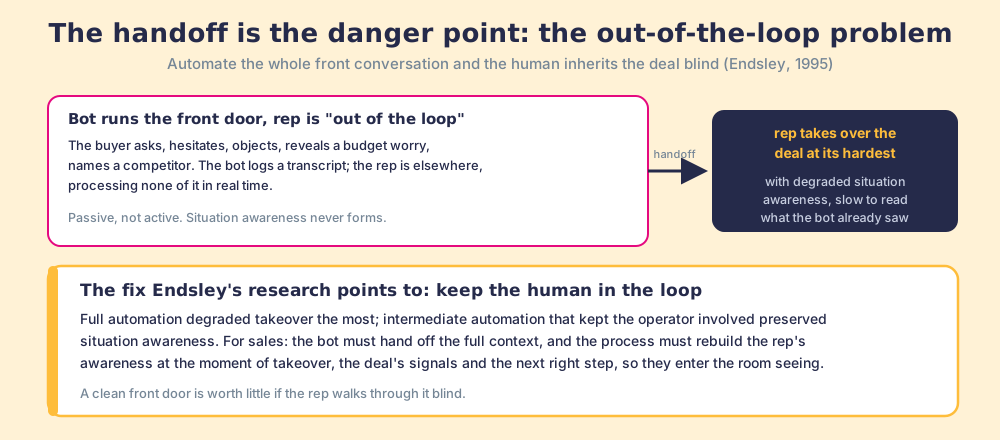
This is where we break with the loud version of the pitch, the one that reads “deflect 70% of conversations, replace the rep.” Endsley’s research says the opposite of what that pitch implies: the fuller the automation, the worse the human performs at the moment of takeover, so maximizing deflection without designing the handoff maximizes the out-of-the-loop problem. The fix is not to automate less or to automate everything; it is to keep the human in the loop and to rebuild their situation awareness at the moment of takeover, handing off the deal’s live signals and the next right step, not a bare transcript, so the rep enters the room seeing what the bot saw.
How do you measure conversational AI for sales?
On two scorecards, the front door and the handoff, because they measure different jobs. The bot’s job is speed and coverage at the top of the funnel, so judge it there: time to first response, the share of inbound it qualifies correctly, meetings booked, and the portion of routine questions it resolves without a human, which for modern LLM-based tools runs 50 to 70% (ZoomInfo). Speed is the number that pays: contacting a web lead within five minutes rather than thirty made it far likelier to qualify, because interest decays fast (Oldroyd, Harvard Business Review, 2011). The trap is stopping at deflection. A high deflection rate looks like success while it rewards the full-automation pattern that degrades the human takeover, so pair every front-door number with a handoff number: when the rep inherits the deal, do they arrive with the buyer’s signals and the next step in front of them, or do they walk in blind. Measure the door and the handoff, or you are scoring half the funnel.
What we recommend
Buy conversational AI for the door, and engineer the handoff like the high-risk moment it is. If your funnel leaks at the top, slow first responses, leads cooling in a queue, reps buried in repetitive questions, a conversational AI platform is one of the highest-return tools you can add, and the LLM-based generation gives buyers a better front-door experience than they have ever had. So get one, and judge it on front-door metrics: speed to engagement, qualification accuracy, meetings booked, inbound deflected.
Then treat the handoff as the design problem, because the research says that is where automation hurts. Do not measure success by deflection rate alone, which rewards the same full-automation pattern that degrades the human takeover. Measure it by what happens after the door: does the rep inherit the deal with full situation awareness, the buyer’s signals and the next step in front of them, or do they walk in blind to reconstruct a conversation they were never part of. The deal conversational AI opens is won by a rep running real discovery, handling the unscripted, and earning trust, which means the work past the door is not another bot but whether your reps consistently run the process that closes, the subject of sales process adoption. This is why conversational AI in sales pays off only when the human handoff lands on a process and a picture, not a guess.
From here: the related category in conversation intelligence, the assistant that helps reps run the deal in AI sales assistant, the full tool field in the best AI sales tools, the wider shift in generative AI for sales, and the closing behavior underneath in sales process adoption.
Frequently asked questions
What is conversational AI for sales?+
What is the difference between conversational AI and conversation intelligence?+
What is conversational AI for sales good for?+
Can conversational AI close deals on its own?+
How do you measure conversational AI for sales?+
Your process, running itself.