AI Sales Forecasting: The Model Is Not Your Problem, Your Pipeline Data Is
AI sales forecasting is sold as the cure for the inaccurate forecast. But a model trained on optimistic pipeline data predicts an optimistic, wrong number. The ceiling is set before the model runs.
AI sales forecasting uses machine learning on CRM and activity data to predict future revenue, and its accuracy is capped by the honesty of that data, because a model trained on optimistic or empty pipeline records learns the bias and returns a confident but wrong number.
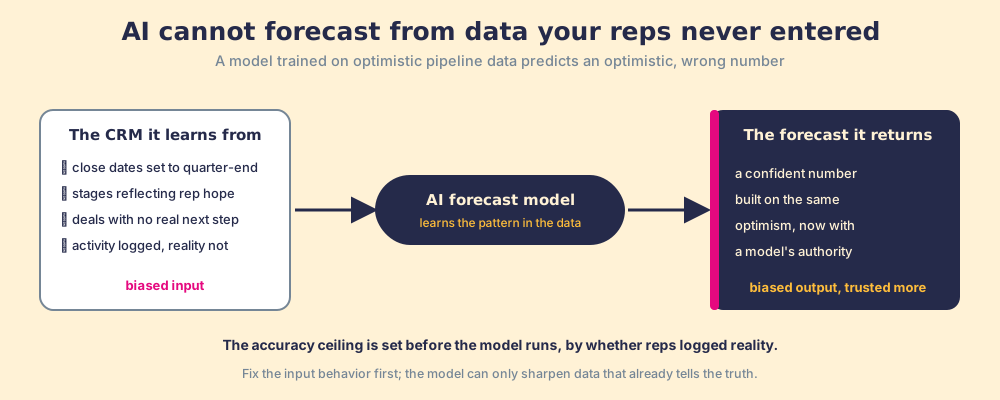
Most AI forecasting vendors sell the same promise: your forecast is wrong because humans are biased, and a model is not, so let the model call your number. It is a seductive pitch, and it misdiagnoses the problem. The reason your forecast is wrong is rarely the math that turns pipeline into a prediction. It is the pipeline. Reps set close dates to the end of the quarter out of habit, mark deals “stage 3” on hope, and leave half the pipeline with no real next step. A model trained on that data does not correct the optimism. It learns it, and hands it back to you with the authority of an algorithm.
AI sales forecasting uses machine learning on CRM and activity data to predict future revenue, and its accuracy is capped by the honesty of that data, because a model trained on optimistic, sandbagged, or empty pipeline records learns the bias and returns a confident but wrong number. The model was never your problem. The input is.
Why does AI not fix forecast accuracy?
Because a forecast is a prediction built on entered data, and the error lives in the data, not the prediction step. This is the oldest law in computing, garbage in, garbage out, and machine learning does not repeal it. A model finds the pattern in its training data and extrapolates it. If the pattern in your CRM is that reps inflate stages and anchor close dates to quarter-end, the model learns precisely that pattern and projects it forward. It will tell you, confidently, that a pile of optimistically staged deals will close, because that is what the data it was given implies. The optimism does not get filtered out. It gets formalized.
There is a deeper trap here that Daniel Kahneman named the illusion of validity: a confident prediction feels more trustworthy than a hesitant one, even when the confidence is unearned (Kahneman, on the illusion of validity). A rep’s gut forecast at least comes with visible doubt. An AI forecast arrives as a clean number with a probability attached, which makes it feel rigorous even when it is built on the same fiction the rep would have told you, now stripped of the rep’s own hedging. The model has not removed the bias. It has removed the warning label.
It helps to be concrete about how bad forecasting already is, because it explains why the AI pitch finds such willing buyers. Gartner found that only about 7 percent of sales teams achieve forecast accuracy of 90 percent or better, and the median lands at 70 to 79 percent. Most leaders are missing the number they commit to, badly, quarter after quarter, and the pain is real enough that “let a model call it” sounds like rescue. But notice what the AI vendor is implicitly claiming: that the 20 to 30 points of error live in the human doing the arithmetic. They do not. They live in a pipeline where a deal marked stage three has had no real discovery, where the close date is the last day of the quarter because that is the default, where a third of open opportunities have no next step at all. The arithmetic was never the bottleneck. The records were.
What sets AI sales forecasting accuracy?
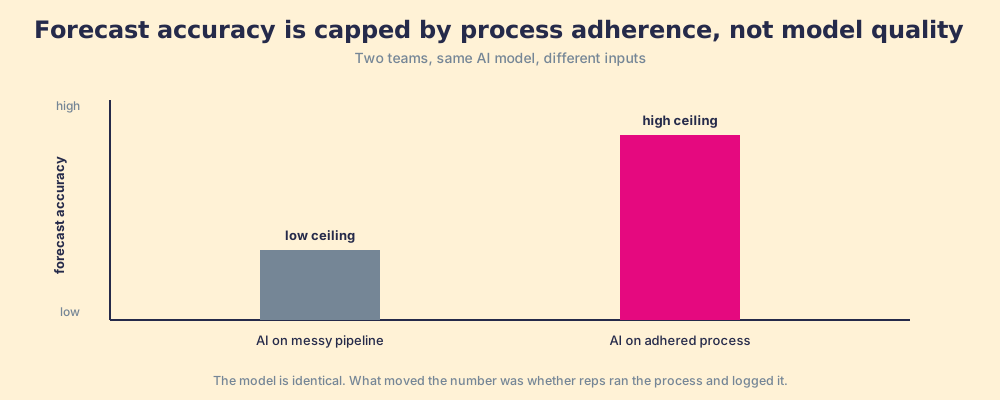
The behavior that produces the data, which sits upstream of any model. Two teams running the identical AI forecasting tool will get markedly different accuracy, and the difference is not the software. It is whether their reps run the process and log reality. The team whose stages map to real buyer commitments, whose close dates reflect actual buying timelines, and whose deals carry genuine next steps, gives the model something true to learn from. The team whose pipeline is a wish list gives the model fiction, and gets fiction back. The model is a constant. The input behavior is the variable, and it sets the ceiling.
This reframes the whole project. Improving ai sales forecast accuracy is not a data-science task; it is a process-adherence task, the same problem we trace in sales process adoption and pipeline hygiene. The lever is the input, not the algorithm.
The fairest version of the opposing case deserves a hearing, because the better AI forecasting tools do something real. A modern machine learning sales forecasting model can read engagement signals a human would miss: email response latency, the spread of contacts engaged, how a deal’s activity pattern compares to past won and lost deals. Where those signals exist and are honest, the model genuinely outperforms a manager’s roll-up, because it weighs hundreds of weak signals without fatigue or favoritism. That is true, and it is the legitimate promise. The catch is the condition buried in it: where those signals exist and are honest. The model reads engagement, deal history, and stage as evidence. If the stage is a fiction and the activity is logged for appearances, the model is reading tea leaves with great statistical rigor. It is not that AI cannot help. It is that AI amplifies whatever process you already have, so a model on a disciplined pipeline sharpens a real signal, and the same model on a wish list amplifies the wish.
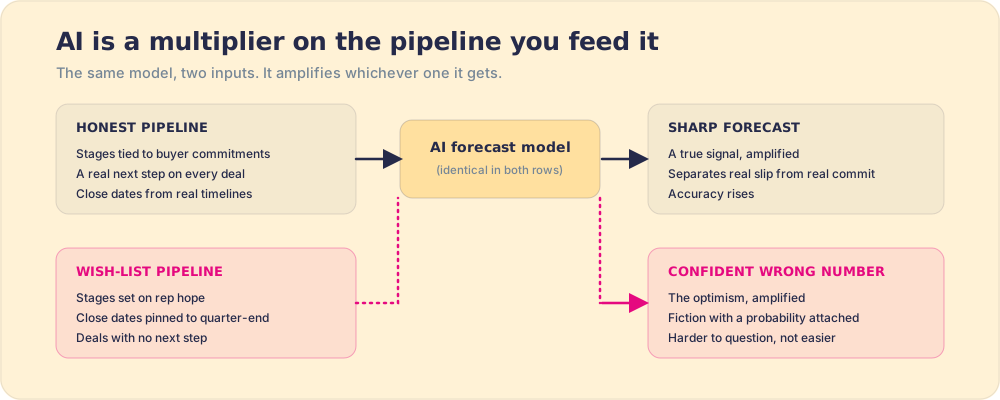
- Stage criteria tied to buyer commitments. A deal advances when the buyer does something verifiable, not when the rep feels good. That makes the stage signal real.
- A required next step on every open opportunity. Records with no next step are the ones that silently die; forcing the field surfaces them before the model has to guess.
- Honest close dates. Dates set to the real buying timeline, not the quarter boundary, so the model learns true timing instead of an artifact of the calendar.
- Adherence, measured. Whether reps keep the pipeline honest, tracked and coached, because the data quality the model depends on is a behavior you have to maintain.
How should you deploy AI forecasting?
Treat the model as the last mile, not the fix. Buy or build the AI forecasting tool, but understand that it can only sharpen a signal that is already in the data. So spend first where the gain is: on getting reps to run the process and log reality in the flow of work, so the pipeline the model reads is honest. Then the AI does real work, separating the true slip from the true commit inside data that means something. Deploy it on a fictional pipeline and you have bought a faster way to be confidently wrong. The order is not optional. Input behavior first, model second, because no algorithm can predict from a number that was never truthfully entered.
There is a sequencing trap worth naming, because it is the expensive one. A leader feeling the pain of a soft forecast reaches for the tool first, because the tool is a purchase you can make this quarter and a behavior change is a slog that takes two. So the model goes in, the pipeline stays a wish list, and three quarters later the forecast is as wrong as ever, now with a renewal invoice attached. The honest order runs the other way. Fix the input behavior, prove the pipeline reflects reality, and only then layer the model on top, where it has a true signal to read. Buying the model first is paying for a telescope before you have cleaned the lens; the magnification is real, and so is the smudge it magnifies.
The same logic governs every AI-in-sales question, forecasting included. AI sits downstream of behavior, so it inherits the quality of the behavior beneath it. Get the process adopted, then let the model compound it. That sequence, behavior first and AI second, is the through-line of how we think about AI sales enablement generally.
What we recommend
Stop shopping for a better forecasting model and start fixing the data it learns from, because that is where your forecast error truly lives. An AI model trained on a pipeline full of quarter-end close dates and hope-based stages will predict exactly that, with a confidence that makes the fiction harder to question, not easier. The teams that get real accuracy from AI forecasting are the ones whose reps run the process and log reality, giving the model something true to extrapolate. So invest in the input behavior first: stage criteria tied to buyer commitments, a next step on every deal, honest dates, and adherence you do measure. Then the model earns its keep. Forecasting is not a math problem you can buy your way out of. It is a behavior problem wearing a math costume.
From here: the discipline that feeds it in pipeline hygiene, the forecasting fundamentals in sales forecasting, the adherence underneath in sales process adoption, and the wider picture in AI sales enablement.
Frequently asked questions
What is AI sales forecasting?+
Is AI sales forecasting accurate?+
Why do sales forecasts fail even with AI?+
How do you improve AI forecast accuracy?+
Your process, running itself.