Change Management Software: Four Tools Hiding Behind One Search
Change management software means four different products. Most of them handle awareness and knowledge, then go silent exactly where change lives or dies: ability and reinforcement.
Change management software is any tool that helps an organization plan, execute, and sustain a change, and the term covers four distinct products, IT change control, org-change tracking, digital adoption platforms, and the behavior layer, that serve different ADKAR stages.
A buyer types “change management software” into a search bar with one problem in mind and gets four different products back, none of which knows which problem the buyer had. The IT director meant approval workflows for system deployments. The transformation lead meant a way to track a rollout. The enablement manager meant in-app guidance. And the operations leader meant the thing none of the others covers: getting the team to do the work the new way and seeing whether they do. One term, four tools, and a great deal of confused shopping.
Change management software is any tool that helps an organization plan, execute, and sustain a change, and the term covers four distinct products, IT change control, org-change tracking, digital adoption platforms, and the behavior layer, that handle sharply different stages of the ADKAR model. These change management tools share a name and little else. Naming the four, and mapping them to where change succeeds or fails, is the only way to buy the right one.
Here is the thesis worth opening with, because it cuts against how the category sells itself. Most change management software is excellent at the first half of a change and silent on the second, and the second half is the one that decides whether the change happens. The tools cluster where work is visible and a vendor can demo a dashboard: comms sent, courses completed, tickets approved. They thin out where the change lives, which is a person, on real work, weeks after launch, choosing the new way over the old habit. That is not a knock on any single product. It is the shape of the whole market, and once you see it you buy differently.
What are the four kinds of change management software?
They share a name and almost nothing else.
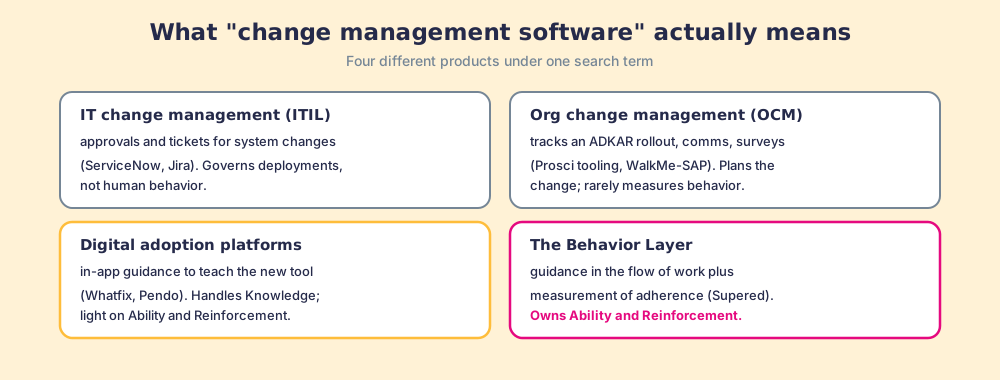
- IT change management. ITIL-style approval and ticketing for system changes, like ServiceNow and Jira. It governs deployments, not human behavior, so it is the wrong tool if your problem is people not adopting a new process.
- Organizational change management. Software that tracks a rollout against a model: comms plans, stakeholder maps, readiness surveys. It plans the human change well and rarely measures whether the behavior changed.
- Digital adoption platforms. In-app guidance to teach a new tool (Whatfix, Pendo, and WalkMe, now part of SAP after a 1.5 billion dollar deal completed September 2024). They build knowledge of the system.
- The behavior layer. Guidance delivered in the flow of the work plus measurement of whether the new behavior is happening. It covers the stages the others leave to hope.
A worked example makes the confusion concrete. Suppose an operations leader at a services firm rolls out a new client-onboarding process: every new account must capture requirements, confirm the internal handoffs, and clear three implementation milestones before it goes live. Which of the four tools does she need? IT change control governs nothing here, no system is being deployed. Org-change software would help her plan the announcement, the manager briefings, the survey three weeks in. A digital adoption platform could put a tooltip on the new onboarding tracker so the team knows what to type. All useful, and none of them answers her real question: is the team running onboarding this way, on the accounts coming live right now, and what do I do about the ones who are not? (A sales leader rolling out a new discovery motion has the identical problem one floor over.) That question lives in the last two ADKAR stages, and three of the four products fall silent there.
Where does change management software stop short?
Map the tools to ADKAR and the gap is unmistakable. Jeff Hiatt’s ADKAR model, the backbone of Prosci’s change methodology, names five stages of individual change: Awareness, Desire, Knowledge, Ability, and Reinforcement (Prosci ADKAR model). Most change management software clusters in the first three and thins out in the last two.
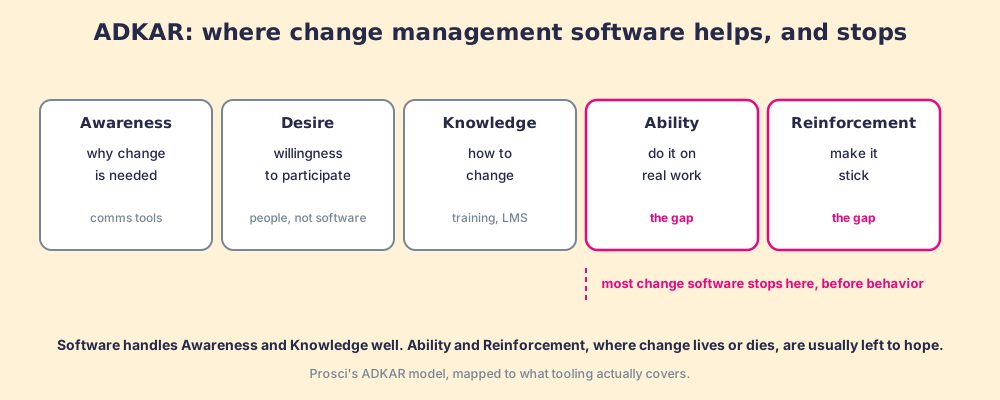
The cruel part is that Ability and Reinforcement are exactly where initiatives fail. Prosci’s research across thousands of projects finds reinforcement the most-skipped stage, and projects that neglect it slide backward even after a strong launch. So the standard initiative makes people aware, wins their desire, trains their knowledge, and then leaves them alone on real work, where the old habit is still the path of least resistance. They revert, the dashboard calls it a people problem, and the software that handled the easy half gets blamed for the hard half it never touched.
There is a number under this that should reorder anyone’s shopping list. McKinsey has tracked transformation success for years and keeps landing on roughly the same figure: about 70 percent of large change programs fail to reach their goals, and the failures cluster not in planning but in sustaining new behavior once the launch energy fades (McKinsey, on transformation success). Read that against the ADKAR map and the diagnosis is almost tautological. The market sells heavily into the stages that succeed and lightly into the stages that fail, then is surprised by the failure rate. You cannot buy your way past a 70 percent failure rate with another tool aimed at the 30 percent that was already working.
Why does change revert after a strong launch?
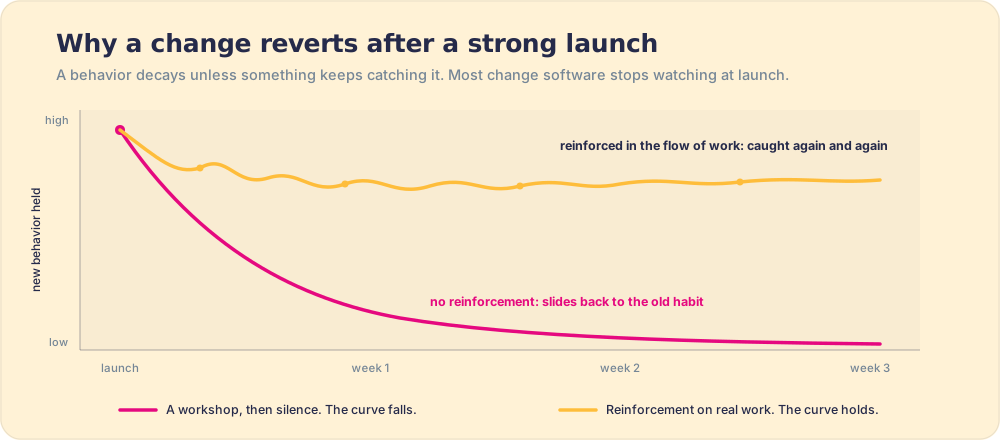
Because behavior decays unless something keeps catching it, and most change software stops watching at exactly the moment decay begins. The mechanism is old and well measured. Hermann Ebbinghaus, mapping memory in the 1880s, found that a person forgets more than half of new material within days unless it is reinforced, the curve that bears his name (Ebbinghaus forgetting curve). What is true of memorized facts is doubly true of new habits competing against an old one that is fast, familiar, and already wired in. A two-day workshop sits at the top of the curve. By the third week, with no reinforcement, the new motion has slid back toward the old one, and the rep is not being defiant. The system stopped reminding them, stopped making the new way the easy way, and stopped checking.
This is why reinforcement is a stage and not a slogan. It is the act of catching the behavior again and again, in the moment, until the new path is the path of least resistance. A comms tool cannot do it, because the comms ended at launch. A course cannot do it, because the course is a one-time event the forgetting curve immediately starts erasing. Reinforcement has to live where the work lives and recur on the cadence the work recurs, which is precisely the property the first three categories of change management software do not have.
How do you choose change management software that changes behavior?
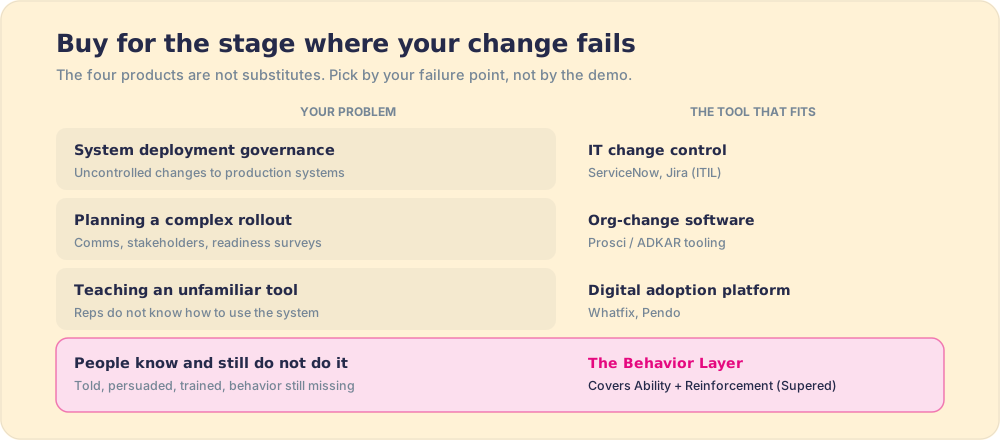
Buy for the stage where your change fails, which is almost always Ability and Reinforcement. The trick is to diagnose before you shop, because the four products are not substitutes and a buyer who picks by which one demos best will reliably pick for the wrong stage. Walk the four honestly against your own failure point.
- System deployment governance. If your problem is uncontrolled changes to production systems, you need approvals and an audit trail, and ITIL tooling like ServiceNow is built for exactly that. A real problem and a real fit, though rarely the one a revenue or enablement leader has.
- Planning a complex human rollout. If a large change needs comms, stakeholder mapping, and readiness surveys coordinated across departments, org-change software earns its place organizing the work. It plans the change well. Notice what it does not claim: to measure whether the behavior changed.
- Teaching an unfamiliar system. If reps genuinely do not know how to use a new tool, a digital adoption platform from best digital adoption platforms builds that knowledge with in-app guidance. It moves the Knowledge stage. It is light on the two after it.
- People know and still do not do it. If your team has been told, persuaded, and trained, and the new behavior still is not showing up on real work, no planning or teaching tool reaches that, because the gap is behavioral. This is the stage that needs guidance in the flow of the work plus measurement of whether the behavior is happening at all.
This is the knowing-doing gap wearing a change-management label: the distance between a trained team and a changed one, examined in the knowing-doing gap, is the same distance ADKAR marks between Knowledge and Ability. Stanford’s Jeffrey Pfeffer and Robert Sutton spent a book on it and reached a verdict the change-software market still has not absorbed: organizations are drowning in knowledge of what to do and starved of the systems that turn that knowing into doing. The fix they prescribe is not more knowing. It is changing how the work is structured so the right action happens by default, which is the same thing reinforcement means inside ADKAR and the same thing a behavior layer is built to deliver.
Diagnose the stage before you shop, because the four tools are not substitutes. For deployment governance, buy ITIL tooling. For planning a complex rollout, buy org-change software. For teaching an unfamiliar system, buy a digital adoption platform. But recognize that all three can succeed and the change can still fail, because they cluster in the stages where change is easy and thin out where it is hard. The McKinsey 70 percent failure rate and the Ebbinghaus curve point at the same culprit: a change is sustained by reinforcement on real work, and reinforcement is the stage the market underbuilds. If your initiatives keep dying after launch, the missing piece is not another planning tool or another course. It is a behavior layer that lives in the flow of the work, makes the new way the easy way in the moment, and measures whether it is being followed. Buy for the stage that fails, not the stage that demos well.
From here: the tool category in best digital adoption platforms, the system view of why rollouts stall in user adoption, the broader category framing in software adoption, and the underlying gap in the knowing-doing gap.
Frequently asked questions
What is change management software?+
What are the types of change management software?+
Why do change management initiatives fail even with software?+
What is the ADKAR model in change management?+
Why does a change revert after a strong launch?+
Your process, running itself.