Win Themes: The Three Reasons This Buyer Chooses You, Not Your Generic Strengths
Win themes are not your standard differentiators pitched to everyone. They are the three or four reasons this specific buyer will choose you over their actual alternative, woven through every touchpoint.
Win themes are the three or four deal-specific reasons a particular buyer will choose you over their real alternative, built from that buyer's priorities and your edge against the competition, not your generic differentiators pitched to everyone.
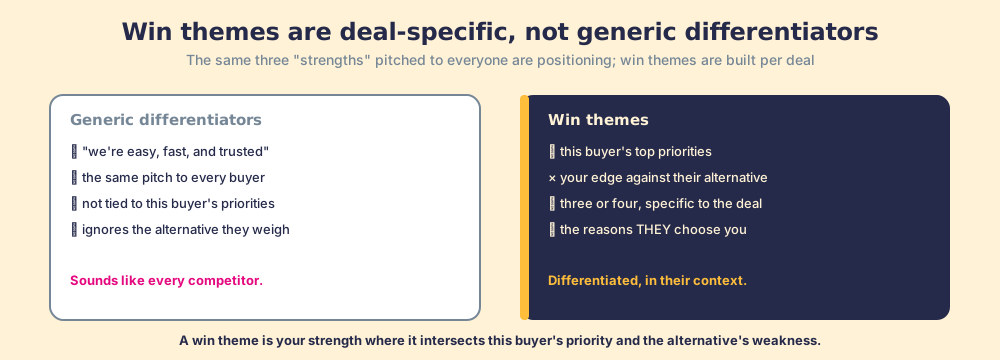
Most teams confuse win themes with differentiators, and it costs them deals. They decide on three company strengths, “we’re easy, we’re fast, we’re trusted,” and pitch those same three to every buyer in every deal. That is not a set of win themes; it is a positioning statement, and a generic one. A win theme is not a fixed claim about your product. It is a deal-specific reason this particular buyer will choose you over the specific alternative they are weighing, built from their priorities and your genuine edge in their context. The same strength can be a decisive win theme in one deal and irrelevant in the next, because what makes it a win theme is not the strength itself but its intersection with this buyer’s priorities and the alternative’s weakness. Pitch generic strengths to everyone and you sound like every competitor. Build win themes per deal and you give each buyer concrete reasons that are theirs.
Win themes are the three or four deal-specific reasons a particular buyer will choose you over their real alternative, built from that buyer’s priorities and your edge against the competition, not your generic differentiators pitched to everyone. Build them per deal, and the buyer remembers why you.
The term came up out of government and enterprise proposal work, where capture managers building a multi-hundred-page bid learned that a proposal stuffed with features lost to a proposal organized around a few themes the customer cared about. The Association of Proposal Management Professionals codified win themes as a discipline for exactly this: a theme is a customer benefit you can substantiate, tied to a customer hot button, that the competition cannot match (APMP, on win themes). The insight has not changed in the move from formal RFPs to ordinary B2B deals. It has only become easier to ignore, because in a normal deal nobody forces you to write the themes down, so most reps never do.
Why do generic differentiators lose to deal-specific win themes?
Because a differentiator that is the same for everyone connects to nothing a specific buyer cares about, while a win theme is anchored in exactly what they care about. Positioning, as April Dunford argues in Obviously Awesome, is contextual: the same product looks differentiated or unremarkable depending on the buyer’s situation and the alternatives they are comparing, so the right question is never “what is our value” but “best for whom, doing what” (Dunford, Obviously Awesome). A generic differentiator ignores that context. It says the same thing to a buyer who prizes speed and one who prizes security, and lands with neither, because it is not built from their priorities. A win theme is built from exactly that context: this buyer’s top priorities, intersected with where you genuinely beat the specific alternative they are weighing. That intersection is what makes a reason both true and relevant, which is what makes it win.
The deeper failure of generic differentiators is that they make you indistinguishable. A rival down the street claims to be easy and fast and trusted too, so a buyer hearing those claims has no basis to choose, and the deal slides toward price or “no decision.” That last word deserves weight. Gartner’s research on the B2B buying journey found that the most common outcome of a qualified deal is not a loss to a competitor but no decision at all, the group that wants to buy and cannot get itself across the line (Gartner, on the B2B buying journey). Matthew Dixon and Ted McKenna, studying that paralysis in The JOLT Effect, found it is driven less by a preference for the rival than by the buyer’s own fear of making the wrong call, indecision born of low confidence in the choice (Dixon and McKenna, The JOLT Effect). Generic differentiators feed that paralysis: they give the buyer nothing concrete to be confident about. Win themes do the opposite. By anchoring in this buyer’s priorities and the alternative’s specific weakness, they hand the buyer a sturdy, repeatable reason to be sure, which is the thing that gets a wavering committee to commit.
The mechanism underneath is plain once you name it. A buyer does not decide in the meeting; they decide later, from memory, often while explaining the choice to someone else. Whatever they can recall and repeat is what wins. A generic claim, identical to three competitors’ claims, leaves no distinct trace to recall. A win theme, built from what this buyer told you matters and repeated until it is theirs, is the line they say back to their own boss. You are not trying to be remembered as impressive. You are trying to be the sentence the champion uses when you are not in the room.
How do you build win themes for a specific deal?
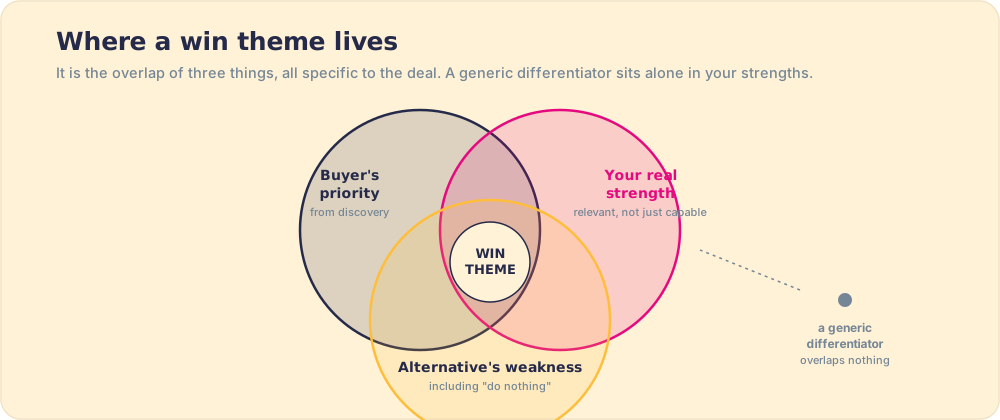
Start from this buyer’s priorities, not your feature list, and find where your real edge meets the alternative’s weakness. The build runs in three moves. First, identify the buyer’s top two or three priorities, which come from discovery, not from your product, the reason discovery call questions matter so much. Second, find where your genuine strengths intersect those priorities, the places you are not merely good but relevant to what they care about. Third, locate where you beat the specific alternative they are weighing, including the option to do nothing, because a reason to choose you is only a win theme if it is a reason against the actual alternative. The three or four points where all three line up, their priority, your strength, the alternative’s weakness, are your win themes for this deal. Anything else, however impressive, is noise in this deal.
- Their priorities first. From discovery, not your feature list. A win theme starts with what the buyer cares about.
- Your real edge. Where you genuinely beat the alternative, not where you merely have a feature. Relevance over completeness.
- Against the actual alternative. Including “do nothing.” A reason only wins if it beats what they would otherwise do.
- Three or four, not ten. Few enough to repeat and remember. A long list of themes is no theme at all.
A pair of win theme examples makes the difference concrete. Sell a data platform to a buyer whose stated priority is speed of deployment, against an incumbent famous for nine-month rollouts, and the win theme is not “we are powerful.” It is “live in three weeks, because that is what your Q3 deadline needs and what the incumbent cannot do.” Same product, different deal: a buyer in a regulated industry weighing a cheaper point tool, and the priority is audit risk, not speed. Now the win theme is “every action logged and exportable for your auditor, which the point tool leaves you to bolt on yourself.” The strength being sold may be the same underlying platform. The reason it wins changed completely, because the buyer’s hot button and the alternative’s weakness changed. That is what people miss when they write down three sales win themes once and reuse them forever.
How do you make win themes win the deal?
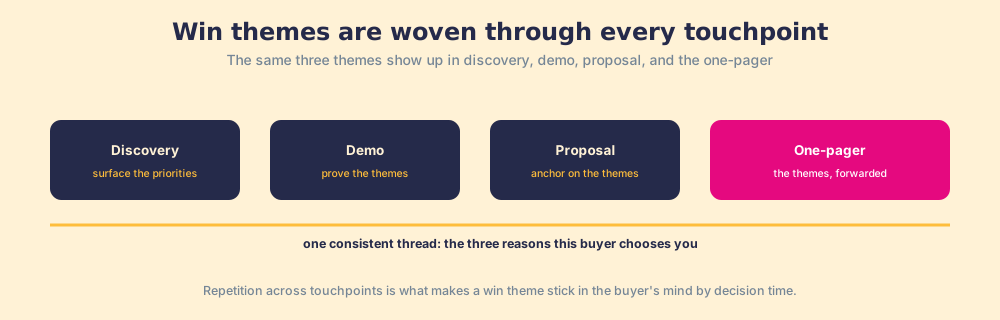
Weave the same themes through every touchpoint and make building them a required play, not a talented rep’s instinct. Win themes only work if they are consistent and repeated: the same three reasons surfaced in discovery, proven in the demo, anchored in the proposal, and carried in the one-pager the champion forwards, so by decision time the buyer associates you with exactly those reasons. The repetition is not laziness; it is how memory works. The mere-exposure effect, one of the most replicated findings in psychology since Robert Zajonc named it, is that people come to prefer and trust what they encounter repeatedly (Zajonc, on mere exposure). A win theme mentioned once is a fact the buyer heard. The same theme met in discovery, the demo, and the win themes proposal becomes a belief the buyer holds, because they have arrived at it three times in their own words. A theme woven through every touch becomes the story the buyer tells themselves, and the story they tell wins.
The trouble is that most teams leave this to whichever reps happen to be good at it, which means most deals are run on generic differentiators by default. Making win-theme development a required step in your sales playbook, surfaced and coached in the flow of work, is the sales process adoption move that turns it from a star rep’s instinct into every rep’s habit. Note what that costs. Asking a rep mid-deal to “build win themes” is asking for judgment and effort precisely when they are buried in the work, so the play that lives only in a training deck dies in practice. The fix is not more exhortation. It is to put the prompt and the structure in front of the rep at the moment they are writing the proposal, so the harder, better motion becomes the easy one. The themes win when every rep builds them and weaves them, deal by deal.
What we recommend
Stop pitching the same three strengths to every buyer and build win themes per deal, because a reason that is the same for everyone is a reason for no one. A win theme is the intersection of this buyer’s priorities, your genuine edge, and the specific alternative’s weakness, which means it is built from discovery and the competitive context, not picked from a fixed list of company differentiators. Find the three or four points where your strength meets what this buyer cares about and where you beat what they would otherwise do, and then weave those same themes consistently through discovery, the demo, the proposal, and the one-pager, so the buyer remembers exactly why you by decision time. Make building and weaving win themes a required, coached play rather than a star rep’s instinct, so every deal gets them. Generic differentiators make you sound like the field. Win themes make you the obvious choice for this buyer, which is the only choice that matters.
From here: the priorities that feed them in discovery call questions, the competitive edge in the sales battlecard, the playbook they belong to in the sales playbook, and the adoption underneath in sales process adoption.
Frequently asked questions
What are win themes?+
How are win themes different from differentiators?+
How do you develop win themes for a deal?+
Why do generic differentiators lose deals?+
Your process, running itself.