Sales Process Adoption: Why Reps Drift, and How to Close the Gap
Your process is written. Adoption is whether reps run it on live deals. Why it stalls, what it costs, and the loop that makes it stick, with the research.
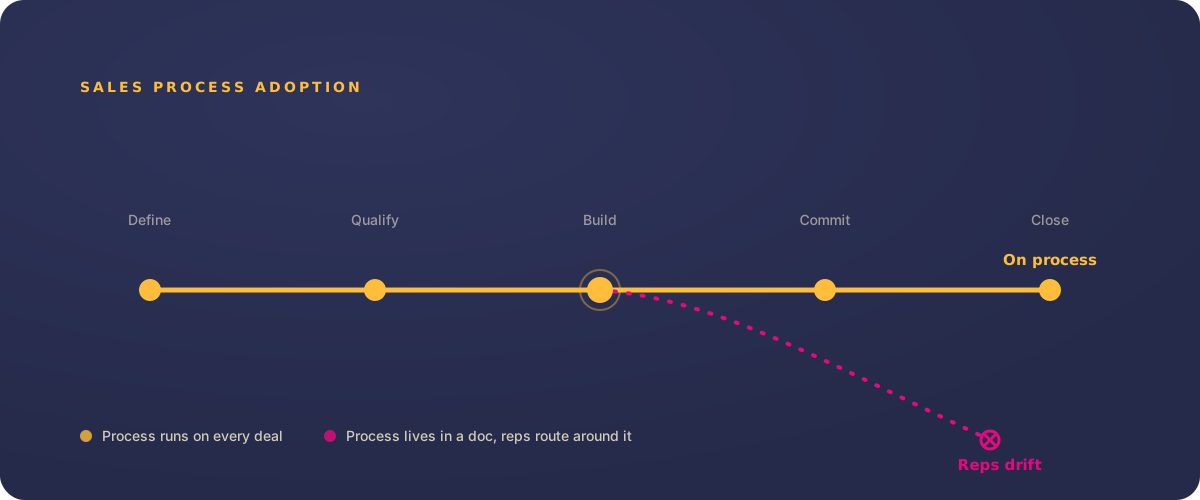
Sales process adoption is the degree to which reps run your documented sales process on live deals, rather than whether that process exists in a playbook somewhere; it is a behavior measured on real opportunities, not a document.
Most teams do not have a sales process problem. They have a sales process adoption problem. The process is written, the playbook is thorough, the kickoff deck was great. Then you pull a sample of open deals and the documented steps are missing on half of them. That gap, between the process you wrote and the process your reps run, is where revenue leaks and forecasts go soft.
There is a name for this gap, and it is older and bigger than sales. Stanford’s Jeffrey Pfeffer and Robert Sutton called it the knowing-doing gap: the chronic distance between what an organization knows it should do and what it does (Pfeffer & Sutton, 2000). They found it almost everywhere, and they found that the companies who closed it did not do so by knowing more. They did it by changing what happened in the daily flow of the work. An unadopted sales process is the knowing-doing gap in its purest form. It is not a process. It is a detailed opinion about how you wish people sold.
What sales process adoption is, exactly
Sales process adoption is a behavior metric. It is the percentage of live deals where reps follow the documented process: the right stages, the required fields, the agreed next step, the qualification criteria you decided matter. It is not the existence of a process document, and it is not what reps say they do in a survey.
This distinction matters because the two get confused constantly. Leaders point to a polished playbook in the company wiki as proof the process is handled. The playbook is the easy part. Adoption is the hard part, and in 2026 it is the only part still genuinely hard. Knowledge is solved. Any rep can find the document, and an AI can summarize it in seconds. Whether they act on it, on a Tuesday, on a slipping deal, with three other tabs open, is a different question entirely, and it is the only question left that money turns on.
Three things are true about adoption that are not true about a process document:
- It is measured on live deals, not in a survey or a kickoff deck.
- It can sit near zero even when the process document is excellent.
- It moves when you change how the process reaches reps and whether you measure it, not how hard you train it.
Why do reps drift from a process you already documented?
Reps drift for a structural reason, not a character one: the process reaches them too late, or never, at the moment they need it. The playbook is in a doc. The decision is happening in the deal, the inbox, the call. Following the process means leaving the work, finding the doc, reading the relevant section, and coming back. That is friction, and friction loses to quota pressure every time.
None of this is a discipline failure. A motivated rep under pressure will route around any step that costs more than it visibly returns. If the documented process is a tab away, it is a tax. If it surfaces in the moment of the decision, it is help. Same content, opposite adoption, decided by when it reached the rep.
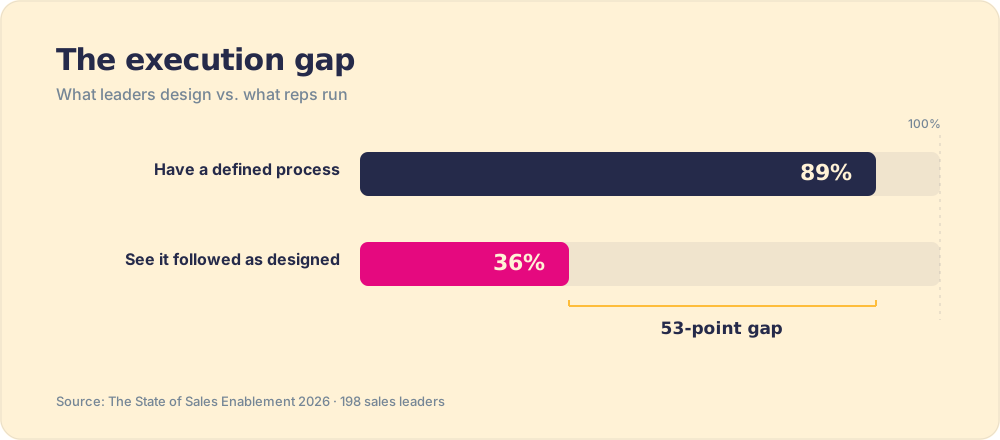
The gap is not a process-quality problem. The processes are fine. It is a delivery-and-measurement problem: the process arrived too late to use, and nobody was counting whether it was used until it was too late to fix.
What does low sales process adoption cost?
Low adoption is expensive in ways that never show up as a line item:
- Deals stall in stages with no clear exit criteria.
- Required fields stay blank, so your reporting and forecast inherit the gaps.
- New reps ramp slowly, because the real process lives in your top performers’ heads, not the system.
- Managers spend the week chasing updates instead of coaching.
Teams whose process reaches reps in the flow of work hit quota at 49 percent. Teams whose process lives in a doc, wiki, or LMS hit quota at 15 percent. The timing of delivery explains most of the gap.
It is a simple trade. A mediocre process that runs on every deal beats an excellent process that runs on half of them. Consistency compounds. Variance leaks.
Is there a threshold where sales process adoption starts to pay off?
We are not the first to put a number on this, and it would be dishonest to pretend otherwise. The sharpest sales-specific work on the question came out of CSO Insights, the research arm then led by Tamara Schenk. Studying thousands of sales organizations, Schenk’s team found that sales process adoption behaves less like a dial you slowly turn up and more like a waterline you have to clear. Below a certain level, the gains barely move. Cross it, and performance lifts. Her words, from the 2018 Sales Enablement Study:
Organizations with a dynamic sales process and a sales process adoption greater than 75% performed better (win rate improvement by 12%, quota attainment by 16%) compared to those without.
Schenk, “How Important is CRM Adoption and Sales Process Maturity for Sales Enablement Success?”, CSO Insights, 2018. A companion finding in the same study put a number on sales process compliance specifically: given CRM adoption above 75%, teams with a formal or dynamic process saw win rates 14.9 points higher and quota attainment 19.3 points higher than teams running a random or informal one (CSO Insights, 2018).
Grant her the point in full, because it is right and it is sourced. A process people run, past three-quarters of deals, changes the number. A process that sits at thirty percent does not. That is the waterline.
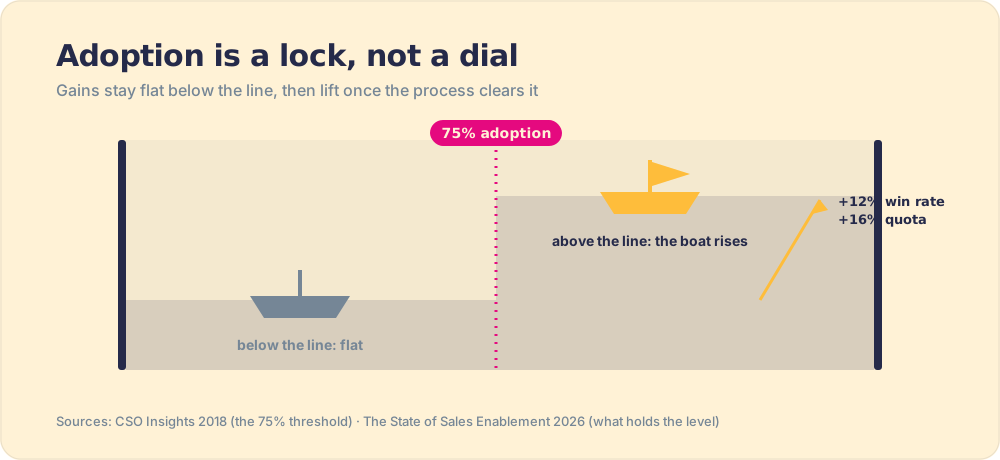
The picture has an edge, and honesty requires marking it. A lock fills on its own once you close the gate. Sales process adoption does not. Left alone, the water drains: most teams that cross seventy-five percent at launch slide back under it within weeks, because nobody is watching the level. This is where our own data extends Schenk’s. CSO Insights measured what high adoption is worth. The State of Sales Enablement 2026 measured what keeps it there, and the answer was the timing of delivery: teams whose process reaches reps in the flow of work hit quota at 49 percent, versus 15 percent for teams whose process lives in a doc, wiki, or LMS. Two independent studies, eight years apart, pointing the same direction. One says the waterline is real. The other says delivery and measurement are the pumps that hold the level.
That convergence is also where sales playbook adoption parts ways with writing the playbook in the first place. Schenk’s teams that cleared the line were not the ones with the thickest playbook. They were the ones who had built the process into the daily flow and measured against it, which is the same mechanism Pfeffer and Sutton found closing the knowing-doing gap in every other field: not knowing more, but changing what happens in the work itself.
How do you drive sales process adoption that sticks?
You make running the process the easy thing to do, and then you measure whether it is being done while you can still act. Practically, that is a loop of four moves working together, the approach we walk through in detail on how Supered works:
- Expect. Set a clear, checkable expectation: the required fields, the stage exit criteria, the next step, stated as something you can verify on a deal.
- Equip. Deliver it in the flow of work, the instant it is relevant, so following the process is the path of least resistance instead of a tax.
- Measure. Track adherence on live deals, continuously, and surface it. This is the keystone, not the afterthought: it is the leading indicator that predicts the lagging sales KPIs like win rate and cycle length, and monitoring progress is one of the most reliable ways known to make a behavior stick, and it works best when the signal is visible and close to the work. See compliance vs adoption for the evidence.
- Reinforce. Coach off that live signal, so a rep who slips gets a useful nudge this week, not a scolding at quarter close. The weekly one-on-one is where it lands, and the right one-on-one meeting questions turn a drift signal into a coaching conversation instead of a reprimand.
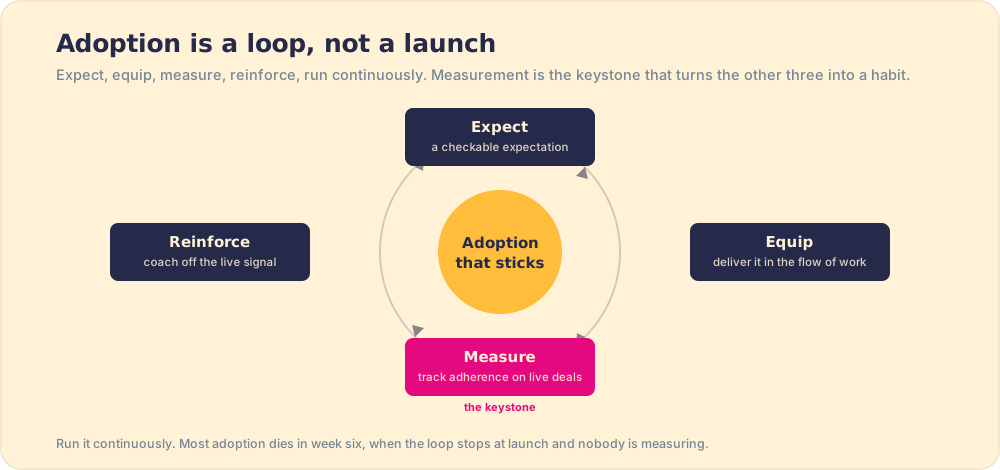
The order is where this usually breaks. Teams jump to measurement as enforcement before making the process useful and present, and they get compliance theater: reps updating fields to pass a check, learning nothing. Make it easy first, measure to coach second, and the measurement becomes the thing reps use to get better rather than the thing done to them. Adoption is compliance that has been measured and coached into a habit.
How do you sustain adoption after the rollout?
Most adoption dies in week six, not week one. The launch has energy, the training is fresh, and then the new process competes with old muscle memory and loses, deal by deal, with nobody counting. Sustaining it is mostly about removing the reasons to drift, over and over:
- Keep the process present in the flow of work, so following it never costs a detour.
- Retire steps that stopped earning their place, instead of letting dead requirements teach reps that the process is noise.
- Keep the adoption signal live and visible, so drift is caught the week it starts.
- Close the loop with whoever owns the process: when reps route around a step, that is data about the step, not a verdict on the rep.
The teams who keep adoption high treat the process as a living system that earns its keep on every deal, which is exactly the posture our customers describe.
Adoption is the last hard problem in enablement
Strip it all back and this is why adoption is worth obsessing over. The other inputs have all been commoditized. Content is easy to make, knowledge is a search away, and a good process can be copied off a competitor in an afternoon. The one thing that cannot be downloaded is whether your team does the thing, consistently, on real deals, when it is inconvenient. That is the knowing-doing gap, and closing it, by reaching reps in the moment and measuring whether they followed, is the entire job.
This is the core idea behind sales process adoption as a use case: stop treating the playbook as a destination reps visit, and start treating it as a layer that meets them in the work and a signal you can act on. Two threads go deeper from here: why even a documented process goes unrun, in the sales execution gap, and why measurement is the thing that makes adoption last, in compliance vs adoption. If you want the proof, the customer stories are the clearest version, and pricing is built around the size of the team you are rolling it out to.
Frequently asked questions
What is sales process adoption?+
How do you measure sales process adoption?+
Why do reps stop following the sales process?+
What is the difference between sales process adoption and compliance?+
Your process, running itself.