Whatfix vs WalkMe: The DAP Choice After the SAP Deal
Whatfix vs WalkMe is the classic digital adoption platform face-off, but SAP's acquisition of WalkMe changed the math. Here is the honest 2026 comparison and the job neither DAP was built to do.
Whatfix vs WalkMe is a choice between the two leading digital adoption platforms, both of which layer in-app guidance over enterprise software, with Whatfix independent and WalkMe now owned by SAP and steered toward the SAP suite.
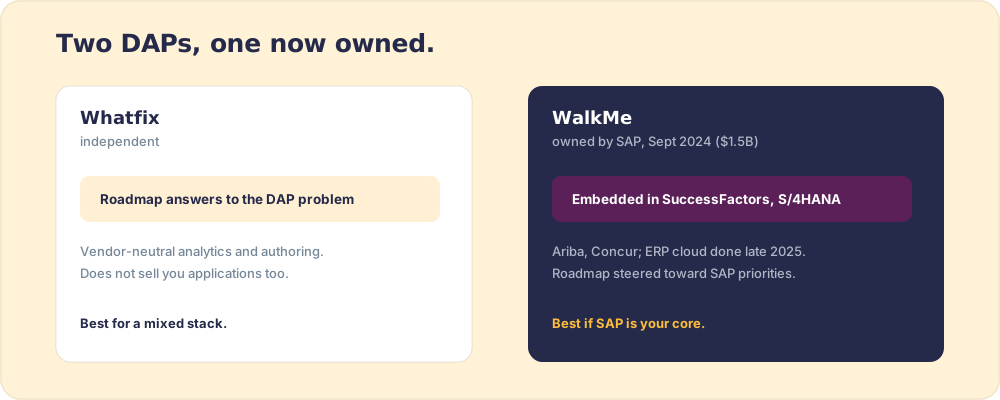
Whatfix vs WalkMe is the comparison nearly every team reaches for when they decide they need a digital adoption platform, and it used to be a clean fight between two independent vendors. It is not anymore. In September 2024, SAP bought WalkMe for about 1.5 billion dollars, and by late 2025 had folded it into SuccessFactors, Ariba, Concur, and S/4HANA (SAP completes WalkMe acquisition). So the honest version of this comparison starts by saying that one of the two is now part of something much larger, and that changes what you are choosing.
Whatfix vs WalkMe is a choice between the two leading digital adoption platforms, both of which layer in-app guidance over enterprise software, with Whatfix independent and WalkMe now owned by SAP and steered toward the SAP suite. Hold the word suite there, because it is the hinge the whole decision turns on.
What do Whatfix and WalkMe each do?
The same job, with different parentage. A digital adoption platform sits on top of your other software and walks users through it: tooltips that appear at the right field, step-by-step flows that complete a task, in-app help that fires the moment a user hesitates, and analytics on where people get stuck. The pitch is that software fails not because it lacks features but because users never learn to use them, and a DAP closes that gap from inside the app.
Whatfix is the independent option. It built its name on strong content authoring and analytics, and because it is not owned by any platform it sells against, its roadmap answers to the DAP problem rather than to a parent suite. For a team that runs a mixed stack and wants guidance that does not favor one vendor, that independence is the draw. It is well capitalized for the fight, a 125-million-dollar Series E led by Warburg Pincus in September 2024 (the same month WalkMe’s sale closed, a coincidence the category noticed), and it was named a Gartner Peer Insights Customers’ Choice for digital adoption platforms in 2026.
WalkMe is now SAP’s. The acquisition closed in September 2024 for about 1.5 billion dollars, and SAP has since embedded WalkMe across its enterprise applications, with core ERP cloud integration finished in late 2025. Read against that, WalkMe is less a neutral DAP than a way to drive adoption inside an SAP estate. It does the DAP job well; its center of gravity has moved toward being part of SAP.
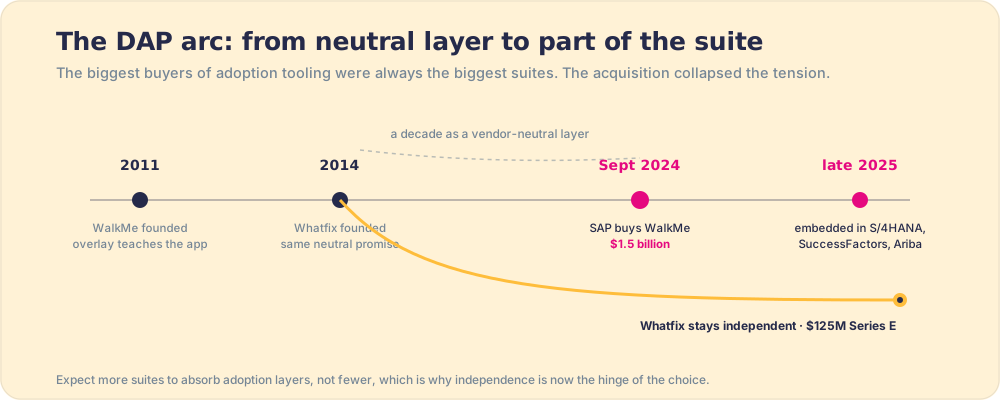
It helps to know where this category came from, because the SAP deal is not a surprise so much as the logical end of a long arc. Digital adoption platforms were born in the early 2010s to solve a problem enterprise software created: companies bought sprawling suites, employees used a fraction of them, and the gap between licensed and used was pure waste. WalkMe (founded 2011) and Whatfix (founded 2014) sold the same promise, an overlay that taught the software from inside, so the unused features got used. For a decade the category was a neutral layer floating above everyone’s stack. The tension was always that the biggest buyers of adoption tooling were the biggest software suites themselves, the ones with the most unused features to activate. SAP buying WalkMe collapsed that tension in one move: the suite acquired the layer that drives adoption of the suite. Expect more of this, not less, which is exactly why the independence question now sits at the center of the comparison.
How do you choose between Whatfix and WalkMe?
If you have decided you want a DAP, the choice, whatfix vs walkme or walkme vs whatfix reversed, is mostly a stack question.
| Whatfix | WalkMe (SAP) | |
|---|---|---|
| Ownership | Independent | Owned by SAP (Sept 2024) |
| Strength | Vendor-neutral analytics and authoring | Deep native SAP integration |
| Best when | Mixed stack, want independence | SAP is the core of your estate |
| Roadmap | Answers to the DAP category | Steered toward SAP priorities |
The decision compresses into a few real differences, and a clean whatfix vs walkme comparison names them rather than counting features:
- Ownership. Whatfix is independent; WalkMe belongs to SAP as of September 2024. That single fact reshapes every other line below it.
- Roadmap pull. Whatfix steers toward the digital adoption platform problem; WalkMe steers toward SAP’s enterprise priorities.
- Best fit. Whatfix suits a mixed stack that wants neutrality; WalkMe suits an SAP estate that wants native guidance.
- The WalkMe alternative question. It now reads as a non-SAP question, because the case for WalkMe leans on being an SAP customer.
Choose Whatfix if you run a mixed stack and want a digital adoption platform whose roadmap is not subordinate to a vendor you also buy applications from. Choose WalkMe if SAP sits at the core of your estate and adoption guidance native to SuccessFactors, Ariba, Concur, and S/4HANA outweighs the loss of neutrality. For most teams it resolves on whether they are an SAP shop.
Why does whatfix vs walkme miss the harder problem?
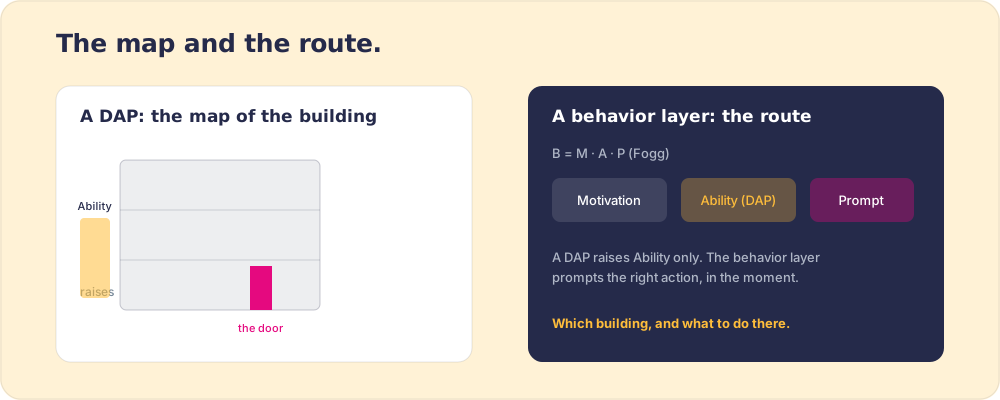
Because both answer a question that is necessary but smaller than the one a team running a process has. A DAP gets a user through the screen. It is a fine map of the building: it shows you the door, the corridor, the right office. What it never tells you is whether you went to the building you should have gone to, or did the thing that mattered once you arrived.
There is a behavioral idea worth naming here. The psychologist B.J. Fogg modeled behavior as B = MAP: a behavior happens when Motivation, Ability, and a Prompt converge at the same moment (Fogg, Behavior Model). A DAP is a beautiful Ability machine: it lowers the difficulty of using the software, makes the hard screen easy. But Ability is one of three. If the prompt fires for the wrong action, or there is no prompt for the action the process actually requires, a DAP cheerfully helps the user do the wrong thing faster. Making a screen easy to use is not the same as making the right thing happen on the real work.
Picture it concretely with a services firm onboarding a big new client. A DAP can teach the team, flawlessly, how to create the project record, update a status field, and mark a milestone done in the software. Every one of those actions is easy now, beautifully guided, and not one of them is the step that protects the account, which is running the requirements review the way the playbook says and making the internal handoff cleanly before kickoff. The DAP raised Ability on the screen tasks and stayed silent on the steps that mattered, because it has no model of what a good onboarding looks like. It maps the building. It does not know which room holds the client relationship.
For a process like that, this is the whole gap. Getting the team fluent in the software is table stakes. Whether they ran the documented onboarding steps, recorded the client’s real requirements, and took the next right step is the question that decides whether the account sticks, and no DAP was built to define that standard or measure adherence to it. As the State of Sales Enablement shows, the spread between teams that follow the process and those that do not is the largest performance variable, and it is a behavior spread, not a click-path spread. We measured it: 89 percent of 198 teams have a defined process, and 36 percent see it run as designed. A DAP closes none of that 53-point gap, because the gap was never that people could not work the screen.
What we recommend
Pick your DAP on the stack question, then decide whether a DAP is even the tool your problem needs. Choose Whatfix for an independent, vendor-neutral digital adoption platform across a mixed stack. Choose WalkMe if you are committed to SAP and want adoption native to it. Both are credible, and the SAP deal is the fact that should weigh heaviest if you are not an SAP customer, because it tells you where WalkMe’s roadmap is heading.
But if the problem you are solving is that the team is in the software and still not running the process, neither DAP finishes the job. A DAP teaches the screen; it cannot define the standard or inspect whether the team meets it. That is the behavior job, and it belongs to a behavior layer that lives where the team works and measures the process itself. Fogg’s model says it plainly: Ability without the right prompt and the right action is motion, not progress.
From here: the category in full in digital adoption, the field of independent options in WalkMe alternatives, the same map-versus-route divide for the process itself in where should your sales process live, and the adoption data in user adoption.
Frequently asked questions
What is the difference between Whatfix and WalkMe?+
Is Whatfix better than WalkMe?+
How did SAP's acquisition change WalkMe?+
What does a DAP not solve, and what does?+
Your process, running itself.