Appcues vs Pendo: Onboarding Flows or Behavior Analytics
Appcues vs Pendo is a choice between a focused onboarding-flow builder and a broad product-analytics platform. Here is the breakdown for 2026 and the adoption lever both leave for someone else.
Appcues vs Pendo is a choice between a focused, no-code onboarding and in-app flow builder (Appcues) and a broader product-analytics platform that pairs deep usage data with in-app guidance (Pendo), with the decision turning on whether you need fast flows or deep measurement.
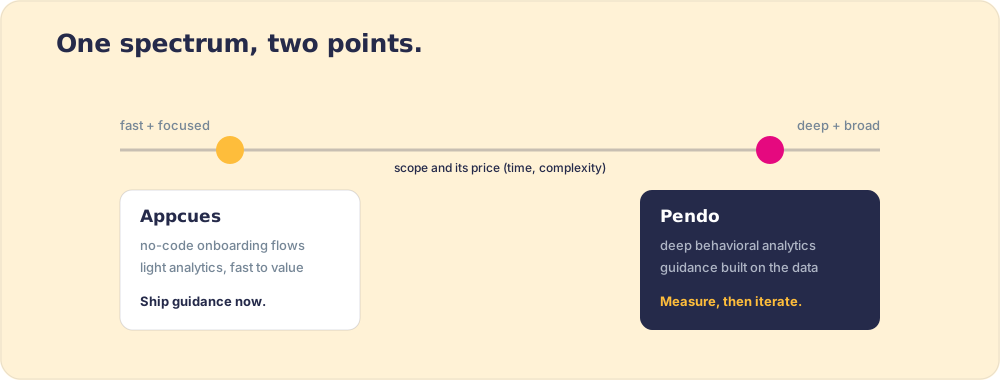
Appcues vs Pendo reads like a straight feature fight, two product-adoption tools lined up to count tooltips and integrations. It is cleaner than that. The two sit at different points on a single spectrum, scope, and once you see where each lands, the choice stops being a shoot-out and becomes a question about how much you need to measure. So before comparing checkboxes, place them on the spectrum, because that is the decision underneath the decision.
Appcues vs Pendo is a choice between a focused, no-code onboarding and in-app flow builder (Appcues) and a broader product-analytics platform that pairs deep usage data with in-app guidance (Pendo), with the decision turning on whether you need fast flows or deep measurement. Hold the words fast and deep, because they sort the entire comparison.
What does Appcues vs Pendo come down to?
It comes down to scope and the price of that scope. A clean appcues vs pendo comparison names the trade rather than tallying features:
- Appcues, the focused builder. No-code onboarding flows, tooltips, and announcements you ship without engineering, with analytics light enough to read but not the product’s center. Faster to value, gentler to learn, less to govern.
- Pendo, the analytics platform. Deep behavioral capture (every click, path, and drop-off) as the foundation, with in-app guidance built on top. More to set up, more to learn, and more it can tell you once it is running.
- The trade. Appcues optimizes for speed and simplicity; Pendo optimizes for depth and breadth. Neither is wrong; they price the same capability differently in time and complexity.
This is the genuine difference, and being fair about it matters more than a feature count. If your job is to launch good onboarding this quarter without an engineering queue, Appcues is purpose-built for it and usually quicker to value, which is why it shows up so often as user onboarding software for smaller product teams. On the third-party scorecards the two run close on satisfaction, with Pendo carrying the larger review base on G2’s product-adoption category and Appcues rated highly for ease of setup, so this is not a quality gap. It is a scope gap. If your job is to understand behavior across the whole product and iterate on it with hard data, Pendo’s analytics foundation pays for its heavier setup.
There is a second reason to read the spectrum carefully in 2026, and it is about direction, not features. The two companies are moving at different speeds. Pendo has been on an acquisition run, four deals in roughly 18 months, most recently buying Chisel Labs in February 2026 to fold an AI product-management agent into the platform, its third acquisition of an AI-native startup. The signal is plain: Pendo is becoming a broad product-operations suite with agentic AI woven through it, which deepens the analytics breadth and adds to the surface area you adopt. Appcues, meanwhile, has stayed deliberately narrow, a focused product-adoption vendor that has not chased the suite. Both are independent companies as of this writing; neither has merged with the other. So the trade is more than fast versus deep today. It is also focused-and-stable versus broad-and-expanding over the next few years, and that matters if you are buying a platform you will live inside.
How should you choose between Appcues and Pendo?
The honest table makes the branch obvious.
| Appcues | Pendo | |
|---|---|---|
| Core strength | Fast no-code onboarding flows | Deep product analytics + guidance |
| Scope | Focused, lightweight | Broad, analytics-heavy |
| Time to value | Faster | Slower, deeper payoff |
| Best for | Shipping flows now | Measuring and iterating at scale |
| Status (2026) | Independent; deliberately focused | Independent; acquisitive (Chisel Labs, Feb 2026), building an agentic-AI suite |
Choose Appcues if onboarding and in-app guidance are the job, you want speed over depth, and a lighter tool your team can run without a dedicated analyst. Choose Pendo if you need behavioral measurement as the foundation and guidance as one output of it, and you have the appetite for a heavier platform. For a pendo vs appcues shopper, the deciding question is rarely a missing feature; it is how much measurement the problem deserves.
Why does appcues vs pendo skip the harder adoption question?
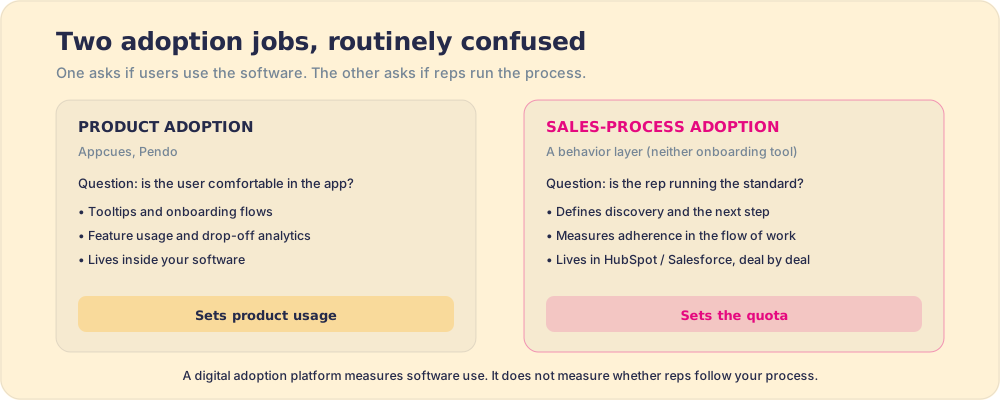
Because both answer adoption inside the product, and for a services or operations team the adoption that decides the outcome happens across the real work, not the app. Both tools are excellent at getting a user comfortable with software and showing how they use it. Neither was built to define the process a team should run on a live client and to check whether they ran it.
It helps to name the distinction these tools blur. User onboarding activates one end-user inside a product: first run, aha moment, the welcome flow. Client onboarding is the other job entirely. A services firm onboarding a big client has to run kickoff, requirements, implementation steps, internal handoffs, and milestones, the same playbook on every account, delivered by the internal team. The first impression and the churn risk both live there. That is a process-adherence job, and it is the job Appcues and Pendo do not touch.
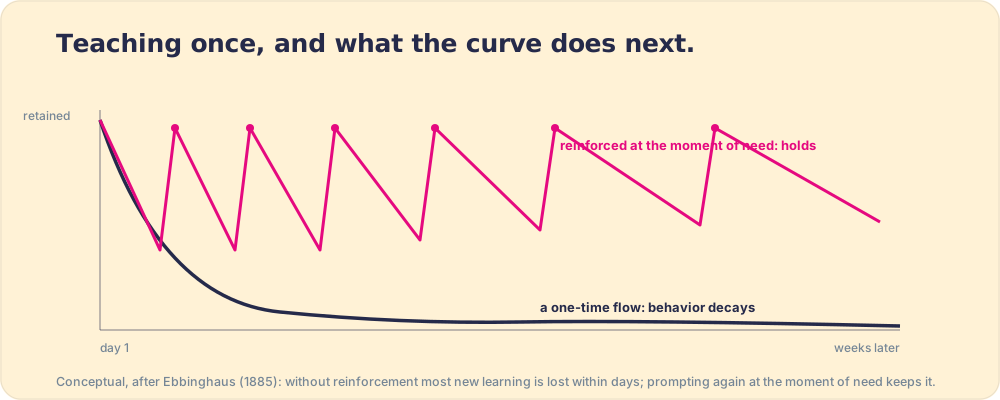
There is a learning-science idea that explains why this matters, and it is older than any of these tools. In 1885 the psychologist Hermann Ebbinghaus measured how fast we forget, and found that without reinforcement people lose the majority of new information within days, the curve now called the forgetting curve (Ebbinghaus forgetting curve). An onboarding flow is a teaching event: it shows a user what to do once. But teaching once, however slick the flow, runs straight into Ebbinghaus. The behavior holds only if it is prompted again at the moment it is needed, after the forgetting has set in. A flow that fires on day one and never returns is a lesson the curve erases. That is true for product onboarding, and it is doubly true for a client-onboarding process, where the right step has to resurface on the next account, weeks after any training, or it decays like everything else.
Hold the difference between the two jobs clearly, because it decides the entire comparison for an operations or delivery leader. Appcues and Pendo both answer the question “is the user comfortable in the software?” That is a real and valuable job, and for a SaaS product team it may be the only job that matters. But a services team has a different question: “is the team running the standard on this client?” An onboarding flow teaches a feature; it does not define the requirements call the team must complete before kickoff, or check whether the handoff to delivery happened, or resurface the next right step on the fortieth account of the year. Those are not product-usage behaviors that a tooltip can guide. They are process behaviors that have to be defined, prompted in the flow of work, and measured for adherence. A digital adoption platform measures whether people use your software. It does not measure whether your team follows your process, and for a delivery leader the second number is the one that decides the payoff.
This is why the comparison, as usually framed, answers a smaller question than an operations leader is asking. Choosing between fast flows and deep analytics is the right debate for a product team deciding how to onboard users. It is the wrong debate for a services leader deciding how to get the team to run the client-onboarding playbook, because both options sit inside the product and the playbook lives across the account.
What we recommend
For product onboarding, the appcues vs pendo choice is real and it resolves on scope. Choose Appcues to ship onboarding flows fast with a light, focused tool. Choose Pendo when you want deep behavioral analytics as the base and guidance built on it. Both are credible product adoption software, and the difference is how much measurement and complexity you are signing up for.
What neither does is the reinforcement job a client-onboarding process needs. Ebbinghaus settled this in 1885: a one-time teaching event decays, and behavior holds only when it is prompted again at the moment of need. For a delivery team, that moment is the next account, not a flow they saw at onboarding. If the behavior you need to hold is the process the team runs on every client, the tool is not an onboarding builder or an analytics platform; it is a behavior layer that lives in the tools the team already uses and prompts the right step in the flow of work, every time.
From here: the full category in digital adoption, the independent field in Appcues alternatives, the deeper analytics comparison in Pendo alternatives, and the adoption mechanics in user adoption.
Frequently asked questions
What is the difference between Appcues and Pendo?+
Is Appcues or Pendo better for user onboarding?+
Are Appcues and Pendo independent companies in 2026?+
What do Appcues and Pendo both leave out?+
Your process, running itself.