Whatfix Alternatives: What You Are Really Shopping For
Whatfix alternatives lists compare tooltip engines. The decision that matters is the job: training people on an app, or changing what they do on the work and proving it.
Whatfix alternatives are the digital adoption tools teams weigh when Whatfix's price, authoring effort, or thin behavior measurement pushes them to look, and they divide into tools that train people on an application and tools that change what people do on the actual work.
A Whatfix alternatives search usually starts the way a kitchen remodel starts: not because the old kitchen was ugly, but because something stopped working and the cost of the fix kept climbing. The lists you find rank guidance engines on smart-tip styles and analytics dashboards, which is fine if a prettier tooltip is the problem. It rarely is. The problem is that the guides need constant tending, and the dashboard never says whether the work is being done right. Choose by the job, and the field sorts itself.
Whatfix alternatives are the digital adoption tools teams weigh when Whatfix’s price, authoring effort, or thin behavior measurement pushes them to look, and they divide into tools that train people on an application and tools that change what people do on the actual work. That division is the comparison. Most lists skip it and rank twins instead.
Why do teams look for a Whatfix alternative?
Strip away the feature noise and two reasons drive almost every switch.
- Authoring burden. Flows, smart tips, and task lists need an owner to build and maintain, and they go stale the instant the process they describe changes. A guidance library is a snapshot of a moving thing.
- Measurement gap. Whatfix reports walkthrough completions and feature usage. Neither answers whether the work the walkthrough described is being done correctly, which is the question that pays the invoice.
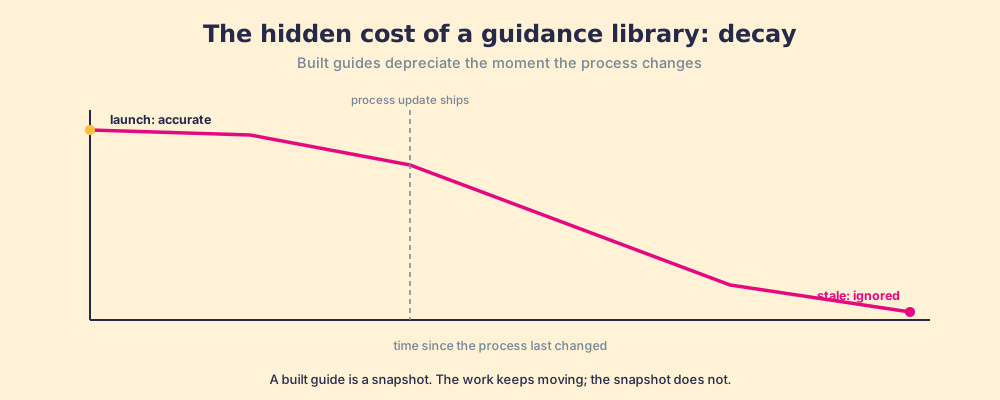
The decay is not a Whatfix flaw, it is a property of guidance built as content. Documents and walkthroughs depreciate the moment the process changes, which makes any guidance library a liability you maintain rather than an asset that compounds. The Whatfix competitors that share this architecture share this cost.
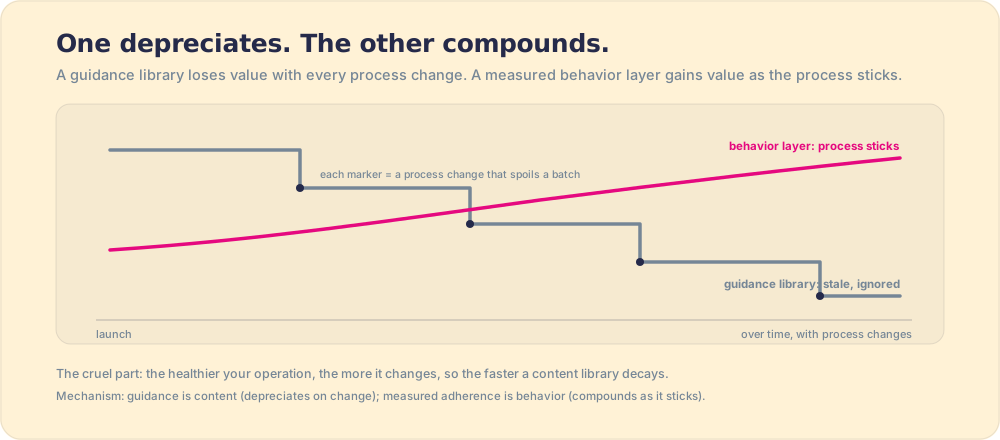
This is worth slowing down on, because it inverts how most teams account for a guidance library. On the purchase order it looks like an asset: a growing stockpile of flows and smart tips, value accumulating. In practice it behaves like inventory with a short shelf life. Every process change silently spoils a batch of it, and unlike a real asset it does not appreciate while you ignore it, it rots. An accountant would call a thing that loses value the moment you stop tending it a depreciating asset, and that is the honest line for a guidance library. The teams that feel this most are the ones whose underlying process is healthy and therefore changing often, which is the cruel part: the better your operation, the faster your guidance library decays, because improvement is exactly what invalidates the snapshot.
It helps to know where this category came from, because the lineage explains the limit. Digital adoption platforms emerged in the 2010s, led by WalkMe, to solve a real and painful problem: enterprise software, especially the heavy ERP and CRM suites, was so unusable that staff needed an overlay of tooltips and walkthroughs to operate it at all. That was a genuine advance, and for the job of teaching an unfamiliar interface it remains one. But the category was born to make hard software learnable, not to make a business process adhered-to, and those are different problems that happen to look alike in a demo. The DAP teaches the button. Whether the right work happens around the button, on the hundredth use, when the tour is long gone, was never the question the category was built to answer.
Which Whatfix alternative solves which job?
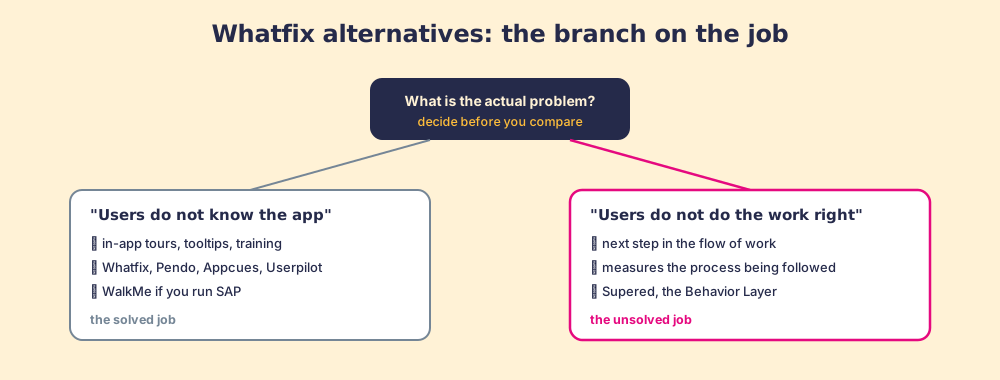
Decide what is broken before you compare anything, because the answer points to a different half of the market.
If the problem is that users do not know an application, the guidance family is the right shelf. WalkMe is the enterprise heavyweight, now part of SAP after a 1.5 billion dollar all-cash deal completed in September 2024, which makes it natural for SAP shops and a heavier lift for everyone else. Pendo brings deep product analytics alongside guidance. Appcues and Userpilot are the lighter, faster product-led onboarding tools. Any of them does the training job honestly, and you choose on price, build effort, and analytics depth. The WalkMe-specific tradeoffs are covered in WalkMe alternatives.
If the problem is that users do not do the work the right way, no training tool closes it, because training delivers knowledge and the gap is behavioral. This is the unsolved job: change what people do in the flow of the work, and prove the process held.
Does in-app guidance change behavior, or just teach it?
This is where the field conflates two things, so it is worth pulling them apart. Guidance teaches. Whether the teaching changes behavior on real work is a separate question, and the evidence is humbling. Research on the forgetting curve, traced back to Hermann Ebbinghaus and confirmed by modern replications, shows people forget the majority of new information within days unless it is reinforced at the moment of use (Ebbinghaus forgetting curve, replication study). A tour at first run is a teaching event. The behavior either resurfaces at the moment of the work, or it decays on Ebbinghaus’s schedule, and a completion analytic cannot tell which happened.
There is a second mechanism stacked on the first. BJ Fogg’s behavior model, built over two decades at Stanford, holds that a behavior fires only when motivation, ability, and a prompt coincide, written B = MAP (Fogg Behavior Model). A guidance library can teach the step to perfection and still lose the behavior, because at the hundredth run there is no prompt and the right step costs effort while the shortcut costs none. Knowing the step does not lower the cost of taking it. That is why a thoroughly trained team can still drift: the gap is not knowledge, it is the cost of the right action in the moment, which guidance leaves untouched.
The size of that gap is not a guess. In the State of Sales Enablement, across 198 leaders, 89 percent had a defined process and only 36 percent saw it followed, a 53-point gap that no amount of guidance completion would have predicted. The teams that closed it, where the process reached people in the flow of the work, hit quota at 49 percent versus 15 percent for the rest.
That is the practical difference between a digital adoption platform and a behavior layer. One gets a user through the first run. The other sustains the behavior and shows you when it slips, which is the only version of adoption that survives the forgetting curve.
What we recommend
The verdict sorts cleanly once you name the job and the corporate status of each option.
| Choose this | If your job is | Status, mid-2026 |
|---|---|---|
| WalkMe | Teaching an unfamiliar app at enterprise scale, especially on SAP estates | Acquired by SAP, 1.5B, closed Sept 2024 |
| Pendo | In-app guidance with deep product analytics | Independent |
| Appcues / Userpilot | Lighter, faster product-led onboarding | Independent |
| Whatfix | Independent enterprise guidance and simulated training | Independent, 139M+ raised |
| Supered | Keeping the work done right and proving the process held | Independent; the behavior layer |
If your job is genuinely teaching people an unfamiliar application, Whatfix is a strong tool and its alternatives are honest: WalkMe for SAP estates, Pendo for analytics depth, Appcues or Userpilot for speed and price. Pick on cost and build effort, and do not overbuy. If your job is sustaining a behavior on real work and proving it held, no guidance engine reaches that, because guidance is a teaching event and behavior is a measurement problem. There you want a behavior layer that meets people in the flow of the work and measures the process, not the tour. The decision is not Whatfix versus a cheaper Whatfix. It is whether you are buying training or behavior.
From here: compare the full category in best digital adoption platforms, see why rollouts stall in user adoption, and read the SAP-era tradeoffs in WalkMe alternatives.
Frequently asked questions
What are the best Whatfix alternatives?+
Why do teams replace Whatfix?+
Is Whatfix worth it for enterprise rollouts?+
What is the difference between digital adoption and behavior change?+
Your process, running itself.