Pendo Alternatives: Sort Them by the Job, Not the Feature List
Most Pendo alternatives lists rank near-identical tools by feature count. The useful cut is by job: which tools help people know what to do, and which change what they actually do.
Pendo alternatives are the digital adoption and product-analytics tools teams evaluate when Pendo's price, build burden, or thin behavior signal pushes them to look, and they sort cleanly into tools that help users know what to do and tools that change what users actually do.
Open any “Pendo alternatives” list and you find a dozen near-twins lined up like cereal boxes, scored on tooltip styles, survey types, and analytics depth. The lists are not wrong, exactly. They answer a question the buyer has not asked. A team rarely leaves Pendo because a competitor has a prettier tooltip. They leave because the bill grew, the guides went stale, and the dashboard never told them whether the rollout was working. To choose well, sort the field by the job each tool is built to do, not by the length of its feature list. The Pendo competitors worth your time are the ones that close a real gap.
Pendo alternatives are the digital adoption and product-analytics tools teams evaluate when Pendo’s price, build burden, or thin behavior signal pushes them to look, and they sort cleanly into tools that help users know what to do and tools that change what users actually do. Hold that line. It is the cut that decides which alternative is right for you, and most lists never make it.
Why do teams start looking for Pendo alternatives?
A switch search has a shape. It almost always begins at the price line and ends at a question the dashboard cannot answer.
- Price at scale. Pendo charges by seats and monthly active users, so the bill climbs as the rollout succeeds, which is a strange thing to penalize. The roughly 45 dollar cost-per-click on the term is the market telling you this is a crowded, expensive decision buyers research hard.
- Build burden. Tours and walkthroughs need a dedicated owner to author and maintain, and they go stale the instant the process they describe changes. Document-heavy guidance is a depreciating asset, not a durable one.
- No behavior signal. Usage analytics report clicks, sessions, and feature paths. None of those tells you whether the work the software exists for is getting done. That is the gap that ends most searches, and the one most alternatives share with Pendo. It is also why a digital adoption platform built on tours alone leaves the hardest question unanswered.
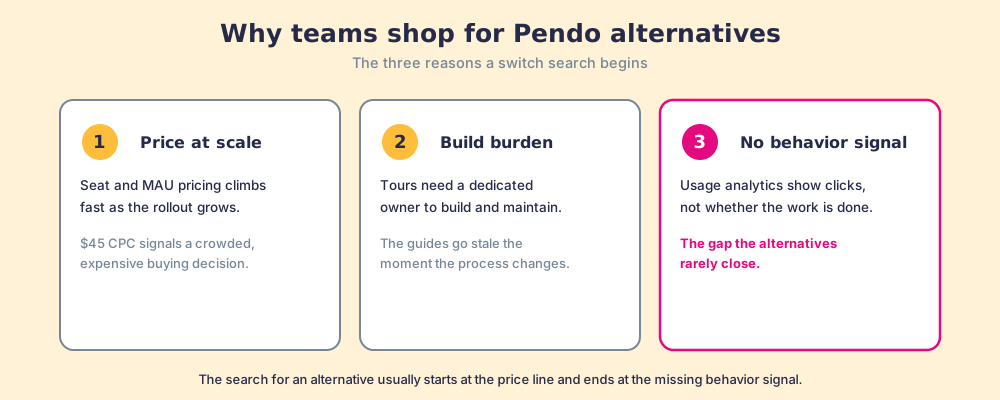
That third reason matters more than the first two, because it is the one money cannot fix by switching to a cheaper twin. Everett Rogers, whose 1962 Diffusion of Innovations still anchors the field, found that adoption is not an event but a process that runs through trial and confirmation over time (Rogers, Diffusion of Innovations). A tour gets a user through trial. Confirmation, the stage where the behavior either sticks or decays, happens later, on the real work, where the tour cannot see.
Which Pendo alternative fits which job?
The honest field splits in two, and naming the split is the whole comparison.
The guidance-and-analytics family does the solved job: helping a user know what to do. Whatfix is the AI-forward digital adoption platform, independent and well funded on a 125-million-dollar Series E led by Warburg Pincus in September 2024 (around 266 million dollars raised in total), strong on simulated training and enterprise guidance, and a Gartner Peer Insights Customers’ Choice for digital adoption in 2026. Appcues and Userpilot are the product-led onboarding tools, lighter and faster to stand up, aimed at SaaS onboarding flows (Appcues vs Pendo breaks down that head-to-head). WalkMe is the enterprise heavyweight, now part of SAP after a 1.5 billion dollar all-cash acquisition completed in September 2024, which makes it a fit if you are already an SAP shop and a heavier lift if you are not. Pendo itself stays independent and acquisitive (it bought Chisel Labs in February 2026 and Forwrd.ai in 2025, with stated IPO ambitions), and remains the analytics-deep option. If your job is in-app guidance and product analytics, any of these is a reasonable pick, and you choose on price, build effort, and how much analytics depth you need.
The behavior family does the unsolved job: changing what a user does on the real work, in the flow of it, and measuring whether the process is followed. This is where a completed walkthrough stops being the goal and the work itself becomes the measure. A finished tour is a fact about the tour. Adoption is a fact about the work, and the two diverge constantly.
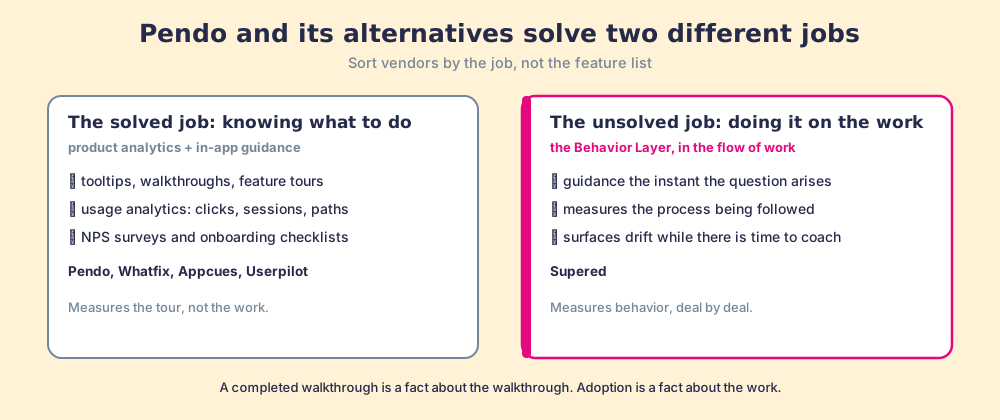
Here is the field on one line each, with current corporate status named, because a comparison that does not name who owns whom is out of date the moment a deal closes.
| Tool | Job it is built for | Status (mid-2026) | Choose it when |
|---|---|---|---|
| Pendo | Product analytics + in-app guidance | Independent, IPO ambitions | You live in the analytics depth |
| Whatfix | Enterprise in-app guidance + training | Independent ($125M Series E) | You want platform-neutral enterprise guidance |
| WalkMe | Enterprise guidance across the stack | Owned by SAP (Sept 2024) | You are an SAP shop |
| Appcues / Userpilot | SaaS product onboarding | Independent | You want a light, fast onboarding flow |
| Supered | Behavior in the flow of work, measured | Independent (ours) | You need people to run the process and proof they did |
The table makes the split visible: five of the six are competing on the same solved job and differ mostly on price, depth, and who signs the roadmap. Only the last row changes the question being asked.
How do you choose without paying for the half you do not use?
Decide which half of Pendo you rely on before you compare anything. If you live in the analytics (clicks, retention, feature paths), the analytics-deep tools earn their keep, and you choose on depth and price. If you live in the guidance (tours, tooltips, checklists), the lighter onboarding tools will stand up faster and cost less, and a digital adoption platform you can compare across in best digital adoption platforms will cover you. If what you need is for people to do the work the right way, every time, and for you to see when they do not, then no amount of tooling that measures the tour will get you there, and you are looking for a behavior layer instead.
The behavioral reason this distinction holds is the intention-action gap, the well-studied distance between deciding to do something and doing it. Peter Gollwitzer’s research on implementation intentions, summarized in a meta-analysis of 94 studies, found that linking an action to a specific cue in the moment roughly doubles follow-through (Gollwitzer & Sheeran meta-analysis). A tour fired at onboarding is the decision. The cue in the moment of work is what closes the gap, and that is a different product job than analytics or guidance, however good either is.
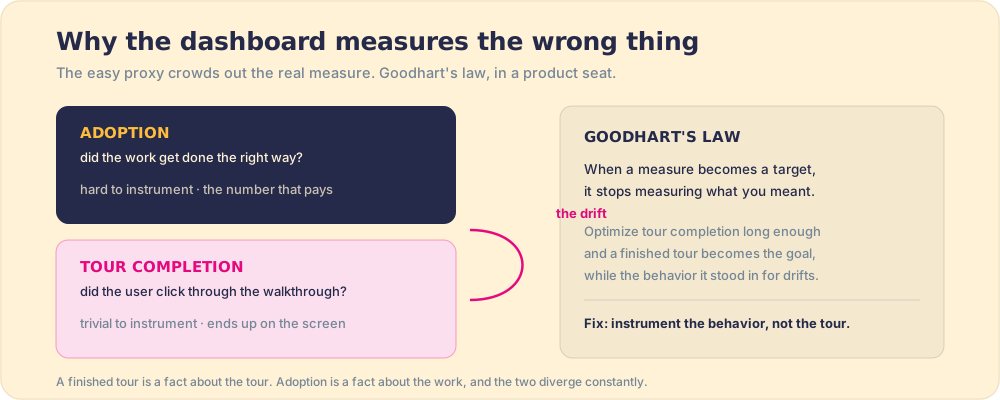
There is a measurement trap underneath all of this, and it is worth naming because it explains why even good teams buy the wrong half. When the thing you care about is hard to measure and a proxy is easy, you drift toward managing the proxy. Adoption (did the work get done the right way) is hard to instrument. Tour completion (did the user click through the walkthrough) is trivial to instrument. So the dashboard fills with the easy number, the team starts optimizing it, and a completed tour becomes the goal because it is the thing on the screen. This is Goodhart’s law in a product seat: a measure that becomes a target stops measuring what you meant. The fix is not a better tour-completion chart. It is to instrument the behavior itself, the step that moves the work, so the number on the screen is the number that pays the invoice. That is the line dividing the two families, and it is why no amount of analytics depth in the solved-job tools reaches the unsolved job; they are measuring the proxy beautifully. The deeper version of this argument, why rollouts stall even when the tool is good, lives in crm adoption.
What we recommend
If your problem is onboarding flows and product analytics, choose a guidance-first alternative on price and build effort: Appcues or Userpilot for speed, Whatfix for enterprise depth, WalkMe if you are already inside SAP. They are honestly good at the solved job, and you should not pay Pendo’s invoice for a job a lighter tool does. If your problem is that people are not doing the work the right way and you cannot see it, no analytics-deep twin will fix that, because the behavior signal is the thing all of them lack. There, the alternative is a behavior layer that meets people in the flow of the work and measures whether the process held. The decision is not Pendo versus a cheaper Pendo. It is which of the two jobs you are buying.
From here: compare the category in best digital adoption platforms, see why rollouts stall in user adoption, and read the WalkMe-specific tradeoffs in WalkMe alternatives.
Frequently asked questions
What are the best Pendo alternatives?+
Why do teams look for a Pendo alternative?+
Is Pendo a digital adoption platform or product analytics?+
What is the difference between user adoption and feature adoption?+
Your process, running itself.