Sales Pitch Examples That Work (and Why the Templates You Copy Don't)
Annotated sales pitch examples for cold outreach, the elevator pitch, and the discovery opener, plus the reason a great pitch is short, problem-first, and ends in a question.
Sales pitch examples that work share one anatomy: they lead with the buyer's problem, prove a single point, and end in a question, because a sales pitch exists to earn the next sentence, not to deliver a feature list.
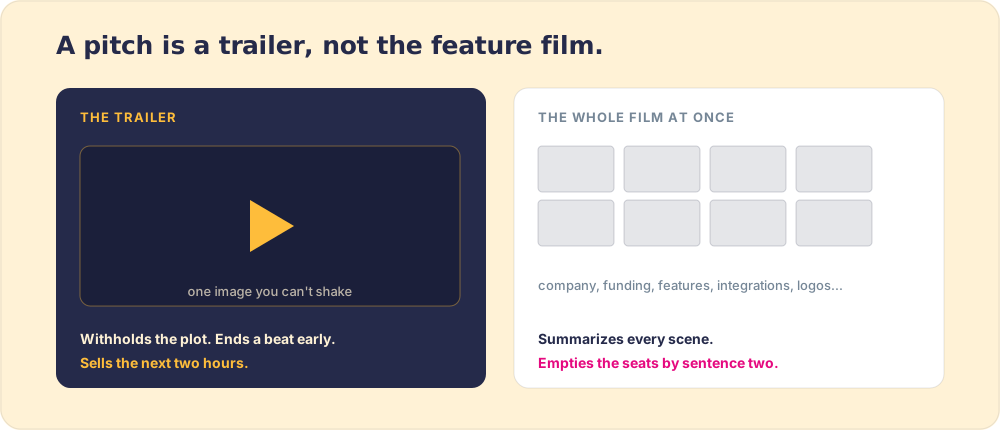
A movie trailer has one job, and it is not to tell you the plot. It is to make you want the next two hours. A good trailer withholds more than it shows, lands one image you cannot shake, and ends moments before you are ready, so you leave the theater already deciding to come back. A trailer that tried to summarize the whole film, scene by scene, would empty the seats it was built to fill.
A sales pitch is a trailer, and most reps deliver the whole film. They open with the company, the funding, the feature list, the integrations, the logos, a complete tour of a movie nobody asked to see yet. The buyer’s attention, which was never more than a thin and flickering thing, is gone by the second sentence. The fix is not better delivery of the same speech. It is understanding what a pitch is for, which is to earn the next sentence, and nothing more. Below are sales pitch examples built that way, weak versions and strong ones side by side, with the reason each works.
The people who have studied pitching for decades already settled the big argument, and they settled it the same way. Daniel Pink, Neil Rackham, and Keenan disagree on plenty, but all three land on one point: lead with the buyer’s problem, not your product. That consensus is right, and the examples below honor it. Here is where we go further than the swipe files that quote them. The reason a great pitch works is the diagnosis underneath it, and a diagnosis does not photocopy. So the lever is not collecting better examples to memorize. It is delivering the right diagnostic move to the rep in the moment they pitch, on the live deal in front of them, then measuring whether they used it.
What makes a good sales pitch?
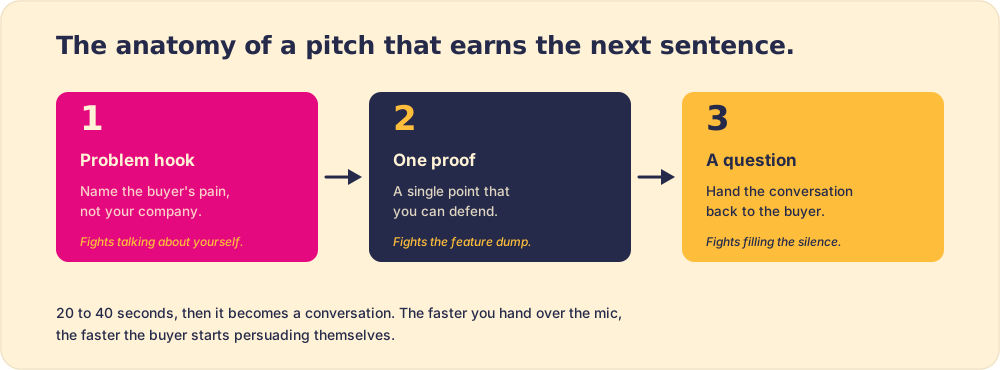
A good sales pitch leads with the buyer’s problem, proves one thing, and ends in a question. That is the anatomy, and like most durable sales techniques, each part fights a temptation. Leading with the problem fights the urge to talk about yourself. Proving one thing fights the feature dump. Ending in a question fights the instinct to fill silence with more talking. A pitch built this way is short by design, because its purpose is to hand the conversation back to the buyer as fast as possible, where the real selling happens.
The reason this works is not style, it is arithmetic about attention and trust. The modern buyer arrives already informed. Gartner finds B2B buyers spend only about 17 percent of the buying journey with suppliers, having done the rest of the research alone (Gartner). They know your category and probably your features before you open your mouth. A pitch that recites features is answering a question the internet already answered. The one thing the buyer cannot get from your website is the sense that you understand their specific problem, so that is what a pitch must lead with. This is the same instinct that drives consultative selling: earn the right to talk by showing you were listening first.
What do Pink, Rackham, and Keenan say about the pitch?
It helps to know who owns this topic before you copy anyone’s example, because the best examples are downstream of an argument three people already won.
- Neil Rackham proved the feature dump backfires. In SPIN Selling (1988), built on a study of about 35,000 sales calls, Rackham found that selling on features and advantages, the brochure move, is mildly useful in small transactions and actively harmful in large ones, where it tends to draw objections from the buyer rather than interest (Rackham, SPIN Selling). The weak examples below are worse than unfashionable. They are measured losers on exactly the deals reps care about most.
- Daniel Pink moved the premium from solving to finding. In To Sell Is Human (2012), Pink argues that the prize has shifted from problem-solving to problem-finding: when a buyer already knows their problem, they can often find the solution without you, so the seller who adds value is the one who helps them see a problem they had not named (Pink, To Sell Is Human). His new ABCs, attunement, buoyancy, and clarity, all point the same way: get inside the buyer’s head before you open your mouth.
- Keenan put a method on it. Gap Selling (2018) makes the problem the entire engine of the sale. Keenan teaches reps to diagnose the gap between the buyer’s current state and their desired future state before they so much as name a product, on the conviction that urgency comes from the size of the problem, not the shine of the solution (Keenan, Gap Selling).
Grant all three their due. They are right, and the evidence behind them is deep. The buyer agrees, too: Gartner found in March 2026 that 67 percent of B2B buyers now prefer a rep-free experience, and a later survey that 69 percent turn to a rep mainly to validate insight they already gathered with AI (Gartner). A buyer who has already read the syllabus does not want it read back. They want a sharper diagnosis than they could reach alone.
Here is where we add the part the swipe files leave out. Pink, Rackham, and Keenan all describe a pitch as the visible end of a diagnosis. The trouble is that the field then sells the diagnosis back to you as a template, a stack of “proven openers” to copy. That is the contradiction. The thing that made the opener work was the rep knowing this buyer’s problem, and that knowing is exactly the part a template cannot carry. Copy the pitch and you copy a prescription written for another patient.
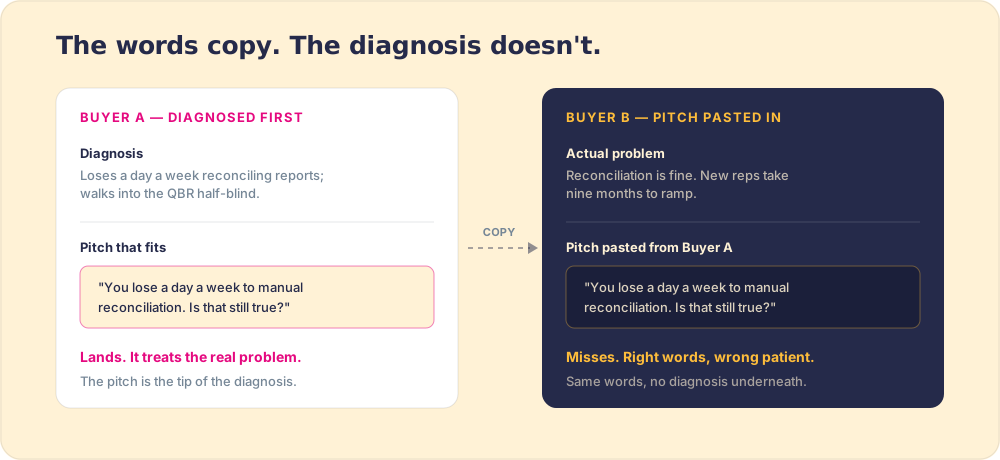
A doctor’s prescription is precise, confident, and exactly correct for the patient it was written for. Photocopy it onto the next patient who walks in and the same precise words can do real harm, because the words were never the medicine. The diagnosis was. A pitch is the same. The opener that earned a reply did so because a rep had attuned to that buyer (Pink), refused the feature dump (Rackham), and found the gap that buyer truly felt (Keenan). Strip the diagnosis and what remains is a stranger reciting someone else’s chart with great conviction. That is why the examples below are worth studying for their shape and worthless to memorize word for word.
Sales pitch examples: weak versus strong
Here are four common moments, each with the version reps default to and the version that works. Read the weak one as the buyer would, with one finger over the “end call” button.
The cold outreach pitch. The same rules govern a cold call pitch, where you have even less time before the buyer reaches for an excuse, and the cold-calling tips that survive the research all turn on it.
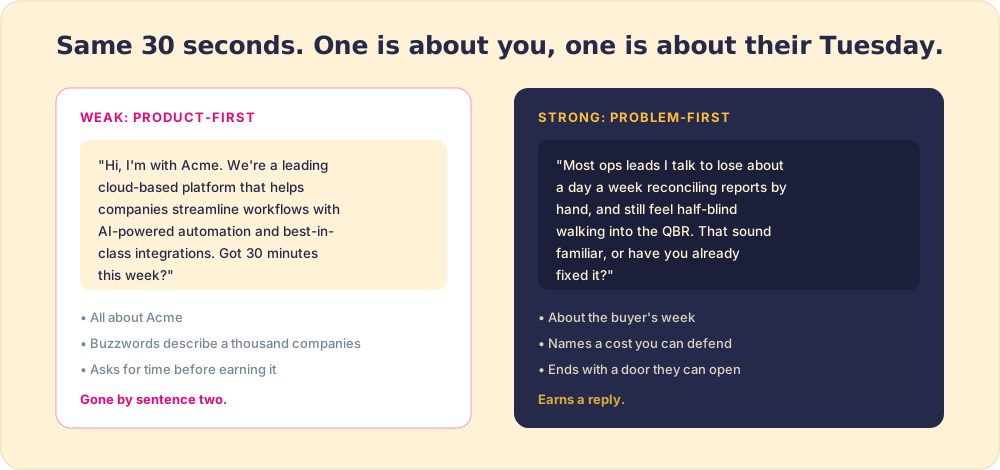
- Weak: “Hi, I’m with Acme. We’re a leading cloud-based platform that helps companies optimize their workflows with AI-powered automation and enterprise-grade integrations. Do you have 30 minutes this week?”
- Strong: “Most ops leads I talk to lose about a day a week reconciling reports by hand, and still feel half-blind walking into the QBR. That sound familiar, or have you already fixed it?”
The weak version is about Acme. The strong version is about the buyer’s Tuesday, names a believable cost (a number you can defend), and ends with a door the buyer can walk through. It earns a reply because it sounds like someone who has seen the problem, not a brochure that found an email address.
The elevator pitch. Most elevator pitch examples online are the weak kind, so the contrast is worth seeing.
- Weak: “We’re building the future of work. We’re an end-to-end platform that empowers teams to do their best work.”
- Strong: “You know how new reps take six to nine months to get productive, and half the ramp is them hunting for answers? We cut that to about four. Happy to show you how if it is ever a headache.”
The weak elevator pitch could describe a thousand companies, which means it describes none. The strong one is specific enough that a listener either leans in (“yes, that is exactly my problem”) or steps out cleanly, and both outcomes are wins, because your time is the scarce resource.
The discovery-call opener.
- Weak: “Thanks for the time. Let me walk you through who we are, and then I’ll do a quick demo of the platform.”
- Strong: “Before I show you anything, I want to make sure it is worth your time. Can you walk me through how your team handles onboarding today, and where it tends to break?”
The weak opener spends your most valuable minutes performing. The strong one trades the demo for diagnosis, so that when the product does appear, it answers a problem the buyer described in their own words, which is what the best discovery call questions are built to surface. This is the discovery that fills the MEDDIC sales process, and it is why the demo lands so much harder when it comes second.
The “why now” pitch.
- Weak: “Our pricing goes up next quarter, so it makes sense to move soon.”
- Strong: “You mentioned the board is asking for ramp numbers by Q3. If we started now, your next cohort would be the proof point you bring to that meeting. Worth lining up?”
Manufactured urgency (“prices rise”) is the oldest tell in the trade, and buyers discount it on sight. Real urgency comes from the buyer’s own calendar and stakes, which you can only use if you discovered them first.
Why do most sales pitch examples fail when you copy them?
Because the words are the surface, and the part that made them work does not copy. This is the prescription problem again. A pitch that lands is the visible tip of an invisible diagnosis: the rep knew this buyer’s problem, named the cost that buyer feels, and chose the one proof point that buyer needed. Lift the words, drop them on a different buyer with a different pain, and you have a generic pitch the buyer has heard a hundred times, delivered with the confidence of someone reading another person’s love letter aloud.
It is worth saying plainly that this is the gap in the popular advice, not a flaw in the thinkers. Pink, Rackham, and Keenan never told anyone to memorize a script. Pink’s whole point about clarity is that you arrive at the buyer’s problem live, by attunement, not by recall. The “100 best cold email templates” posts that cite him have inverted his argument: they sell the output of problem-finding as a substitute for doing it. The structure does transfer, problem, proof, question. The diagnosis underneath never does. So here is how to write a sales pitch that lands: use the examples above to learn the shape, then do the unglamorous work the template cannot do for you, which is to find this buyer’s real problem before you write a word. A pitch is the last 5 percent of a process that is mostly listening, the same lesson that runs through the seven sales process steps. Skip the listening and the best template in the world reads as if a stranger were guessing.
How long should a sales pitch be, and how do you make it land every time?
Short, and the second question is the one that matters more. A pitch should run 20 to 40 seconds before it becomes a conversation, because length is where pitches go to die. Gong’s analysis of sales calls finds that long monologues correlate with losing and that the strongest reps spend more of the call listening than talking (Gong). Brevity is not politeness, it is strategy: the faster you hand the buyer the mic, the faster they start persuading themselves.
The examples leave out the one thing that decides whether any of them work. A perfect pitch written on a slide is worthless. What moves revenue is the pitch a rep delivers, on the fortieth call of the week, when they are tired and the easy thing is to fall back into the feature dump. We asked 198 sales leaders, and 89 percent had a defined process and messaging while only 36 percent saw their reps follow it in the field (The State of Sales Enablement). The gap between the pitch in the playbook and the pitch on the call is where deals are won and lost, and it has nothing to do with the quality of the example.
So here is the recommendation, and it follows straight from the prescription problem. You have three options. Hand reps a swipe file of openers to memorize, which Pink, Rackham, and Keenan all predict will fail, because the words arrive without the diagnosis that made them work. Train reps in the diagnostic method and hope it survives the fortieth call of the week, which is better and still loses to fatigue and the easy slide back into the feature dump. Or deliver the diagnostic structure to the rep at the moment they pitch, on the specific deal in front of them, then measure whether they used it. We recommend the third, and not as a preference. It is the only one that closes the gap the data keeps showing.
Memorized scripts desert a rep at exactly the moment they are needed, the same way a rehearsed rebuttal collapses the moment a real objection lands, and the common sales objections a pitch provokes are best answered with a question, not a counter-pitch. The durable fix is to put the right diagnostic prompt, the question that finds this buyer’s gap, in front of the rep in the moment of the call, tuned to the deal they are working, and to measure whether they used it so a manager can coach the pattern. That is the deeper subject of sales process adoption, and it is why we built Supered as the Behavior Layer: it surfaces the proven opener and the next diagnostic question for the buyer in front of the rep, in the flow of the work, and shows whether it was delivered. The example takes a minute to copy. Diagnosing the buyer’s problem first is the work, and it is the part no swipe file can hand you, only the rep can do it, and only in the moment. To see how messaging sits beside qualification, discovery, and objection handling in one motion, the sales playbook guide ties it all together.
Frequently asked questions
What is a good example of a sales pitch?+
How do you start a sales pitch?+
How long should a sales pitch be?+
Why do sales pitch templates fail when you copy them?+
What is the difference between a sales pitch and an elevator pitch?+
Your process, running itself.