Userpilot Alternatives: Activation Is Not Adherence
Userpilot alternatives lists rank onboarding tools by flow-builder features. The decision that matters is whether you are buying activation or whether the work gets done right.
Userpilot alternatives are the product-led onboarding and digital adoption tools teams weigh when Userpilot's flows, pricing, or thin behavior measurement push them to look, and they split into tools that activate a new user and tools that prove the work keeps getting done right.
There is a moment in every software rollout that feels like victory and is only halftime. The activation chart turns green. New users hit the aha moment, the checklist completes, the dashboard shows a clean curve up and to the right. Then a few months pass and the work is being done the old way again, by the same users the chart said were activated. Userpilot, like its peers, is built for the green-chart moment. The “Userpilot alternatives” search usually begins right after a team learns that the green chart and the real behavior are two different things.
Userpilot alternatives are the product-led onboarding and digital adoption tools teams weigh when Userpilot’s flows, pricing, or thin behavior measurement push them to look, and they split into tools that activate a new user and tools that prove the work keeps getting done right. That split is the comparison, and the lists that rank flow-builders never make it. So before we name names, a confession about the genre: most “best Userpilot alternatives” posts are written by the alternatives, which is why they all compare the same five features and reach the same shrug. We are going to do the more useful thing and sort the field by the job you are really trying to get done.
Why do teams look for a Userpilot alternative?
Two reasons drive most switches, and only one is about features. The Userpilot competitors worth weighing are the ones that answer a question the activation chart cannot.
- The job outgrew onboarding. Userpilot activates new users well. Teams hit its edge when they need the right behavior to persist on real work weeks later, which is a sustaining job an onboarding tool is not built for.
- Price and analytics depth. As the company scales, the bill climbs and the appetite for real behavioral analytics outgrows what a product-led onboarding tool reports.
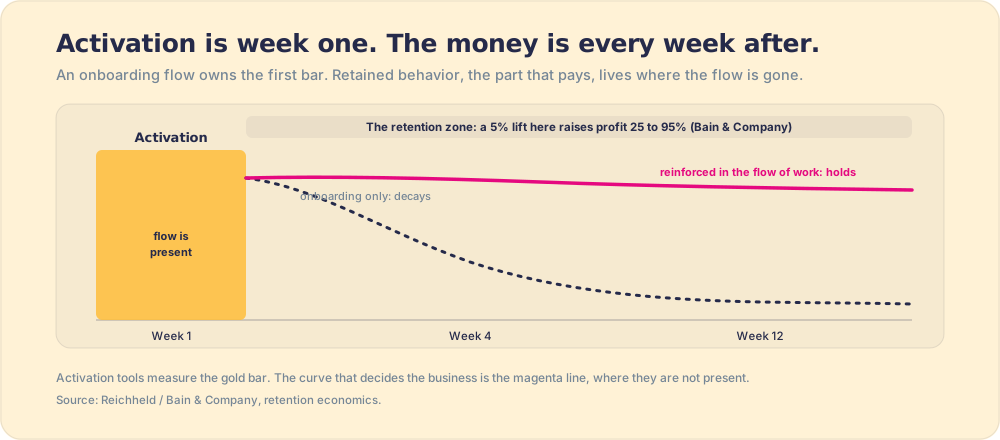
The first reason deserves a harder look, because it is where the money leaks. The discipline Userpilot belongs to, product-led growth, was largely codified by Wes Bush, whose book Product-Led Growth made the case that the product itself should carry a user to value with as little human touch as possible. It is a genuinely good idea, and Userpilot executes it well. But there is a sleight of hand in how the category measures itself. Activation, the metric the whole shelf is built to move, is a fact about the first session or the first week. It says nothing about week ten. The famous Bain and Company finding, popularized by Fred Reichheld, that a five percent lift in retention can raise profit anywhere from 25 to 95 percent, lives entirely in the territory after activation, the part an onboarding flow was never designed to hold (Reichheld, Bain & Company). You can win every activation chart and still bleed out in the part of the funnel that pays.
Which Userpilot alternative fits the job?
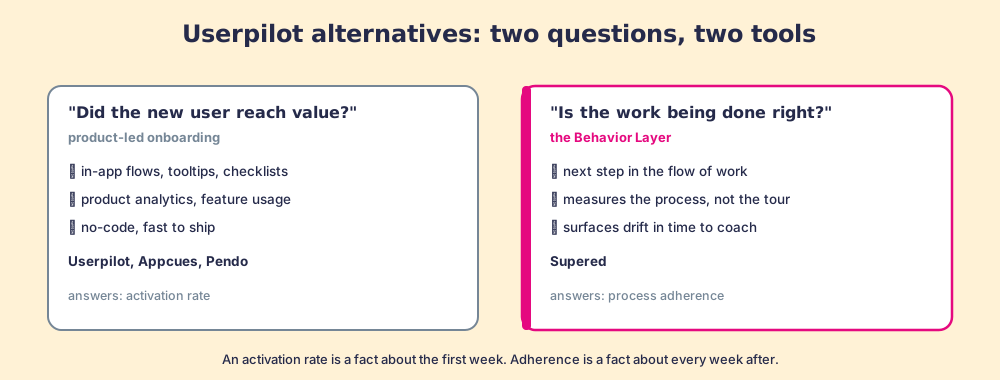
The honest field sits on two shelves. The product-led user onboarding shelf is where Userpilot lives, with Appcues as its closest peer and Pendo as the analytics-deep neighbor; the Appcues comparison is the one most Userpilot buyers want. The enterprise digital adoption shelf is Whatfix and WalkMe, the latter now part of SAP after a 1.5 billion dollar deal completed September 2024, built to train staff on internal applications. If your job stays inside onboarding, you choose among these on price, flow-building, and analytics, and a category comparison like best digital adoption platforms covers the field.
A word on the trap inside the word onboarding, because Userpilot’s whole shelf hides it. User onboarding is activating one end user inside a product: first run, aha moment, checklist done. That is Userpilot’s job and Appcues’s. Client onboarding is a different animal: a services firm bringing a new, often large client live, running kickoff, requirements, implementation steps, internal handoffs, and milestones, the team executing the same playbook on every account. It is delivered by your internal team, it has to be consistent because the first impression and the churn risk both live there, and it is a process-adherence job rather than a product-tour one. A flow-builder does nothing for it, and most Userpilot buyers who feel the pain of onboarding mean this second kind without having a name for it.
The different shelf, the one a Userpilot search often arrives at without knowing its name, is the behavior layer. It does not activate or train. It delivers the next step in the flow of the work and measures whether the process is followed, the way a services team running client onboarding needs, which is the question the activation chart cannot answer.
| The job you are buying | The right shelf | What it measures | Best examples |
|---|---|---|---|
| Get a new user to first value | Product-led onboarding | Activation rate, time to value | Userpilot, Appcues |
| Train staff on internal software | Enterprise digital adoption | Walkthrough completions, feature usage | Whatfix, WalkMe (SAP), Pendo |
| Keep the work getting done right | The behavior layer | Process adherence, in the flow of work | Supered |
The table is the whole decision. Read down the middle column and the difference stops being a feature argument. An activation rate, a completion rate, and an adherence rate are three different facts about three different moments, and a team shopping by feature list will buy the first when the problem they actually have lives in the third.
Why does activation fade, and what makes behavior stick?
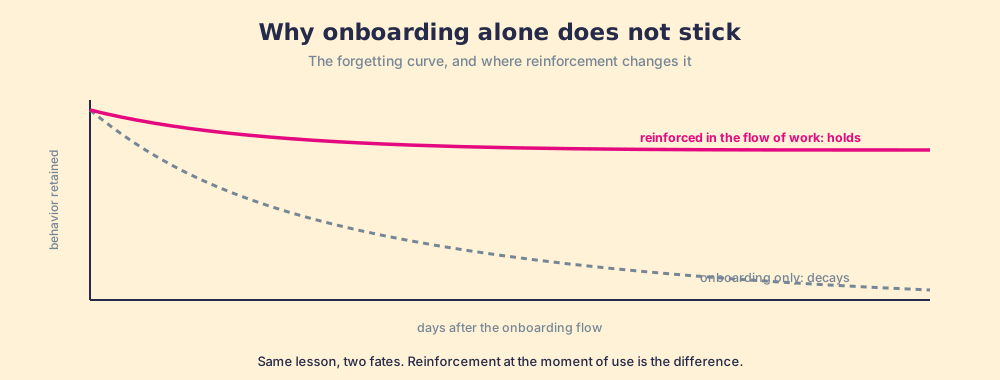
The fading is not a Userpilot defect, it is the forgetting curve doing its work. Hermann Ebbinghaus measured it in the 1880s and modern replications confirm it: people forget most of what they learn within days unless the lesson resurfaces at the moment of use (Ebbinghaus forgetting curve replication). An onboarding flow is a lesson delivered at the front door. Without reinforcement on the real work, it decays on schedule, and the activated user reverts.
There is a second mechanism underneath the first, and it is the one that explains why even a remembered process gets skipped. BJ Fogg, who ran Stanford’s Behavior Design Lab for two decades, reduced behavior to three things arriving at the same instant: motivation, ability, and a prompt. He writes it as B = MAP (Fogg Behavior Model). The piece teams underrate is ability, which Fogg defines not as skill but as simplicity, how little time and effort the action costs in the moment. An onboarding flow can raise knowledge to the ceiling and still leave the behavior below the action line, because at the moment of real work the right step is sitting in a different tab, a different doc, a different system. The user knows what to do and does the easier thing instead. That is not a motivation failure and it is not a training failure. It is a distance failure, and no flow-builder closes distance on the live work, because the live work is not where the flow lives.
That reinforcement is what makes behavior stick, and it is a different product job than the front-door flow. The work on why knowing does not become doing, gathered in the knowing-doing gap, is the mechanism behind the whole distinction: a perfectly activated user can still skip the step under pressure, because activation delivered knowledge and the gap is behavioral. Our own field data puts a number on the stakes. Across 198 leaders in the State of Sales Enablement, 89 percent had a defined process and only 36 percent said it was followed, a 53-point gap that is pure adherence, not knowledge. Teams whose process reached people in the flow of the work cleared their target at 49 percent, against 15 percent for those whose process did not. The activation chart cannot see any of that.
What we recommend
Name the job, and the verdict writes itself.
- Userpilot or Appcues. Choose them if product-led onboarding and activation is the job; pick between them on flows, analytics, and price, and do not overpay for depth you will not use.
- Pendo. Choose it if you want deeper product analytics fused to the onboarding guidance.
- Whatfix or WalkMe. Choose them if the job is training staff on internal enterprise applications; WalkMe is the natural pick inside an SAP estate.
- Supered. Choose it if the job is the work getting done right week after week: a behavior layer that delivers the next step in the flow of the work and measures whether the process was followed, because activation is a first-week fact and adherence is the fact about every week after.
The decision is not Userpilot versus a cheaper flow-builder. It is whether you are buying activation or adherence. Most teams searching for a Userpilot alternative think they have a tooling problem on the first shelf, and discover, somewhere in the middle of the search, that the thing breaking is on the third. Buy for the job in front of you, and if that job is the work getting done right week after week, do not let a prettier onboarding flow talk you out of it.
From here: the closest-peer comparison in Appcues alternatives, the full category in best digital adoption platforms, and the mechanism in the knowing-doing gap.
Frequently asked questions
What are the best Userpilot alternatives?+
Why do teams replace Userpilot?+
Is Userpilot a digital adoption platform?+
What is the difference between activation and adherence?+
Your process, running itself.