Appcues Alternatives: The Front Door Is Not the House
Appcues is built to activate new users. Most Appcues alternatives lists compare the same front door. The harder job, whether anyone is still living in the house, needs a different tool.
Appcues alternatives are the user-onboarding and digital adoption tools teams compare when Appcues activation flows hit their ceiling, and they sort into tools that get a user through the first run and tools that sustain the behavior on real work afterward.
Appcues is good at one thing and honest about it: getting a new user through the front door. The welcome flow, the feature spotlight, the checklist that nudges someone to first value, that is the skill, and Appcues practices it well. The trouble in most “Appcues alternatives” searches is that the team has walked through the front door and now wants to know whether anyone is still living in the house. That is a different question, and most of the alternatives on the usual lists answer the same front-door question Appcues already answers.
Appcues alternatives are the user-onboarding and digital adoption tools teams compare when Appcues activation flows hit their ceiling, and they sort into tools that get a user through the first run and tools that sustain the behavior on real work afterward. Keep that sort in mind. It separates a lateral move from a real upgrade, and it is the sort almost every comparison list avoids, because naming it would disqualify half the products on the list.
Why do teams look for an Appcues alternative?
The switch search usually starts when the job outgrows activation, and the Appcues competitors worth weighing are the ones that close a job the front door cannot.
- Activation ceiling. Appcues is built for the first run, so once a user is activated, it has done its job and steps back. Teams that need the behavior to persist hit this ceiling and start looking.
- Price and analytics depth. As flows multiply and the company scales, the bill grows and the appetite for deeper behavioral analytics outgrows what an onboarding tool reports.
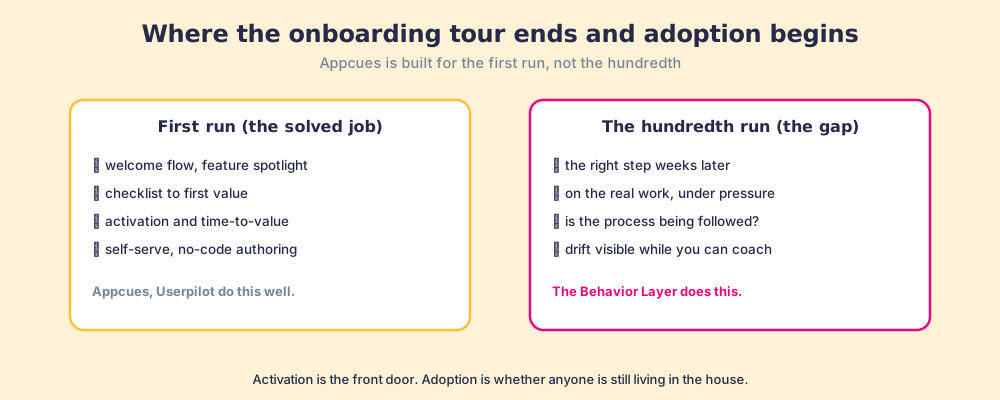
It helps to name the philosophy Appcues comes from, because the ceiling is built into it by design. Appcues is a product-led growth tool, and product-led growth, codified by Wes Bush in his book of that name, rests on a clean premise: let the product carry the user to value with the least possible human touch. It is a strong idea for acquisition and a real advance over the old demo-then-onboard slog. But the premise has a horizon. It optimizes for the moment a user first sees value and goes nearly silent after, because in the PLG model the product is supposed to take it from there. For a self-serve note-taking app, fine. For a process that a team is supposed to run the same way on every deal, every ticket, every week, “the product takes it from there” is exactly the assumption that breaks. The behavior the business depends on lives past the horizon the tool was built to see.
The deeper reason the ceiling exists is the forgetting curve. Hermann Ebbinghaus showed, and modern replications confirm, that people forget most of what they learn within days unless it resurfaces at the moment of use (Ebbinghaus forgetting curve replication). An onboarding flow teaches at the front door. By the hundredth run, the lesson has decayed unless something reinforces it on the real work, and an activation tool is not built to be there for the hundredth run.
Which Appcues alternative fits which job?
The market sits on three shelves, and naming them is the comparison.
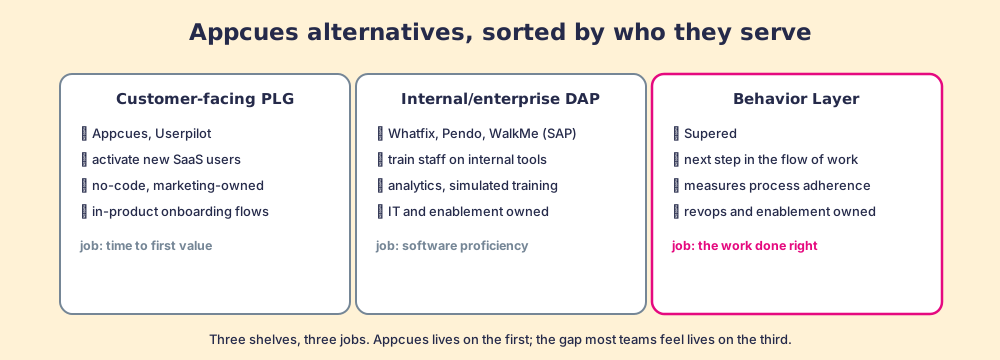
The customer-facing user onboarding shelf is where Appcues lives, alongside Userpilot, its closest peer. These are no-code, marketing-owned tools for activating new SaaS users, and the Userpilot tradeoffs are the comparison most Appcues buyers want. The internal enterprise shelf is the digital adoption platforms: Whatfix, Pendo (weighed head-to-head in Appcues vs Pendo), and WalkMe, which SAP acquired for 1.5 billion dollars in a deal completed September 2024, built to train staff on internal tools at scale. The behavior shelf is different in kind: it does not train or activate, it delivers the next step in the flow of the work and measures whether the process is followed.
| Your real problem | The shelf | The metric it reports | Where to look |
|---|---|---|---|
| A new user is not reaching first value | Product-led onboarding | Activation rate | Appcues, Userpilot |
| Staff cannot operate an internal app | Enterprise digital adoption | Walkthrough completions | Whatfix, Pendo, WalkMe (SAP) |
| The work is not getting done right week after week | The behavior layer | Process adherence, in flow | Supered |
The trap is that the first row and the third row feel similar in a demo and are worlds apart in production. Both show a user being guided. Only one of them is still watching, and still measuring, on the hundredth run when there is no tour and the rep is under pressure.
Does an onboarding tool change behavior, or just start it?
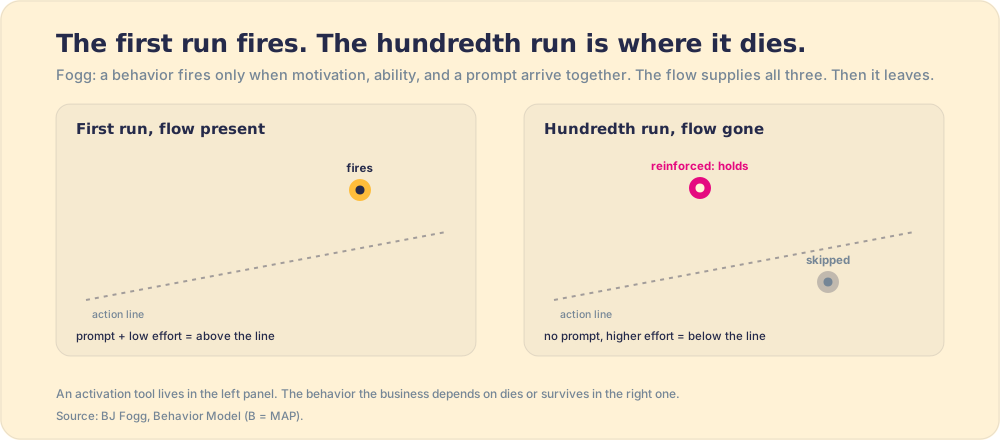
It starts it, which is valuable and not the same thing. Activation gets a user to the aha moment. Whether the right behavior persists on real work is a sustaining problem, and the evidence says sustaining requires reinforcement at the moment of use, not a one-time tour. The mechanism underneath is BJ Fogg’s behavior model from his two decades at Stanford: a behavior fires only when motivation, ability, and a prompt land together, B = MAP, and ability is mostly about how little effort the action costs in the moment (Fogg Behavior Model). An onboarding flow raises knowledge once and then leaves. At the hundredth run there is no prompt and no help with ability, so a user who knows the right step still does the cheaper wrong one. This is the gap between knowing and doing: a user can complete every onboarding flow and still skip the step under pressure on real work, because knowledge delivered once is not behavior sustained over time. The work on this gap, summarized in the knowing-doing gap, is the reason an activation tool cannot be the whole answer.
The stakes are not abstract. In the State of Sales Enablement, across 198 sales leaders, 89 percent had a defined process and only 36 percent saw reps follow it, a 53-point gap that is pure adherence. Teams whose process reached people in the flow of the work hit quota at 49 percent, against 15 percent for those whose process did not. An activation tool would score every one of those teams the same at onboarding, then go dark exactly where the 34-point quota gap opens up.
What we recommend
If your job is customer-facing onboarding and activation, Appcues is a strong tool and Userpilot is its honest peer; choose on flow-building, analytics, and price. If your job is training staff on internal applications at scale, the digital adoption platforms (Whatfix, Pendo, WalkMe for SAP estates) are the right shelf. If your job is sustaining a behavior on real work and proving it held, no activation or training tool reaches that, because activation is a front-door event and the behavior lives in the house. There you want a behavior layer that meets people in the flow of the work and measures the process.
The decision is which of the three jobs you are buying, and most teams realize, mid-search, that it is the third. The honest test is one question: a quarter from now, will you need to know whether the work is still being done right, or only whether new users got in the door? If it is the former, do not buy another front door. The front door is not the house.
From here: compare the category in best digital adoption platforms, read the closest-peer comparison in Userpilot alternatives, and see why behavior outlasts onboarding in the knowing-doing gap.
Frequently asked questions
What are the best Appcues alternatives?+
Why do teams switch off Appcues?+
Is Appcues a digital adoption platform?+
What is the difference between user activation and user adoption?+
Your process, running itself.