The 7 Sales Process Steps (and the Buyer Commitment Behind Each)
The seven sales process steps, what each is for, and the buyer commitment that advances a deal from one to the next, plus why knowing the steps is the easy part.
Sales process steps are the defined sequence a deal moves through, commonly seven (prospect, qualify, discover, demonstrate, propose, negotiate, close), where each step is marked by a verifiable buyer commitment that earns the deal into the next one.
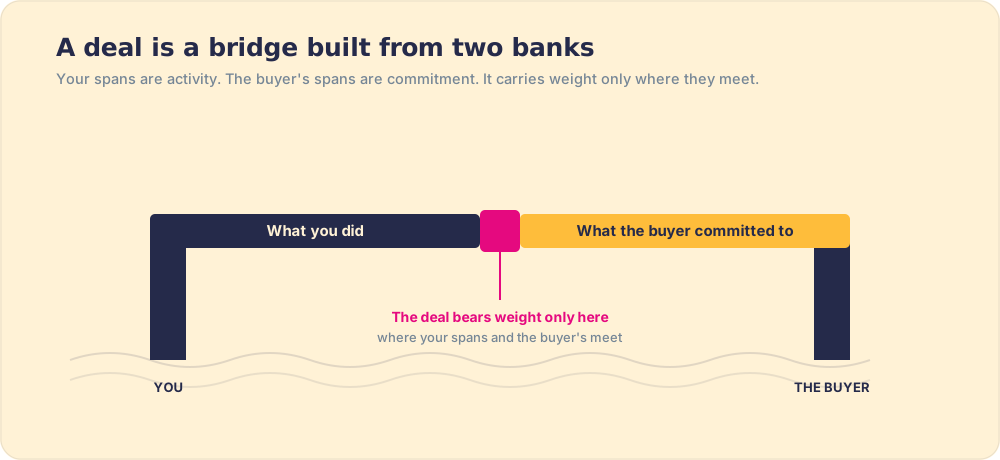
Picture a deal as a bridge built from two banks. You lay your spans from your side, the call, the demo, the proposal, the patient follow-up. The buyer lays theirs from the far bank, the budget freed, the boss won over, the last doubt finally put to rest. The bridge carries weight only where your spans and theirs meet over the water.
Here is the trouble with the seven famous steps of a sales process. They are a list of your spans, and they say almost nothing about the buyer’s. So a rep can stand at the rail of a half-built bridge, proud of five clean spans reaching out into the air, and not see that little has come the other way. The CRM says “Proposal.” The water below says otherwise.
A deal is built from both banks. The standard seven steps describe one of them. It is why a pipeline can read healthy while the forecast comes in light, and it is worth holding in mind as we walk the steps, because each one is a question about the far bank: has the buyer laid the span that meets yours, or are you reaching into open sky?
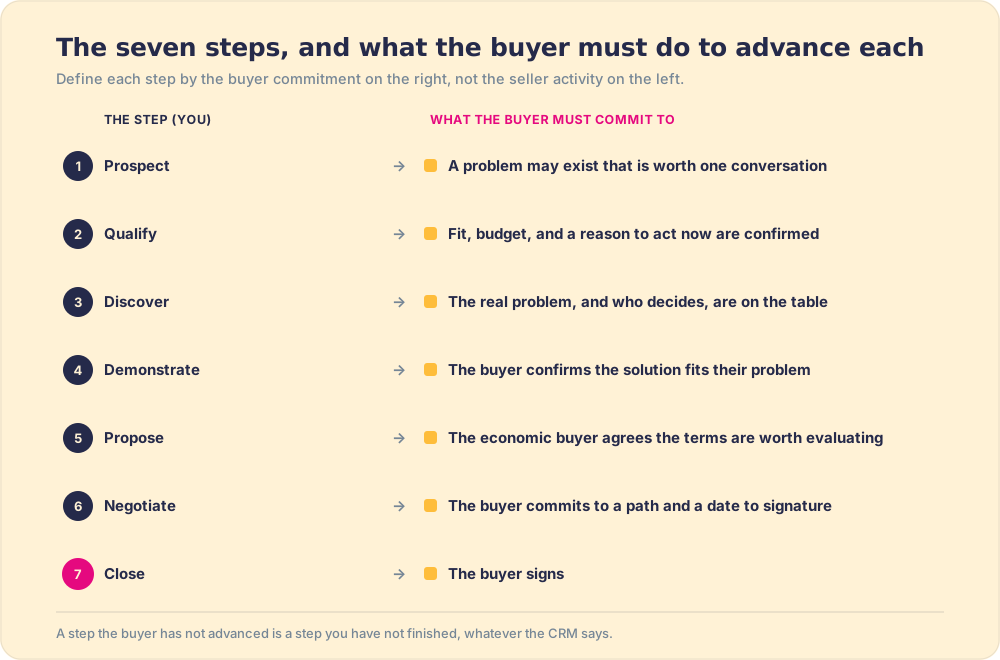
So here are the seven, in full, with what each is for. Each comes with the part the standard list leaves off: the span the buyer must lay for the step to bear weight, and how you would know it is there.
What are the sales process steps?
A sales process step is a marked point on the path a deal takes from a stranger to a signature. Strung together, the steps in the sales process give a whole team one road to walk, so a deal travels the same way no matter which rep is holding the reins.
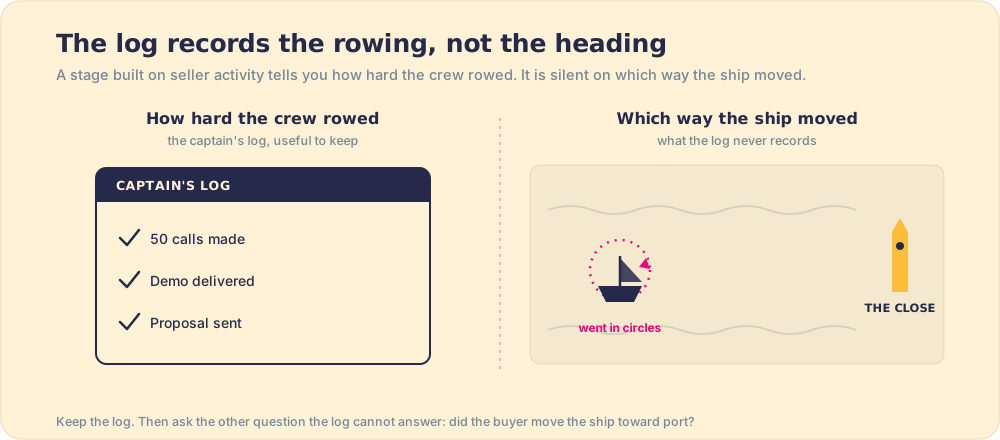
The old temptation is to name each step after something the seller does. “Demo completed” is a step most teams keep, and it records a real thing the rep performed, worth knowing, but it is not the same as a thing the buyer decided. It is a captain’s log of how hard the crew rowed: useful to keep, and silent on which way the ship is pointed. A step earns its keep only when it is pinned to something the buyer has done that you could prove to a skeptic. That single shift, from your motion to their commitment, is the difference between a pipeline that flatters you and one that tells you the truth, and it is the deeper subject of the deal-stage mistakes that distort a forecast.
The 7 step sales process, one step at a time
1. Prospect
Prospecting is the work of finding the people who plausibly have the problem you solve and earning the first real conversation. It is the top of the funnel, and it is where reps most often mistake motion for progress, because a full calendar feels, for a few warm hours, indistinguishable from a full pipeline.
The buyer’s span here is small but real: they agree there may be a problem worth one conversation. A hundred emails sent is your rowing. A single reply that says “yes, this is worth half an hour” is the buyer setting one foot on the bridge. Only the second counts. The common mistake is to admire the size of the top of the funnel before anyone on the far bank has reached back. What good looks like is humbler and far more useful: a short list of accounts where a real person has agreed their problem is worth their time.
2. Qualify
Qualifying is where you decide whether a conversation is a deal. The textbook version asks whether the buyer has the problem, the budget, and the authority. That version is half the story, and the missing half is the one that ruins forecasts.
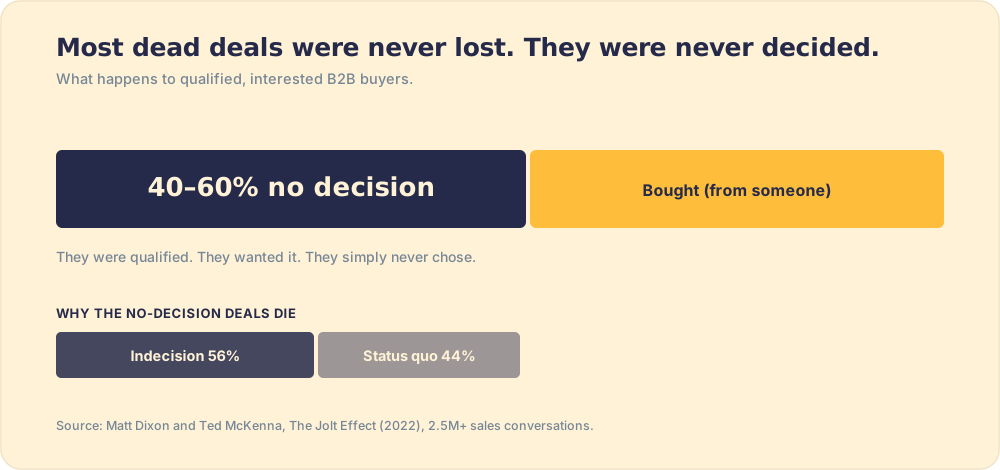
Here is the sobering fact. In The Jolt Effect, Matt Dixon and Ted McKenna studied more than two and a half million recorded sales conversations and found that between 40 and 60 percent of qualified, interested buyers end in “no decision”, not lost to a rival but lost to their own inability to move (Matt Dixon and Ted McKenna, The Jolt Effect, 2022). Sit with that. Most of your dead deals were qualified. They wanted it. They never decided. So qualification is not the question “can this buyer buy”; it is the harder question “will this buyer choose,” which is the difference between a traveler who can afford the trip and one who has resolved to leave the house. The common mistake is qualifying on warmth, a friendly champion with no deadline and no pain sharp enough to act on. What good looks like is a deal you could defend to a skeptic, with a reason it must happen this year that the buyer, not you, supplied.
3. Discover
Discovery is the patient work of learning the buyer’s real problem, what it costs them, and who will sit in the room when the decision is made. It is the most valuable step and the most often skipped, because the rep is itching to show the product and the buyer is too polite to stop them.
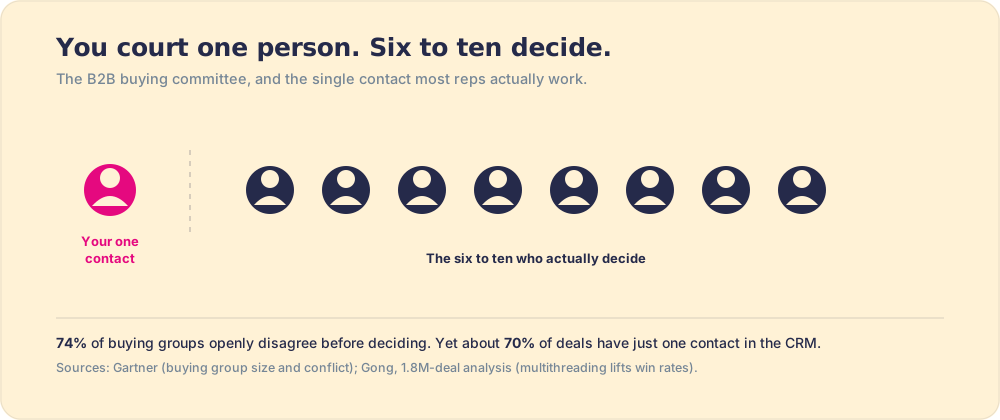
And the room is more crowded than most reps imagine. Gartner finds that a typical B2B purchase now runs through a buying group of six to ten people, each arriving with four or five pieces of information they gathered on their own, and that 74 percent of those groups fall into open disagreement before they decide (Gartner). You think you are courting a person; you have walked into a town meeting. This is why working a single contact is so dangerous: Gong’s analysis of 1.8 million deals found that reaching more of that group lifts win rates dramatically, by well over a hundred percent on larger deals. The buyer’s span here is to put the real problem and the real cast of characters on the table. A demo booked is not discovery. A buyer who has told you how the decision will be made, and by whom, is. What good looks like is plain: you can describe the buyer’s problem better than they can, and you can name everyone whose hand will touch the contract.
4. Demonstrate
Demonstrating is showing the buyer that your solution answers the specific problem discovery uncovered. Done well it is a tailored argument. Done badly it is a tour of every feature you have, which is a little like answering “do you love me” by reading aloud from your résumé.
The buyer’s span is to say, in their own words, that the thing fits, that it would solve the problem they admitted costs them. “Demo delivered” is another captain’s-log entry: a real record of your effort, worth tracking, and on its own silent on whether the buyer moved. A buyer connecting one capability to one cost they named earlier is the span landing. The common mistake is demoing before discovering, so you show everything and learn nothing, and the buyer nods politely at a key that may not fit their lock. What good looks like is the buyer finishing your sentence.
5. Propose
Proposing puts price and terms in front of the buyer. It feels like the finish line, which is exactly why it traps so many forecasts. A proposal is an email leaving your outbox, and outboxes have never closed a deal in the history of selling.
The span that matters is the economic buyer, the person who truly controls the money, agreeing the terms are worth taking forward in earnest. A deal sitting in “Proposal” with no confirmed economic buyer is a span thrown out over open water, anchored to nothing on the far side, and it is the single most common way a pipeline overstates itself. The common mistake is sending a beautiful proposal to a champion who cannot say yes, then filing the deal as late-stage. What good looks like is simpler than it sounds: the person who signs the check has seen the number and agreed it is worth the next conversation.
6. Negotiate
Negotiating is the work of turning broad agreement into terms both sides can sign, the price, the scope, the legal language, the dates. It is where deals that looked certain reveal whether they were ever real.
The buyer’s span is a commitment to a path and a date to signature, a mutual plan with named steps and a day circled on a calendar both of you can see. A negotiation with no agreed close date is not a negotiation. It is a conversation that can wander on for quarters while the forecast pretends. The common mistake is negotiating against yourself, discounting to manufacture an urgency the buyer never expressed. What good looks like is a written, shared plan from “agreed in principle” to “signed,” with the buyer owning dates alongside you rather than receiving them.
7. Close
Closing is the buyer signing. After six steps of asking the far bank to keep laying spans, this one is meant to be the easy part: if every earlier commitment was real, the signature is a formality, the ribbon cut on a bridge that already stands.
This is why “the deal fell apart at the last minute” is, on inspection, almost always a fiction. Bridges do not collapse on opening day if their spans truly met; they were never joined, and the gap was invisible from the rail. Remember the Jolt Effect number: most deals that die do not die to a competitor at the close, they dissolve into indecision long before, at a qualify or discover step that was marked complete on your activity rather than their commitment. The common mistake is to treat a stalled close as a closing problem and lean harder, when it is usually an earlier honesty problem surfacing late. What good looks like is a close that is almost boring, because every real decision was already made upstream.
How many sales process steps should you have?
Five to seven, with each one marking a distinct commitment from the far bank. The instinct runs the other way: more steps feel like more rigor, so pipelines swell to ten or eleven stages and forty required fields, and the result is the opposite of rigor. The thing falls into disuse, which is the same trap good CRM best practices are built to avoid.
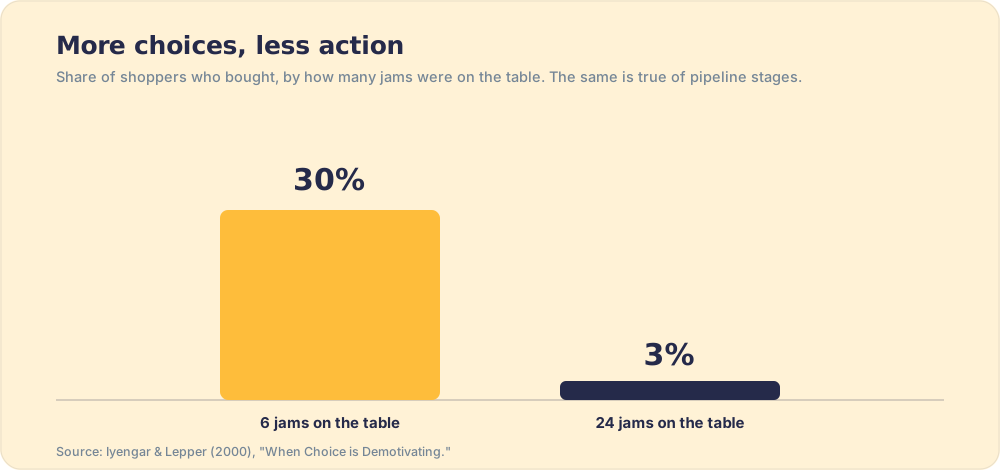
There is a reason more choices produce less action, and it is one of the prettiest findings in behavioral science. Sheena Iyengar and Mark Lepper set up a grocery tasting table, some days with 24 jams, some with 6. The big display drew a bigger crowd and far fewer buyers, 3 percent against 30 percent, because a wall of options raises the cost of choosing until people walk away (Iyengar & Lepper, 2000). An eleven-stage pipeline does that to a rep at every gate. And long pipelines tend to map your own internal handoffs, SDR to AE, AE to engineer, deal desk, legal, dressed up as buyer progress, when the buyer could not care less about your org chart and is certainly not walking through it. Cut until every step is something the buyer would recognize as a moment in their own decision.
Sales process steps vs. stages vs. methodology
Three words get used as one: the steps, the stages of a sales process, and the methodology. Keeping them apart will save you a dozen confused pipeline reviews.
- Steps and stages. The same thing under two names: where a deal sits on its path. A “stage” in your CRM is one of these steps given a status field.
- The sales process. The full sequence of steps, shared across the team, that every deal runs. This is the subject of what a sales process is.
- A methodology. How a rep works inside the steps, mostly how they qualify and run the conversation. MEDDIC, SPIN, and Challenger are methodologies. They sharpen a rep within a step; they do not tell you where the deal is.
The short of it: the steps tell you where the deal stands, the methodology tells you what to do while you are standing there, and you want both.
Do the steps still matter when buyers run their own process?
They matter more, and they have to be cut differently. The fashionable worry is that buyers now do everything alone, so the seller’s neat funnel is a fiction. The data says the worry is half right, and the half it gets right is the important one.
Gartner finds that B2B buyers spend only about 17 percent of the entire buying process in contact with all the suppliers they are weighing, combined, and that the path is not a tidy line at all. Buyers loop through a handful of “buying jobs”, naming the problem, exploring options, building requirements, choosing, doubling back to each in whatever order their own politics demand (Gartner). So the buyer is walking a real and messy road, mostly out of your sight, and a pipeline drawn as your seven activities charts a road they are not on.
This does not retire the steps. It tells you what they must be made of. When you can watch only a sixth of the work, you cannot afford to measure your own footsteps. The buyer’s commitments are the only honest signal you get from a process you mostly cannot see, which is why every step has to be defined as a span from the far bank.
Knowing the steps is the easy part
Here is where it all comes to rest, and it is the same place every honest conversation about sales process ends. The seven steps are common property. Any rep can recite them, any chatbot can lay them out in a tidy list, a competitor can copy your stage names over a lunch break. None of that is your edge. Your edge is whether your team walks the steps, on real deals, on a Tuesday, when the buyer goes dark and the number is due, and you only know whether they did if you can see it.
The size of that gap is not a matter of opinion. We asked 198 sales leaders, and 89 percent had a defined process while only 36 percent saw their reps follow it (The State of Sales Enablement). The teams that close the distance, by reaching the rep in the moment of the decision and measuring whether the buyer’s span landed, hit quota at 49 percent against 15 percent for teams whose process sits in a document. Same seven steps on paper. A threefold difference in the field, decided entirely by whether the steps got run.
That is the work no recipe can do for you, and it is why we built Supered as the Behavior Layer: it surfaces the real test for each step in the moment a rep is working the deal, the question “has the buyer laid this span,” and measures whether the answer is yes on every open deal. The seven steps are the plan. Walking them is the job, and the job is the only part that was ever hard.
So take the seven steps, rewrite each one as a span the buyer must lay, and cut any that record only your own rowing. Then go deeper on the part that decides the outcome: why a documented process still goes unwalked, in the sales execution gap; why measurement is what makes it stick, in sales process adoption; and how to put the steps in front of reps in the moment they need them, in where your sales process should live.
Frequently asked questions
What are the steps in a sales process?+
How many steps should a sales process have?+
What is the first step in the sales process?+
What is the difference between sales process steps, stages, and a methodology?+
Do sales process steps still matter when buyers research on their own?+
Your process, running itself.