The Challenger Sale: Great Methodology, Hard to Install
The Challenger Sale is one of the best-evidenced sales methodologies there is. The catch is not the model, it is that teaching, tailoring, and taking control is hard behavior to get a whole team to run consistently.
The Challenger Sale is a methodology based on CEB research showing the best reps win by teaching customers something new, tailoring the message, and taking control of the sale, rather than by building relationships.
The Challenger sales methodology is, in our view, one of the best-evidenced approaches ever published, and we will defend that against the fashionable take that it is overrated. Matthew Dixon and Brent Adamson did something most sales books do not: they studied thousands of reps with real data and let the findings overturn the conventional wisdom, including wisdom the sales profession had treated as gospel for decades. The model is strong. The reason most teams do not get Challenger results is not the model. It is that teaching, tailoring, and taking control is hard behavior, and hard behavior does not install itself because a team read the book.
The Challenger Sale is a methodology based on CEB research showing the best reps win by teaching customers something new, tailoring the message, and taking control of the sale, rather than by building relationships. That last clause was the bombshell, and it is worth understanding why it landed so hard.
What is the Challenger Sale, and why did it matter?
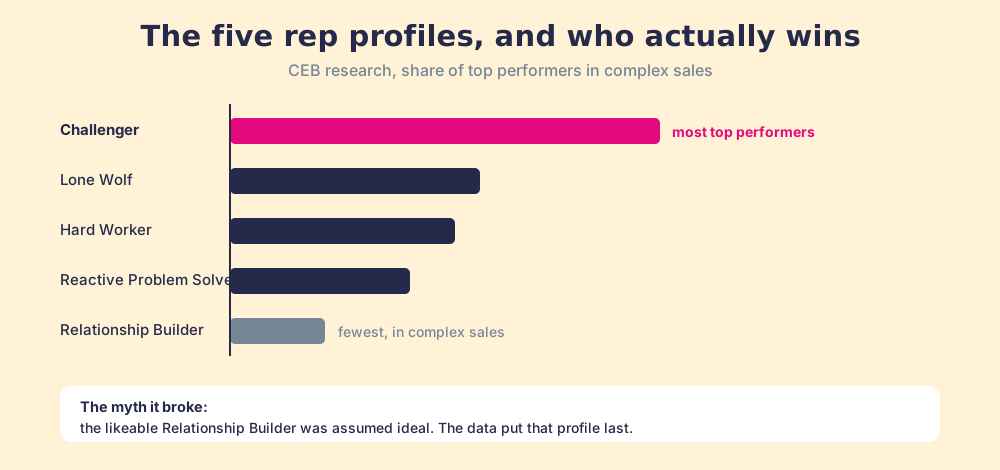
It is the argument that the best B2B reps lead with insight, not rapport. Dixon and Adamson, working from CEB’s study of thousands of reps, sorted sellers into five profiles, the Hard Worker, the Relationship Builder, the Lone Wolf, the Reactive Problem Solver, and the Challenger, and asked which profile produced top performers. The expected answer, drilled into a generation of salespeople, was the Relationship Builder: the rep who is liked, available, and easy to work with. The data said the opposite. Challengers made up the largest share of star performers, and Relationship Builders the smallest, and the gap widened as sales grew more complex (The Challenger Sale, Dixon & Adamson).
That finding mattered because it reframed what a great rep is. The Challenger does not win by being pleasant; they win by being useful in a specific way, bringing the customer a view of their own business the customer did not have. In a world where buyers can self-educate on features, the rep who only answers questions adds little. The rep who teaches the buyer something true and uncomfortable about their situation earns the right to lead the deal.
What does teach, tailor, take control mean?
It is the Challenger method in three moves, and each is a behavior, not an attitude.
- Teach. Bring a commercial insight that reframes the customer’s problem, ideally one that points toward your strengths. Not a pitch, a genuine reframe that changes how they see their own business.
- Tailor. Adapt that insight to the specific stakeholder, the CFO and the end user need the same truth told in different terms.
- Take control. Drive the process and engage directly on money and next steps, rather than deferring to the customer’s pace out of fear of seeming pushy.
Done together, these create demand rather than waiting for it, which is consultative selling taken to its sharpest edge. The Challenger does not discover an existing need and fill it; the Challenger shows the customer a need they had not fully seen.
Why is the Challenger Sale hard to install?
Because every one of those three moves is demanding, and under pressure reps revert to the comfortable default. Teaching requires real insight, which requires preparation, which is the first thing to fall away on a busy week. Tailoring requires knowing each stakeholder, which takes work. And taking control requires nerve, the willingness to push on price and process when it would be easier to be agreeable. The Relationship Builder profile that the data exposed as weak is also the most comfortable to be, which is exactly why reps drift back to it. Insight is hard; being liked is easy.
This is the gap between knowing the Challenger model and running it, and it is the same gap that limits every methodology. Pfeffer and Sutton at Stanford named it the knowing-doing gap: organizations stall when they treat a behavior problem as a knowledge problem, because knowing the play and running the play are different acts (Pfeffer & Sutton, The Knowing-Doing Gap). A team can read The Challenger Sale, run a training, and still sell exactly as before, because the book changed what reps know and not what they do on the next live deal.
How to install Challenger selling across a team
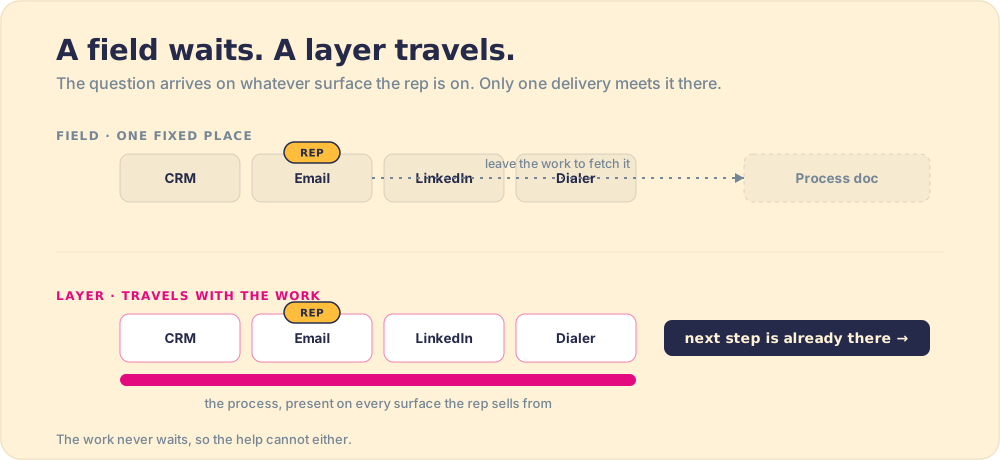
Treat it as an adherence problem, because that is what it is. The insight has to be built once and made reusable, so reps are not each inventing a teach from scratch. The tailored versions have to be ready for the stakeholders reps meet in real deals. And the behavior has to be surfaced in the flow of the deal and inspected, because you can only expect what you inspect, and a Challenger motion nobody checks reverts to a relationship motion within a quarter. Our research found teams that consistently inspect deals against a defined process hit quota at 6.3 times the rate of those that rarely do (The State of Sales Enablement). Challenger is exactly the kind of demanding motion that needs that inspection to survive contact with a busy week.
This is where a behavior layer earns its place alongside the methodology. A tool like Supered can surface the right teach and the right next move inside the CRM at the moment of the deal, and measure whether reps ran it, turning Challenger from a book everyone read into a motion the team runs. The methodology supplies the what; the behavior layer supplies the consistency.
The verdict
The Challenger Sale deserves its reputation. It is rigorous, it overturned a comfortable myth with real data, and its core claim, that insight beats rapport in complex sales, has only gotten truer as buyers self-educate. If you are choosing a methodology, it belongs at the top of the list, which is why it features in our roundup of sales methodologies. Go in knowing that buying the model is the easy part. The hard part, the part that separates teams who get Challenger results from teams who only own the book, is installing the behavior and inspecting it until it sticks.
From here: the broader field in sales methodologies, the consultative roots in what is consultative selling, the coaching that builds the skill in sales coaching, and the adherence system in sales process adoption.
Frequently asked questions
What is the Challenger Sale?+
What are the five Challenger profiles?+
What does teach, tailor, take control mean?+
Does the Challenger Sale still work?+
Your process, running itself.