How to Handle a Sales Objection (the Real One Is Usually the One You Don't Hear)
Most objection-handling training teaches rebuttals. The data says rebuttals make it worse. Here is how to handle a sales objection by treating it as information, not an attack, and why the deadliest objection is silent.
To handle a sales objection is to treat the buyer's stated concern as information about an underlying fear, surface that real concern with questions, and resolve it with evidence rather than pressure, because pushing back on an objection usually hardens it.
How to handle a sales objection
- 1
Pause and let it land
When the objection comes, do not answer on reflex. A short silence signals you are weighing the concern, not waiting to pounce, and it keeps you from triggering the buyer's defenses with a fast rebuttal.
- 2
Acknowledge and label the concern
Name the emotion or worry out loud: 'It sounds like the price feels hard to justify right now.' Labeling lowers the buyer's guard, because a concern that has been heard no longer has to be defended.
- 3
Ask a question to find the real issue
Most stated objections are proxies. Ask what is underneath: 'When you say too expensive, is it the number itself, or is it that you are not yet sure it will work?' The answer is usually the deal's real blocker.
- 4
Respond with evidence, not pressure
Address the actual concern with a relevant proof point, a customer in their situation, a number, a guarantee that reduces their risk. Reassurance beats persuasion for an anxious buyer.
- 5
Confirm the concern is resolved
Check that the answer landed: 'Does that put the cost worry to rest, or is there still something nagging?' Confirming prevents a buried objection from resurfacing at the close.
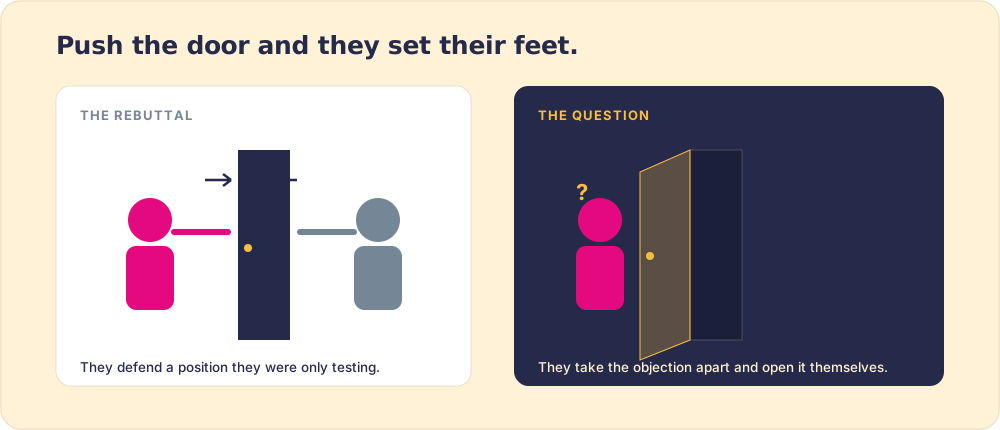
A door that is being held shut from the inside does not open by pushing. Push, and the person behind it sets their feet and pushes back, and now you are in a contest of strength you can only lose, because they have the better angle and the door was theirs all along. The strange thing, which any parent of a stubborn child knows, is that the same door often swings open the moment you stop shoving and ask what is keeping it closed.
A sales objection is that door, and most reps are trained to push. “It’s too expensive” arrives, and the rep braces and pushes back with value, with ROI, with a rehearsed rebuttal, leaning into the door with their shoulder. Sometimes it works. More often the buyer sets their feet, because you have made them the defender of a position they were only testing, and a position defended out loud is a position believed. Learning how to handle a sales objection is mostly learning to take your shoulder off the door. The trade calls it overcoming sales objections, and the word “overcoming” is the first mistake: you do not overcome a door, you understand why it is shut.
How do you handle a sales objection?
You handle a sales objection by treating it as information about a fear, surfacing the real concern with a question, and answering that concern with evidence instead of pressure. The instinct to rebut is the thing to unlearn first, because the rebuttal fights the wrong enemy. The buyer’s words are rarely the obstacle. The obstacle is whatever the words are standing in for, and you cannot move it until you know what it is.
The method is five moves, laid out above, and not one of them is a clever line. They are all restraint, which is what makes them hard, and restraint is the through-line of the sales techniques that move complex deals.
The shape of it is older than sales. Listen, acknowledge, ask, answer, confirm: it is what a good negotiator does, what a good doctor does, what a good friend does when you are upset and they resist the urge to fix you before they understand you. The hostage negotiator Chris Voss built a career on the first two steps alone, labeling and mirroring a counterpart’s emotion until the person felt understood enough to move. The technique works because being heard is what lets a person lower the weapon, or the objection.
Why does arguing back make objections worse?
Because of a quirk of the mind that psychologists named more than fifty years ago, and every parent and salesperson has felt. When someone pushes against a position you have stated, you defend it harder, regardless of whether you held it firmly to begin with. Jack Brehm called this psychological reactance: a threat to our freedom to choose makes us want the threatened option more, and dig into the challenged belief deeper (Jack Brehm, A Theory of Psychological Reactance, 1966). A rebuttal is exactly such a threat. You tell the buyer their objection is wrong, and you have handed them a reason to prove it right.
This is why the question outperforms the rebuttal so reliably. A rebuttal makes the buyer the owner and defender of the objection. A question makes them its examiner. When you ask “is it the number itself, or the confidence that it will work,” you invite the buyer to take the objection apart in their own hands, and people will accept from their own mouth what they reject from yours. It is the same engine that powers consultative selling: the buyer persuaded by their own voice stays persuaded.
What is behind “it’s too expensive”?
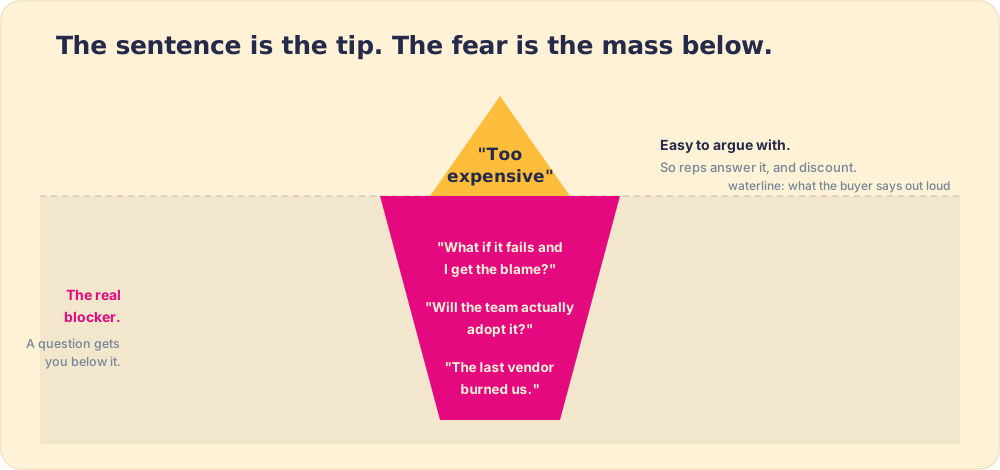
Usually fear, wearing a number as a costume. “Too expensive” is the most common objection in B2B, and the most misread, because reps hear a budget problem and answer with a discount, when the words are almost always standing in for risk. The buyer is not telling you they cannot afford it. They are telling you they are not yet certain it will work, and that they will be the one blamed if it does not. Price is the symptom they can say out loud. The fear of being wrong is the disease, and it does not respond to a coupon.
Think of an objection as an iceberg. The part above the waterline is the sentence the buyer said, sharp and visible and easy to argue with. The far larger part below is the unspoken worry that produced it: a bad experience with the last vendor, a boss who will scrutinize the decision, a doubt that the team will adopt the thing at all. Handling price objections well starts here, below the waterline, not at the number itself. Answer the visible tip and you have chipped at ice while the mass below floats on untouched. Discovery, the kind that fills the MEDDIC sales process and answers the Need at the core of BANT, is how you get below the surface before the objection ever hardens.
How do you handle the objection you never hear?
This is the deepest part of the craft, and the data forced the trade to learn it. The deadliest objection in any deal is the one the buyer never voices, because a spoken objection is a gift, a thing you can see and work. The silent one kills in the dark. In The Jolt Effect, Matt Dixon and Ted McKenna studied more than two and a half million recorded sales conversations and found that between 40 and 60 percent of qualified, interested buyers end in no decision, and that the larger share of those deaths, around 56 percent, came from the buyer’s own indecision, their fear of making the wrong choice, rather than a preference for the status quo (The Jolt Effect). These buyers wanted to buy. They never raised a real objection. They could not bring themselves to decide, and the rep, hearing no objection, assumed the road was clear.
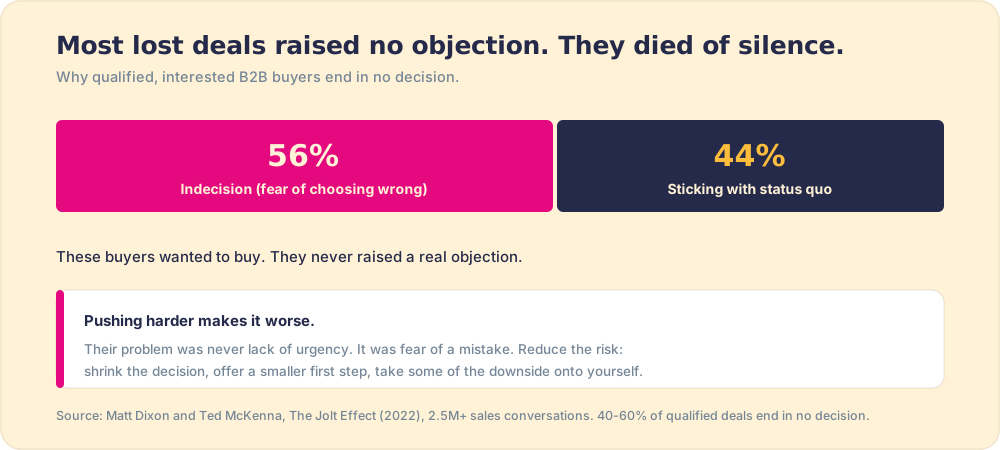
This rewrites the closing instinct. Faced with a hesitant buyer, the old playbook says manufacture urgency and push, the same shoulder against the same door. The Jolt research found that pushing harder makes an indecisive buyer more afraid, not less, because their problem was never lack of urgency, it was fear of a mistake. The move that works is to reduce the risk: shrink the decision, offer a smaller first step, take some of the downside onto yourself with a guarantee or a pilot. You handle the silent objection by diagnosing the fear and making the choice feel safe, which is the same diagnostic instinct that runs through every good discovery conversation.
What are the main types of sales objections?
They sort into five families, the same set of common sales objections reps hear on nearly every deal, and the value of naming them is that each one points to a different question, not a different rebuttal.
- Price. The value is not yet clear, or the risk is too high. Ask whether the issue is the number or confidence in the outcome.
- Timing. No urgency, real or felt. Ask what changes if they solve it this quarter versus next year, and let the cost surface in their words.
- Need or fit. The problem is not sharp enough to act on. Go back to discovery; the objection is a sign you skipped it.
- Authority. You are working someone who cannot decide. Map the six-to-ten-person buying group and find your champion, the discipline at the heart of qualification.
- Trust or risk. The deepest family, and the one hiding inside most price objections. They fear the thing will fail. Answer with proof and a smaller, safer first step.
Notice that four of the five resolve through a question rather than an answer. That is the through-line: objection handling is discovery that arrived late, the diagnosis you did not finish surfacing under pressure, which is why the strongest discovery call questions prevent most objections before they are ever spoken.
The part no script can do
The five moves are simple to write and brutal to perform, because they ask a rep to stay calm and curious in the one moment a deal feels most at risk, when every nerve says push. Reps know the theory. They fold anyway, because the objection arrives on a Thursday with the quarter short and the shoulder goes to the door on its own.
The gap between knowing the method and running it is not a knowledge problem, and you cannot close it with another workshop. We asked 198 sales leaders, and 89 percent had a defined sales process while only 36 percent saw their reps follow it under real conditions (The State of Sales Enablement). Objection handling is where that gap is widest, because it is the highest-pressure behavior in the job, and high-pressure behaviors are the first to revert to instinct.
The recommendation follows from the mechanism. Stop trying to install objection handling as a memorized binder of rebuttals, which is the format most likely to desert a rep mid-call. Put the right response in front of them in the moment the objection lands, while they are working the deal, and measure whether they used it so a manager can coach the pattern, rather than the outcome. That is the deeper subject of sales process adoption, and it is why we built Supered as the Behavior Layer: it surfaces the proven move when the buyer pushes back, in the flow of the work, and shows whether the rep took their shoulder off the door. The script was never the hard part. Staying curious when the deal feels like it is slipping always was. For how this skill sits beside qualification and discovery in one motion, the sales playbook guide holds it together.
Frequently asked questions
What is the best way to handle a sales objection?+
How do you handle the 'it's too expensive' objection?+
Why shouldn't you argue back against an objection?+
What are the most common types of sales objections?+
What is the most dangerous objection in a deal?+
Your process, running itself.