What Is Consultative Selling? Diagnose, Then Prescribe
Consultative selling is the approach every sales leader endorses and most reps abandon under pressure. Here is what it actually is, the cognitive reason it works, and why it is harder than it sounds.
Consultative selling is a sales approach in which the rep acts as a trusted advisor who diagnoses the buyer's real problem through questions and prescribes a fitting solution, rather than pitching a product the same way to everyone.
A poor doctor sells you the tonic before you have finished describing the ache. A good one asks where it hurts, and when, and what you have already tried, and only then says a word about treatment. The difference is not bedside manner. It is that the second doctor is solving your problem and the first is moving inventory, and you can feel which is which from the second chair, even when you cannot name it.
Consultative selling is the attempt to be the second doctor. Almost every sales leader endorses it. There is a problem with that endorsement, and it is worth putting on the table before we praise the approach any further: the most-cited research of the last fifteen years found that the rep who behaves most like a warm, attentive advisor is the worst performer on the floor. Matthew Dixon and Brent Adamson, studying more than 6,000 reps for the Corporate Executive Board, sorted sellers into five profiles and discovered that the Relationship Builder, the likeable, service-minded rep who sounds exactly like the consultative ideal, made up only 7 percent of top performers in complex deals (Dixon and Adamson, The Challenger Sale, 2011). On its face, that is a loaded gun pointed straight at this article.
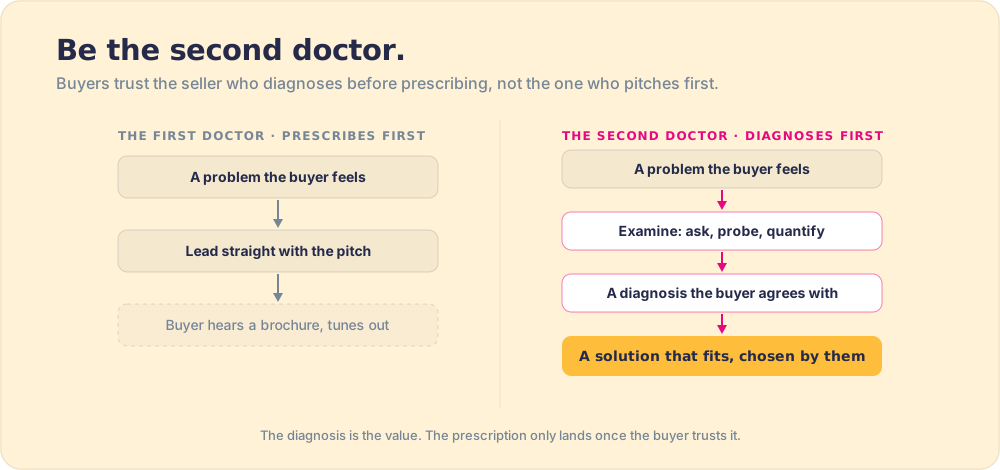
We are going to take that finding seriously, grant it its full force, and then show why it indicts the execution of consultative selling and not the idea. The philosophy is sound. It is also brutally hard to do, and the gap between admiring it and doing it is the most expensive thing in B2B sales.
What is consultative selling?
Consultative selling is an approach where the rep works as a trusted advisor, diagnosing the buyer’s real problem through questions before prescribing anything, rather than delivering the same product pitch to everyone. The idea was named by Mack Hanan in his 1970 book Consultative Selling, and it has been rediscovered under new labels every decade since, from solution selling to gap selling, because the core truth keeps proving durable: in any purchase complex enough to involve risk, the buyer is not shopping for a product. They are shopping for someone who understands their problem.
Hanan’s own definition was sharper than the soft “be a nice advisor” version that survives him. He drew a hard line between two jobs. “Vendors ask for an order, which represents a cost to their customers,” he wrote. “Consultants offer improved profits, which represent a gain.” A vendor sells a product against a budget. A consultant sells a better business outcome to the manager who owns that outcome. The consultative seller is not pleasant company; they are useful to the buyer’s profit and loss, and that is a much taller bar than likeability.
Hanan also saw, decades before anyone measured it, why most reps who claim the title fail at it. In a 2010 interview he was blunt about the people who adopt the label and then abandon the behavior: they are “people who pledge allegiance to what I am doing, but who don’t act it out when it is time to perform” (Mack Hanan, interview with Anthony Iannarino, The Sales Blog, June 2010). The founder of consultative selling diagnosed its central failure himself. The allegiance is cheap. The acting-it-out is the whole job.
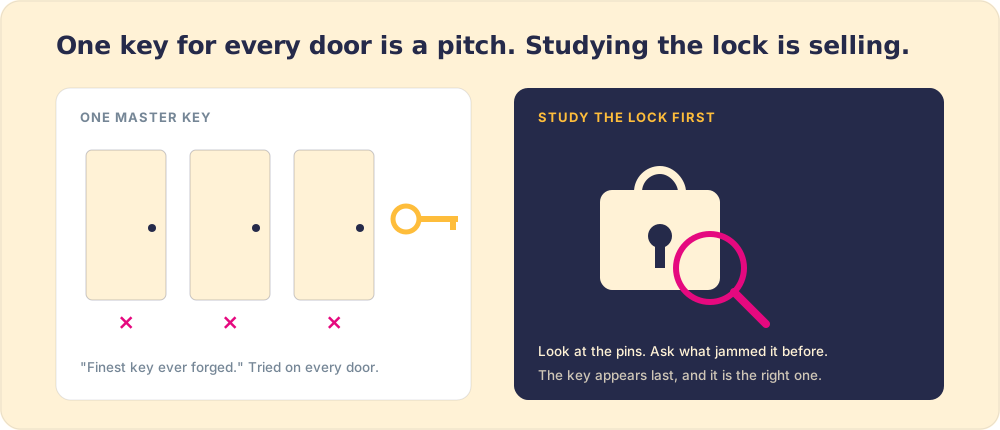
The approach is sometimes called trusted advisor selling, and the label is earned, not granted: the buyer decides whether you are an advisor by how you behave on the first call. The word that matters is “diagnose.” A product seller arrives with the answer and goes looking for a question it fits. A consultative seller arrives with questions and lets the answer assemble itself from what they hear. One carries a single key and tries it in every door. The other studies the lock first, and reaches for a key only once they know its shape.
How is consultative selling different from transactional selling?
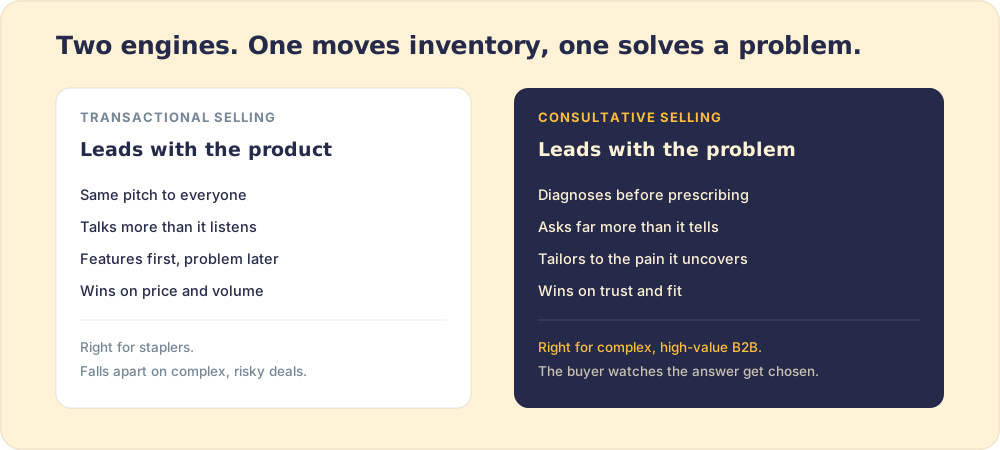
The two run on opposite engines. Transactional selling is built for volume and simplicity: a known product, a low price, a short decision, and a pitch that can be repeated word for word a hundred times a day. It is the right tool for buying staplers. Where the deal is complex, costly, and political, the same approach falls apart, because the buyer is weighing risk, not features, and a rep who leads with features is answering a question the buyer did not ask.
Here is the locksmith again, because the image earns a second look. The transactional rep is a traveling salesman with one master key, knocking on every door and explaining, with real enthusiasm, why this key is the finest key ever forged. Sometimes a door swings open and he calls it skill. The consultative rep does the unglamorous thing first: kneels at the lock, looks at the pins, asks what has jammed it before. By the time a key appears, it is the right one, and the buyer watched it get chosen, which is why they trust it.
Why does asking outperform pitching?
Because people believe conclusions they reach themselves, and disbelieve ones handed to them. This is the cognitive machinery underneath the whole approach, and it is worth saying plainly: a cost the buyer states in their own voice persuades them; the identical cost asserted by a seller does not. When a rep asks “what does it cost you when a rep ramps in nine months instead of five,” and the buyer works out the figure aloud, the buyer has argued your case to themselves, in language they cannot dismiss as a sales tactic. An old proverb has it that a man convinced against his will is of the same opinion still. The corollary is the consultative seller’s whole edge: a man who convinces himself stays convinced.
The evidence for this is not a hunch. Neil Rackham and his team analyzed 35,000 sales calls to write SPIN Selling, and found that in successful large deals, top reps asked a particular pattern of questions, Situation, Problem, Implication, and Need-payoff, with the implication questions, the ones that make the buyer feel the cost of the problem, doing the heavy lifting that pitching never could (Neil Rackham, SPIN Selling, 1988). Rackham’s central finding cuts against everything the old closing manuals taught: “What works in small sales can hurt your success as the sales grow larger.” The aggressive close, the slick pitch, the objection rebuttal, all of it earns the order on a small ticket and poisons a large one. The seller’s job in the big deal was the opposite of telling: to ask the question that made the buyer say the painful thing out loud.
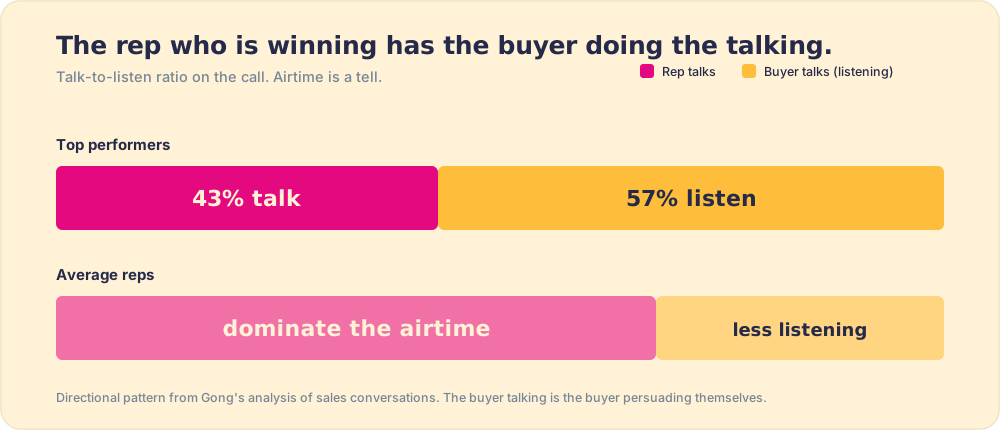
And the listening is measurable. Gong’s analysis of sales conversations found that top performers talk markedly less than average reps, landing near a 43 percent talk to 57 percent listen ratio on their best calls, while weaker reps invert it and dominate the airtime (Gong). The number is a proxy for the deeper behavior: the rep who is winning is the one who has the buyer doing the talking, because the buyer talking is the buyer persuading themselves.
Does the Challenger Sale prove consultative selling is dead?
This is the objection that deserves the most honest hearing, because it is the strongest case against everything above, and it comes with the best data in the field. So let us state it at full strength, the way Dixon and Adamson would.
Their CEB study sorted 6,000 reps into five profiles: the Hard Worker, the Relationship Builder, the Lone Wolf, the Problem Solver, and the Challenger. They expected the Relationship Builder, the warm, available, deeply attentive rep, to dominate, because that rep is the living picture of consultative selling. The opposite was true. Relationship Builders were 7 percent of top performers in complex deals, dead last. Challengers, the reps who teach the buyer something unexpected about their own business, tailor the message, and take control of the conversation, were nearly 40 percent of high performers and more than half in the most complex deals (Dixon and Adamson, The Challenger Sale, 2011). Their verdict was plain: “classic relationship building is a losing approach.” If consultative selling means being the agreeable advisor who asks what the buyer needs and fetches it, the largest dataset we have says it loses.
Grant all of it. The data is real and the warning is fair. Now look at what the Challenger does, step by step, and a strange thing happens: the Challenger is not the opposite of the consultative seller. The Challenger is a consultative seller who finished the job. Teaching the buyer something they did not know about their own cost structure is an implication question delivered as a statement. Tailoring the message is diagnosis applied. Taking control is refusing to let the buyer steer toward a comfortable feature tour before the problem is named. What Dixon and Adamson killed was not consultative selling. It was the soft caricature of it, the rep who mistakes being pleasant for being useful, who listens warmly and then prescribes nothing the buyer could not have reached alone.
Picture two physical therapists. The first is endlessly kind, asks how you are feeling, nods, and lets you keep favoring the bad knee because pushing back feels rude. You like her. You do not get better. The second asks harder questions, watches you walk, tells you the thing you have been doing is the thing hurting you, and hands you the exercise you did not want. You trust her more by the end, because she was useful, not because she was agreeable. The first is the Relationship Builder. The second is the Challenger. Both diagnosed. Only one prescribed something that cost the buyer effort and changed the outcome.
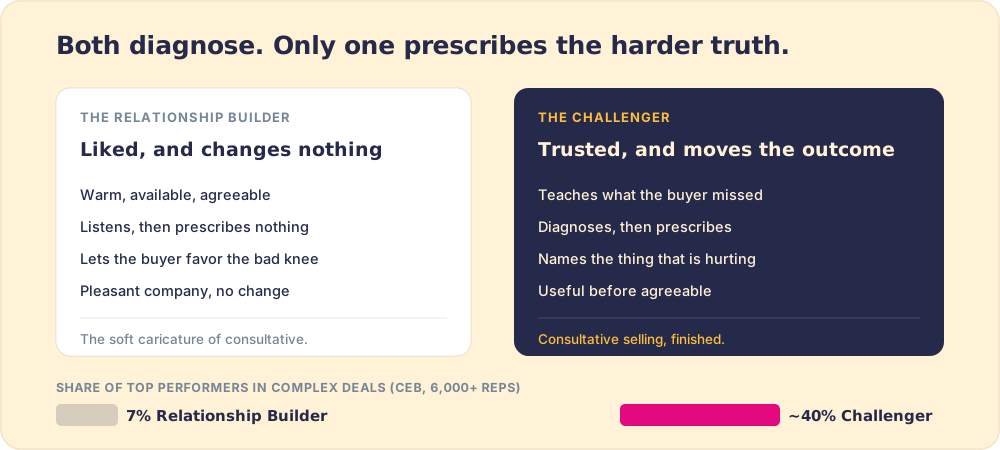
So the POV is this. The consultative ideal is right, and the Challenger evidence confirms it rather than refuting it. What the data exposes is an execution failure dressed up as a philosophy failure. “Be consultative” fails as a trait you coach into a person, the same way “be confident” or “be likeable” fails, because it is too vague to act on and too easy to fake under pressure. It only works when the specific behavior, the implication question, the tailored prescription, the refusal to demo before diagnosing, is delivered on the real call and inspected afterward. The trait is unteachable. The behavior is trainable, and only if you can see whether it happened.
What does a consultative sales approach look like in practice?
The consultative selling techniques that matter are less a script than a sequence of restraints, each one a place the average rep rushes and the consultative rep waits. Unlike the closing tricks that fill most lists of sales techniques, every one of these is a thing the rep refuses to do too soon.
- Diagnose before you prescribe. Spend the first real conversation on the buyer’s world, the problem, its cost, who it touches, before your product is named, working from a sharp set of discovery call questions. This is the same discovery that fills the MEDDIC sales process and answers the Need at the heart of BANT.
- Make the buyer quantify the pain. Ask the implication question that turns a vague annoyance into a number with a dollar sign. A problem the buyer has priced is a problem the buyer will fund.
- Tailor the recommendation. Connect one capability to one cost the buyer named, and leave the rest of your feature list in the bag. A demo that answers everything proves you were not listening.
- Listen more than you talk. Treat airtime as a budget you are spending too fast. The call where the buyer talks most is usually the call you win.
- Earn the close upstream. When discovery is real, the close is almost boring, which is the same lesson that runs through the seven sales process steps: the signature is a formality if every earlier commitment was true.
There is a trap worth naming, because the data caught it. Consultative does not mean relentless. In The Jolt Effect, Matt Dixon and Ted McKenna found that the classic move of piling on urgency to push an uncertain buyer over the line backfires, because between 40 and 60 percent of lost deals die not to a competitor but to the buyer’s own indecision, and pressure deepens that fear rather than curing it (Dixon and McKenna, The Jolt Effect, 2022). The advanced form of consultative selling is to reduce the buyer’s risk, to make the decision feel safe, not to lean harder. Diagnosis includes diagnosing the fear, which is the same instinct behind the Sandler sales methodology, where the rep reverses the pressure and lets the buyer talk themselves into the decision.
Does consultative selling still work in 2026?
It works better than ever, for a reason that would have surprised Mack Hanan. Gartner finds B2B buyers now spend only about 17 percent of the buying journey in contact with all suppliers combined, having done the bulk of their research alone, through a buying group of six to ten people (Gartner). That fact retires the pitch and crowns the diagnosis. The buyer already knows your features; they read the website before you called. The one thing they cannot get from a website is an expert who has watched this exact problem get solved fifty times and can help them reason through their own.
So the generic pitch is worth less each year, and good diagnosis is worth more. Knowledge is solved. A buyer can learn what your product does in an afternoon. What they still cannot do alone is see their own situation clearly, and that is the consultative seller’s enduring job.
Knowing it is not doing it
This is where the philosophy meets the wall every sales floor hits. The idea of consultative selling fits on a napkin: ask, listen, diagnose, prescribe. The behavior is brutally hard to sustain, because the incentives on a busy sales floor push the other way, toward the comfortable demo, the talking, the feature dump that feels like effort. The result is the oldest gap in the trade. We asked 198 sales leaders, and 89 percent had a defined sales process while only 36 percent saw their reps run it (The State of Sales Enablement). Consultative selling is the part of that process most often abandoned under pressure, because it asks a rep to do the slow thing when the fast thing feels safer.
There are two honest ways forward, and they sort cleanly. You can keep treating “consultative” as a trait and train it in the classroom: run the workshop, hand out the SPIN cards, and hope it survives contact with a Thursday afternoon. The data above is the verdict on that path. Hanan watched reps pledge allegiance and not act it out; Dixon and Adamson watched the warmest reps finish last; 89 percent of leaders documented a process and 36 percent saw it run. Training the trait does not move the number, because the trait was never the missing piece.
The other path treats consultative selling as a behavior to deliver and inspect, not a personality to instill. That is what we recommend, and the evidence in this post is the argument for it. The lever is in the moment of the call, not the classroom: putting the right question in front of the rep when they are about to skip discovery and reach for the demo, and measuring whether the behavior happened on real deals. That is the deeper subject of sales process adoption, and it is why we built Supered as the Behavior Layer: it surfaces the consultative move in the flow of the work, the instant the rep is in the conversation, and shows a manager whether the diagnosis happened. The Challenger who teaches and the doctor who diagnoses are doing the same trainable thing, and it only compounds when it is delivered and inspected, not admired. Diagnosis is easy to endorse and costly to practice, and the practice is the only part that ever moved a number. To see how consultative selling sits inside the whole motion, alongside qualification and objection handling, the sales playbook guide puts the pieces together.
Frequently asked questions
What is consultative selling in simple terms?+
How is consultative selling different from transactional selling?+
Why does asking questions outperform pitching?+
What are the main consultative selling techniques?+
Does consultative selling still work with self-directed buyers?+
Your process, running itself.