BANT, the Oldest Qualification Framework, and How to Use It Without Killing Good Deals
BANT is the qualification framework IBM built for a world that no longer exists. Here is what it stands for, why budget-first gating now discards real demand, and how to run it in 2026.
BANT is a sales qualification framework that checks a lead against four criteria (Budget, Authority, Need, and Timeline) to judge whether it is worth a rep's time, originally built by IBM to triage high volumes of inbound interest.
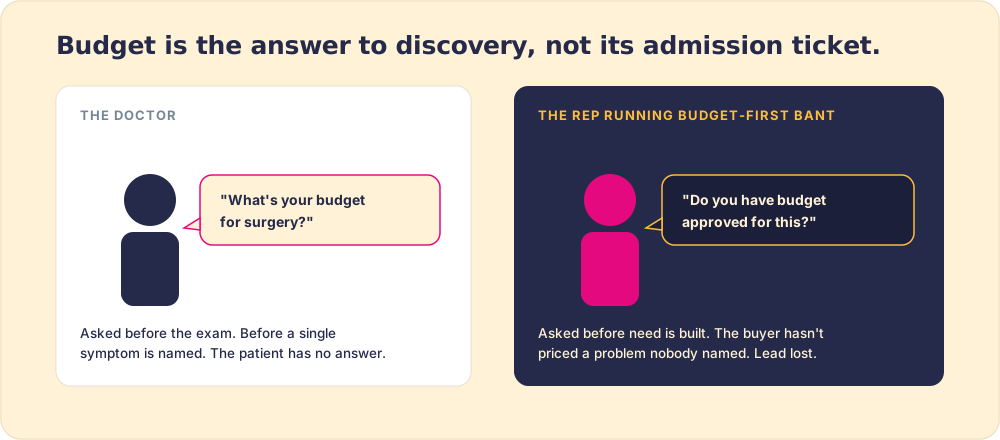
Imagine a doctor who opened every appointment with one question: “What is your budget for surgery?” Before the exam, before a single symptom is named, before anyone knows whether the trouble is a cracked rib or a bad lunch. Most patients would have no answer, not because they are poor or unserious, but because you do not budget for a problem nobody has told you that you have. The number comes after the diagnosis. It was always going to.
BANT, run the way most teams run it, is that doctor. It leads with budget, treats a missing number as a reason to send the patient home, and congratulates itself on an efficient morning. The framework is not foolish. It was built for a world where leading with budget made sense. That world is gone, and the framework outlived it, which is why so many teams now use a sound idea to do real damage to their own pipeline.
What is BANT?
BANT is a sales qualification framework that scores a lead against four questions, Budget, Authority, Need, and Timeline, to decide whether it deserves a rep’s time. IBM built it decades ago for a specific and sensible problem: a sales force drowning in inbound interest, finite hours to spend, and a need to triage fast. A four-part filter let a rep sort the serious from the curious in a single call and move on.
To understand BANT you have to understand the world it was born into. In IBM’s heyday the seller held the information. If you wanted to know what a mainframe could do, what it cost, whether it fit, you called a rep, because the knowledge lived with them. The buyer arrived dependent, and the rep could reasonably ask for budget and authority up front, because a buyer serious enough to have those things was a buyer worth the day. BANT was a rational response to scarcity: scarce seller time, abundant buyer ignorance.
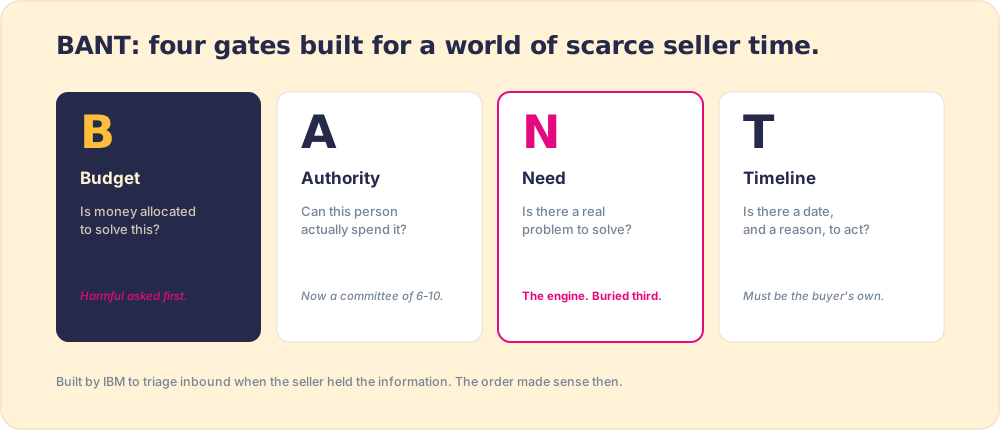
What does BANT stand for, letter by letter?
Four letters, each a gate the lead has to clear.
- Budget. Has the buyer allocated money to solve this? The original first question, and the one that now causes the most harm when asked first.
- Authority. Is this person able to spend it, or are they an interested bystander? Sound in principle, except the modern decision rarely has a single owner.
- Need. Does a real problem exist that the product solves? This is the engine of every other answer, and the framework buries it third.
- Timeline. Is there a date to act, a reason it must happen this year rather than someday? Without it, even a willing buyer drifts.
The order is not innocent. BANT reads as Budget first because IBM was rationing rep time and wanted the cheapest disqualifier up front. Put Need third and you signal, in the shape of the acronym itself, that the problem matters less than the purse. In 1965 that was efficient. In 2026 it is backwards, and the reason is the single biggest change in selling this century.
Is BANT still relevant in 2026?
It is relevant as a checklist and dangerous as a gate, and the difference is the whole argument. The world BANT was built for has inverted. Knowledge is no longer scarce or locked with the seller; a buyer can learn more about your product before lunch than your reps could have told them in 1990. What is scarce now is not information. It is the buyer’s ability to act on it.
The numbers are stark. Gartner finds B2B buyers spend only about 17 percent of the buying journey in contact with all suppliers combined, and that the deciding group runs from six to ten people who frequently disagree before they choose (Gartner). Two of BANT’s four gates buckle against that finding on their own. Authority is no longer one person to qualify; it is a committee to map. And Budget, asked on a first call, lands before the buying group has even agreed it has a problem, because most of that agreement is built later, out of your sight.
Then there is the deepest cut of all, and it has nothing to do with budget or authority. In The Jolt Effect, Matt Dixon and Ted McKenna studied more than two and a half million sales conversations and found that between 40 and 60 percent of qualified, interested buyers end in no decision, not lost to a rival but lost to their own inability to choose (Matt Dixon and Ted McKenna, The Jolt Effect, 2022). Read that against BANT and the irony surfaces: the framework spends its first two gates on Budget and Authority, and the thing that kills most deals lives in the last two, a Need not made sharp enough and a Timeline never truly fixed. BANT puts its weakest filters first and its decisive ones last.
How should you use BANT today?
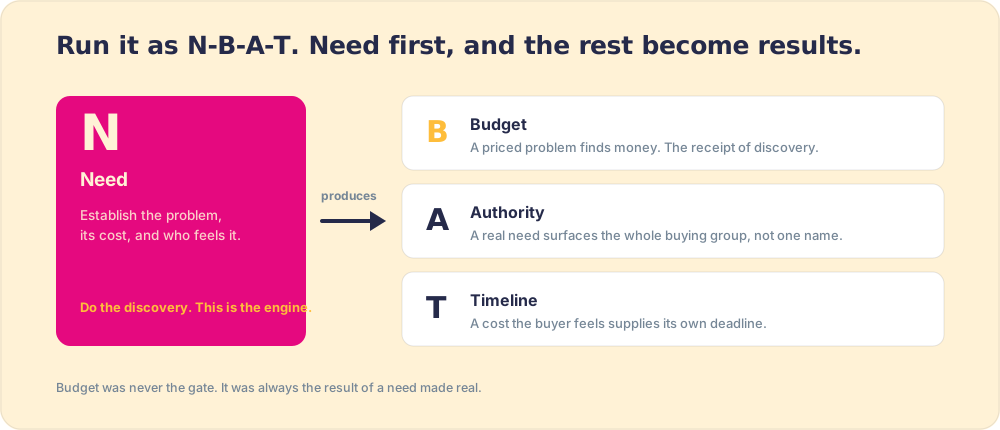
Turn it around. The fix is not to throw the BANT framework out, it is to stop running BANT qualification as a bouncer at the door and start running it as a map you fill in. Lead with Need, let it do the work, and the other three letters fill themselves in, because a buyer who believes a problem is worth solving finds budget, names the decision-makers, and sets a date. Budget was never the gate. It was always the receipt.
- Need first, always. Open on the problem, its cost, and who feels it. Good discovery, the kind we walk through in consultative selling, is what manufactures budget where none existed, because a problem nobody has priced has no number attached to it yet. Skip it and the common sales objections pile up later, when “too expensive” usually means the need was never made sharp.
- Treat Authority as plural. Do not qualify for “the decision-maker.” Map the six-to-ten-person group and find your champion inside it, the distinction that the MEDDIC sales process is built to enforce.
- Use BANT to track, not to reject. Mark each letter known or unknown on a live deal, the same way you would in any sales process. “Unknown budget” on a first call is normal and fine. “Unknown need” on a late-stage deal is a fire.
- Make Timeline the buyer’s, not yours. A close date you invented to fill a forecast is the most common lie in a pipeline, and it is exactly how a healthy-looking quarter comes in light. The date has to come with a reason the buyer supplied.
BANT vs MEDDIC: which should you use?
Both, at different moments, because they were built for different jobs. BANT is a lightweight filter for the top of the funnel, four quick questions to decide whether a lead is worth a real conversation. MEDDIC is a heavier discipline for deals already in flight, six facts you must prove before you call a deal a commit. Using MEDDIC to triage cold leads is overkill; using BANT to forecast a six-figure deal is negligence. Most strong teams run a Need-led BANT on the first call and graduate the survivors into MEDDIC, a handoff we lay out in the seven sales process steps.
What neither framework can do is run itself. BANT is four words a rep can learn in a minute and forget by the second call. The hard thing is getting a busy rep to ask the four questions, in order, on a real deal, and getting a manager to see whether they did. We asked 198 sales leaders about that gap, and the answer was plain: 89 percent had a defined process and only 36 percent saw their reps follow it (The State of Sales Enablement). A qualification framework adopted on paper and skipped in the field qualifies nothing.
So keep BANT. Run it the way the modern buyer requires: Need first, Authority as a committee, Timeline the buyer’s own, and Budget as the thing that arrives once the rest is true. Then solve the harder problem the acronym cannot, which is whether your reps run it at all. We built Supered as the Behavior Layer for that: it puts the right qualifying question in front of the rep in the moment they are working the deal, and measures whether the answer is real. The four letters were never the hard part. Walking them on a Tuesday, when the lead is lukewarm and the quarter is short, always was. For the full picture of how qualification fits the rest of the motion, the sales playbook guide ties it together.
Frequently asked questions
What does BANT stand for?+
Who invented BANT?+
Is BANT still relevant in 2026?+
What is the difference between BANT and MEDDIC?+
Why does budget-first qualification fail?+
Your process, running itself.